
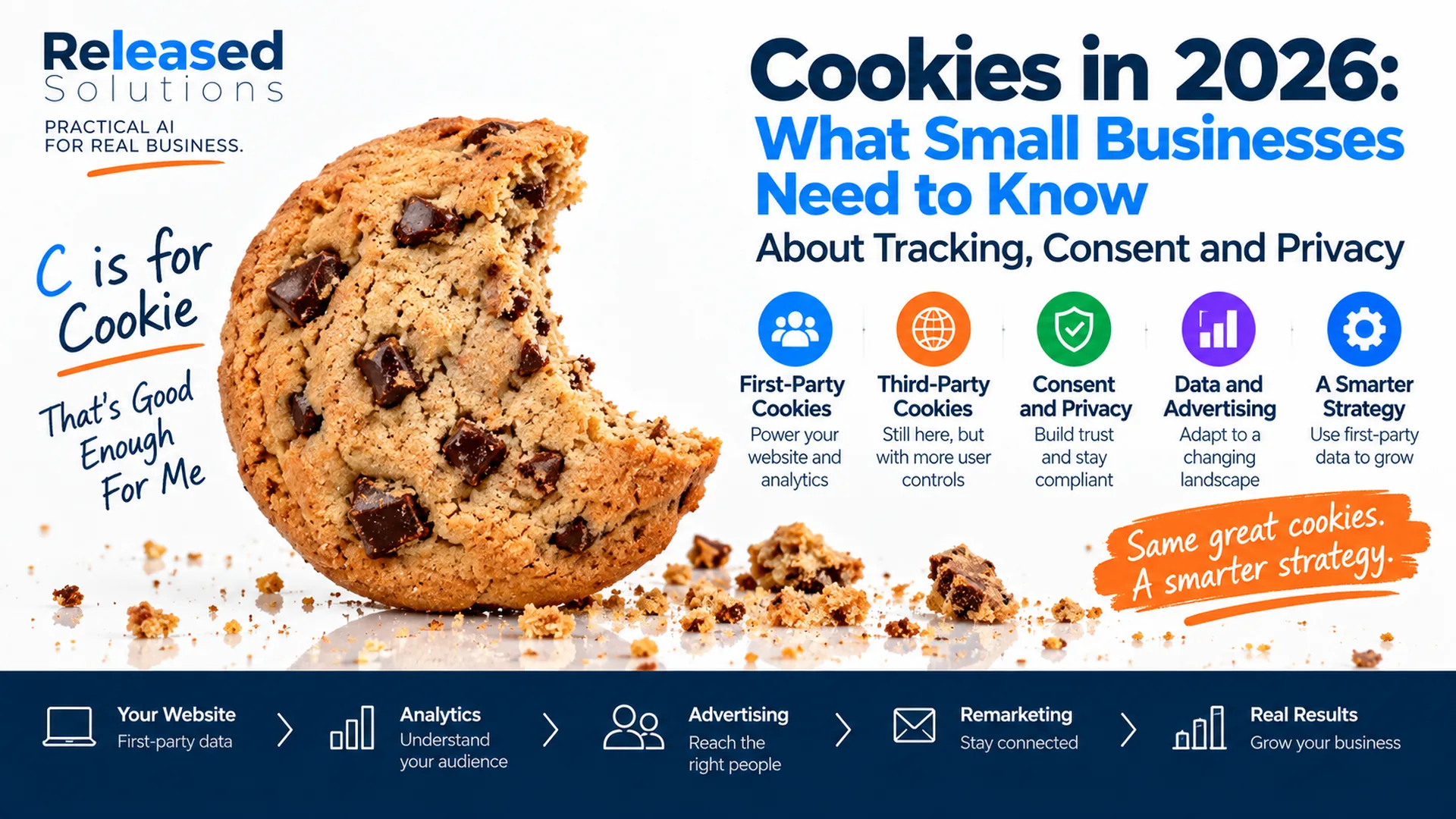

Cookies in 2026: What Small Businesses Need to Know About Tracking, Consent and Privacy
When I originally wrote about website cookies, the digital marketing conversation was much simpler. Cookies helped websites remember visitors. Marketers used them for analytics, advertising and remarketing. Browsers stored them, advertising platforms relied on them, and the industry was already debating privacy.
Then the conversation turned into a countdown: third-party cookies were supposedly disappearing, marketers would lose tracking, and businesses needed to prepare for a "cookieless future."
That prediction turned out to be too simple.
In April 2025, Google announced that Chrome would maintain its existing approach to third-party cookie choice rather than roll out the planned new standalone prompt. Chrome users can continue managing those choices in Privacy and Security settings, while Incognito mode blocks third-party cookies by default.
So in 2026, cookies are not gone. What has changed is the environment around them: stronger privacy expectations, more browser controls, consent requirements in many jurisdictions, changes in advertising technology, more modeled measurement and a much greater need for businesses to understand what data they collect and why.
Third-party cookies did not simply disappear. What changed is the environment around them: stronger privacy expectations, browser controls, consent requirements and modeled measurement.
First, What Is a Website Cookie?
A cookie is a small piece of information that a website can ask a browser to store. Cookies can help a website remember information between page views or visits. They may be used to maintain a shopping cart, remember preferences, distinguish users or sessions, support analytics, maintain logins and enable advertising-related functions.
The important point is that "cookie" does not automatically mean "advertising tracker." Some cookies are necessary for a website to function. Some support measurement. Some support personalization. Others may be used across sites for advertising or tracking.
That is why a modern cookie discussion needs more precision than simply asking whether a website uses cookies.
First-Party and Third-Party Cookies Are Not the Same Thing
| First-party cookie | Third-party cookie | |
|---|---|---|
| Where it lives | Associated with the website the visitor is using. | Generally associated with a different domain or service embedded on that site. |
| Typical use | Preferences, cart, login, analytics, session or user distinction. | Cross-site advertising, tracking or remarketing. |
| GA4 example | gtag.js uses _ga and _ga_ | Not used by GA4 for the same purpose. |
| Browser behavior | Broadly accepted in most browsers. | Chrome retains user choice; Incognito blocks by default; other browsers apply their own restrictions. |
| Business risk | Under the business's own control. | Availability varies by browser, consent and platform. Do not build the whole measurement plan around it. |
Google Analytics 4 uses first-party cookies with the Google tag to distinguish users and sessions. First-party data has also become more strategically important because it comes from the direct relationship between a business and its audience: website interactions, form submissions, purchases, appointments, CRM records, email subscribers and other information a business collects through its own customer experience.
Third-party cookies can still exist in Chrome, but businesses should not build their measurement strategy around the assumption that every browser, every visitor and every environment will make third-party tracking available. The safer long-term strategy is to strengthen the data and relationships the business controls.
Cookies Are Not Gone
Chrome retained user choice for third-party cookies. What changed is user control, privacy expectations and how measurement adapts.
Banner ≠ Consent Mode
A cookie banner is the interface. Consent Mode is the technical mechanism that tells Google tags how to behave. They are not interchangeable.
First-Party Wins
The data you collect through your own customer relationships is more durable than any specific tracking cookie.
The 2026 Cookie / Consent / Measurement Stack
The Third-Party Cookie Did Not Simply Disappear
For years, Google's planned phaseout of third-party cookies in Chrome became shorthand for a much broader privacy shift. But Google's direction changed.
On April 22, 2025, Google said it would maintain Chrome's existing approach to third-party cookie choice and would not introduce the new standalone prompt it had previously discussed. Users remain able to manage third-party cookie settings themselves.
That does not mean the privacy conversation went backward. Chrome's Incognito mode already blocks third-party cookies by default. Other browsers and privacy technologies have their own restrictions. Users have more control. Regulations and platform policies continue to affect what businesses can collect and how data can be used.
So I would not tell a business owner, "Third-party cookies are dead." I would say: third-party tracking is less dependable as a universal foundation, and your marketing should be designed to work in a world where consent, browser settings, platform rules and privacy protections vary.
A Cookie Banner and Consent Mode Are Different Things
This is one of the areas where business owners can easily become confused.
The banner is the interface a visitor sees. Consent Mode is a technical mechanism that communicates the consent choice to Google tags so they can adjust their behavior.
Installing a banner does not automatically mean your tracking implementation is correct. The banner, consent-management platform, Google Tag Manager or Google tag, Analytics and advertising tags all need to work together.
Google describes basic and advanced implementations. With basic Consent Mode, Google tags are blocked until the visitor interacts with the consent mechanism and grants the relevant consent. With advanced Consent Mode, tags can load with consent defaults and, when consent is denied, send limited cookieless signals rather than storing the same advertising or analytics cookies.
GA4 Still Uses Cookies, but Measurement Is More Flexible
Google Analytics has not become a completely cookieless analytics product. Google's current documentation says the gtag.js library uses first-party cookies to distinguish unique users and sessions. At the same time, Google notes that gtag.js does not require setting cookies in order to transmit data.
When consent is denied in an advanced Consent Mode implementation, Google can receive cookieless pings. Google may then use modeling where eligibility and data thresholds are met. That means an Analytics report may contain a combination of directly observed behavior and modeled information rather than a perfect one-to-one record of every person who visited a website.
Modern GA4 reports can combine directly observed behavior with modeled information based on consent and configuration. Use analytics to make better decisions, not to produce a one-to-one record of every visitor.
Advertising and Remarketing Need a Better Foundation
Cookies became famous in marketing because of advertising and remarketing. Visit a product. Leave the website. See an ad later. That experience taught consumers what tracking felt like.
Remarketing and audience-based advertising have not disappeared, but the underlying systems are more complicated now. Browser restrictions, consent choices, platform policies, first-party data, modeled conversions and privacy-preserving technologies all influence what can be measured or activated in paid advertising.
Instead of asking only, "Can I follow this visitor around the internet?" ask better questions:
- Did the right person reach the website?
- What source or campaign helped bring them there?
- Did they call, submit a form, book, buy or take another meaningful action?
- Did the lead become a customer?
- Can we reconnect with customers or prospects through channels where they have appropriately chosen to hear from us?
- Can we evaluate advertising against real business outcomes?
First-Party Data Is the Asset I Would Strengthen
If I were advising a small business about cookies in 2026, I would spend less time trying to preserve every old tracking technique and more time strengthening first-party data.
That includes information generated through direct customer relationships and business systems: CRM records, purchases, appointments, lead forms, customer inquiries, email subscriptions, account activity and meaningful website events. Ongoing online presence management is where this discipline actually gets maintained.
This does not mean "collect everything." It means collect the information the business actually needs, explain what is being collected, secure it appropriately, respect applicable consent and privacy requirements, and connect it to useful business outcomes.
What Small Businesses Should Do Now: A Practical Audit
INVENTORY WHAT IS ACTUALLY RUNNING ON THE WEBSITE
Review analytics tags, advertising pixels, embedded services, chat tools, forms, video players, plugins and other technologies that may store or transmit information. If you cannot list them, you cannot govern them.
UNDERSTAND WHY EACH TECHNOLOGY IS THERE
If nobody can explain what a tag or cookie does, that is a reason to investigate it. "It was there when we got here" is not a business justification.
REVIEW THE PRIVACY AND CONSENT EXPERIENCE
Make sure the banner or consent mechanism matches the technologies actually deployed and the requirements that apply to the business. Whether a specific business is legally required to obtain consent depends on jurisdiction, visitors, technologies and applicable law. A marketing article is not a substitute for legal advice.
VERIFY GOOGLE CONSENT SIGNALS
When you use Google's measurement and advertising products, verify Consent Mode implementation with Google Tag Assistant. Consent defaults, tag behavior on denied consent and cookieless pings all need to be tested, not assumed.
STRENGTHEN FIRST-PARTY MEASUREMENT
Define meaningful actions such as calls, qualified forms, purchases, appointments and other business outcomes. Measure what the business actually needs to decide, not every possible click.
CONNECT MARKETING DATA TO THE CRM OR SALES PROCESS
A conversion in an advertising dashboard is more useful when you can determine whether it became revenue. Close the loop between ad platforms, analytics, CRM and sales outcomes.
REVISIT THE SETUP REGULARLY
Privacy rules, browser behavior, advertising platforms and analytics products continue to change. Treat the cookie / consent / measurement stack as something that needs quarterly attention, not a one-time install.
The Google Analytics Consent Controls Changed Again in 2026
This is exactly why older cookie articles become outdated. Google announced additional Analytics data-control changes taking effect in 2026. Starting June 15, 2026, Google said Consent Mode settings would become the control for how Google Ads cookies and IDs from Google Analytics are used for advertising-related purposes, while the Google Signals setting would focus on association with signed-in user information for behavioral reporting.
Google also said additional changes to ads personalization and related controls would continue later in 2026. For a small-business owner, the lesson is not to memorize every setting. It is to recognize that consent configuration is now part of maintaining an analytics and advertising stack. It cannot be treated as a banner that was installed once and forgotten. If this feels like a lot to keep up with, that is what digital marketing coaching is designed to solve.
Website
Inventory what runs on the site. Every tag, pixel, embed, plugin and form.
Consent
Banner + Consent Mode wired to the tags actually deployed. Verified with Tag Assistant.
Analytics + Advertising
GA4 first-party cookies, Consent Mode signals, modeled measurement, ad platform conversions.
CRM / First-Party Data
Purchases, forms, appointments and customer records connected back to campaigns and outcomes.
The Takeaway: The Cookie Is Still Here
The original cookie metaphor still works because cookies remain part of the web. But "C is for Cookie" is no longer good enough by itself.
In 2026, the better conversation is:
- C is for cookies.
- C is for consent.
- C is for customer data.
- C is for control.
- C should also be for clarity.
Small businesses do not need to panic about a cookieless future. They need a marketing and measurement system that does not depend on one browser technology surviving forever.
Understand what your website collects. Build stronger first-party relationships. Configure consent properly. Measure meaningful business actions. Keep your analytics implementation current.
Need Help Understanding What Your Website Is Tracking?
Released Solutions helps small businesses connect websites, analytics, advertising, CRM and automation so measurement supports real business decisions instead of becoming another layer of confusion.
If your consent, tag and analytics stack has drifted, we can audit it and help you rebuild it around the actions the business actually needs to measure.
Need Help Understanding What Your Website Is Tracking?
Released Solutions helps small businesses connect websites, analytics, advertising, CRM and automation so measurement supports real business decisions instead of becoming another layer of confusion.
If your consent, tag and analytics stack has drifted since 2024, we can audit it and rebuild it around the actions the business actually needs to measure.
The cookie is still here. The recipe is different.
Kenneth Durrum, Released Solutions