

I Built a Lead Scoring System Before AI Made It Easy
How small businesses can connect email activity, website behavior, GA4, a spreadsheet or lightweight database, and AI to recognize when a prospect may be ready for human follow-up.
Years ago, I built a version of this for Save The Earth Eco System and Jeff Tucker using MailerLite and Airtable. The goal was not simply to send email. I wanted a way to keep track of what people did after we sent it, recognize when interest appeared to be increasing, and give the business a better reason to follow up.
At the time, connecting those pieces took more work. Today, the same idea is far easier to build. Email platforms expose engagement events. Websites can measure what happens after the click. GA4 and Google Tag Manager can help explain the customer journey. Airtable, Google Sheets and lightweight databases can hold the history. Automation tools can move data between them. AI can help analyze the activity and surface the people who deserve a closer look.
That does not mean every small business owner should become a database engineer. It means the capability is no longer reserved for companies with enterprise marketing stacks.
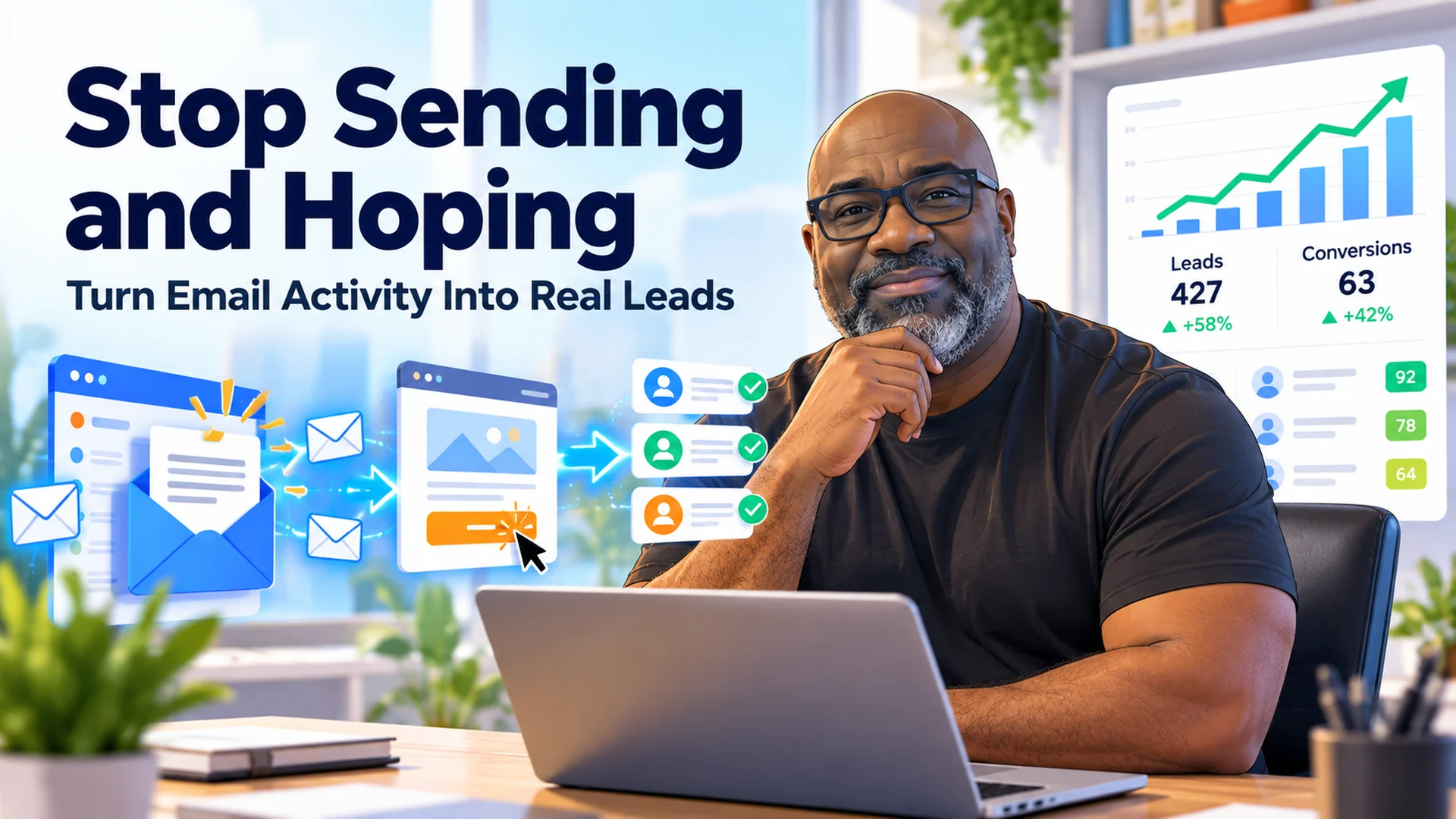
Email marketing should not be treated as a send-and-see-what-happens activity. It can be part of a behavioral sensing system that watches for increasing intent, closes the loop with sales outcomes, and helps a human decide when follow-up makes sense.
The Problem Was Never Just Sending Email
A basic email report usually tells us how many messages were delivered, opened or clicked. Those numbers can be useful, but they are not the business outcome.
A click does not tell me whether the reader visited one page and disappeared, researched three services, returned two days later, opened a case study, started a form or eventually became a customer. If the measurement stops at the email platform, a large part of the story disappears.
That is why I think of email as one sensor inside a larger lead-generation system. The email can start or continue the conversation. The website shows what happens next. The database remembers the history. The scoring model translates behavior into a practical signal. The salesperson or business owner decides what to do with it.
The Solution I Released: MailerLite Plus Airtable
When I worked on this for Save The Earth Eco System, MailerLite handled the email side and Airtable became the place where the broader lead history could be organized. The important part was not the brand of software. It was the architecture.
MailerLite today can generate webhook events for campaign clicks, opens, unsubscribes, bounces and spam reports, which means those signals can be passed to another system rather than remaining trapped inside a campaign report. Airtable can trigger automations when records meet conditions and can create, find, update and link records. The tools have become more capable, but the strategy is still the same: collect signals, connect them to the right record, and decide which patterns matter.
What I built then was an early lightweight lead-intelligence system. With current tools, a small business can create a similar system with less custom work and add AI on top of the data instead of manually reviewing every row.
A Name on a List Is Not the Same Thing as a Lead
Businesses now collect and source email addresses in many ways: contact forms, past-customer lists, networking, events, CRM history, business data providers and visitor-identification tools. Those records do not all represent the same relationship.
Someone who submitted a quote request is different from someone who appeared in a B2B data source. A former customer is different from a cold prospect. A newsletter subscriber is different from a person whose company matches your ideal customer profile.
The system should preserve that source and context. Otherwise the scoring model can mistake a good demographic fit for buying intent, or mistake curiosity for readiness.
Use Two Scores: Fit and Intent
I recommend separating two questions that marketers often mash together into one score:
Fit score: Is this the kind of person or company we want to serve?
Intent score: Are they behaving like someone who may be moving toward a decision?
That separation keeps a perfect-looking prospect from being treated as sales ready when they have shown no interest, and it keeps a highly active but poor-fit contact from automatically becoming a priority.
Example Fit Score
| Fit characteristic | Example points |
|---|---|
| Correct geographic market | +5 |
| Appropriate company size | +5 |
| Relevant industry or use case | +5 |
| Decision-maker or influencer role | +5 |
| Problem or service need matches the offering | +5 |
| Maximum example fit score | 25 |
These are example values, not industry benchmarks. Each business should define what a genuinely good customer looks like.
Example Intent Score
| Observed behavior | Example points | Why it matters |
|---|---|---|
| Email open | +1 | Very weak signal because privacy technology can create artificial opens. |
| First verified email click | +3 | A stronger action, but one click still needs context. |
| Additional email click | +4 | Repeated engagement is more useful than an isolated event. |
| Return website visit within 7 days | +5 | Shows continued interest after the first visit. |
| Blog or educational page | +2 | Useful engagement, but often earlier in the journey. |
| Service page visit | +6 | Moves from education toward a commercial topic. |
| Second service page | +8 | Suggests broader or deeper evaluation. |
| Case study visit | +6 | Often reflects validation or proof-seeking behavior. |
| Pricing or other high-intent page | +10 | Can indicate commercial evaluation. |
| Contact page visit | +8 | May indicate movement toward a conversation. |
| Positive email reply | +15 | A direct human signal. |
| Form started | +10 | Shows movement toward an explicit action. |
| Form submitted | +25 | Explicit conversion. |
| Appointment requested | +30 | Very strong explicit intent. |
The goal is not to pretend these numbers are scientifically correct on day one. The goal is to create a starting hypothesis that can be improved with your own outcomes.
Add Decay and Negative Signals
| Behavior | Recommended treatment |
|---|---|
| No meaningful activity for 30 days | Reduce the intent score or move the contact back into nurture. |
| No meaningful activity for 60 days | Reduce further and review whether continued sending makes sense. |
| Negative reply | Pause or stop the relevant outreach and update the record. |
| Unsubscribe | Suppress marketing. Use the event as aggregate campaign feedback, not as a reason to pursue the person. |
| Spam complaint | Suppress immediately and investigate list quality, relevance and sending practices. |
| Hard bounce | Remove or suppress the address. |
Do Not Overvalue the Open
Email opens used to be treated like a clean signal. They are not. Apple Mail Privacy Protection can preload tracking pixels, making an email look opened even when the recipient did not actually open it. MailerLite itself recommends focusing more attention on clicks when Apple Mail users make up a meaningful part of the list.
Even clicks need context. Security systems and automated link checks can create activity that looks human. One click should be interesting. A pattern of repeated engagement across email and the website is much more useful.
That is why I would score an open lightly, score a meaningful click more heavily, and reserve the largest values for behaviors that show deliberate research or direct human action.
The Click Should Begin the Measurement, Not End It
This is where GA4 belongs in the conversation. The email platform can tell you that a link was clicked. The website can tell you what happened after the click.
Did the visitor land on an article and leave? Did they move to a service page? Did they read a case study? Did they return later? Did they trigger a key event, submit a form, call, book or buy?
That is the distinction between measuring email engagement and measuring buyer behavior.
Do not put a person's email address, name or other personally identifiable information into UTM parameters, URLs, GA4 custom dimensions or User-ID. Google specifically prohibits sending email addresses and similar PII to Analytics.
Use an Anonymous Internal Lead ID
A safer architecture uses a random internal identifier that cannot be read as a person's identity. Your spreadsheet or database keeps the private mapping. The marketing link carries campaign information, and your own first-party system can associate the visit with the internal lead record.
For example, your database might know that lead ID RS8K42P belongs to a specific contact. The public-facing identifier should not contain the email address, company name or another value that exposes identity.
There is an additional technical detail that matters: if a lead token appears in a landing-page URL, GA4 may receive the page location. A stronger implementation captures the token in a first-party redirect or server-side process, stores the association, and redirects the visitor to a clean URL before analytics measurement begins. That is one of the places where a business owner may reasonably want implementation help.
If a business chooses to send its own anonymous IDs into GA4, Google recommends the User-ID feature instead of creating a custom dimension with a unique ID for every user. High-cardinality custom dimensions can degrade GA4 reports. The implementation still needs to comply with Google's User-ID policy and the business's privacy obligations.
The Poor Man's Lead-Intelligence Stack
A small business does not need to begin with an enterprise CRM. A practical starter stack can look like this:
The system can start very small. One spreadsheet with four logical sections is enough to prove the concept:
- Contacts: Lead ID, name, email, company, source, fit attributes, status.
- Email activity: campaign, sent date, clicks, replies, unsubscribes, bounces.
- Website activity: landing page, service-page visits, return visits, key events, last activity date.
- Outcome: review status, opportunity, won, lost, nurture, revenue if appropriate.
Turn the Score Into an Action
| Lead state | Example rule | What happens next |
|---|---|---|
| Nurture | Low intent or insufficient evidence | Continue useful, appropriate communication. |
| Engaged | Repeated meaningful activity | Keep monitoring the pattern. |
| Review | Strong intent pattern or rapid score increase | A human reviews the history and context. |
| Sales Ready | Strong fit plus strong intent plus a meaningful human or conversion signal | Use personal follow-up, not another blind automated blast. |
The important word is review. A score should help a person decide where to look. It should not become an excuse to let automation make every sales decision.
Close the Loop or the Score Never Gets Smarter
The scoring system becomes more useful only when the business records what eventually happened.
If we know that a contact clicked four times, visited three service pages and returned twice, that is interesting. If we also know whether that person became a qualified opportunity, bought, declined, disappeared or was never a fit, we can begin learning which behaviors actually matter.
At first, I may decide that a service-page visit is worth six points. That is a hypothesis. Six months later, the data may show that service-page visits did not separate customers from non-customers, while return visits and positive replies did. The scoring model should change.
Do not ask only, “Which email got the most clicks?” Ask, “Which behaviors were most common among the people who eventually became qualified opportunities or customers?”
AI Makes the Analysis Easier
This is where today's technology changes the economics of the idea. AI did not invent lead scoring. It lowered the cost of analyzing the data and maintaining the workflow.
Once the activity is structured in a spreadsheet or database, AI can help answer questions that used to require manual sorting, formulas or a dedicated analyst.
AI becomes the analyst sitting on top of the system. The business still defines the strategy, the thresholds and the appropriate human response.
An Unsubscribe Is Data, but It Is Also a Stop Sign
Unsubscribes belong in the measurement system because they can tell us something about list quality, audience fit, frequency, messaging or relevance. They do not belong in the sales-priority system as a positive engagement signal.
Once someone unsubscribes from marketing, suppress that person according to the applicable rules and your sending platform. Learn from the pattern in aggregate. Do not turn the unsubscribe itself into a reason to chase the individual.
Deliverability and compliance are part of the marketing system too. Gmail currently requires authentication and low spam rates for senders, with additional requirements for higher-volume senders, including DMARC and one-click unsubscribe for marketing messages. In the United States, CAN-SPAM requires accurate headers and subject lines, a valid postal address, a clear opt-out mechanism and timely honoring of opt-out requests.
The lesson is simple: more data is not permission to ignore the relationship with the recipient.
Nurture
Low intent or insufficient evidence
Engaged
Repeated meaningful activity
Review
Strong intent pattern or rapid score increase
Sales Ready
Strong fit plus strong intent plus a meaningful human or conversion signal
What I Would Build Today
If I were rebuilding the original Save The Earth Eco System concept today, I would start with the smallest version that can close the loop:
You Do Not Need an Enterprise Stack to Think Like One
Can the average small-business owner build every part of this alone? Some can. Many will need help with the identity layer, GA4/GTM setup, automation, database design or privacy-safe implementation.
That is not the point.
The point is that small businesses should know what is possible. You do not need to accept “we sent 1,000 emails and got a 4 percent click rate” as the end of the analysis. You can connect email activity to website behavior, combine it with fit and sales outcomes, and create a much better signal for when a human should pay attention.
That is the same idea I was trying to solve with MailerLite and Airtable years ago. The technology has finally made the plumbing easier.
Do not build a system that automatically chases every open and click. Build a system that remembers behavior, recognizes patterns, learns from outcomes and helps a person decide when a real conversation makes sense.
Want Help Connecting the Pieces?
If your email platform, website analytics and lead data live in separate places, Released Solutions can help you map the system, connect the measurements and build a practical follow-up workflow around the tools you already own.
These are the current primary sources used to verify technical and compliance statements in the article. They are included for editorial review and can be retained as external links where useful.
Google Analytics: Best practices to avoid sending PII
Google Analytics: Custom dimensions and high-cardinality guidance
MailerLite Developers: Webhooks
MailerLite: Tracking and Apple Mail Privacy Protection
Airtable: When record matches conditions