
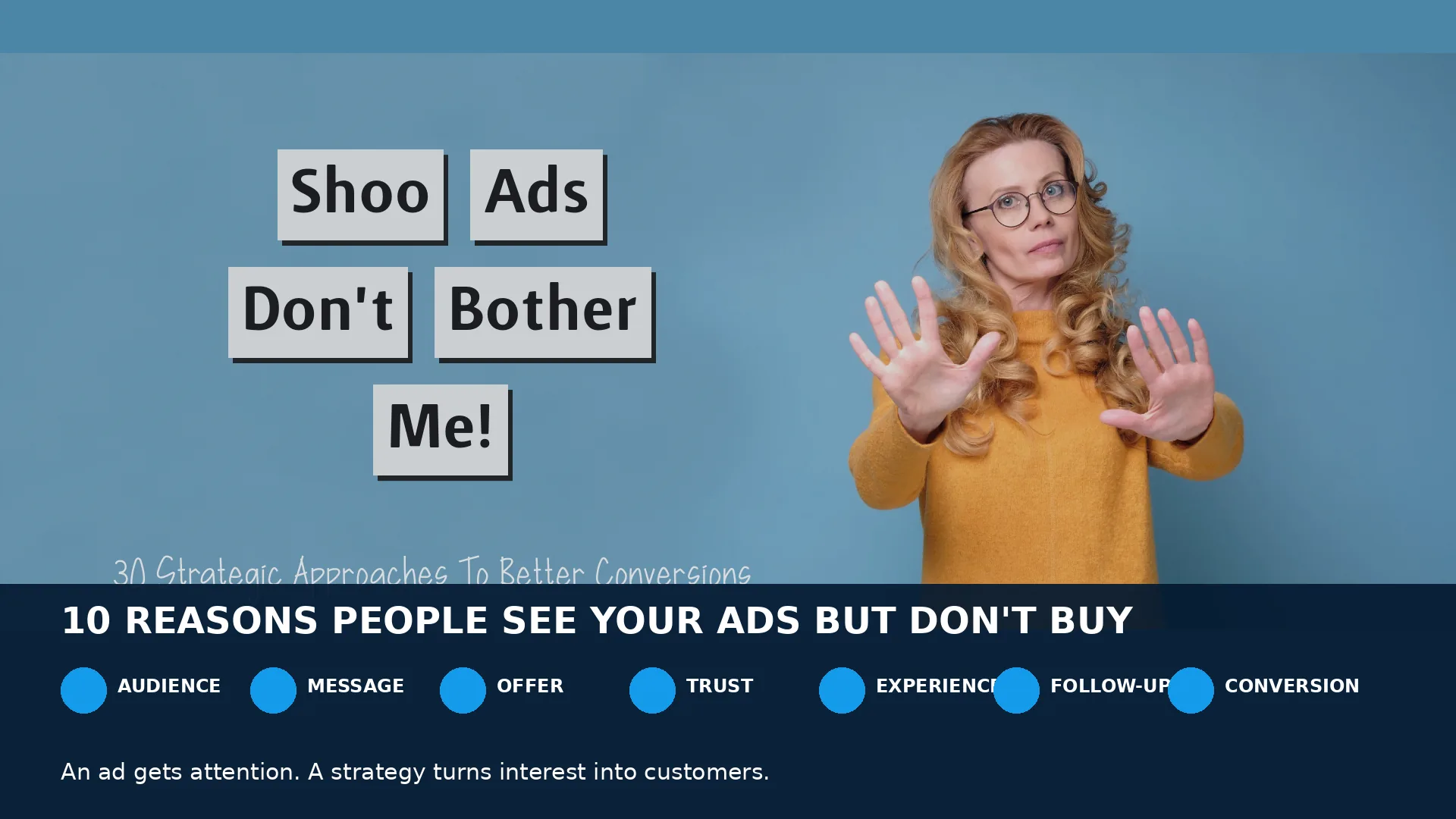

10 Reasons People See Your Digital Ads but Don't Buy
When a campaign produces impressions or clicks but not enough customers, the first reaction is often to blame the advertisement. Sometimes that is correct. But sometimes the ad did exactly what it was supposed to do: it earned attention and created an opportunity. Then something else in the customer journey failed.
A digital ad is not the entire sales process. It is one touchpoint in a larger digital marketing system. Google itself evaluates Search ad quality partly through ad relevance and landing page experience, and describes landing page experience in terms such as usefulness, relevance, ease of navigation and whether the page meets the expectations created by the ad. That is a useful reminder for any advertiser: the experience after the click matters.
At Released Solutions, I would diagnose the path this way:
A digital ad is not the entire sales process. It is one touchpoint in a larger system. When customers do not buy, the fix is often outside the ad platform.
The Diagnostic Path: Where Ads Stop Producing Customers
If people are seeing the ads but not buying, the job is to find where the path is breaking. Walk it end to end before you touch the budget.
AUDIENCE is the right person seeing the campaign. MESSAGE is whether it fits their intent. OFFER is a compelling reason to act. TRUST is proof the business is safe to buy from. EXPERIENCE is the destination after the click. FOLLOW-UP is what happens between interactions. CONVERSION is the meaningful business outcome.
A break at any stage can make the whole campaign look like the ad failed.
Ad Is a Touchpoint
The ad creates an opportunity for the rest of the customer journey to succeed. It is not the entire sale.
Diagnose the Path
Before increasing spend, find the bottleneck. Audience, message, offer, trust, experience, follow-up and conversion can each break the result.
Connect the Systems
Ad platform data alone will not diagnose a business system. Wire it to analytics, CRM, calls and sales outcomes so you can see the whole path.
The Full Conversion Journey, One Reason at a Time
10 Reasons People See Your Ads but Do Not Buy
YOU ARE REACHING THE WRONG PEOPLE
A campaign can deliver traffic and still miss buying intent. The audience may be too broad, the keywords may represent research instead of purchase intent, or the targeting may reach people who fit a demographic profile but do not have the problem you solve right now. Do not judge audience quality only by impressions or clicks. Compare traffic with qualified leads, booked appointments, purchases and the characteristics of the customers who actually close.
YOUR MESSAGE DOES NOT CONNECT WITH THE PROBLEM
An advertisement can be visually attractive without making the customer think, "This is for me." The message has to connect the offer to a recognizable need, desire, risk or opportunity. Google recommends matching ad language more closely to what users are looking for, and the principle travels beyond search advertising: the message should make sense in the context in which the customer encounters it.
YOUR OFFER IS NOT STRONG OR CLEAR ENOUGH
Advertising amplifies an offer. It does not automatically make the offer compelling. Customers still evaluate price, value, differentiation, urgency, convenience and alternatives. If the ad generates curiosity but the offer gives them no convincing reason to act, more ad spend may simply buy more people who decide not to purchase. Before changing targeting, ask whether the offer itself is easy to understand and meaningfully different from doing nothing or choosing another option.
THEY DO NOT TRUST YOU YET
A click is not the same thing as trust. The customer may still need reviews, testimonials, proof of experience, clear policies, recognizable credentials, examples of your work or simply enough consistent exposure to believe the business is legitimate. Trust becomes especially important when the purchase is expensive, personal, unfamiliar or difficult to reverse. The larger the perceived risk, the more proof the customer may need before acting.
THE LANDING EXPERIENCE BREAKS THE PROMISE
The ad and the destination should feel like one continuous conversation. If the advertisement promises one thing and the landing page makes the visitor hunt for it, confidence drops. Google explicitly recommends keeping messaging consistent from the ad to the landing page and evaluates landing page usefulness, relevance and navigation as part of the user experience. A strong click-through rate cannot compensate indefinitely for a confusing destination.
YOU ARE ASKING FOR TOO MUCH, TOO SOON
Not every person who clicks is ready to buy immediately. Some are comparing options. Some need to understand the service. Others may be interested but not ready to make a high-commitment decision. Match the call to action to the customer's stage in the marketing funnel. A purchase may be appropriate for a simple product. A consultation, estimate, appointment, guide, comparison or other lower-friction next step may work better when the decision requires more confidence.
YOU CREATED TOO MUCH FRICTION
Every unnecessary step creates another opportunity to lose someone. Slow or confusing pages, poor mobile layouts, long forms, unclear pricing, hidden contact information, broken scheduling, difficult checkout and weak calls to action can all turn paid traffic into abandonment. The objective is not to remove every step. It is to remove steps that do not help the customer make the decision or help the business qualify the opportunity.
YOU STOPPED MARKETING AFTER THE FIRST INTERACTION
Many customer journeys include more than one interaction. Google Analytics attribution documentation explicitly describes paths where someone sees an ad, searches later, returns through another channel and eventually completes an important action. That is why follow-up matters. Depending on the business and the customer's permissions, follow-up might include remarketing, email, SMS, sales outreach, educational content or another campaign touchpoint. The first ad may introduce the business. The next interaction may create the confidence to act.
YOU ARE MEASURING THE WRONG CONVERSION
A click is not a lead. A lead is not necessarily an appointment. An appointment is not necessarily a customer. Google Analytics now uses key events for actions that are important to the business, and those events can be used to create Google Ads conversions. Attribution reports can also show how different touchpoints contribute along the path. For a small business, the measurement plan should follow the economics of the business. Track the meaningful stages you can reliably measure, then connect ad-platform data to analytics, CRM and sales outcomes whenever possible.
Match each measurement to a real business outcome. Otherwise you are optimizing the wrong metric.
THE ADVERTISING MAY BE WORKING WHILE THE BUSINESS SYSTEM IS FAILING
This is the diagnosis advertisers sometimes miss. The campaign can create a legitimate opportunity and the business can still lose it. Calls go unanswered. Leads sit in an inbox. Appointments are difficult to schedule. Inventory is unavailable. Quotes take too long. Salespeople fail to follow up. The customer receives a poor experience after submitting the form. None of those failures can be repaired by changing the headline inside the ad platform.
Diagnose the Funnel Before You Increase the Budget
When ads are not producing enough customers, increasing the budget before finding the bottleneck can make the problem more expensive.
Start at the beginning and work forward. Is the right audience seeing the campaign? Does the message fit their intent? Is the offer compelling? Does the destination build trust? Is the next step easy? Is follow-up happening? Are you measuring the action that actually matters?
That diagnostic process is more useful than assuming every disappointing sales result means the advertising itself failed.
Audience Fit
Right people, right intent, right moment. Not just cheap traffic.
Message + Offer
The ad has to connect to the problem and give a compelling reason to act.
Trusted Experience
Continuity from ad to landing page. Proof, clarity, low friction.
Follow-Up + Measurement
Nurture across touchpoints. Measure the outcomes that pay the bill.
The Takeaway
People do not buy simply because an advertisement appeared in front of them. Advertising creates attention, context and opportunity. The rest of the business has to convert that opportunity.
That is why I do not look at paid media in isolation. The better question is not only, "Did the ad work?" It is, "What happened after the ad did its job?"
When you can answer that question with data, you can stop guessing, identify the actual bottleneck and make smarter decisions about where the next marketing dollar should go.
Turn More Advertising Opportunities Into Customers
Released Solutions helps small businesses connect advertising, websites, analytics, CRM, automation and conversion tracking so we can identify where opportunities are being lost and improve the entire path to the customer.
If your ads are producing clicks but not customers, we can help you diagnose the break before you spend more.
Turn More Advertising Opportunities Into Customers
Released Solutions helps small businesses connect advertising, websites, analytics, CRM, automation and conversion tracking so we can identify where opportunities are being lost and improve the entire path to the customer.
If your ads are producing clicks but not customers, we can help you diagnose the break before you spend more.
The ad did its job. Ask what happened after.
Kenneth Durrum, Released Solutions