
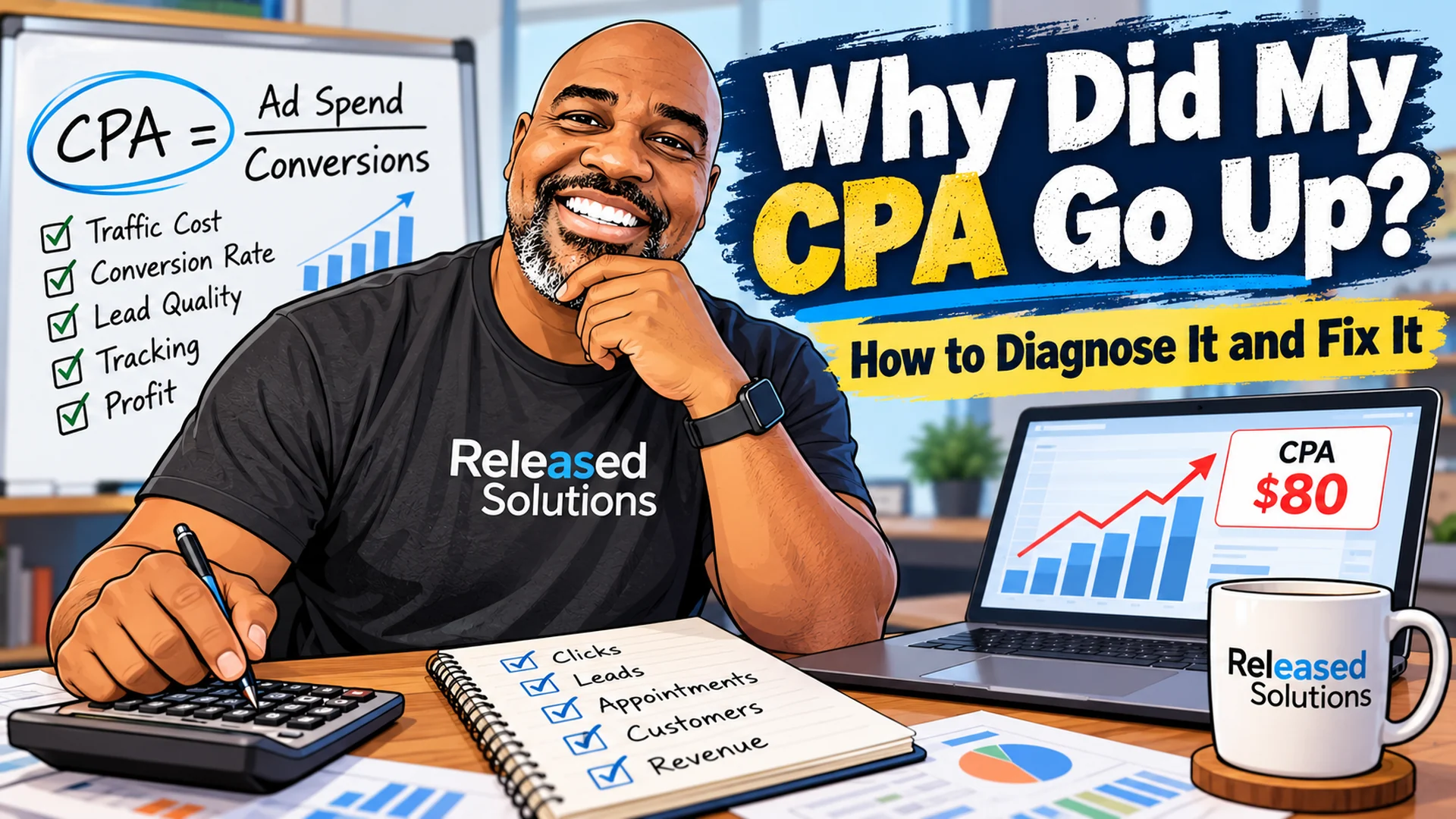

Why Did My CPA Go Up? How to Diagnose and Lower Advertising Costs
CPA is not the answer. It is a signal. The job is to understand what changed, whether the conversion is valuable, and what the business can profitably afford to acquire.
When a client tells me that CPA went up, I do not start by changing bids, cutting keywords, or rebuilding the landing page. I start by asking what the CPA is measuring and whether the number is real.
I almost never agree to start an advertising campaign until the client and I have worked out what the target CPA needs to be. That target should come from the economics of the business, not from an advertising platform, an industry benchmark, or a number that simply sounds affordable.
If we do not know what the business can afford to pay for a meaningful acquisition, we can generate conversions all day and still have no reliable way to decide whether the campaign is working.
| THE PRINCIPLE A $50 CPA is not automatically good. A $200 CPA is not automatically bad. The real question is whether the cost of acquiring the right customer makes financial sense for that business. |
|---|
What CPA Actually Measures
CPA commonly means cost per acquisition or cost per action. In its simplest form:
Google Ads defines average CPA as the total cost of conversions divided by the total number of conversions. The math is simple. The hard part is deciding what should count as a conversion.
- For e-commerce, the action may be a completed purchase.
- For a local service business, it may be a qualified lead, phone call, estimate request, or booked appointment.
- For SaaS, it may be a demo, free trial, or paid subscription.
- For a mobile app, it may be an install, registration, or another meaningful in-app action.
That definition matters because a cheap action is not automatically a profitable acquisition.
Work Out the Business Target CPA Before You Launch
When I use the phrase target CPA with a client, I mean the business target first: the amount the business can reasonably afford to pay for the outcome we want. That is different from selecting Target CPA as an automated bidding strategy inside Google Ads.
The business target should come first. A simple way to work backward is:
- What is a new customer worth?
- What direct or variable costs are attached to fulfilling the sale?
- How much contribution margin or profit needs to remain after advertising?
- What percentage of qualified leads normally become customers?
- What can we therefore afford to pay for a qualified lead or another upstream conversion?
Hypothetical example: if a business can profitably spend $500 to acquire a customer and 20% of qualified leads become customers, the allowable cost per qualified lead is approximately $100.
This is a planning example, not an industry benchmark. Every business needs its own margins, close rates, customer values, and capacity assumptions.
For a deeper pre-launch framework, see Digital Advertising Campaign Planning: Goals, CPA, KPIs & Budget.
Cost Per Action Is Not Necessarily Customer Acquisition Cost
One of the easiest mistakes in digital advertising is calling every platform conversion an acquisition. A form submission, a qualified lead, an appointment, and a paying customer are not the same thing.
Consider this hypothetical funnel from $4,000 in advertising spend:
| Stage | Results | Cost |
|---|---|---|
| Clicks | 2,000 | $2 CPC |
| Form leads | 100 | $40 per lead |
| Qualified leads | 50 | $80 per qualified lead |
| Appointments | 32 | $125 per appointment |
| Customers | 10 | $400 per customer |
The advertising platform could report a $40 CPA if the configured conversion is the form submission. The business, however, is spending $400 in media to acquire each customer. Both numbers can be mathematically correct. They answer different questions.
Why CPA Goes Up
CPA rises when you pay more for traffic, convert a smaller share of that traffic, or record fewer conversions. That means CPA itself is not the diagnosis. It is the symptom.
For a click-based campaign, a useful relationship is:
Suppose CPA rises from $50 to $80. There are at least two very different ways to get there.
| Scenario | CPC | Conversion rate | CPA | What changed |
|---|---|---|---|---|
| Traffic got more expensive | $3.20 | 4% | $80 | Auction/traffic cost |
| Traffic converted worse | $2.00 | 2.5% | $80 | Conversion rate |
Same $80 CPA. Completely different problem. That is why I prefer to break CPA apart before changing the campaign.
Start by Proving the CPA Spike Is Real
Before optimizing ads, verify the conversion signal. If the tracking changed, stopped firing, duplicated events, or started counting the wrong action, the reported CPA can move even when the underlying business performance did not.
- Run a real test through the entire conversion path. Submit the form, place a test order when appropriate, test the call path, and confirm the event is recorded once.
- Compare platform conversions with the CRM, e-commerce backend, booked calls, qualified leads, and closed sales.
- Confirm that the advertising platform is optimizing toward the conversion that actually matters, not a page view, button click, or other low-value event.
- Preserve UTMs, click IDs, landing-page source data, and CRM identifiers so a lead can be traced from the ad interaction to the business outcome.
- For lead generation, return downstream outcomes such as qualified lead, converted lead, sale, or revenue to the advertising platform when the implementation supports it.
Google Ads explicitly distinguishes primary conversion actions that can be used for bidding from secondary actions that are generally observation-only. Google also recommends qualified lead or converted lead goals for enhanced conversions for leads. That is a reminder that the optimization signal should represent something the business actually wants more of.
Four Places I Look When CPA Spikes
Traffic became more expensive
More competition, tighter inventory, weaker relevance, changing demand, or a shift into more expensive auctions can increase CPM or CPC. If traffic cost rises while conversion rate is roughly stable, the problem is usually upstream of the website conversion.
Conversion rate fell
The same traffic can suddenly produce fewer conversions because of a slow page, broken form, weak offer, pricing change, stock issue, mobile problem, checkout error, lower-intent traffic, or a mismatch between the ad promise and the landing page.
The account changed
Budgets, bids, conversion goals, audiences, keywords, locations, schedules, creative, product feeds, and campaign structure can all change delivery. In Google Ads, Change History is one of the first places I check because it maps account edits against the performance timeline.
Measurement or lead quality changed
A tracking failure can create a fake performance problem. The opposite can happen too: a platform can report an attractive CPA while the CRM shows that lead quality has collapsed. Platform CPA and business outcomes should be reconciled, not treated as separate realities.
A Fast CPA Diagnostic Table
| Pattern | Likely issue | First response |
|---|---|---|
| CPC/CPM up, CVR stable | Auction cost, competition, or weaker ad efficiency | Review auction pressure, creative relevance, targeting, and search intent. |
| CPC stable, CVR down | Landing page, offer, site issue, or weaker traffic | Test the page, form, checkout, mobile experience, price, and offer. |
| CTR down, frequency up | Creative fatigue or audience saturation | Refresh creative angles and review audience breadth. |
| Platform CPA rises, CRM sales do not | Tracking, attribution, or conversion-definition issue | Audit tags, conversion actions, event duplication, and CRM matching. |
| Spend scales, CPA rises | More marginal inventory or lower-quality reach | Scale deliberately and inspect where incremental spend is going. |
| CPC and CVR both worsen | Multiple problems at once | Separate traffic-quality, auction, page, and measurement issues before editing. |
Repair the Landing Experience Before Blaming the Advertising
Sometimes the advertising is doing its job: it is delivering people who were interested enough to click. The failure happens after the click. Improving landing-page conversion rate can lower CPA even when CPC does not change.
- Make the headline and offer match the ad or search intent.
- Make the primary action obvious and reduce unnecessary distractions.
- Ask only for the information sales actually needs at that stage.
- Test the experience on a phone, including load time, tap targets, autofill, calendar flow, payment flow, and form errors.
- Check for surprise pricing, invalid offers, unavailable products, broken widgets, disconnected phone numbers, and other friction.
- Change one major variable at a time when possible so you can learn what actually affected performance.
This is one reason I treat advertising as part of a larger online presence system. The ad, landing page, CRM, follow-up, tracking, and sales process all affect the business outcome. See What Is Online Presence Management? for the broader operating model.
What I Check in Google Ads
- Search terms: review the actual queries that triggered ads, identify irrelevant demand, and use negative keywords when appropriate.
- Change History: compare budgets, bids, keywords, targeting, conversion settings, and other account edits with the date performance changed.
- Conversion goals: confirm the right primary actions are in the Conversions column used for bidding.
- Brand versus non-brand: do not let inexpensive brand conversions hide weak acquisition performance elsewhere.
- Device, geography, time, and audience segments: look for meaningful differences, but avoid cutting segments on tiny samples.
- Landing-page alignment: use search-term data to see whether the ad and page match what people are actually looking for.
- Target CPA expectations: a platform target that is far below attainable performance can reduce traffic and conversion volume rather than magically creating cheaper customers.
Google notes that actual CPA can differ from the target because of factors such as website or ad changes, auction competition, and differences between predicted and actual conversion rates. Google also changed the labeling of Smart Bidding strategies in 2026 and updated target-based bidding behavior for campaigns limited by budget, which is another reason to verify current platform guidance rather than rely on an old rule of thumb.
What I Check in Meta Ads
The same diagnostic logic applies to Meta, even though the interface and delivery system are different.
- Confirm the conversion event represents the outcome you want Meta to find more often.
- Validate Pixel and server-side conversion tracking where applicable, and make sure duplicate events are not inflating the signal.
- Watch creative performance. Falling click-through rate, rising frequency, and weakening conversion quality can point to fatigue or saturation.
- Keep prospecting and retargeting performance understandable so a small warm audience does not make overall acquisition look healthier than it is.
- Avoid making several major budget, audience, optimization, and creative changes at the same time. Even when a change is necessary, changing everything together makes it harder to know what worked.
- Judge lead quality in the CRM, not just the cost of the platform conversion.
Platform interfaces and delivery guidance change frequently. Recheck current Meta Business guidance before publication or implementation of platform-specific setup steps.
Verify Signal
Diagnose Lever
Fix Experience
Measure Profit
Optimize for Profit, Not Platform CPA
The most important improvement is often not lowering the platform CPA. It is improving what happens after the conversion and giving the advertising system a better definition of value.
- Cost per lead
- Cost per qualified lead
- Cost per booked appointment
- Cost per completed appointment
- Cost per sale or customer
- Customer acquisition cost and contribution margin
- Revenue, repeat purchase rate, and lifetime value by channel or campaign
Here is a simple example of why the cheapest lead can be the wrong goal.
| Lead source | Cost per lead | Close rate | Media cost per customer |
|---|---|---|---|
| Source A | $30 | 20% | $150 |
| Source B | $12 | 2% | $600 |
Source B appears cheaper if you stop at the lead. Source A is four times more efficient at producing customers in this example. That is why the reporting loop needs to continue beyond the ad platform.
The same measurement mindset applies across channels. For another example of connecting traffic to business outcomes, see AI Citations Can Convert: How to Measure AI Traffic and Conversions in GA4.
What to Do When CPA Suddenly Spikes
- Confirm the conversion event is firing correctly and only once.
- Compare platform conversions with CRM, orders, booked calls, qualified leads, and sales.
- Break CPA into traffic cost and conversion rate before changing anything.
- Compare the spike period with a similar prior period by campaign, device, geography, audience, creative, landing page, and placement where relevant.
- Review account change history, site releases, pricing or offer changes, tracking changes, and product availability.
- Fix the most likely broken lever first, then measure the result before stacking additional major changes.
- Return to the business target CPA and downstream customer economics before deciding whether the campaign is truly underperforming.
The Takeaway
CPA is one of the most useful numbers in digital advertising, but only when the conversion has been defined correctly and the number is connected to the economics of the business.
That is why I prefer to establish the target before the campaign launches. Then, when CPA changes, we have a real benchmark and a disciplined way to diagnose the cause.
Last fact-check: September 26, 2026
Need help finding where your CPA is breaking?
Released Solutions can help connect campaign performance, conversion tracking, landing pages, CRM outcomes, and the numbers that matter to the business.