

What Are Buyer Intent Keywords? How to Find Searches That Actually Convert
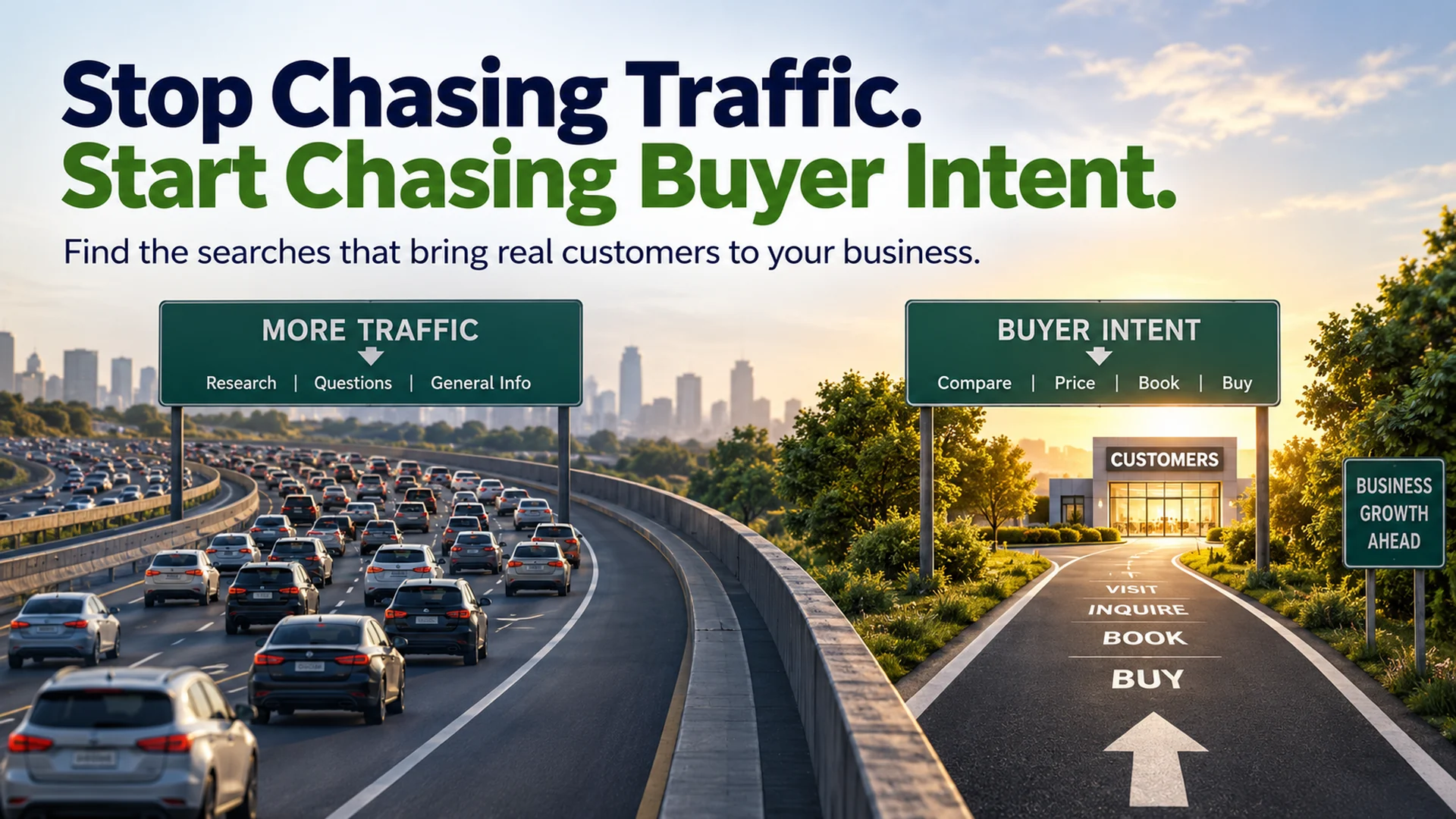
Would you rather have 1,000 website visitors or 10 people actively looking for exactly what you sell?
The answer sounds obvious, but a surprising amount of SEO work still begins with traffic. Businesses look for the keyword with the biggest search volume, try to rank for it, and celebrate when impressions and clicks increase. Those numbers matter, but they do not automatically mean the marketing is producing customers.
Buyer intent keywords shift the question. Instead of asking only, “How many people search for this?” we also ask, “What is this person trying to accomplish, and how close are they to becoming a customer?”
That distinction can change which keywords you target, which pages you build, how you use paid-search data, and how you measure SEO success.
What Are Buyer Intent Keywords?
Buyer intent keywords are searches that suggest a person is moving toward a purchase, booking, quote request, trial, consultation, or another meaningful conversion. They are not limited to searches containing the word “buy.” A person can reveal buying intent while comparing options, checking reviews, looking for pricing, searching for a provider nearby, or asking which solution is best for a specific problem.
The useful way to think about intent is as distance from a conversion. Some searches are primarily about learning. Others show that the person is comparing options. Some indicate a decision is being made. The strongest transactional searches suggest the person wants to act now.
| Search | Stage | Likely next need |
|---|---|---|
| What is CRM software? | Learning | Education |
| Best CRM for small business | Comparing | Help evaluating options |
| HubSpot vs Zoho CRM | Deciding | Detailed comparison |
| CRM software pricing | Deciding / Acting | Pricing and offer details |
| Book CRM implementation consultant | Acting | Contact or booking |
Commercial Intent vs. Transactional Intent
Commercial and transactional searches are both valuable, but they represent different moments in the buying process.
Commercial intent usually means, “Help me decide.” Searches containing terms such as “best,” “reviews,” “vs,” “top,” and “alternatives” often come from people evaluating products, services, or providers before choosing.
Transactional intent usually means, “Help me do it.” Searches containing terms such as “buy,” “book,” “hire,” “quote,” “pricing,” “order,” “demo,” and “near me” can indicate that the person is ready to take an action.
These categories overlap. Someone searching for pricing may still be comparing vendors, and someone searching “best emergency plumber near me” may be ready to call immediately. That is why intent labels from SEO tools should be treated as a starting point, not the final answer.
The Words That Often Reveal Buyer Intent
Certain modifiers repeatedly appear in searches with commercial value. Purchase terms include “buy,” “order,” and “subscribe.” Price terms include “price,” “cost,” “pricing,” and “affordable.” Decision terms include “best,” “reviews,” “vs,” and “alternatives.” Action terms include “quote,” “demo,” “trial,” “hire,” and “book.” Local intent often appears through “near me,” city names, neighborhoods, or other geographic language.
The modifier alone does not determine the value of a keyword. “Cheap” might indicate a buyer, but it might also attract the wrong customer for a premium service. “Best” may signal commercial investigation, but the searcher could still be early in the decision process. The phrase has to be evaluated in the context of your actual offer.
Why Search Volume Can Mislead You
Search volume is useful because it estimates demand, but volume is not the same thing as business value.
Imagine one keyword receives 2,000 searches per month but mostly attracts people researching a topic. Another receives only 70 searches but describes your exact service, location, and customer problem. If the second keyword consistently generates qualified calls or bookings, it can be far more valuable to the business.
For a local roofing company, “how long does a roof last?” can be useful educational content. “Emergency roof repair Homestead FL” is different. The second search contains a service, an urgent problem, and a location. The potential customer is much closer to taking action.
What CPC Can Tell You About a Keyword
Cost per click, or CPC, is another useful clue. If advertisers repeatedly compete for traffic around a search, there is usually an economic reason. Businesses are willing to pay for clicks when they believe those searches can contribute to leads or sales.
That does not mean a high CPC automatically makes a keyword a good SEO target. CPC varies dramatically by industry, location, competition, device, season, and other advertising conditions. A $4 click could be expensive in one market and inexpensive in another.
The better approach is to compare CPC within your own market and use it alongside intent, relevance, SERP evidence, and your ability to convert the visitor.
The Buyer Intent Scorecard
Before committing time or money to a keyword, score it against five practical questions.
Intent
Does the search suggest the person is moving toward a purchase, quote, booking, demo, or meaningful comparison?
Relevance
Does your business directly provide the product, service, or solution the searcher appears to want?
Commercial Evidence
Are advertisers competing for the search, and is CPC meaningful relative to other keywords in your market?
SERP Evidence
What does the live search results page show? Ads, local listings, product pages, pricing pages, comparison pages, and service pages can reveal what Google believes satisfies the query.
Conversion Path
Do you have a page where this person can take the logical next step without hunting through your website?
How to Find Buyer Intent Keywords
Start with broad seed terms describing your services, products, customer problems, brands, and locations. Keyword platforms such as Semrush and Ahrefs can expand those seeds into related searches and provide data such as intent, volume, difficulty, and CPC.
Filter for commercial and transactional intent, but do not stop there. Add modifiers that make sense for your business, including pricing, quote, best, reviews, vs, alternatives, book, hire, demo, near me, and relevant locations.
Then look at Google Keyword Planner for additional keyword ideas and advertising signals. The goal is not to create a giant spreadsheet. The goal is to produce a shortlist of searches that appear commercially meaningful and directly relevant to what you sell.
Finally, search the phrase yourself. The live results page is evidence. If Google consistently returns service pages, local businesses, pricing pages, shopping results, or comparison content, that tells you something about the likely intent and the content format competing for that search.
Your Existing Search Data May Be More Valuable Than Another Keyword List
Before buying another tool or exporting another 10,000 keywords, look at what your own audience is already doing.
Google Search Console’s Performance report shows queries associated with your site’s Google Search visibility, including clicks, impressions, click-through rate, and average position. That can reveal phrases for which Google already sees some relationship between your site and the searcher’s question.
Now connect that information to what happens after the click. Your analytics and conversion tracking can help determine whether visitors become leads, calls, bookings, purchases, or other meaningful outcomes.
If you run Google Ads, the Search Terms report adds another layer because it shows actual searches that triggered ads and performance data associated with those searches. Search terms that produce conversions can reveal language worth investigating for SEO, landing pages, and content.
Do Not Trust the Keyword Tool Blindly
Keyword tools are useful, but they are models and databases, not your customer. A tool can label a query “transactional” while the live search results tell a more complicated story.
Before building a page, inspect the search results. Are the top results educational articles, ecommerce products, local businesses, directories, comparison pages, videos, or pricing pages? The dominant page types give you a strong clue about what searchers expect.
This also prevents a common mistake: trying to force a service page to rank for a query Google consistently treats as educational, or publishing a generic blog article for a search where people clearly want to book, buy, or request a quote.
Match the Page to the Intent
A keyword strategy is incomplete until the search is mapped to the right destination.
| Search behavior | Best-fit page |
|---|---|
| Learn | Educational article, guide, FAQ, or explainer |
| Compare | Comparison page, buyer’s guide, reviews, alternatives |
| Evaluate price | Pricing, service, package, or product page |
| Find locally | Local service or location page with clear contact options |
| Act | Quote, booking, demo, product, checkout, or contact page |
The page should also make the next step obvious. If someone searches for a quote and lands on a page with no clear quote request, the keyword may be excellent while the conversion experience is poor.
Learning
Education
Comparing
Help evaluating options
Deciding
Detailed comparison
Acting
Contact or booking
Buyer Intent Is Becoming More Conversational in AI Search
Buyer intent does not disappear when people use AI-assisted search. The wording simply becomes more conversational.
Instead of typing “best CRM small business,” someone might ask an AI system, “What is a good CRM for a five-person service company that needs email automation and does not have a full-time sales manager?” Another person might ask, “Who provides WordPress support near Homestead for a small business that needs ongoing help?”
Those prompts still contain intent. They may actually contain more context about budget, location, audience, features, urgency, and constraints than a traditional two- or three-word search.
This is one reason content should clearly explain who a service is for, what problems it solves, where it is available, how it differs, what the process looks like, and what someone should do next. That clarity helps human visitors and gives search and answer systems more useful information to understand.
Measure Customers, Not Just Rankings
Rankings, impressions, clicks, and traffic are useful diagnostic metrics. They tell you whether your content is being discovered. They do not, by themselves, tell you whether the marketing is working.
The measurement path should continue: rankings to clicks, clicks to leads, leads to qualified opportunities, opportunities to customers, and customers to revenue.
That is why a low-volume keyword that repeatedly produces qualified leads can be more important than a high-volume keyword that produces thousands of visits and no business.
SEO becomes much more useful when keyword research is connected to conversion measurement. Instead of asking, “How much traffic did we get?” you can ask, “Which searches brought the right people, and what did those people do?”
Stop Chasing Traffic. Start Identifying Opportunity.
Buyer intent keyword research is not about ignoring informational content. Educational content can introduce your business, answer important questions, build authority, and support people earlier in the decision process.
The mistake is treating every visitor as equally valuable or assuming the keyword with the largest number beside it deserves the most attention.
Start with intent. Check relevance. Look at advertiser demand. Inspect the search results. Make sure the destination page fits the searcher’s next step. Then measure whether those visitors become customers.
That turns keyword research from a traffic exercise into a business decision.
Turn Search Visibility Into Measurable Business Results
Finding high-intent searches is only part of the job. Your website, analytics, content, local presence, and conversion paths need to work together. Released Solutions helps small-business owners manage the complete online presence around measurable business goals.