

Stop Repeating Yourself: How Content Saturation Hurts Social Media Reach
Years ago, I wrote that over-saturating social media with repeated content could sabotage a brand's reach. The examples were real, and the underlying warning was useful. But I would phrase the lesson differently today.
Posting frequently is not automatically the problem. Repetition without additional value is the problem. A business can publish often and still build an audience when each post gives people a new reason to stop, watch, read, respond or act.
The modern social feed is personalized. Platforms are trying to predict what each person will find relevant, engaging and satisfying. That means the question is no longer simply, "How many times should I post?" A better question is, "Am I giving this audience something worth seeing again?"
A business can publish often and still build an audience when each post gives people a new reason to stop, watch, read, respond or act.
What Content Saturation Actually Means in 2026
Content saturation happens when an audience repeatedly encounters substantially the same message, creative, angle or offer without enough novelty or added value to justify another exposure. It can happen organically, through paid media, or when a business cross-posts and reposts without adapting the idea to the context.
This is different from strategic consistency. Consistency reinforces a recognizable point of view, brand promise or campaign. Saturation is when the execution becomes so repetitive that people have little reason to engage with the next version.
The Platforms Are Telling Us What They Want
Facebook has become unusually direct about originality. In March 2026, Meta said Facebook is prioritizing original content in Feed and Reels while reducing the reach of unoriginal content. It specifically said duplicative content and minor edits to someone else's post can be deprioritized. Meta also reported that 75% of Instagram recommendations in the United States were coming from original posts in Q4 2025.
LinkedIn describes its Feed as a relevance system using hundreds of signals. It looks at the context and quality of a post, what people view, how they interact, time spent, recency and whether a conversation is constructive. LinkedIn also gives members controls to mute, unfollow or mark content as not interesting.
YouTube frames recommendations around three broad performance questions: did people choose the content, did they keep watching, and were they satisfied? Its recommendation guidance also notes that systems consider what people watch, what they do not watch, dislikes and "Not interested" feedback.
None of that proves that posting the same business message twice automatically triggers a reach penalty. That is too simplistic. What it does show is that the major platforms are optimizing for relevance, originality, engagement and satisfaction. Repetition that makes people ignore, hide, mute or disengage works against those goals.
Frequency vs Repetition
Posting often is fine. Posting the same thing repeatedly is what quietly costs reach, comments and clicks.
Consistency vs Saturation
Consistency reinforces a brand point of view. Saturation is what happens when the execution becomes background noise.
Duplication vs Repurposing
If the only thing that changed is the caption color, you have duplication. Repurposing changes audience, angle, format, proof or action.
Where Repetition Actually Costs You
Five Ways Repetitive Content Can Work Against You
These are the practical costs I see when a small business leans on repetition instead of variety. They matter more than any hypothetical reach penalty.
YOUR AUDIENCE STOPS NOTICING
When people recognize the same visual, headline or offer before they have a reason to reconsider it, the content becomes background noise. The post may be delivered, but attention is the scarce resource.
YOU SPLIT THE CONVERSATION
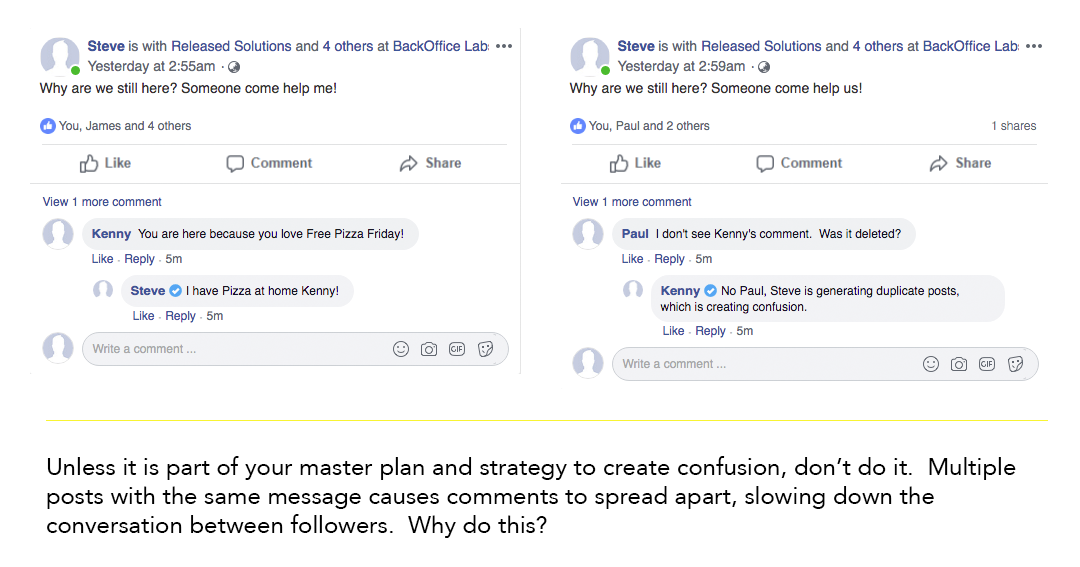
Two nearly identical posts can generate separate comment threads. If the same audience is being asked to discuss the same thing in multiple places, comments, reactions and social proof become fragmented.
YOU CREATE NEGATIVE FEEDBACK OPPORTUNITIES
People can mute, hide, unfollow or select "Not interested" and teach recommendation systems they want less. Unnecessary repetition creates more chances for fatigue to turn into negative feedback.
YOU WASTE CREATIVE OPPORTUNITIES
If you have one good idea, repeating the exact execution is usually the least interesting way to extend it. The same idea can become a short video, a founder observation, a case example, a checklist, a customer question, a chart, a carousel or a behind-the-scenes explanation.
YOU CONFUSE FREQUENCY WITH STRATEGY
A content calendar can be full while the strategy is empty. Volume is not the same as coverage. Good content planning varies audience, angle, format, stage of the customer journey and desired action.
The Historical Data Still Teaches Something
The screenshots from the original Released Solutions article should not be treated as current Facebook interface documentation, but the experiments themselves are still instructive. One repeated-post example showed reach stepping down from 101 people to 73, then 61, then 44. Another example compared an organic version of a creative with a paid version.
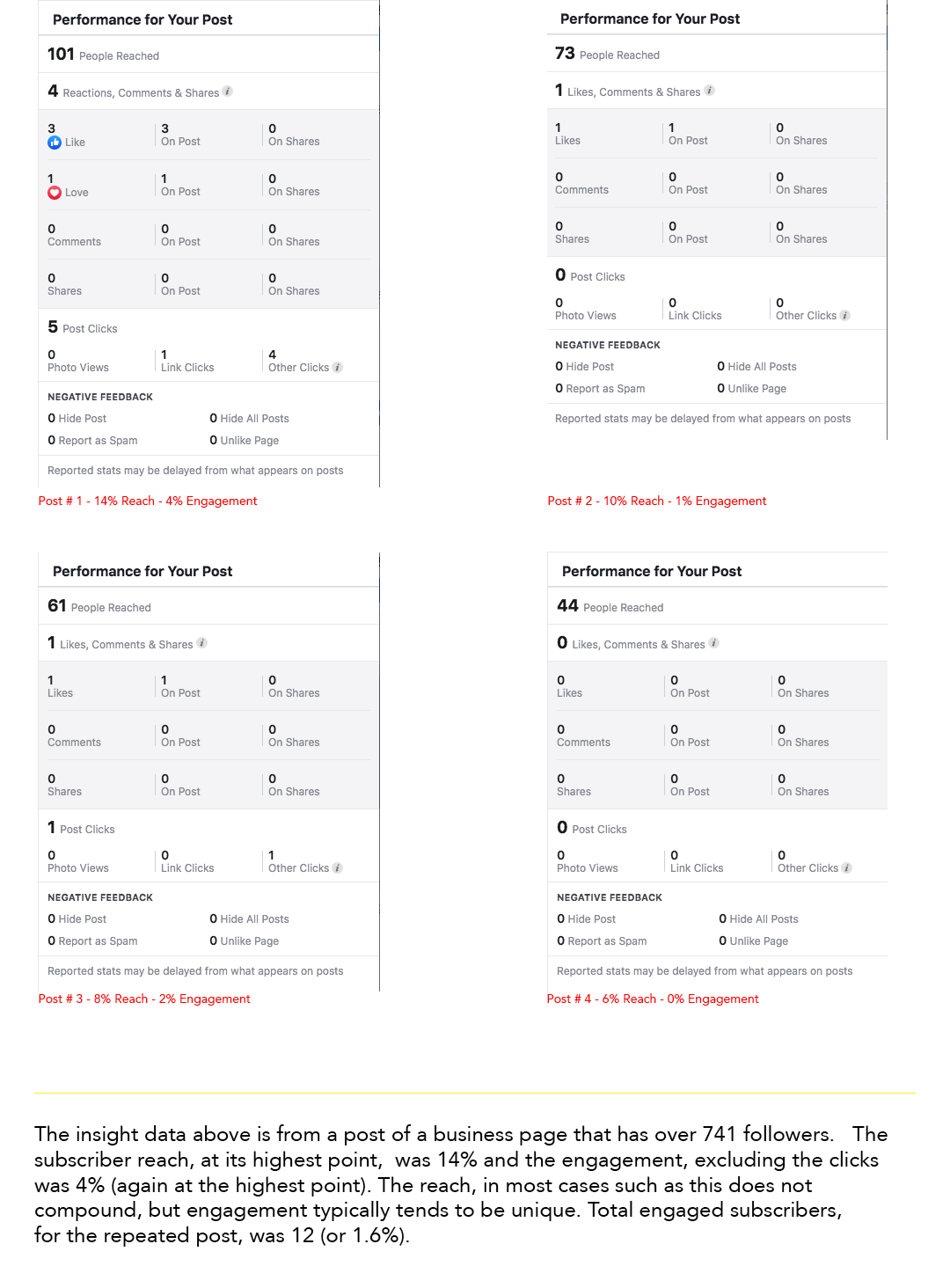
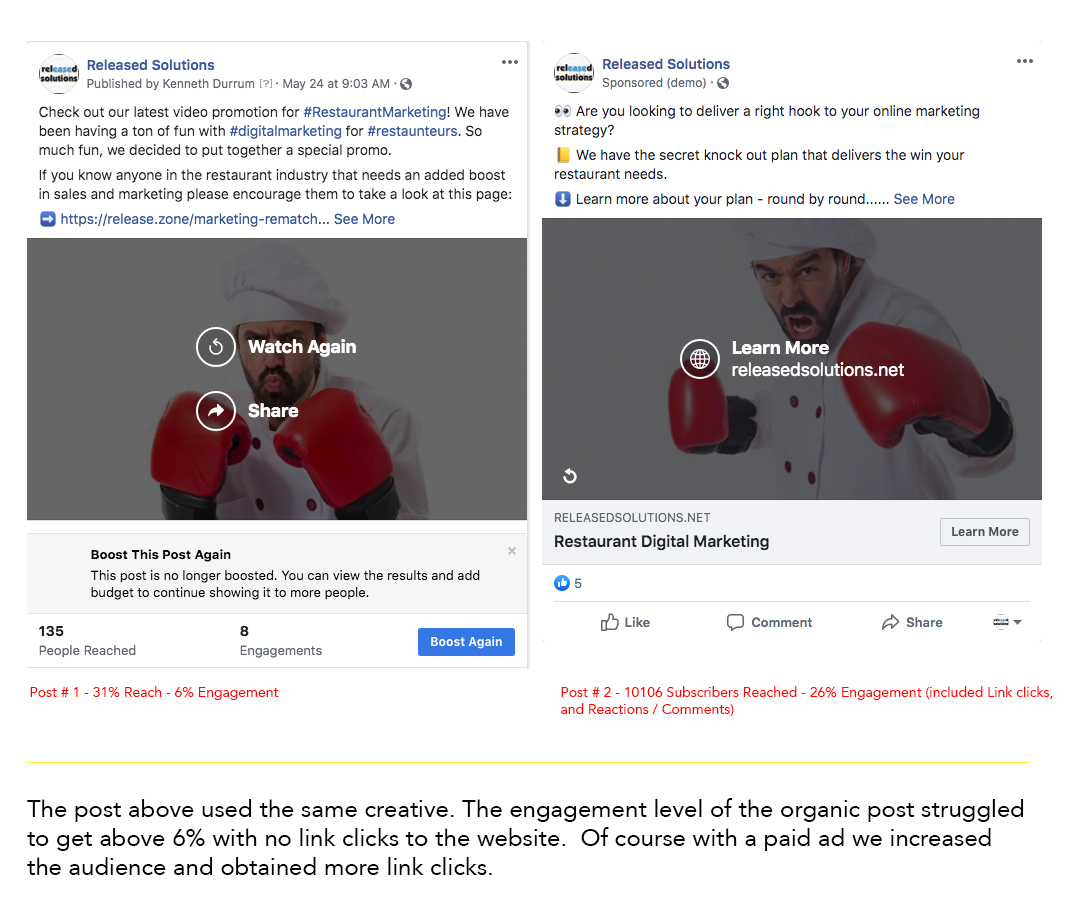
The sample was small, the posts were from an older Facebook environment, and paid distribution changes the audience opportunity. The takeaway is qualitative, not quantitative.
Repurpose the Idea, Not the Post
This is the part I would emphasize much more today. Businesses should absolutely reuse good ideas. A strong idea is an asset. The mistake is assuming reuse means duplication.
| Keep | Change | Example |
|---|---|---|
| Core idea | Angle | "Why customers leave" -> "3 warning signs before a customer leaves" |
| Expertise | Format | Article -> short video -> carousel -> email -> FAQ |
| Offer | Audience | Same service, but speak separately to owners, managers and buyers |
| Topic | Proof | Opinion -> case example -> data -> customer question |
| Campaign | Hook | Same destination, but a different problem, benefit or objection |
The goal is to build a content system where one useful idea can support multiple pieces of content without making your audience feel as if they are seeing the same post again and again.
A Simple Content Variation Framework
Before publishing another version of an idea, change at least one meaningful dimension. Who is this version for? What new angle does it take? Is the format different (see the creative size guide)? What new proof, example or context does it add? What action should the reader take?
If the only thing that changed is the date, crop, border, caption color or a few words, you probably have duplication rather than repurposing.
Frequency
The right cadence for your platform, audience and resources. Not a fixed rule.
Variety
Different angle, format, proof or audience on every version of the idea.
Originality
Platforms reward relevance and originality. Repetition without value fights that goal.
Measurement
Watch fatigue signals: reach, engagement, saves, negative feedback and conversion.
How Often Should a Business Post?
There is no universal posting frequency that is correct for every small business. The right cadence depends on the platform, audience size, content quality, resources, campaign objectives and how much genuinely useful material the business can sustain.
I would rather see a business publish three useful pieces that address different customer needs than seven posts that repeat the same promotion. But I would also rather see seven strong, distinct pieces than artificially limit a business to three because someone declared a universal posting rule.
Measure the response. Watch reach, unique audience, watch time, saves, shares, comments, profile activity, clicks, leads and conversions. Look for declining performance across repeated themes or creatives. Then change the execution before assuming the answer is simply to post less.
Paid Media Has Its Own Version of the Same Problem
Advertising adds another layer because platforms can repeatedly deliver the same creative to an audience. Here the practical concern is creative fatigue. Frequency can be useful when people need multiple exposures before acting, but rising frequency combined with falling response, weaker click-through rate or worsening conversion economics is a reason to test new creative, offers, hooks or audience segments.
Again, the lesson is not "never repeat." It is to manage repetition intentionally and measure whether additional exposure is still producing value.
What I Would Do Differently Today
The old article told businesses not to over-saturate their content. I still agree with the concern, but the modern strategy is more constructive: build enough creative variety that you can stay visible without becoming repetitive.
- Repeat your core message, not the exact post.
- Give each version a different audience, angle, format, proof point or next step.
- Use analytics to identify fatigue instead of relying on a fixed posting-frequency myth.
- Treat originality and relevance as strategic advantages.
- Let strong ideas become content families instead of duplicate posts.
The Takeaway
Your business does not need to disappear from social media to avoid over-saturation. It needs to stop confusing repetition with consistency.
Consistency says, "This is what we stand for." Repetition says, "Here is the same thing again." The strongest content strategy keeps the first and fixes the second.
Build a Smarter Content System
Released Solutions helps small businesses connect content strategy, social media, paid advertising, analytics and automation around measurable business funnel outcomes.
If your content calendar feels busy but your audience response is getting weaker, the answer may not be more posts. It may be a better system for turning ideas into useful, varied content.
Consistency is a point of view. Repetition is background noise.
Kenneth Durrum, Released Solutions