
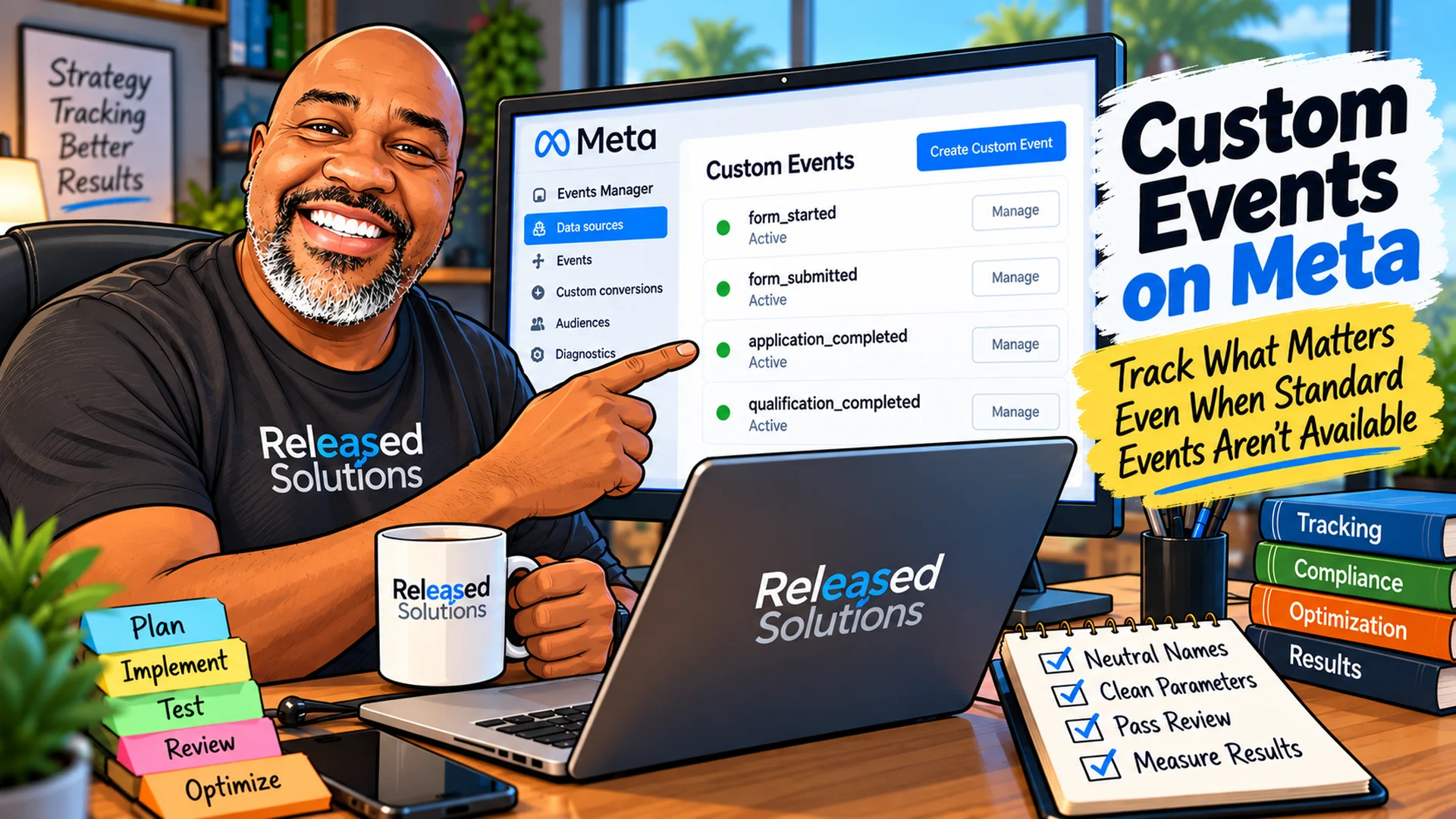

Meta Custom Events When Standard Events Do Not Fit
A conversion event should describe something that actually happened in the customer journey. That sounds obvious, but measurement gets messy when a business tries to force a meaningful action into the nearest label available in an advertising platform.
Meta provides standard events for common actions such as leads, registrations and purchases. Those standard definitions are useful because they create a shared measurement language. But every business has steps that do not fit a standard path cleanly. A service business may need to recognize completion of a pricing tool. A B2B company may care about a qualified intake milestone. A membership organization may need to record a completed eligibility check that is not itself a registration or purchase.
That is where a custom event can help. It gives the business a clear name for a legitimate action when a standard event would be inaccurate or misleading.
The important boundary is simple: a custom event is not a loophole around Meta restrictions. A different event name does not make prohibited data acceptable, and it does not turn a restricted action into an approved one. Custom events are a measurement design option, not a policy exception.
Start With the Business Action
Before choosing an event name, define the action in plain English. What did the person do? What changed in the business process? Why does that action matter?
This keeps the implementation connected to the real customer journey. It also prevents a common mistake: selecting an event because its name sounds valuable even though its definition does not match the action being measured.
For example, a person who finishes a pricing calculator has completed a useful step. That action may indicate stronger interest than a page view, but it is not automatically a lead, completed registration or purchase. Calling it one of those things can make reporting look cleaner while making the underlying measurement less honest.
A useful event begins with a useful sentence: The visitor completed the pricing calculator and reached the results state. Once the action is clear, the technical design becomes much easier.
Use a Standard Event When It Truly Fits
Custom should not mean preferred by default. If a standard event accurately describes the action, I generally start there. Standard events make the setup easier for other marketers and developers to understand, and they preserve a familiar structure across reporting and campaign work.
The test is not whether a standard event is close enough to sound plausible. The test is whether its meaning matches the action. A completed purchase should normally remain a purchase. A genuine lead submission may fit a lead event. A completed account registration may fit a registration event.
When the definition fits, use it consistently. When it does not fit, do not distort the customer journey simply to avoid a custom name.
What a Custom Event Actually Solves
A custom event solves a naming and measurement problem. It gives a business-specific action a durable identity so it can be tested, reported, documented and, where Meta currently permits, used in eligible audience, conversion or optimization workflows.
That does not mean every click deserves an event. A custom event becomes useful when the action represents a meaningful change in intent, qualification or progress. If the action does not influence a decision, explain performance or support a next step, adding another event may create more noise than insight.
It is also important not to confuse a custom event with a custom conversion. A custom event is the named action sent to Meta. A custom conversion is a rule or reporting definition that may use an event, URL or event parameters. The interface and available uses can change, so the current Events Manager workflow should be verified during implementation.
The Compliance Boundary Does Not Move
The name of an event does not determine whether the underlying data is appropriate to send. The business still has to follow Meta's current terms, applicable laws, consent requirements and its own privacy commitments.
That means the implementation should transmit only the information needed for the approved measurement purpose. Event names and parameters should not reveal sensitive details, form answers, confidential information or other data that should not be shared with an advertising platform.
I would not approve an event simply because the code fires successfully. I would ask what the event communicates, which parameters accompany it, whether the business has the right to share that data, how the event will be used and whether the same goal can be achieved with less data.
Custom events can make measurement more accurate. They cannot make an impermissible data practice permissible.
A Seven Step Decision Framework
Define the action
Write one plain-language sentence describing exactly what occurred.
Check the standard events
Use a standard event if its current definition accurately matches the action.
Confirm business value
Explain what decision the event will improve and where it sits in the customer journey.
Review the data
List every value and parameter that would be sent. Remove anything unnecessary, sensitive or unclear.
Choose a durable name
Use a concise name that describes the action without embedding personal or sensitive details.
Implement and test
Validate firing conditions, browser and server behavior, deduplication where applicable, and reporting consistency.
Document and review
Record the trigger, owner, parameters, purpose and approval date, then revisit the event when the workflow or platform changes.
Examples of Better Event Decisions
The examples below are hypothetical measurement choices, not universal prescriptions. The correct implementation depends on the actual workflow, the data being sent, the business category and Meta's current requirements.
| Business action | Standard fit | Possible choice | Implementation caution |
|---|---|---|---|
| Pricing calculator completed | No exact standard match | PricingCalculatorCompleted | Fire only after the calculation is completed; do not send the person's answers or sensitive inputs in the event name or parameters. |
| Service area confirmed | May not be a lead | ServiceAreaConfirmed | Measure the confirmation state, not the visitor's full address or other unnecessary personal data. |
| Qualified intake milestone completed | Depends on what completed means | QualifiedIntakeCompleted | Define qualification outside the event name and review the underlying data carefully before anything is transmitted. |
| Purchase completed | Standard event fits | Purchase | Keep the standard event when it accurately represents the transaction and the implementation meets current requirements. |
Common Custom Event Mistakes
✓ Forcing a business action into the closest standard event even when the meaning is wrong.
✓ Creating a custom event for every button click, scroll or minor interaction.
✓ Embedding sensitive details, form responses or personal information in event names, URLs or parameters.
✓ Assuming a custom name creates a new policy permission.
✓ Optimizing a campaign around an event before confirming its volume, consistency and connection to business value.
✓ Running browser and server events without validating duplicates and event identity.
✓ Changing the website workflow without retesting the event trigger.
✓ Stopping at the platform event instead of checking lead quality, CRM progress and revenue outcomes.
Define the action
Confirm business value
Review the data
Document and review
Measurement Still Has to Reach the Business Outcome
A clean Meta event is not the final business result. It is one signal inside a larger measurement system.
If a custom event represents completion of a qualified intake step, the reporting should continue into the CRM. How many of those people became appointments, opportunities or customers? Did the event predict value, or did it merely create another attractive number in Ads Manager?
That is why I connect event design to the business funnel before campaign optimization. The event should help answer a real question. It should also be possible to compare platform reporting with website analytics, CRM stages and actual revenue or customer outcomes.
Better event names do not replace better business measurement. They make that measurement easier to organize.
The Takeaway
Use a standard event when its definition matches the action. Use a custom event when a legitimate business action matters and the standard path would describe it inaccurately.
Then keep the boundary clear. Custom events do not bypass Meta restrictions. They do not make prohibited data acceptable. They do not replace consent, governance, testing or documentation.
The goal is not to invent a more impressive conversion. The goal is to represent what actually happened, send only the data that is appropriate, and connect the signal to a business outcome that matters.
Need Help Defining What Meta Should Measure
Released Solutions helps businesses connect advertising, websites, analytics, CRM and conversion tracking so campaign signals reflect real business outcomes. If your current events are unclear, duplicated or disconnected from lead quality, we can help you map the journey and build a cleaner measurement plan.