
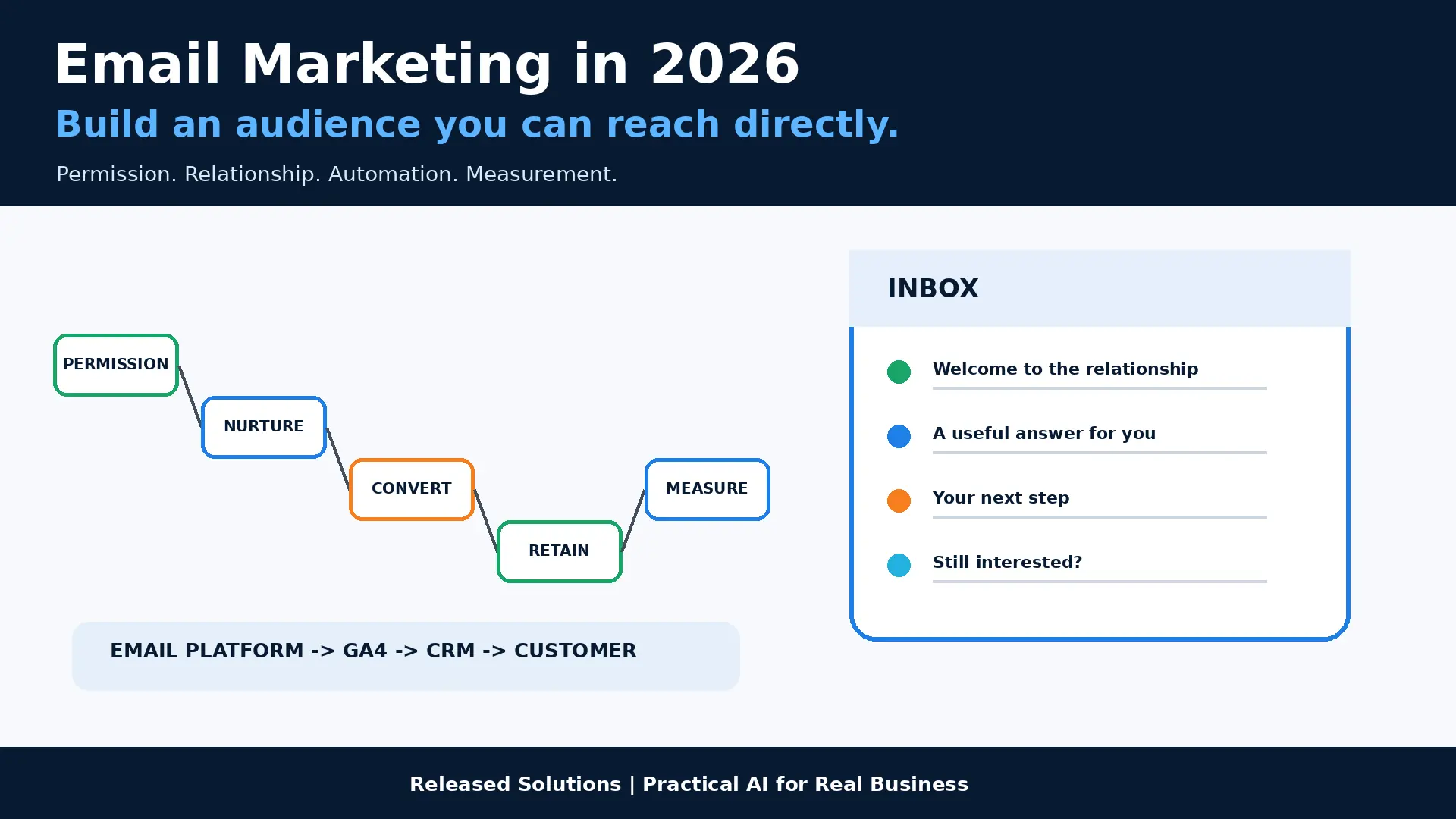

Email Marketing in 2026: Why an Owned Audience Still Matters for Small Business
The original version of this article focused on seven benefits of email marketing. In 2026, I would frame the question differently.
Why does email still matter when businesses have social media, paid search, short video, AI assistants, text messaging and increasingly sophisticated CRM systems?
Because email plays a different role. Social media can create discovery. Search can capture intent. Advertising can buy attention. AI can accelerate content and analysis. Your website can convert interest. Email can keep the relationship moving after the first interaction.
Social platforms can change the algorithm. Search results can change. Advertising costs can change. An email list gives a business a permission-based relationship it can continue developing directly.
My framework: PERMISSION → RELATIONSHIP → SEGMENT → NURTURE → CONVERT → RETAIN → MEASURE → IMPROVE.
Permission, Not Just Reach
Email is not old marketing. Bad email is old marketing. Permission-based, authenticated, useful email remains one of the strongest channels a small business can build.
| Stage | What has to happen there |
|---|---|
| PERMISSION | The subscriber actually asked to be there, with clear expectations. |
| RELATIONSHIP | The business earns continued attention through useful communication. |
| SEGMENT | Different subscribers see different messages when relevance improves the result. |
| NURTURE | Content moves people from interest to confidence over time. |
| CONVERT | A clear next step turns nurtured attention into a real business action. |
| RETAIN | Customers stay, come back and buy again because the relationship stayed useful. |
| MEASURE | Platform + UTM + GA4 + CRM turn activity into understood outcomes. |
| IMPROVE | What the data and customer response teach the team to change next. |
Owned Audience
The subscriber gave permission to communicate directly. That is different from renting distribution on someone else's platform.
First-Party Data
Real customer signals tell the business who to serve, how and when, using data the customer chose to share.
Connective Tissue
Email connects social, search, ads, content, website, analytics and CRM into one continuing customer relationship.
PERMISSION, RELATIONSHIP, SEGMENT, NURTURE, CONVERT, RETAIN, MEASURE, IMPROVE
Eight Reasons Email Still Belongs in a 2026 Marketing System
The 2013 article listed seven benefits. Eight is closer to the 2026 job.
OWNED AUDIENCE, NOT A RENTED ONE
A social following is valuable, but the platform controls distribution. An email subscriber has given the business permission to communicate through a more direct channel. That does not mean you own the person or have unlimited permission. It means the relationship is less dependent on whether a social algorithm decides to distribute tomorrow's post. Respect consent, expectations, frequency and the subscriber's ability to leave. An owned audience works only when people continue wanting the relationship.
FIRST-PARTY DATA FROM REAL CUSTOMER SIGNALS
When someone subscribes, downloads a useful resource, requests information, purchases, books or interacts with an email, the business begins learning from its own customer relationship. Collect what helps you serve and communicate better, not everything possible. A restaurant may care about location or interests. A B2B company may care about role or service need. An ecommerce business may care about purchase history. A service company may care about lifecycle stage. Useful segmentation begins with useful, permission-based data.
NURTURE PEOPLE WHO ARE NOT READY TODAY
Not every website visitor, social follower or lead is ready to buy immediately. Email gives the business a way to continue helping. A welcome sequence can introduce the company. Educational emails can answer common questions. Case studies build confidence. Product education reduces uncertainty. Reminders can bring someone back. A useful nurture sequence is not a string of increasingly desperate sales messages. It is a planned progression that helps the customer make a better decision.
SEGMENTATION MAKES RELEVANCE SCALABLE
The same message should not always go to everyone. Customers differ by interest, geography, purchase history, lifecycle stage, service need and engagement. Segmentation lets a business make communication more relevant without manually writing every message to every person. Personalization should have a reason. Putting someone's first name in a subject line is not a strategy by itself. The stronger question: what do we know, with permission, that helps us send something more useful?
AUTOMATION LETS THE BUSINESS RESPOND TO MOMENTS
A customer joins the list. A lead requests a guide. Someone abandons a process. A customer purchases. A renewal approaches. An appointment needs preparation. A subscriber has not engaged for a long time. These moments can trigger different communications. Good automation is not about emailing more; it is about making the right message more likely to arrive at the right stage. That saves staff time while creating a more consistent customer experience.
CONVERSION WITHOUT MAKING EVERY MESSAGE A SALES PITCH
Email can drive appointments, purchases, consultations, registrations, downloads and other actions. But conversion does not require every email to say BUY NOW. Useful email builds momentum. Teach something. Answer an objection. Show a customer result. Explain a process. Invite a reply. Then make the next step clear when there is a next step. The relationship creates opportunities for conversion because the business has remained useful between transactions. See also website engagement.
RETENTION AND REPEAT BUSINESS
Acquisition gets a great deal of marketing attention. Retention deserves more. Email can support onboarding, product education, service reminders, renewals, reorder cycles, loyalty, customer education, events and reactivation. The best customer for the next transaction may already know the business. Email gives the company a structured way to continue that relationship after the first sale.
CHANNEL CONNECTION: EMAIL IS OFTEN THE BRIDGE
Email works especially well when it is not isolated. A useful article can become an email. A webinar can become a nurture sequence. A social post can drive people toward a useful subscription. Paid advertising can introduce the business and email can continue the relationship. Customer questions from email replies can become future content. One strong idea can move through multiple channels without becoming identical copy everywhere. Related: social media optimization, how people find your content.
Permission Is the Foundation
A smaller list of people who actually asked to hear from you can be more useful than a giant database of people who did not. Do not buy lists. Do not quietly add unrelated contacts. Set expectations. Make unsubscribing easy. Yahoo explicitly warns against purchased lists. Google's sender guidance focuses on wanted mail, authentication, low spam complaints and easy unsubscribe. List growth is not the goal if the list does not want the email.
| DO | DON'T |
|---|---|
| Grow permission-based lists with clear expectations. | Buy lists or scrape addresses into marketing campaigns. |
| Use relevant opt-in experiences at real customer moments. | Quietly add unrelated contacts because you found their email. |
| Use confirmed opt-in where it makes sense for the program. | Assume that a business card at a booth means marketing consent. |
| Make unsubscribe obvious, one-click and honored quickly. | Bury unsubscribe or make it a punishment. |
| Segment when it improves relevance for the reader. | Personalize with a first-name subject and call it strategy. |
Deliverability, SPF/DKIM/DMARC and Bulk Senders
A beautiful email that never reaches the inbox is not a successful campaign. Authentication and sender reputation belong in the marketing conversation.
SPF identifies authorized sending systems. DKIM adds a cryptographic signature. DMARC builds policy and reporting around alignment. Google requires SPF or DKIM for all senders to personal Gmail and SPF, DKIM and DMARC for bulk senders. Yahoo requires SPF or DKIM for all senders and stronger authentication for bulk. Do not wait to become a bulk sender to start.
| Area | Gmail | Yahoo |
|---|---|---|
| All senders | SPF or DKIM minimum; Google recommends SPF, DKIM and DMARC broadly. | SPF or DKIM minimum; low complaint rate; valid DNS and standards compliance. |
| Bulk senders | SPF + DKIM + DMARC, alignment, TLS, low spam rate, one-click unsubscribe for qualifying promotional mail. Gmail bulk threshold is close to 5,000 messages/day to personal Gmail from same primary domain. | SPF + DKIM + DMARC, alignment, one-click unsubscribe for marketing/subscribed mail, visible unsubscribe, low complaint rate. Yahoo does not publish a numeric bulk threshold. |
| Unsubscribe | One-click unsubscribe required for qualifying bulk marketing / promotional mail. | One-click unsubscribe required for bulk marketing / subscribed mail; Yahoo says honor within 2 days. |
| Implementation note | Recheck Google sender documentation immediately before deployment. | Recheck Yahoo Sender Hub immediately before deployment. |
Businesses sometimes treat an unsubscribe like a lost opportunity. Make it easy for someone to leave rather than train them to mark the business as spam. Google requires one-click unsubscribe for qualifying bulk marketing mail. Yahoo requires easy one-click unsubscribe and says requests should be honored within two days. U.S. commercial email also has CAN-SPAM requirements from the FTC. Not legal advice: consult counsel for compliance in your jurisdictions.
Design, Subject Lines and What the Email Actually Does
| Design area | What to actually do |
|---|---|
| Mobile readability | Layouts, buttons, links and text sizes have to work on a phone first. |
| Clear CTA | One primary action per message. Do not send five different next steps. |
| Descriptive links | Use link text that says what it does, not "click here". |
| Design or plain | Designed newsletters fit some brands. Plain-text notes fit others. Serve the purpose. |
| Subject + preheader | Subject sets accurate expectation. Preheader adds context, not a repeat. |
Measure the Whole Chain, Not Just the Open
Email-platform reporting tells you what happened with the message. GA4 shows what happened on the website. The CRM connects the interaction to the customer relationship. That is the measurement chain.
| Stage | What it says |
|---|---|
| DELIVERED | The message reached the inbox at all. |
| CLICKED | Someone acted on the message, not just opened it. |
| VISITED | The click resulted in a real session on the website. |
| ENGAGED | The visitor did something meaningful on the page. |
| CONVERTED | A key event, form, appointment or purchase happened. |
| PURCHASED / BOOKED | A revenue-carrying event occurred. |
| RETAINED | The customer came back or continued the relationship. |
Privacy features, image loading behavior, inbox technology and automated systems can affect open tracking. Opens are directional. Delivered / clicked / visited / engaged / converted / purchased / retained is a more honest measurement chain.
| Layer | What it explains |
|---|---|
| Email platform | Sends, opens (directionally), clicks, unsubscribes, complaints, bounces. |
| UTM link | Which campaign, source or message drove a specific visitor. |
| GA4 | What the visitor did on the website, including key events. |
| Key event | The measurable action that matters (form submit, appointment, purchase). |
| CRM | Whether the lead progressed, became a customer and stayed. |
| Customer / revenue | The business outcome email attention actually produced. |
AI: Faster Email, Not Just More Email
AI can help brainstorm subject lines, draft variations, summarize an article, turn a webinar into a follow-up sequence, analyze patterns, suggest segments and personalize drafts. It also makes it very easy to produce generic email. Human review still matters. Verify facts. Protect private customer data. Review personalization logic. Make sure the offer is real, the tone fits, and the automation does not fire the wrong message at the wrong moment.
BUILD WITH PERMISSION set expectations and make the value clear. WELCOME confirm what they will receive. SEGMENT WHEN IT HELPS not just because the software can. AUTOMATE THE MOMENTS welcome, nurture, onboarding, reminders, retention, reactivation. AUTHENTICATE SPF, DKIM and DMARC as business infrastructure. UNSUBSCRIBE EASY respect the choice. TAG LINKS consistent UTMs where appropriate. CONNECT THE DATA platform → website → GA4 → CRM → outcome. REVIEW THE LIST bounces, complaints, inactivity, quality. IMPROVE use results and customer feedback to decide what changes next.
Build the List
Permission + expectations + confirmed opt-in when the program warrants it, plus welcome and segmentation that actually improves relevance.
Authenticate the Domain
SPF, DKIM and DMARC are business infrastructure. Deliverability sits underneath every campaign the business runs.
Connect the Data
Platform → UTM → GA4 → key event → CRM → customer / revenue. That is the measurement chain worth building.
Improve the System
Use bounces, complaints, inactivity, engagement and customer replies to decide what changes next. Do not just run the plan on autopilot.
The Takeaway
The original question was whether email marketing had benefits. It does. The more useful 2026 question is why email deserves a place inside a modern marketing system.
Because it gives the business a direct, permission-based relationship. Because it can nurture people after discovery. Because it can personalize communication using useful first-party data. Because automation can support important moments. Because email can drive repeat business. Because it connects content, search, social, paid media, websites, analytics and CRM. And because the business can continue developing that audience even when another platform changes its algorithm.
Email is not old marketing. Bad email is old marketing. Useful, permission-based, authenticated, measurable email remains one of the strongest relationship channels a small business can build.
Want to Build an Email System That Connects to the Rest of Your Marketing?
Released Solutions helps small businesses connect email, CRM, websites, content, advertising, analytics and AI so customer relationships can continue after the first click.
Related reading: online marketing strategy, social media optimization, website engagement, marketing frequency.
Want to Build an Email System That Connects to the Rest of Your Marketing?
Released Solutions helps small businesses connect email, CRM, websites, content, advertising, analytics and AI so customer relationships can continue after the first click.
An email list is a permission-based relationship. Treat it that way and it outlives every algorithm change.
Kenneth Durrum, Released Solutions