
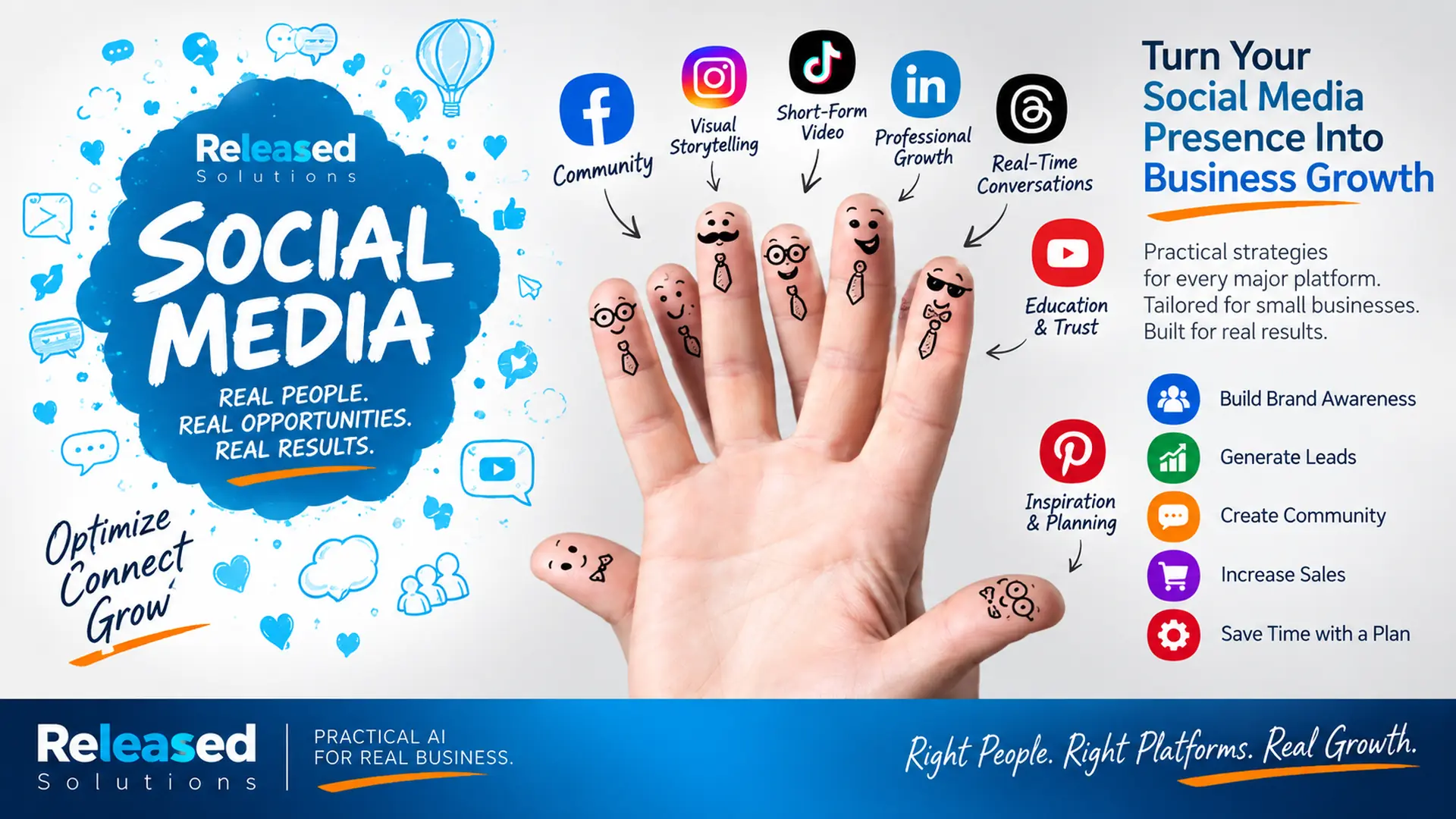

Social Media Optimization in 2026: How Small Businesses Turn Attention Into Business Growth
When I originally wrote about social media optimization, the job was easier to describe. Set up the profiles. Use the right images. Post consistently. Use hashtags. Engage with followers.
Those things still matter, but they are no longer enough.
In 2026, a social profile can be a discovery surface, a reputation check, a customer-service channel, a video library, a search result, a lead source, an advertising destination and a place where an AI-assisted recommendation or platform algorithm introduces someone to your business.
That changes what optimization means.
Social media optimization is not about squeezing more posts out of every platform. It is about making every part of your social presence more useful to the customer and more measurable to the business.
My framework is GOAL → AUDIENCE → PROFILE → CONTENT → CONVERSATION → CONVERSION → MEASURE → IMPROVE.
Start with the Foundation, Not the Posting Calendar
Before deciding what to post, decide what social media is supposed to accomplish. Brand awareness. Local discovery. Website traffic. Appointments. Online sales. Recruiting. B2B credibility. Customer support. Community. Event attendance. Email subscribers. A business trying to generate consultations should optimize differently from a restaurant trying to stay top-of-mind locally.
The posting calendar comes after the business objective. Otherwise the team can become very efficient at producing activity that does not move the business.
Optimization cannot rescue a platform that is wrong for the customer. Our companion guide, which social media platforms should your small business use in 2026, answers where a business should participate. This article answers what to do after those platforms are chosen.
Reach Is Now a Risk Multiplier, Not Just a Benefit
The algorithm will amplify a poorly-judged post as easily as a strong one. Optimization is what keeps reach working for the business.
The Profile Is Part of the Conversion Path
Treat the profile as a landing page, not paperwork. It is the first place many customers evaluate the business.
Discovery Rewards Clarity, Not Keyword Stuffing
Use the words the customer actually uses. Make the topic clear. Let AI-assisted recommendations understand what the content is about.
GOAL, AUDIENCE, PROFILE, CONTENT, CONVERSATION, CONVERSION, MEASURE, IMPROVE
The 2026 Social Media Optimization Framework
Optimization is not one activity. It is a repeating system.
| Stage | What it answers |
|---|---|
| GOAL | What business result is this channel supposed to support? |
| AUDIENCE | Are the right customers actually here, and how do they behave? |
| PROFILE | Can a new visitor understand the business and take a next step? |
| CONTENT | Are we publishing useful ideas in formats that fit the platform? |
| CONVERSATION | Are we replying, listening and learning from the audience? |
| CONVERSION | Is there a logical path from social attention to business action? |
| MEASURE | Are links tagged, are GA4 and CRM outcomes connected where practical? |
| IMPROVE | What did the data and customer response teach us to change? |
Fourteen Optimization Areas That Actually Move the Business
The 14 areas below group into Foundation (1-4), Content and community (5-6), Conversion and measurement (7-9), AI, accessibility and security (10-12) and Ownership and improvement (13-14).
OPTIMIZE THE PROFILE FOR DISCOVERY AND TRUST
Every profile should quickly answer basic customer questions: WHO | WHAT | WHO YOU HELP | WHERE | CONTACT | NEXT STEP. Keep the business name, description, visual identity and contact information consistent so the customer recognizes the same business across channels. Use the bio in customer language. Use available links intentionally. On Threads, Meta supports multiple profile links and link-performance insights. LinkedIn Pages support company information, publishing and analytics. YouTube provides channel-level audience and content analytics. The profile is part of the conversion path, not paperwork.
OPTIMIZE FOR EACH PLATFORM'S NATIVE BEHAVIOR
One piece of content should not be pasted everywhere without adaptation. TikTok = native short video with a strong hook, sound, captions and a hook / body / close structure. LinkedIn = expertise, thought leadership and business conversation. Threads = conversation, replies, topics and original observations. YouTube = durable video and search, with no minimum posting cadence required for Shorts. Pinterest = visual discovery and planning. Meta (Facebook and Instagram) = Reels, community and messaging. The idea can be repurposed. The execution has to respect the platform.
BUILD CONTENT PILLARS INSTEAD OF ARBITRARY POSTING QUOTAS
A useful social strategy usually has a few repeatable content pillars. For Released Solutions those might include practical digital marketing education, AI and automation, website and technical insights, paid-media observations, analytics and measurement, small-business strategy and real work from the field. Another business will have different pillars. The purpose is a system that reflects what the business genuinely knows, not a rigid quota. Related reading: social media content saturation.
TREAT SOCIAL SEARCH AND DISCOVERY AS PART OF OPTIMIZATION
People increasingly discover content through recommendations, platform search, topics, hashtags, captions, video titles, profile descriptions and the language used inside the content itself. That does not mean stuffing every post with keywords. Use the words customers actually use. Make the topic clear. Write descriptive titles and captions. On YouTube, search considers how well metadata matches the viewer's search along with how people watch and continue watching. On Threads, Meta has reported that topics can help posts receive more views. See also how people find your content.
SHORT VIDEO NEEDS A JOB
Short video is now part of Facebook, Instagram, TikTok and YouTube, but that does not make every short video strategically useful. Give the video a job: TEACH | DEMONSTRATE | ANSWER | COMPARE | SHOW PROCESS | CORRECT | TELL STORY | SHOW PROOF. TikTok recommends hooking the audience quickly and building creative that feels native to the platform. Meta promotes vertical Reels built for mobile. YouTube evaluates Shorts based on viewer response and personalization rather than requiring a specific content type. Do not make a Reel because the calendar says Tuesday. Make it because video is the right format for the idea. Related: can your business count on the social media views?
OPTIMIZE THE CONVERSATION, NOT JUST THE POST
Social media is not finished when the content is published. Comments matter. Replies matter. Direct messages matter. Questions matter. Customer complaints matter. Threads has emphasized conversation and reply behavior as part of discovery. LinkedIn encourages Pages to respond and build community around professional content. TikTok recommends engaging with comments to sustain momentum. A business that posts every day but ignores customers is not optimized. The conversation is part of the content.
CREATE A CLEAR PATH FROM SOCIAL ATTENTION TO BUSINESS ACTION
A social post can perform well and still fail the business. What should the interested person do next? Visit a service page? Read an article? Book an appointment? Call? Send a message? Join an email list? Buy? Register? Download something? The next step should match the content and the customer's level of intent. Do not send every person to the home page. Do not force every post into a hard sales pitch either. Build logical pathways. Social media creates attention. Optimization turns that attention into movement.
USE UTM TRACKING, GA4 AND CRM OUTCOMES
I do not want social media reporting to stop at likes and views. Use tagged links so traffic can be understood in GA4. Google Analytics supports manual campaign tagging and its Traffic acquisition report gives a cross-channel view. Then keep following the customer journey. Did the visitor engage? Did they complete a key event? Did they submit a form? Did the lead enter the CRM? Did the lead become a customer? Social analytics say what happened on the platform. GA4 explains what happened on the website. The CRM connects marketing activity to the business outcome. That is a much stronger measurement chain than celebrating 10,000 views.
USE ORGANIC CONTENT AND PAID AMPLIFICATION FOR DIFFERENT JOBS
Organic social can build proof, familiarity, community, expertise and a library of useful content. Paid social can extend reach, retarget audiences, generate leads and support campaigns. Optimization means understanding when to use each. A strong organic post may become a candidate for paid amplification. Paid campaigns can reveal messages or creative angles worth developing organically. The two systems should learn from each other, but paying to promote weak content does not make the content strategically strong. See also marketing frequency.
USE AI TO ACCELERATE THE WORKFLOW WITHOUT REMOVING THE HUMAN
AI can help turn one useful idea into multiple drafts, hooks, captions, platform variations, summaries, images and analysis. Platforms themselves are adding AI-assisted tools. I use AI as a coworker because it can shorten the distance between an idea and execution. But the business still needs a point of view. Someone still needs to verify facts, decide whether the tone fits, answer the comment and recognize when the AI produced generic content. Use AI to accelerate useful work. Do not use it to manufacture a larger pile of forgettable content. Related: AI image prompts for small business.
MAKE ACCESSIBILITY PART OF THE PUBLISHING CHECKLIST
Useful social content should be understandable by more people. Use captions on video. Keep important text readable on mobile. Use available alt-text features for meaningful images where the platform supports them. Avoid burying the entire message inside an image that cannot be understood without reading tiny text. Think about contrast, pacing and clarity. Accessibility is not separate from optimization. If the audience cannot consume the content, the content is not optimized.
PROTECT THE ACCOUNTS YOU ARE OPTIMIZING
A social account can become a valuable business asset. Treat it that way. Use multi-factor authentication where available. Keep administrative access intentional. Remove former staff and vendors who no longer need access. Use business-management tools rather than sharing one password across a team. Document ownership. Know which email and phone number control account recovery. An optimized account that the business cannot recover or control is not an optimized business asset.
BUILD AN OWNED AUDIENCE ALONGSIDE THE SOCIAL AUDIENCE
Social platforms are rented distribution. The business does not control the algorithm, feature roadmap or reach. Use social media to build relationships, but create pathways to assets you control: WEBSITE | CRM | EMAIL | CUSTOMER DATABASE | CONTENT LIBRARY | FIRST-PARTY ANALYTICS. This does not mean pulling people off social at every opportunity. It means not allowing the entire customer relationship to exist only inside someone else's platform.
MEASURE THE ROLE EACH PLATFORM IS SUPPOSED TO PLAY
Do not use one scoreboard for every platform. A LinkedIn thought-leadership program may support B2B credibility and qualified conversations. TikTok may be generating discovery. Instagram may be providing visual proof. YouTube may be building long-term educational discovery. Facebook may support local community, paid reach and retargeting. Threads may be building conversation and founder voice. Pinterest may influence planning before declared purchase intent. Measure each platform against its job, then connect those platform signals to business outcomes.
AI Changes the Workflow, Not the Judgment
Use AI to accelerate useful work. Do not use it to manufacture a larger pile of forgettable content. Fact-check what it produces, keep a human point of view, and remember that generic AI output could come from any competitor in your category.
From Social Attention to Business Action
The conversion path is where a lot of social strategy quietly breaks. Attention arrives, then nothing meaningful happens next.
| Stage | What has to happen there |
|---|---|
| Social attention | Content earns a click, comment, DM, save, share or profile visit. |
| Relevant next step | A clear, matching next action for the customer's level of intent. |
| Website / message / form | A page, offer, form or DM that continues the conversation. |
| Call / booking / sale | A qualified conversation, a booked appointment or a completed purchase. |
| CRM record | The customer relationship is captured so it can be nurtured over time. |
The Measurement Chain You Actually Want
Social analytics on their own can flatter the team. What matters is the chain from platform to customer.
| Layer | What it answers |
|---|---|
| Platform analytics | Reach, engagement, saves, follows, watch time, conversions on that platform. |
| UTM link | Which post or campaign brought a specific visitor. |
| GA4 | How the visitor engaged on the website: pages, key events, path. |
| Key event | The measurable action that matters (form submit, appointment, purchase). |
| CRM | Whether the lead progressed, became a customer, and stayed a customer. |
| Customer / revenue | The business outcome social attention actually produced. |
Organic vs Paid, Working Together
Optimization decides when a topic deserves organic depth and when it deserves paid reach. The two systems should learn from each other. Related: online marketing strategy.
| Organic | Paid amplification |
|---|---|
| Builds proof, familiarity, community and expertise. | Extends reach beyond your existing audience. |
| Grows a library of useful content over time. | Retargets people who already engaged with the business. |
| Reveals what the audience actually responds to. | Generates leads and supports specific campaigns. |
| Strong organic content is a candidate for paid boost. | Paid data reveals angles worth doing organically. |
| Weak paid content is still weak content. | Paying to promote weak content does not fix the content. |
Own Something Beyond the Social Platforms
Social media is one distribution channel among several. Optimization means using it to build assets the business actually owns.
| Rented distribution (social platforms) | Owned assets (protected by the business) |
|---|---|
| Algorithms and features are outside your control. | Website, CRM and email list are not. |
| Reach can shift with a single policy or product change. | First-party analytics keep working regardless. |
| Great for discovery, conversation and reach. | Better for retention, revenue and long-term relationships. |
| An account can be lost or restricted overnight. | A customer database and content library persist. |
GOAL business result the channel supports. AUDIENCE right customers, real behavior. PROFILE understandable, actionable, consistent. CONTENT ideas that fit each platform. DISCOVERY topics, titles, captions and links that make the topic clear. CONVERSATION replies, listening, learning. CONVERSION a real next step from attention to action. MEASUREMENT tagged links, GA4 and CRM outcomes. SECURITY account control and recovery. IMPROVEMENT what the data and customers just taught you.
Foundation
Business goal, right audience, useful profile and platform-native content.
Community and Conversion
Real conversation, then a real next step from social attention to business action.
Measurement and AI
UTM, GA4 and CRM outcomes, plus AI used to accelerate, never to replace human judgment.
Ownership and Improvement
Own the customer relationship beyond the platform, then improve the whole system based on what the data and customers say.
The Takeaway
Social media optimization used to sound like a checklist of profile settings, posting times and hashtags. Today it is much closer to an operating system.
Choose the right platforms. Make the profiles understandable. Create content that fits the platform. Make the content discoverable. Participate in the conversation. Give interested customers a useful next step. Measure what happens after the click. Use AI to move faster without giving away the business's voice. Protect the accounts. Build owned customer relationships. Then improve the system based on what the data and customers are telling you.
The goal is not more social media. The goal is a better connection between social media and the business.
Want Social Media to Do More Than Generate Activity?
Released Solutions helps small businesses connect social media, content, advertising, websites, analytics, CRM and AI so social attention can become measurable business movement.
Want Social Media to Do More Than Generate Activity?
Released Solutions helps small businesses connect social media, content, advertising, websites, analytics, CRM and AI so social attention becomes measurable business movement.
Choose the platforms first. Then optimize them. Then measure what happens after the click.
Kenneth Durrum, Released Solutions