
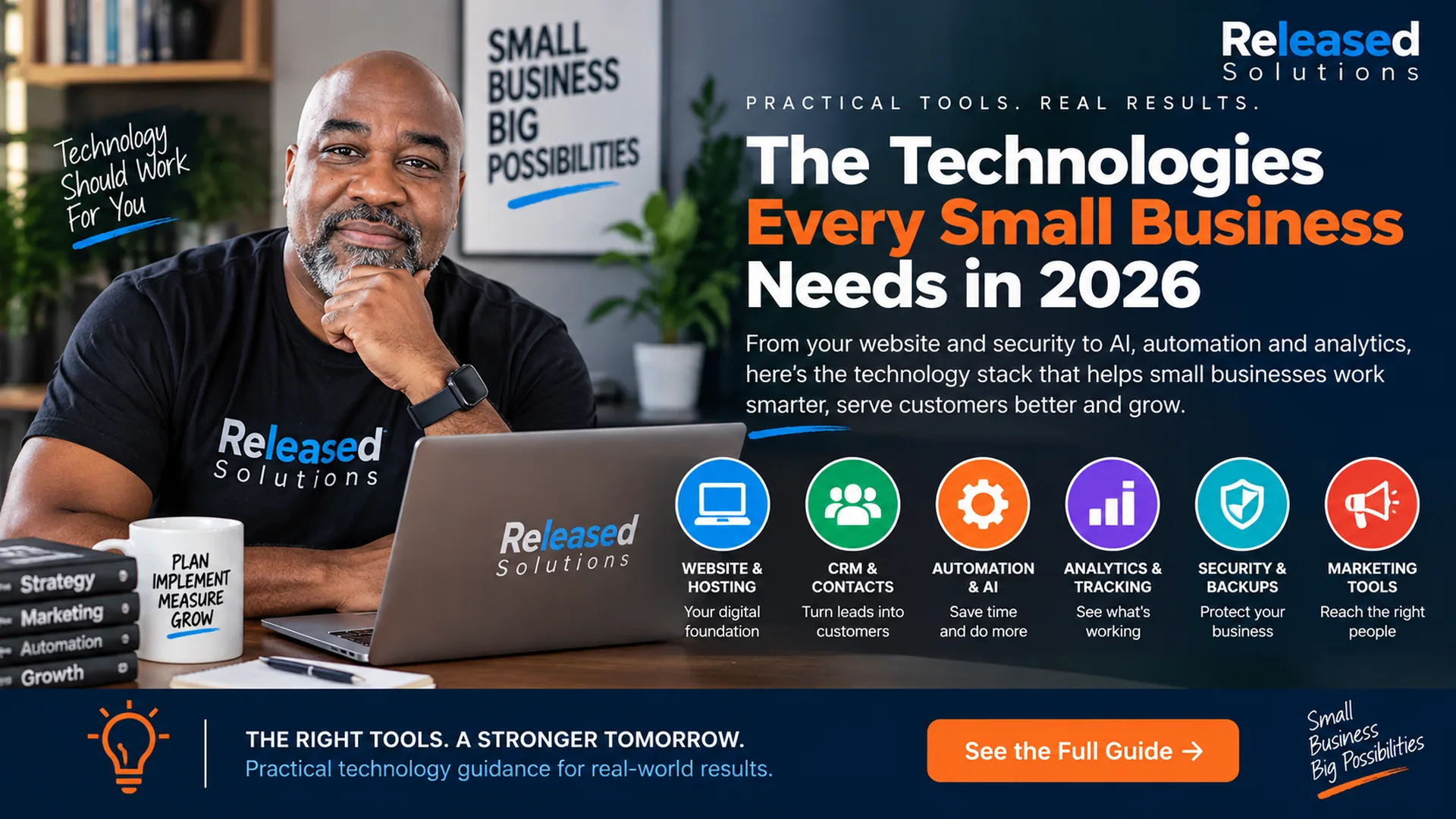

The Technologies Every Small Business Needs in 2026
Small-business technology has changed dramatically since I first published this article.
The original version recommended web development, dropshipping, cloud technology, and cybersecurity. None of those ideas were completely wrong, but the list no longer reflects how a modern small business actually operates.
Today, technology touches almost every part of the company: how customers discover you, how leads are managed, how employees communicate, how work moves from one person to another, how money is collected, how performance is measured, how data is protected, and, increasingly, how artificial intelligence helps people get more done.
The goal is not to collect software subscriptions. The goal is to build a connected set of tools that helps the business communicate, sell, deliver, measure, protect, and improve.
Start With the Business, Not the Software
A technology decision should begin with a business problem.
What takes too long? Where are leads being lost? What information lives in one employee's head? What gets entered twice? What breaks when someone is out of the office? What do customers repeatedly ask for? What cannot be measured? What would create a serious problem if the company lost access to it tomorrow?
Those questions reveal the technology you actually need. A five-person professional-services company and a 50-person manufacturer may both need a CRM, but their workflows, integrations, permissions, and reporting requirements can be completely different.
The 8 Technology Layers I Would Build Around a Small Business Today
Communication and Collaboration
Business email, calendars, shared files, meetings, chat, and collaboration tools form the daily operating layer. Use company-controlled accounts, clear ownership, appropriate permissions, and a reliable way to preserve business information when employees or vendors change.
A Website and Digital Presence You Control
Your website is still a foundational business asset, but the job is larger than having a few pages online. It should be mobile-friendly, secure, maintainable, measurable, easy to update, and connected to the actions customers need to take.
Your broader online presence also includes search listings, reviews, social profiles, and the information AI systems may encounter about the business.
CRM and Customer Management
Leads should not disappear into individual inboxes, spreadsheets, and text messages. A CRM can centralize contacts, opportunities, notes, follow-up, ownership, and pipeline visibility.
The best CRM is not necessarily the one with the longest feature list. It is the one your team will actually use and that matches the sales process.
Marketing and Customer Communication
Email, SMS where appropriate, social publishing, advertising, forms, landing pages, and reputation tools should connect to a coherent customer journey.
Technology should make it easier to reach the right people, follow up consistently, and understand which activities are producing useful business outcomes.
Operations, Automation, and Workflow
Project management, task systems, scheduling, invoicing, document workflows, and automation can remove repetitive work. Tools such as Zapier, Make, n8n, and platform-native automations can connect systems, but automation should follow a stable process.
Automating a broken process simply makes the problem move faster.
Analytics and Measurement
A business should know what success looks like and whether its technology is producing it. GA4 can measure important actions as key events, while advertising platforms, CRM data, call tracking, ecommerce systems, and financial reporting can add the rest of the picture.
Dashboards are useful only when they lead to decisions.
AI as a Working Layer
AI belongs in the modern stack, but I would not treat it as a separate magic department. It can help with research, drafting, summarization, analysis, coding, customer-service support, workflow assistance, and marketing automation.
The SBA Office of Advocacy reported in 2025 that small firms were closing the AI adoption gap and that marketing automation was an area where small businesses using AI were especially active. If you are new to it, how to learn AI for your small business is a good starting point. The opportunity is real, but businesses still need human review, data rules, and clear accountability.
Cybersecurity, Backups, and Access Control
Security is not an optional technology category. It is part of business continuity.
Use multi-factor authentication, strong account and permission management, timely updates, reliable backups, and a plan for what happens when an account, device, or vendor is compromised. NIST now publishes a Cybersecurity Framework 2.0 Quick-Start Guide specifically for small and medium businesses with modest or no cybersecurity program.
Online Presence Readiness Assessment
Is your business ready to market online?
Answer 20 quick questions while we scan your website for tracking, ad pixels, structured data, search basics, speed and contact paths. Get a scored readiness report, free.
Own the Accounts
Domain, hosting, analytics, advertising, social, CRM, payments, cloud storage: the business, not a former employee or agency, should hold the admin account. If it is not in a business-controlled email, it is not owned.
Integrate the Systems
A website form that creates a CRM contact, assigns an owner, and starts follow-up is more valuable than five disconnected tools with impressive feature lists. Before buying another platform, check whether an existing one already does the job.
Measure the Outcomes
Judge software by whether it reduces time, improves response speed, increases qualified leads, shortens a process, improves retention, reduces errors, or generates revenue. Define the outcome, implement, measure what changed.
Cloud Technology Is No Longer a Category. It Is the Environment.
The original article described cloud technology as a trend. That framing has aged. For many small businesses, email, documents, CRM, accounting, project management, analytics, websites, and customer systems are already delivered as cloud services.
The more useful question now is whether those cloud systems are governed well: Who owns the account? Who has administrator access? Is MFA enabled? Can data be exported? Are backups adequate? What happens if a vendor changes pricing or the relationship ends?
Convenience does not remove the need for ownership and continuity planning.
Cybersecurity Has to Move Higher on the List
The old article treated cybersecurity as a section near the end. I would move it into every technology decision.
CISA guidance for small and mid-sized businesses emphasizes foundational controls including multi-factor authentication, password and permission management, and reliable backups. NIST's small-business guidance similarly treats cybersecurity as an ongoing risk-management responsibility rather than a one-time software purchase.
Security also includes people and process. Know which systems the company uses, who can access them, what data they contain, how access is removed, how backups are verified, and who is responsible when something goes wrong.
Good technology should reduce friction. If the team needs three consultants and a 70-page manual to perform a routine task, the system may be too complex for the business at its current stage.
AI Changes the Stack, but It Does Not Replace the Stack
AI can sit across many of these systems. It can help draft an email in the communication layer, summarize CRM notes, create a first version of content, analyze a spreadsheet, assist with code, classify information, or trigger an automated workflow. The way I use AI to build websites is one specific example.
But AI still needs access to reliable information and a well-designed process. If customer data is scattered, analytics are broken, and nobody agrees on the sales process, adding AI will not magically create operational discipline.
I think of AI as a coworker assistant: extremely useful when it has a clear assignment, useful context, appropriate access, and someone responsible for the result.
MFA Everywhere
Multi-factor authentication on every business account. Email, admin, cloud, CRM, banking, hosting. It is the single highest-leverage control CISA lists.
Reliable Backups
Backups that are actually verified to restore. For key systems, keep a copy that ransomware or a compromised admin cannot reach.
Access Control
Least-privilege accounts, role separation, offboarding checklist. When someone leaves, access should be gone that day, not eventually.
Vendor Continuity
Know who owns each cloud account, how to export data, and what happens if a vendor raises price, closes, or is acquired. Continuity is a business decision.
A Practical Order for Building the Stack
If I were helping a small business starting from a patchwork of disconnected tools, I would not replace everything at once.
First secure the critical accounts and data. Then establish reliable communication and file ownership. Fix the website and digital presence. Centralize customers. Define the sales and service workflows. Add measurement. Automate repetitive steps. Add AI where it genuinely improves the work. Integrate the systems as the process becomes clearer.
That sequence will vary by company, but the principle matters: build from business continuity and customer value outward.
Own the Accounts, Data, and Credentials
Small businesses often lose control of technology because a former employee, freelancer, or agency created an important account under their own email address.
The business should know who owns the domain, hosting, analytics, advertising accounts, social profiles, CRM, payment systems, cloud storage, and other critical platforms. Use business-controlled administrator accounts, maintain a credential and access process, document vendors and integrations, and remove access when relationships change.
This is not glamorous technology work. It is some of the most important.
What I Would Remove From the Original Article
I would remove dropshipping entirely. It is a business model, not a technology every small business needs.
I would remove the recommendation to hire a PHP developer as though that were the central website decision. Modern website development can involve WordPress, hosted platforms, ecommerce systems, APIs, JavaScript frameworks, low-code tools, and many other approaches. The right choice depends on the business.
I would remove broad compliance statements that make it sound as though installing SSL makes a business compliant. Security and regulatory obligations depend on the data, industry, location, payment environment, and applicable laws.
I would keep cloud technology, but reposition it as part of the operating environment rather than an emerging trend. And I would greatly expand cybersecurity, customer systems, automation, analytics, and AI.
The Takeaway: Build a Technology System, Not a Software Collection
The technologies every small business needs are not defined by a list of brand names. They are defined by capabilities.
You need to communicate. Be found. Manage customers. Market. Operate. Measure. Automate. Protect the business. And increasingly, use AI intelligently across those functions.
The right tools will change as the business grows. The objective stays the same: technology should make the business easier to run and better able to serve its customers.
Build a Technology Stack Around the Way Your Business Actually Works
Released Solutions helps small businesses connect websites, online presence, CRM, analytics, automation, AI-assisted workflows, marketing, and technology strategy around measurable business goals.
If your tools have grown into a disconnected collection of subscriptions, accounts, and manual processes, we can help identify what should stay, what should connect, and what should change.
The right technology is the technology your business actually uses.
Kenneth Durrum, Released Solutions