
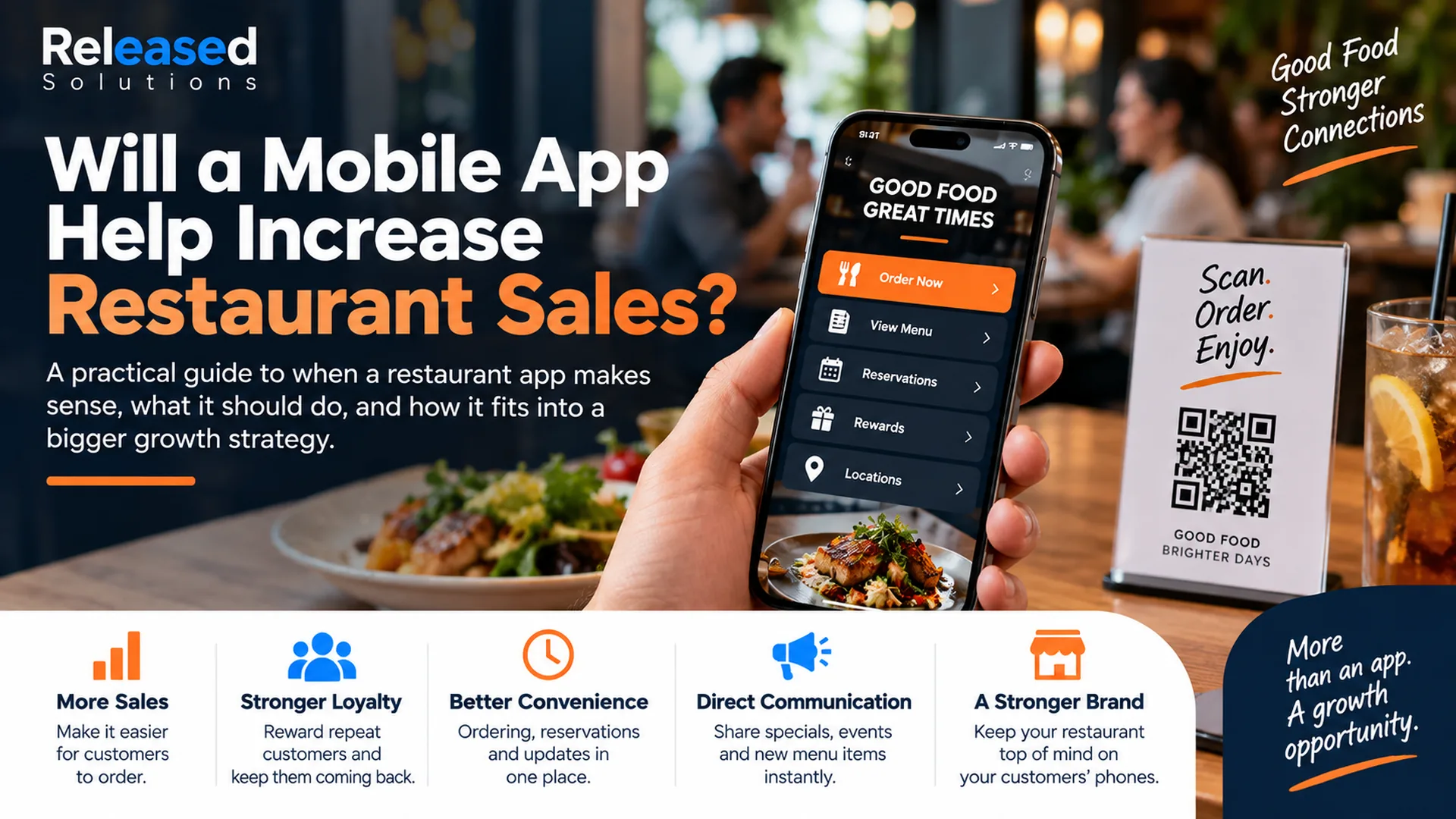

Will a Mobile App Help Increase Restaurant Sales?
When I first wrote this article, the question was whether a restaurant could increase sales by giving customers an app with deals, loyalty rewards, one-tap ordering, notifications, a location finder, and even a small store.
Those features still sound familiar. What has changed is the decision restaurants should make before building them.
In 2026, the question is not simply, "Can we build an app?" It is, "Will customers have a reason to install it, keep it, and use it often enough to justify the investment?"
That is a much better place to start.
Yes, a restaurant app can help increase sales, frequency and loyalty when it removes friction or gives repeat customers meaningful utility. But an app is not automatically the best digital investment for every restaurant.
Mobile Ordering Is No Longer a Novelty
The restaurant customer is already mobile. The National Restaurant Association's 2025 off-premises research found that 57% of adults had recently used mobile ordering, including 74% of millennials and 65% of Gen Z adults.
The same research identifies intuitive ordering and payment technology, value offers, loyalty programs, speedy service, and good customer service as core expectations for repeat off-premises business.
So the opportunity is real. The mistake is assuming that opportunity automatically requires a custom native app.
First Ask: What Problem Will the App Solve?
This is the strongest idea from my original article, and I would keep it exactly at the center of the strategy.
If customers can already order quickly from a fast mobile website, earn loyalty points, save payment details, receive email or SMS offers, find locations, make reservations, and reorder favorites, another icon on their phone may not create much additional value.
An app becomes compelling when it makes frequent interactions meaningfully easier.
Five Jobs a Restaurant App Should Be Good At
Make Ordering Faster
Save favorites, remember preferences, support easy reordering, make payment simple, show order status, and reduce unnecessary steps.
Make Loyalty Useful
Let customers earn, see, and redeem rewards without confusion. The National Restaurant Association reports loyalty is an important driver of restaurant choice, especially for off-premises customers.
Create a Direct Customer Relationship
An owned app can give the restaurant a direct digital relationship with customers rather than making every interaction dependent on a third-party marketplace. That relationship becomes more valuable when ordering, loyalty, POS, and customer data work together.
Give Customers a Reason to Come Back
Useful offers, personalized rewards, saved favorites, limited-time menu items, and well-timed notifications can support repeat visits. Notifications should provide value, not become a reason to disable them.
Connect the Digital and Physical Experience
Locations, pickup instructions, reservations, pay-at-table features, order tracking, loyalty redemption, and other conveniences can make the app part of the restaurant experience instead of a separate marketing toy.
Customer Utility
How often will a real customer use this? Does it beat what your mobile website already does? Every step you skip is a reason to keep the app installed.
Business Integration
Does it connect to POS, ordering, loyalty, payments, reservations, and your customer data? A disconnected app becomes another silo, not a system.
Economics and Ownership
Transaction fees, monthly platform costs, maintenance, app-store fees, and who owns the customer data and history if you leave the vendor. Do the math before the build.
When to Build an App, and When Not to
Customers order frequently, loyalty is important, the restaurant has multiple locations, digital ordering already represents meaningful volume, repeat ordering can be simplified, or the restaurant has enough customer activity to benefit from personalization.
It can also make sense when reducing dependence on third-party marketplaces is strategically important and the restaurant can successfully move loyal customers toward its own ordering channel.
An independent restaurant with infrequent repeat ordering, weak online ordering, a poor mobile website, no loyalty strategy, and limited customer data may have more important work to do first.
A fast mobile-first website, strong Google Business Profile, accurate menu, frictionless direct ordering, reservations where appropriate, email or SMS retention, analytics, and a well-designed loyalty program (all part of good online presence management) may produce more value before a native app enters the roadmap.
The customer should not have to install software just to accomplish something your website should already make easy.
Apple's current App Review Guidelines say an app should provide features, content, and UI that elevate it beyond a repackaged website. Apps that are not particularly useful, unique, or app-like may not be accepted.
Google Play likewise requires meaningful functionality and an engaging, stable user experience.
That is good strategic advice even before app-store review: do not build an app that is simply your website wearing an app icon.
Restaurant Marketing Checkup
What's really keeping tables empty?
Answer 15 quick questions to find the three marketing problems costing you the most guests, and see how your Google reviews compare with local competitors.
What About White-Label Restaurant Apps?
White-label platforms can reduce development cost and time, and they can be a practical option when they integrate well with the restaurant's POS, ordering, loyalty, and customer systems.
But "white label" should not mean generic. Apple specifically addresses apps produced from commercial templates (Guideline 4.2.6) and requires the provider and content owner to follow its submission rules. The final product still needs meaningful customer utility.
Evaluate the platform around ownership of customer data, integrations, transaction fees, payment processing, loyalty flexibility, analytics, accessibility, support, app-store maintenance, and what happens if you later leave the vendor.
Data Ownership
Who owns customer profiles, order history, and loyalty data if you switch platforms?
POS Integration
Does the app talk to your point of sale, kitchen display, and payment processor in real time?
Total Cost
Setup, monthly platform fee, transaction fees, app-store cut, and ongoing maintenance. Not just year one.
Exit Terms
How you export data, transfer domains and app-store listings, and keep serving customers if the vendor changes.
The Real Value May Be the Data and Relationship Behind the App
A useful restaurant app is not just an ordering screen.
When loyalty, POS, ordering, reservations, and customer information are connected, the restaurant can better understand visit frequency, favorite items, purchasing patterns, and how customers respond to offers.
The National Restaurant Association has described technology-powered loyalty as a marketing engine when those systems connect and the restaurant can act on the resulting customer information. That is much more strategically valuable than simply counting downloads.
Do Not Measure Success by Downloads
Downloads are an adoption metric, not a business outcome. Measure:
- Active users, repeat orders, order frequency, average order value
- Loyalty enrollment and redemption rates
- Direct-order share versus third-party marketplace share
- Retention, customer acquisition, offer performance, revenue
- Abandonment and uninstalls (if customers download for a coupon and never return, the app has not yet become a useful part of the relationship)
A Better Decision Framework
Before approving an app project, answer these questions honestly:
✓ What customer problem does the app solve better than our website?
✓ How often will customers realistically use it?
✓ Which features create repeat utility, not just first-visit novelty?
✓ Does it integrate with ordering, POS, loyalty, and payments?
✓ How will we persuade customers to install it, and what will make them keep it?
✓ What data will we own, and what stays with the vendor?
✓ What ongoing maintenance, app-store review, and platform updates will it require?
✓ What single business metric should improve if this app succeeds?
If the answers are weak, do not build the app yet. If the answers are strong, you are no longer building an app because restaurants are supposed to have one. You are building a customer experience with a measurable business purpose.
What I Would Change From My Original Advice
I would keep exclusive value, loyalty, easy ordering, and location tools on the list of useful features.
I would remove the idea that proximity beacons and in-store push notifications are must-haves. They are possible tactics, not universal requirements. I would not assume a restaurant needs an in-app merchandise store unless retail products are actually part of the business model.
Most importantly, I would change the old conclusion that an app can "definitely" boost revenue. An app can contribute to revenue. Whether it does depends on adoption, usefulness, economics, integration, customer behavior, and execution.
The Takeaway: Build the Customer Experience Before You Build the App
Restaurants absolutely have an opportunity to use mobile technology to make ordering easier, strengthen loyalty, and build more direct customer relationships.
But the winning strategy is not "we need an app." It is: make it easier for customers to order, return, earn value, and stay connected.
Sometimes a native app is the right tool for that job. Sometimes a better mobile website, direct ordering system, and loyalty platform should come first.
Thinking About a Better Digital Experience for Your Restaurant?
Released Solutions helps businesses connect websites, mobile experiences, online ordering, analytics, automation, paid media, and customer-retention strategy around measurable goals.
Before investing in an app, we can help you evaluate what customers actually need and where the technology can create real business value.
An app worth installing is one people keep using.
Kenneth Durrum, Released Solutions