

Restaurant Online Ordering and Delivery in 2026: How to Choose Your Ordering Platform, Delivery Model, and Off-Premise Strategy
Originally published as two separate articles in 2024: one on choosing a restaurant online ordering system, one on picking the right food delivery solution. Consolidated and rewritten September 2026 as one hub around the actual question small restaurants are trying to answer: how do we sell food off-premise without giving up margin, brand, or customer relationships in the process?
Restaurants ask me two questions, usually at the same time. Which online ordering system should we use? and Which food delivery app should we sign up for? Those sound like the same question. In 2026, they are not.
Online ordering is your digital storefront: the technology and customer experience for taking orders directly. Food delivery is your fulfillment and discovery strategy: how off-premise customers find you, order, and receive their food. Some vendors offer both, some offer one, and the platform economics look very different depending on which job you are asking each one to perform.
This guide covers both decisions in the order I would make them: separate the jobs first, then choose the ordering system, then choose the delivery mix, then score everything against how your restaurant actually operates.
Separate the Jobs: Discovery, Ordering, Delivery, Relationship
The single most useful move a restaurant can make in 2026 is to stop treating "online ordering" and "delivery" as one decision. There are actually four distinct jobs, and different tools handle them well.
| Job | What it means | Typical solution |
|---|---|---|
| Discovery | Help new customers find the restaurant when they are deciding what to eat | Marketplace apps (DoorDash, Uber Eats), Google, local SEO |
| Ordering | Let a customer browse the menu and place an order | Marketplace or direct online ordering |
| Delivery fulfillment | Move the order from the restaurant to the customer | Marketplace courier, on-demand courier, or restaurant staff |
| Customer relationship | Build repeat business through your own brand, data, loyalty and marketing | Direct ordering, CRM, email/SMS and loyalty tools |
One company can sometimes provide several of these functions, but restaurant owners should evaluate them separately. A marketplace order can be expensive compared with a direct order, but it may also introduce a customer who would not otherwise have found you. A direct order can protect margin and customer relationships, but the restaurant has to create the demand that brings people to that ordering page.
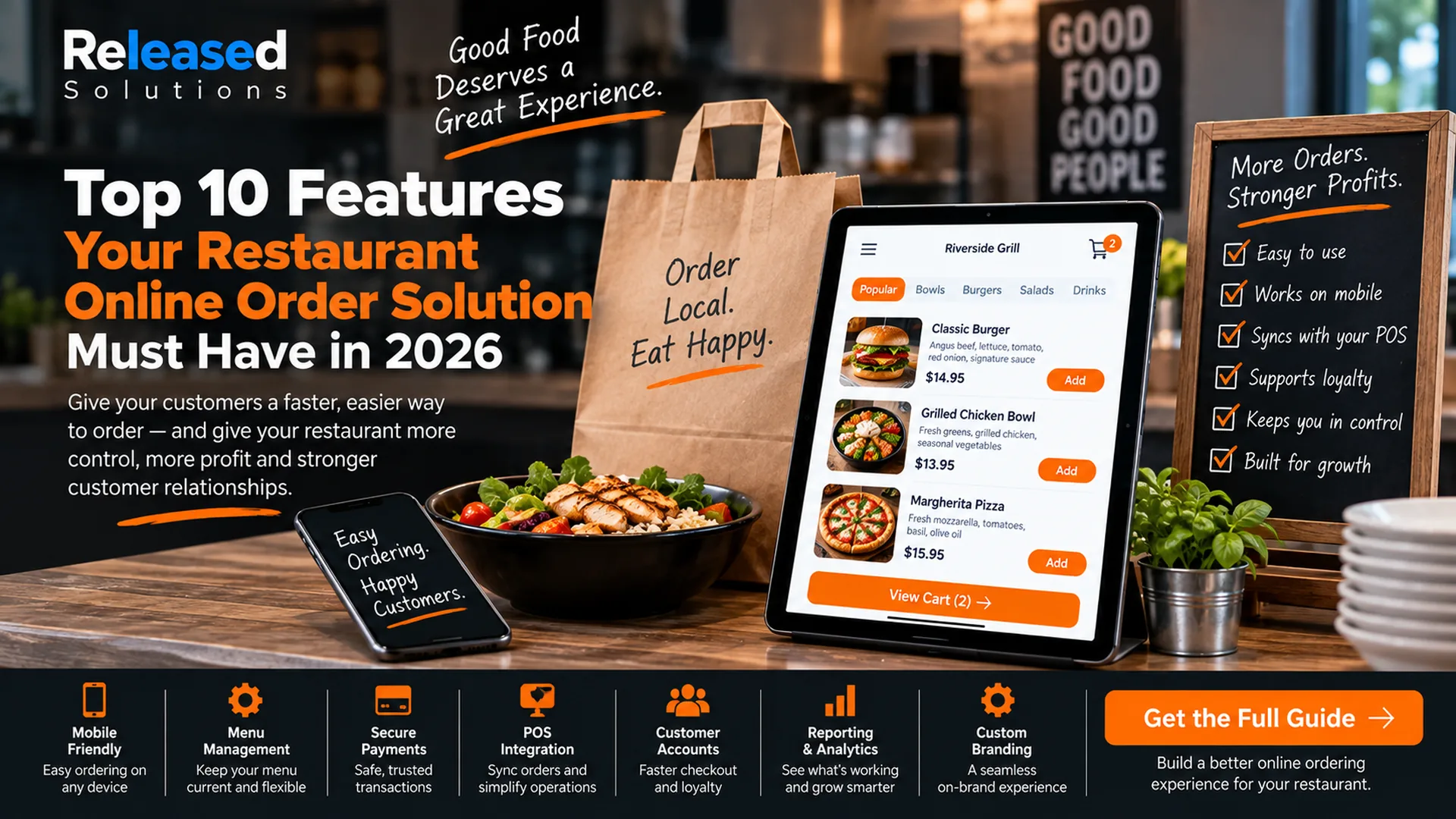
Part 1: Choose an Online Ordering Platform: The 10 Must-Have Features
A good ordering system in 2026 is not simply a digital menu with a checkout button. It connects the restaurant's website, point of sale, kitchen, delivery workflow, loyalty program, customer data, marketing, Google discovery, and reporting. Choose it as a technology and customer-experience decision, not just a website feature to bolt on later.
1. Mobile-first UX
Customers should be able to move from menu to payment quickly on a phone without pinching, zooming, or hunting for buttons. Look for: responsive/mobile-first design, fast load, clear categories, readable modifiers, Apple/Google Pay wallets, low-friction guest checkout.
2. Real-time menu and availability management
The online menu should reflect what the kitchen can actually sell. Out-of-stock items, time-based menus, location differences, and modifiers should not require a separate manual cleanup process. Look for: central menu control, item availability/86-ing, scheduled menus, location-specific pricing, modifier rules, bulk updates.
3. Direct POS and kitchen integration
Online orders should flow into the same operational system as in-store orders. Manual re-entry adds labor and creates opportunities for delayed, duplicated, or incorrect tickets. Look for: POS integration, kitchen display/printer routing, synchronized taxes and tips, order status, no tablet re-keying, aggregation of third-party delivery orders where needed.
4. Flexible fulfillment controls
Pickup and delivery are not one workflow. Restaurants need to control lead times, capacity, service areas, and fulfillment options so online demand does not overwhelm the kitchen. Look for: pickup, curbside, and delivery; quote/lead times; throttling or pausing; delivery zones/radius; scheduled orders; catering rules; location selection.
5. Secure, flexible payments
The checkout needs trusted payment processing and payment options customers expect. Look for: PCI-aware provider, card processing, digital wallets, tips, gift cards, refunds, taxes and fees, fraud controls, clear reconciliation.
6. Customer accounts, loyalty, and easy reordering
A direct ordering system becomes more valuable when it helps turn a transaction into a repeat customer relationship. Look for: saved favorites/order history, fast reorder, loyalty earning/redemption, gift cards, customer profiles, consent-aware email/SMS enrollment, cross-channel loyalty where possible.
7. Offers, upsells, and merchandising
The ordering interface should help the restaurant sell, not merely list menu items. Look for: featured items, add-ons, modifiers, bundles, BOGO/promotions, minimum order rules, time-based offers, smart upsell prompts, catering add-ons.
8. Analytics, attribution, and customer insights
The restaurant needs to know what is selling, which channels create orders, and whether customers return. Gross online sales alone are not enough. Look for: orders and revenue, AOV, item mix, new vs. repeat, promo performance, source/UTM or pixel support, location reporting, customer cohorts, exports/API.
9. Brand control, accessibility, and discoverability
Direct ordering should feel like the restaurant, work for customers with different needs, and be discoverable from the places people search. Look for: custom domain or embedded ordering, logo/colors/fonts, accessible experience, search-friendly menus, Google ordering/discovery integration, consistent hours and location data.
10. Reliability, scalability, integrations, and support
Online ordering is revenue infrastructure. It must survive a dinner rush, support growth, and connect with the rest of the restaurant technology stack. Look for: uptime/reliability, multi-location support, permissions, APIs/integrations, third-party delivery aggregation, implementation help, support hours, data portability, clear ownership of domains and accounts.
Restaurant Marketing Checkup
What's really keeping tables empty?
Answer 15 quick questions to find the three marketing problems costing you the most guests, and see how your Google reviews compare with local competitors.
Part 2: The Four Restaurant Delivery Models
Once the ordering system is settled, delivery is the next question, but delivery is really four different strategic choices. Every off-premise strategy in 2026 is one of these, or a combination.
Third-party marketplace (DoorDash, Uber Eats, Grubhub)
The restaurant appears inside a consumer marketplace. The platform provides discovery, ordering, payment processing, customer support, and courier logistics. The restaurant pays a percentage of marketplace orders. Marketplace commissions in 2026 typically range 15% to 30% depending on the tier, plus separate pickup and self-delivery fees.
Direct online ordering + third-party courier
Customers order through the restaurant's own website or ordering page. A courier network (Uber Direct, DoorDash Drive On-Demand, Relay, etc.) handles delivery. This reduces marketplace commission dependence while keeping the customer journey inside the restaurant's brand.
Direct online ordering + in-house delivery
The restaurant owns the ordering experience and uses employees or dedicated drivers for fulfillment. This provides the most operational control but creates staffing, routing, insurance, and management responsibilities.
Hybrid strategy
The restaurant uses marketplaces for reach and discovery while encouraging repeat customers to use its direct ordering channels where permitted. Delivery may be handled by marketplace couriers, on-demand courier networks, or in-house staff depending on the order source. For many independent restaurants, this is the most practical answer.
Part 3: The Real Cost Is More Than the Commission Rate
Restaurant owners often compare delivery platforms by asking, "What is the commission?" That is the wrong first question. A better question is What is the contribution of an order after every real cost has been counted?
Delivery order contribution / planning formula:
Order revenue − food cost − packaging − platform/processing fees − delivery subsidy − discounts/promotions − incremental labor = estimated contribution before fixed overhead
This is a planning model, not an accounting standard. The exact cost structure will differ by restaurant. The point is to compare channels with the same math.
A marketplace commission can partly function like a customer acquisition expense because the marketplace is providing access to an existing audience. That does not make every commission automatically worthwhile. It means restaurants should ask: what did it cost to acquire this customer, what did the first order contribute, and did the customer become valuable over time?
For direct ordering, the commission may be lower, but the restaurant may need to pay for Google Ads, Meta ads, SEO, email, SMS, loyalty programs, or other marketing to generate the order. There is no free customer acquisition channel. Marketplace fees are visible; the marketing cost required to generate direct orders can be less obvious. Compare total economics, not one line item.
Part 4: Protect the Customer Relationship
Whichever ordering system and delivery mix you choose, the restaurant needs a plan for turning first-time awareness into repeat business. That does not mean violating a marketplace's terms or extracting customer data the restaurant is not entitled to use. It means building a strong direct presence that customers can choose the next time they want to order.
Make the restaurant easy to find directly. Keep the website current. Offer a good direct ordering experience. Use loyalty, email, and SMS with proper consent. Put the restaurant's own brand on the packaging. Give customers reasons to remember the restaurant, not only the delivery app.
A branded mobile app can help here, but it is not mandatory. A mobile-first web ordering experience serves many restaurants without asking customers to install anything. A branded app becomes more compelling when the restaurant has enough repeat behavior to make saved payments, favorites, loyalty, push notifications, and fast reordering genuinely useful. If you are still weighing that decision, see the companion piece on whether your restaurant needs a mobile app.
Part 5: Your Menu Needs a Delivery Strategy Too
Not every dish that sells in the dining room performs well in a delivery bag. Six variables to review before the next delivery-cover shift:
- Travel quality: some menu items simply do not survive 30 minutes in a container. Delivery menus should favor food that arrives well.
- Packaging cost: packaging protects quality but changes unit economics. Include it in contribution calculations.
- Prep time: long or unpredictable prep times hurt customer experience and kitchen flow.
- Menu complexity: a smaller delivery menu may be easier to execute accurately during busy periods.
- Average order value: bundles, family meals, add-ons, and thoughtful upsells improve delivery economics.
- Availability: restaurants may need different delivery hours or the ability to pause channels when the kitchen is overloaded.
Order Like a Customer
Place a mobile order. Add modifiers. Remove an item. Apply a promotion. Choose pickup or delivery. Pay. Request a refund. Where does the system slow you down or confuse you?
Follow the Ticket Into the Kitchen
Mark an item unavailable. Change a price. Pause ordering. Watch the ticket land on the kitchen display or printer. Does the operator have to re-key anything or babysit a tablet?
Then Look at the Reporting
Can you see orders, revenue, AOV, item mix, and channel source? Can you export or connect it to your other systems? Reporting that only lives in a vendor dashboard is a ceiling on the strategy.
A Feature List Is Not Enough: Test the Workflow (Ordering + Delivery)
A vendor can check every box on a feature sheet and still create a poor restaurant workflow. Before committing to any ordering platform or delivery configuration, test the experience as both a customer and an operator.
The best demo question I know: "Show me what happens from the moment a customer taps Order Now until the kitchen completes the ticket, the delivery driver picks it up, and the transaction appears in reporting."
The objective is to find where the system creates extra work, confusion, or loss of control. Walk through the full loop before you sign:
Order like a customer
Place a mobile order. Add modifiers. Remove an item. Apply a promotion. Choose pickup or delivery. Pay. Request a refund. Where does the system slow you down or confuse you?
Follow the ticket into the kitchen
Mark an item unavailable. Change a price. Pause ordering. Watch the ticket land on the kitchen display or printer. Does the operator have to re-key anything or babysit a tablet?
Follow the delivery handoff
If the platform includes fulfillment, watch how a courier claims the order, whether hand-off is clear, what happens on a delayed pickup, and how a customer gets a refund on a missed delivery. If the courier is a separate provider, watch how the two systems talk.
Then look at the reporting
Can you see orders, revenue, AOV, item mix, and channel source? Can you export or connect it to your other systems? Reporting that only lives in a vendor dashboard is a ceiling on the strategy.
Customer Experience
Mobile-first, fast, clear. The order should get through in a minute on a phone, whether the customer chose your site or a marketplace.
Kitchen Operations
POS + kitchen integration, throttling, fulfillment controls, no tablet re-keying, for both direct and third-party orders.
Delivery Economics
Contribution per order after packaging, platform fees, courier cost, promos and labor, not the visible commission alone.
Customer Relationship
Accounts, loyalty, saved payments, email/SMS with consent, and clear ownership of your domain and customer data.
Score the System, Not the Sales Presentation
I recommend scoring each ordering platform and each delivery model against the restaurant's actual requirements instead of choosing based on the longest feature list or the lowest visible commission. A small independent restaurant may prioritize mobile ordering, menu control, POS integration, pickup, loyalty, and simple reporting. A multi-location operation may weight centralized menus, permissions, APIs, delivery aggregation, and location-level analytics more heavily.
The right combination is the one that removes friction from the customer journey while fitting the restaurant's operating model.
Questions to answer before signing up for anything
What problem are we solving? Discovery, ordering, delivery logistics, customer retention, or all four?
What does an average order contribute? Know food, packaging, platform, processing, promotion, and labor costs. Use the formula in Part 3.
Who owns the customer journey? Understand what data and marketing permissions the restaurant actually receives from each platform.
Does it integrate with our operation? Check POS, menu, kitchen, inventory, loyalty, and accounting workflow.
Can our food travel? Define realistic delivery radius, packaging, and menu rules for each fulfillment model.
What happens when volume spikes? Know how to pause, throttle, or adjust delivery without damaging in-store service.
How will we measure success? Set channel KPIs before launch rather than judging any platform by gross sales alone.
What happens if we change providers? Know how domains, customer data, menus, and reporting can be moved.
The Restaurant Ordering + Delivery Scorecard
Review this monthly, and more frequently while testing a new platform, pricing structure, menu, or promotion. The objective is not to find one universal winner. It is to know what each channel contributes to the restaurant.
- Orders by channel: where off-premise demand is coming from
- Average order value: whether order economics differ by channel
- Platform / processing cost %: how much revenue is consumed by channel costs
- Estimated contribution per order: what may remain after variable order costs
- Cancellation / error rate: operational quality and avoidable cost
- Prep time: kitchen performance and delivery readiness
- Repeat direct-order rate: whether customers are building a direct relationship
- New vs. repeat customers: whether the channel is primarily acquisition or retention
- Promo / ad spend: additional cost required to generate marketplace or direct demand
- Customer acquisition cost: total acquisition expense divided by new customers where measurable
Score every ordering vendor and every delivery model the same way.
The Takeaway
The best restaurant online ordering and delivery setup is the one that performs the jobs your restaurant actually needs at economics your business can support. Marketplaces can be valuable discovery engines. Direct ordering can strengthen margins and customer relationships. On-demand courier networks can separate ordering from delivery logistics. In-house delivery can provide control where the volume justifies the operation.
For many restaurants, the strongest answer is a deliberate combination. Reach customers where they already are. Give loyal customers a strong reason to order directly. Measure contribution by channel. Protect food quality and customer experience. Keep the restaurant's brand at the center of the strategy.
Own the strategy. Rent the tools.
Last fact-check: September 2026.