
Should You Use Your Personal Social Media Profile to Market Your Business?
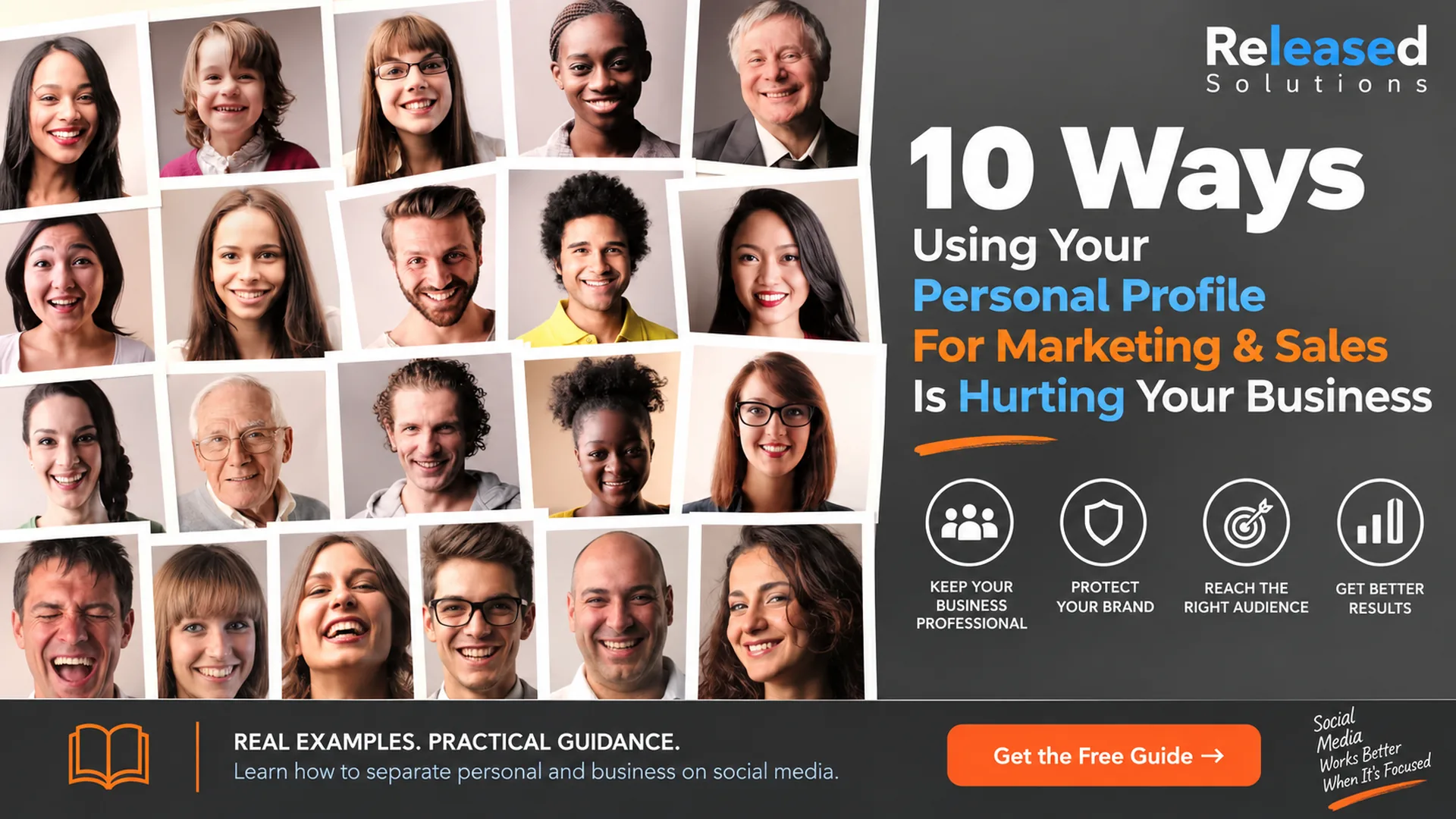
In 2019, I created a guide called "10 Ways Using Your Personal Profile for Marketing & Sales Is Hurting Your Business." The message was aimed primarily at business owners who were trying to make a personal Facebook profile do the job of an actual business presence.
A lot has changed since then.
Facebook now has professional mode for individual profiles. LinkedIn has become an even stronger platform for founder-led expertise. Creators, consultants, and small-business owners routinely build trust through personal accounts. People often want to hear from the person behind the company, not only the logo.
So I would not publish the old argument today as "personal profiles are bad for business."
Use the person to build trust. Use the business presence to build an asset. The strongest strategy often uses both.
Why the Old Advice Needed an Update
The original guide was right to worry about businesses operating entirely through a personal account, but social platforms have blurred the line between personal brand, creator presence, and company marketing.
LinkedIn explicitly distinguishes the two: profiles represent individuals and Pages represent organizations. At the same time, LinkedIn lets professionals offer services through a personal profile, which means personal expertise can legitimately contribute to business development.
Facebook likewise supports professional features for profiles while maintaining Pages with business-specific access, insights, ads, messaging, reviews, and administrative controls.
That makes this less of an either-or decision and more of an ownership, purpose, and measurement decision.
10 Ways Over-Relying on a Personal Profile Can Still Hurt the Business
The Business Identity Becomes Too Dependent on One Person
Customers may know the owner but not remember the company. That can be useful for a solo consultant, but it becomes a weakness when the business needs to grow beyond the founder, add employees, build enterprise value, or eventually change ownership.
The Company Does Not Build Its Own Audience Asset
Followers of a person are not the same thing as followers of a company. If all awareness is concentrated on the owner's account, the business itself may have very little independent reach, recognition, or community.
Access and Continuity Become Riskier
Business Pages are designed for multiple authorized people to manage content, messages, ads, and insights without sharing one person's login. Meta supports Facebook access and task access for Pages. LinkedIn likewise assigns Page admin roles directly to real member profiles and warns against sharing credentials.
Measurement Becomes Harder to Organize
Business Pages and advertising systems provide structured analytics around content, audience, ads, and business actions. Personal-profile activity can still be measured in some contexts, but it may not provide the same clean organizational reporting needed for a repeatable marketing program.
Paid Advertising and Organic Content Get Blurred Together
A founder's post can create awareness and conversation. Paid media has a different job: controlled distribution, targeting, testing, optimization, and conversion measurement. A business needs to know when it is earning attention through a person and when it is intentionally buying distribution.
Personal Content Can Dilute the Business Message
Your audience followed you as a person. They may enjoy family updates, opinions, hobbies, and professional insights. If every personal interaction becomes a sales pitch, the relationship can become exhausting. Business marketing should fit naturally into the reason people follow the account.
Customers May Not Know Where the Official Business Lives
The business should have a clear destination where people can verify the company, understand services, read reviews, find contact information, see locations, visit the website, and take the next step. Facebook Pages and LinkedIn Company Pages are designed to represent organizations in ways personal profiles are not.
Team Members Cannot Easily Participate in the Brand
A business presence lets multiple people contribute while preserving the organization as the common identity. That matters as the company adds salespeople, marketers, customer-service staff, locations, or leadership.
The Business Becomes Harder to Separate From the Owner's Personal Life
Entrepreneurs do not need to hide their personality. In fact, personality can be a major advantage. But the owner should still have the ability to decide what belongs to the person and what belongs to the company.
You Can Mistake Attention for a Marketing System
A post that gets reactions is not automatically generating business. A sustainable system connects social activity to the website, CRM, email, advertising, analytics, reviews, lead capture, sales follow-up, and customer retention. Personal reach can start the conversation, but the company needs infrastructure behind it.
PERSON
Build relationships. Share expertise. Participate as a person. Show leadership and personality. Founders, sales teams, and subject-matter experts belong here.
BUSINESS
Establish the official brand. Centralize business information. Support teams, analytics, advertising, reviews, messages, and organizational continuity. Facebook and LinkedIn Pages, Google Business Profile, and other company-owned accounts.
OWNED CHANNELS
Website, CRM, email list, SMS program where appropriate, customer database, content library, and conversion paths. Social platforms are rented distribution; owned channels are the durable relationship. Connect them to a real online presence management system.
Where Personal Profiles Are Actually Powerful
There is another side to this conversation that I would emphasize much more strongly today. People trust people.
For consultants, agency owners, sales professionals, founders, and subject-matter experts, a personal profile can be one of the strongest places to share experience, explain ideas, participate in conversations, and make the business more approachable.
LinkedIn's current product structure reflects that reality. A profile is a professional identity for an individual, while a Company Page represents the organization. LinkedIn even allows services to be offered through either a profile or a Company Page depending on the setup.
Facebook and LinkedIn Need Different Thinking
Do not apply one rule to every platform.
On Facebook, a Page provides business-specific capabilities such as Page access for teams, messages, ads, insights, events, linked accounts, and reviews. A personal profile can still support professional visibility, especially with professional mode, but it is not a substitute for every Page function.
On LinkedIn, the personal profile is often central to professional networking and thought leadership. The Company Page provides the official organizational identity, analytics, followers, company information, jobs, products or services, and other company-level functions.
The strategy should respect what each account type is designed to represent. For a related take on how you build your audience once you have the right accounts, see Stop Chasing Reach.
Do Not Share Personal Login Credentials With Your Team
This is one part of the original argument that has become even more important.
Do not solve business access by giving employees, agencies, or contractors your personal social-media password. Use the platform's official Page access and admin roles. Meta allows trusted people to receive Facebook access or task access for a Page. LinkedIn states that Page access is assigned through individual member profiles and that Pages do not have separate login credentials.
That gives the company a cleaner way to add and remove people without turning one individual's identity into a shared company account.
Personal Wins
Trust, personality, real-time conversation, founder voice, subject-matter authority.
Business Wins
Team access, insights, ads, reviews, messaging, integrations, continuity across staff changes.
Personal Risks
Owner dependency, no independent audience, credential sharing, blurred lines with personal life.
Owned Wins Always
The website, CRM, and email list survive every platform change. Move relationships toward what you own.
What Should Happen to the Original Guide?
I would keep it.
The 2019 guide is a useful snapshot of how small-business social marketing was being discussed at the time, and it is part of the Released Solutions content history. But I would not present the deck as though every recommendation is still current.
The rebuilt article above is the current guidance. The original deck is now hosted directly on the Released Solutions website (no HubSpot form required) and clearly labeled as the 2019 edition for readers who want to see the earlier thinking.
10 Ways Using Your Personal Profile for Marketing & Sales Is Hurting Your Business
The 2019 edition of this guide, preserved for historical reference. Some Facebook specifics have aged; the article above is the current 2026 recommendation.
What I Would Change From the 2019 Message
I would no longer say that using a personal profile for marketing is inherently hurting the business. I would say that relying on it exclusively can hurt the business.
I would give personal branding and founder-led content a much larger role. I would distinguish Facebook from LinkedIn instead of treating every social network the same. I would put much more emphasis on account ownership, team access, analytics, CRM integration, and owned channels. And I would encourage business owners to build a system in which the person and the company strengthen each other.
The Takeaway: Your Personal Brand and Business Brand Should Work Together
You do not have to choose between being a person and being a business.
Use your personal presence to create trust, demonstrate expertise, and participate in real conversations. Use your business presence to create structure, continuity, discoverability, team access, measurement, and a clear place for customers to engage with the company. Then connect both to digital assets the business actually controls.
Build a Social Presence That Supports the Business, Not Just the Feed
Released Solutions helps small businesses connect social media, websites, online presence, content, advertising, CRM, analytics, and automation around measurable business goals.
If your marketing depends too heavily on one social account or one person's audience, we can help build the structure behind it.
Let the person be personal. Let the business be a business. Connect both to something you own.
Kenneth Durrum, Released Solutions