

5 Reasons Digital Marketing and Advertising Matter More in 2026
When this article was originally written, the argument for internet marketing was fairly simple: customers were spending more time online, so businesses needed to be there too.
That is still true, but it is no longer enough.
In 2026, customers do not move through one predictable online channel. They search Google. They ask AI assistants. They watch videos. They read reviews. They discover businesses on social platforms. They click ads. They visit websites. They compare competitors. They return through branded search. They open email. They interact with chatbots. They may move between several of these before contacting a business.
Digital marketing is no longer a collection of isolated online tactics. It is a connected growth system. The website, search visibility, AI discovery, advertising, social media, content, CRM, automation and analytics should help move the same customer toward the same business objective.
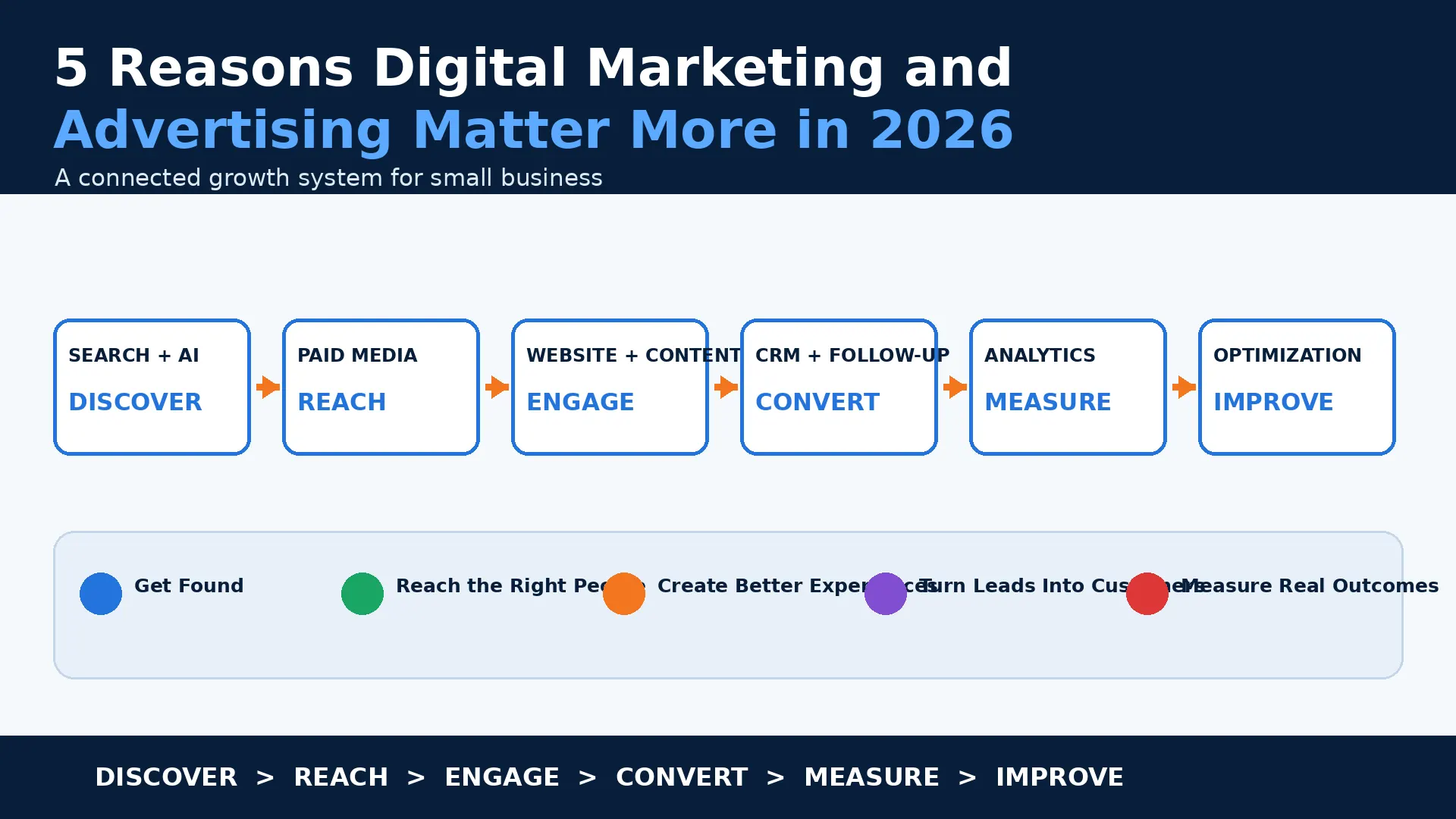
My framework is: DISCOVER → REACH → ENGAGE → CONVERT → MEASURE → IMPROVE.
Marketing determines what happens before and after the click. Spending more money on ads does not fix a weak offer, a broken website or a slow follow-up.
Marketing and Advertising Are Not the Same Thing
Marketing and advertising are used as if they mean the same thing. They do not. Advertising is one part of marketing. Paid search, paid social, display, video and other media can buy attention and accelerate reach. Marketing is the larger system: positioning, audience, offer, website experience, search visibility, content, reputation, email, CRM, follow-up, customer experience, analytics and the decisions that connect all of those pieces. See marketing strategy for business for how strategy sits above the tactics.
| Marketing (the whole system) | Advertising (one tactic inside marketing) |
|---|---|
| Positioning, audience and offer. | Paid placements in search, social, video, display and other media. |
| Website experience and content. | Bought attention that can accelerate reach and capture intent. |
| SEO, AEO/GEO and AI discovery. | Controlled targeting: geography, audience, message, budget, action. |
| Reputation, reviews and trust. | Retargeting to reconnect with people who already showed interest. |
| Email, CRM and automation. | Local advertising to reach people in a specific market. |
| Analytics, attribution and business outcomes. | Media buying that depends on the whole marketing system to convert. |
Advertising buys the click. Marketing decides whether that click has anywhere useful to go and what happens next.
System, Not Channels
Discovery, website, ads, CRM and analytics feed the same customer journey. A disconnected channel plan produces activity without outcomes.
Speed With Direction
AI compresses research, creation, testing and analysis. Strategy decides which direction that speed should be pointed at.
Outcomes Over Impressions
Modern digital marketing can measure activity end-to-end. What matters is what the activity produced.
DISCOVER, REACH, ENGAGE, CONVERT, MEASURE, IMPROVE
Five Reasons Digital Marketing and Advertising Matter More in 2026
DISCOVERY: CUSTOMERS ARE FINDING BUSINESSES IN MORE PLACES
The first reason digital marketing matters is discovery. Traditional search is still important, but search itself is changing. People can discover a business through Google Search, Maps, AI Overviews, AI Mode, ChatGPT, YouTube, social media, review platforms, directories, email, ads and referrals. Google's current guidance says SEO remains foundational even as generative AI becomes part of Search. The lesson is not to chase every new acronym or platform: it is to create a strong online presence that can be discovered in multiple ways. See how people find your content for how the layers overlap.
PAID REACH: ADVERTISING CAN CREATE DEMAND AND CAPTURE EXISTING INTENT
Digital advertising gives a business something organic marketing cannot always provide quickly: controlled access to an audience. Search advertising can help capture people who are actively looking. Social and video advertising can introduce a business before someone searches for it. Retargeting can reconnect with people who already showed interest. Local advertising can reach people in a specific market. But modern advertising is also becoming more automated: Google continues expanding AI-powered campaign systems such as AI Max, while generative tools such as Asset Studio can help advertisers create and refine more campaign assets faster. AI can help the platform move faster: the business still needs to know what a profitable customer looks like. See why digital ads do not convert for the pattern that appears when the post-click experience is weak.
AI SPEED: COMPRESS THE TIME BETWEEN IDEA, EXECUTION AND IMPROVEMENT
AI is one of the biggest changes to digital marketing since the original version of this article. I use AI as a coworker: research, brainstorming, content development, creative concepts, ad variations, technical analysis, reporting, data review, documentation and automation. An agency that genuinely integrates AI into its workflows can often move from an idea to a test much faster than older workflows allowed. Google is doing the same thing inside its advertising ecosystem: Asset Studio uses briefs, brand guidance, websites and campaign goals to generate and refine creative, and Google is expanding agentic tools across Ads and Analytics. See online marketing strategy for how strategy keeps that speed pointed at the right target.
CONNECTED WEBSITE + CONTENT: THE ASSET GAINS VALUE AS THE SYSTEM CONNECTS
A useful website does more than sit online like a brochure. It can educate. It can answer questions. It can qualify prospects. It can support advertising. It can help search engines understand the business. It can become source material for generative AI discovery. It can capture leads. It can connect to a CRM. It can support existing customers. And it can give every campaign a place where the customer can continue the journey. See website engagement for how the site turns discovery into outcomes. A strong article can support organic search, AI discovery, social distribution, email, sales conversations and paid campaigns. The asset becomes more valuable when the marketing system is connected.
MEASUREMENT: BUSINESS OUTCOMES, NOT JUST ACTIVITY
One of the greatest advantages of digital marketing is not that everything is perfectly attributable: it is that we can observe far more of the customer journey than we could with many traditional channels. We can measure impressions, clicks, search visibility, AI visibility, engaged visits, calls, form submissions, chat conversations, appointments, quote requests, purchases, CRM opportunities, revenue and returning customers. Attribution is messy. The job is to combine platform data with website analytics and business outcomes so we can make better decisions. See AI citations and GA4 conversions for the practical measurement view.
The Real Advantage Is the Connection Between the Pieces
A Google Ads campaign can generate traffic. But where does the traffic go? A blog article can rank. But what should the reader do next? A social post can get attention. But does it create a useful customer journey? A chatbot can answer questions. But does the conversation enter the CRM? A CRM can collect leads. But does anyone follow up? Analytics can produce reports. But does the business change anything based on what the data says?
The advantage comes from connecting the pieces. That is why I think of modern digital marketing as an operating system rather than a list of services.
AI Does Not Eliminate the Need for a Marketing Strategy
AI can create more ads, more images, more copy, more reports, more analysis, more automation. That sounds impressive until you ask whether the business needed more of those things. AI increases capacity. Strategy determines how that capacity should be used.
A small business still needs to understand its customer, offer, margins, competitive position, sales process, budget and operational capacity. The goal is not to automate everything: it is to remove unnecessary friction so people can spend more time on judgment, relationships, creativity and the decisions that actually move the business.
Faster execution is valuable only when the strategy, data and human judgment behind it are sound. AI increases capacity: strategy determines how that capacity should be used.
What I Would Prioritize for a Small Business in 2026
I would not tell every small business to be everywhere. I would build the system in layers. The exact channel mix will vary; the system should not.
| Layer | What it means for a small business |
|---|---|
| FOUNDATION | A fast, useful website, accurate business information, analytics and conversion tracking. |
| DISCOVERY | SEO, local search, useful content and readiness for AI-assisted discovery. |
| ACQUISITION | Paid search, paid social or other advertising where the economics make sense. |
| ENGAGEMENT | Useful landing pages, FAQs, chat, forms, tools, reviews and clear next steps. |
| FOLLOW-UP | CRM, email, SMS and automation where appropriate. |
| MEASUREMENT | GA4, Search Console, advertising data, CRM outcomes and revenue. |
| OPTIMIZATION | Use the evidence to improve the next version. |
DISCOVER: make the business findable across search, AI, social, video, reviews and referrals. REACH: use paid media to create demand or capture intent where the economics support it. ENGAGE: give visitors useful pages, tools, chat, forms and answers. CONVERT: design next steps around real customer intent. MEASURE: combine platform data, website analytics and CRM outcomes. IMPROVE: change the plan based on what the evidence shows.
DISCOVER → REACH → ENGAGE → CONVERT → MEASURE → IMPROVE.
Discovery + Paid Reach
Search, AI, social, video, reviews and paid media put the business in front of the right people at the right time.
AI Speed + Strategy
AI compresses research, creation and analysis. Strategy decides which direction that speed should be pointed.
Website + Content
A useful website supports SEO, AI discovery, advertising, sales and customer service across the same journey.
Measurement + Outcomes
Platform data, GA4, Search Console and CRM together tell you whether marketing activity produced business results.
The Takeaway
Digital marketing and advertising are important because customers live in a connected digital environment. But the reason is no longer simply that people spend time online. The opportunity is much bigger.
A small business can use digital marketing to be discovered, create demand, capture intent, educate customers, build trust, generate leads, follow up, measure outcomes and improve continuously. AI makes many parts of that system faster. Search and discovery are becoming more conversational. Advertising platforms are becoming more automated. Measurement is becoming more sophisticated.
The business that wins is not necessarily the one using the most tools. It is the one that connects the right tools around a clear customer journey and a measurable business goal.
Want a Digital Marketing System That Works Together?
Released Solutions helps small businesses connect strategy, websites, search, advertising, AI, CRM, automation and analytics so marketing activity becomes a measurable customer journey instead of a collection of disconnected tools.
Want a Digital Marketing System That Works Together?
Released Solutions helps small businesses connect strategy, websites, search, advertising, AI, CRM, automation and analytics so marketing activity becomes a measurable customer journey instead of a collection of disconnected tools.
Connect the pieces. Measure the outcome. Improve the next version.
Kenneth Durrum, Released Solutions