

How to Choose a Website Support and Marketing Service Plan for Your Business in 2026
A few years ago, a small business could reasonably think about website support as a maintenance decision. Who updates the plugins? Who changes the hours? Who fixes a broken page? How many edits are included each month?
Those questions still matter. But they are no longer enough.
In 2026, the website is connected to search visibility, AI discovery, advertising, analytics, CRM, forms, automation, email, customer data, security and the rest of the online presence. When a business chooses a support or marketing service plan, the real question is not how many website changes do I get. It is what level of ongoing support does my business need to keep its digital system secure, visible, measurable and moving toward its goals.
I evaluate a plan through this framework: PROTECT → MAINTAIN → IMPROVE → ATTRACT → CONVERT → MEASURE → GROW.
You are choosing a level of digital responsibility across website, search, AI, advertising, CRM, analytics and ownership.
Start by Separating Website Support From Marketing
Website support and marketing support overlap, but they are not the same service. Website support generally protects and maintains the digital asset. Marketing support uses that asset and other channels to create visibility, engagement and business opportunities. A business may need one, the other or both.
WEBSITE SUPPORT can include software and plugin updates, backups, security monitoring, uptime and performance, technical troubleshooting, content edits, forms and integrations, and hosting and DNS coordination.
MARKETING SUPPORT can include SEO and search visibility, AI visibility and content optimization, content strategy, paid advertising, social media, email and CRM, conversion optimization, analytics and reporting, and campaign strategy.
The first mistake is buying a maintenance plan and expecting it to produce marketing growth. The second mistake is buying marketing while ignoring the technical foundation the marketing depends on.
PROTECT the site and accounts. MAINTAIN the software, integrations and content. IMPROVE performance, indexing and user experience. ATTRACT the right visitors through search, AI, content and advertising. CONVERT them through landing pages, CRM and follow-up. MEASURE what is actually working. GROW by turning evidence into the next decision.
That is what a modern service plan should support.
Responsibility, Not Hours
A useful plan defines what a provider is accountable for: not just how many edits the invoice covers.
System, Not Silo
Website, search, AI, reviews, social, CRM, ads and analytics are one connected operating environment.
Match, Not Maximize
The right plan matches business dependence: not the largest package on the menu.
Choosing Where the Provider Is Responsible
Website Support vs Marketing Support
The two overlap, but they are not the same service. This side-by-side is a quick way to see which parts each one is responsible for.
| Website support | Marketing support |
|---|---|
| Software and plugin updates | SEO and search visibility |
| Backups and restore | AI visibility and content optimization |
| Security monitoring | Content strategy |
| Uptime and performance | Paid advertising |
| Technical troubleshooting | Social media |
| Content edits | Email and CRM campaigns |
| Forms and integrations | Conversion optimization |
| Hosting and DNS coordination | Analytics and reporting |
Twelve Decisions Behind Choosing a Service Plan
DECIDE HOW IMPORTANT THE WEBSITE IS TO REVENUE
Not every business has the same website risk. A simple informational site that receives a few inquiries each month has different support needs from an ecommerce store, appointment platform, membership site or lead-generation website supported by advertising. Ask: what happens if the site is unavailable for a day, if a form stops working, if a landing page breaks under a live campaign, if the CRM stops syncing? The more the website participates in revenue and operations, the less sense it makes to treat support as occasional emergency repair.
UNDERSTAND WHAT MAINTENANCE ACTUALLY INCLUDES
The word maintenance can hide a lot of differences between service plans. A useful plan should make responsibilities clear: who handles software updates, whether updates are tested, whether backups are being created, who restores the site if something fails, whether uptime is monitored, who handles hosting issues, whether security incidents are included, whether broken forms and integrations are checked, and what happens after hours. CISA guidance for small and midsized businesses emphasizes practices such as maintaining backups, using multi-factor authentication and controlling provider permissions according to need.
LOOK AT RESPONSE TIME, NOT JUST INCLUDED HOURS
A plan that includes five hours of support is not necessarily better than a plan with three hours. What happens when you actually need the help? Look at normal response expectations, emergency response, support days and hours, how requests are submitted, whether unused time carries forward, what counts as billable support and how work outside the plan is approved. For a business that depends heavily on its website, responsiveness can be more valuable than a large bucket of hours that is difficult to use when something is actually wrong.
DECIDE WHETHER YOU NEED TECHNICAL SEO AND SEARCH MONITORING
A website can look fine to a customer while having search problems underneath. Indexing issues, redirects, broken links, canonical problems, structured-data errors, sitemap issues and technical mistakes can affect how search engines understand the site. Google Search Console exists specifically to help site owners monitor Search performance and indexing. A basic support plan may keep WordPress running. A more complete plan may also monitor Search Console, indexing, technical SEO, structured data and search performance. If organic visibility matters, ask whether search monitoring is actually part of the service or merely assumed.
IN 2026, ASK HOW THE PLAN HANDLES AI VISIBILITY
Customers are increasingly discovering information through AI-assisted search experiences and AI assistants. That does not mean a business needs a mysterious new package full of AI acronyms. See SEO, AEO, GEO, AIO and SXO for context on how these overlap in practice. Ask whether the provider is paying attention to clear service information, useful question-and-answer content, authoritative source material, structured data where appropriate, crawlability and indexing, AI referral traffic and citations when they can be measured, and how content performs after publication.
DECIDE WHETHER MARKETING EXECUTION IS INCLUDED
Some plans advise. Some plans execute. Know which one you are buying. A marketing service plan might include strategy but not ad management. It might include social posts but not content creation. It might include SEO recommendations but charge separately for implementation. It might include reporting but not optimization. Ask specifically what the provider will do every month: create or update content, manage Google or Microsoft advertising, build landing pages, manage social campaigns, send email, maintain CRM workflows, improve conversion tracking, review analytics, optimize campaigns, develop creative, and conduct strategy meetings.
MAKE SURE ANALYTICS AND CONVERSION TRACKING ARE PART OF THE CONVERSATION
Traffic is not the same as business performance. A useful marketing relationship should eventually answer questions such as where leads are coming from, which campaigns create appointments or sales, which landing pages convert, which content attracts qualified visitors, what the cost per result is, and whether AI referrals are converting. If the provider cannot connect activity to business outcomes, it becomes difficult to know what should be improved.
ASK WHO OWNS THE ACCOUNTS AND DATA
This should be decided before the relationship begins. Your business should understand who controls the domain, DNS, hosting, website administrator access, Google Analytics, Search Console, Google Business Profile, advertising accounts, CRM, email and SMS platforms, code repositories, AI projects and API credentials, automation platforms, customer data, and billing and recovery information. See what your business should retain control over for how to structure that. An agency may need broad access. That does not mean the agency should become the only party capable of controlling the business's digital infrastructure.
THINK ABOUT CRM, AUTOMATION AND FOLLOW-UP
A website support plan that stops at the form submission may leave a major part of the customer journey unmanaged. What happens after someone becomes a lead? Does the form reach the right person? Does the lead enter a CRM? Is there an acknowledgement? Is follow-up tracked? Are missed opportunities visible? Can the business tell which marketing source created the lead? For many businesses, the next level of support is not another website edit. It is connecting the website to the operational systems that help turn interest into revenue.
CHOOSE THE LEVEL OF PARTNERSHIP, NOT JUST THE PRICE
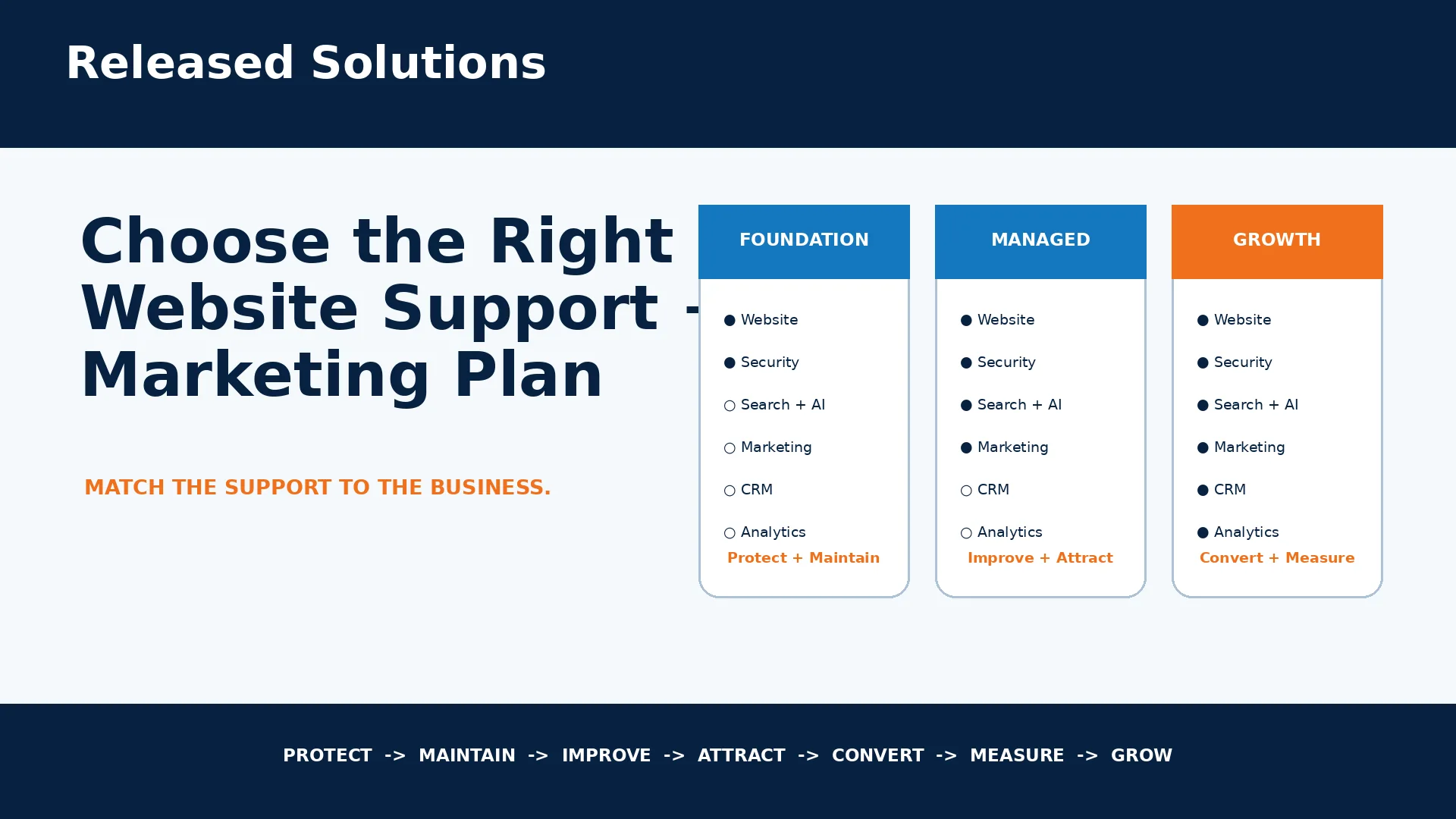
I think about service plans in three broad levels. FOUNDATION SUPPORT is best for businesses that primarily need the website protected, maintained and available. MANAGED PRESENCE is best for businesses that need ongoing website work plus online presence management: search monitoring, analytics, content, local visibility, CRM or other coordinated presence work. GROWTH PARTNERSHIP is best for businesses actively using advertising, campaigns, content, CRM, automation and ongoing optimization to pursue growth goals. Those are categories, not universal package names. The point is to match the relationship to the business.
BEWARE OF PLANS THAT ARE TOO VAGUE
A plan should not require you to guess what you purchased. Watch for vague language such as SEO included, AI optimization, unlimited support, marketing management, reputation management, website security or monthly optimization. Those phrases can describe meaningful work. They can also describe almost nothing. Ask what is actually done, how often it is done, who is responsible, what gets reported and what happens when additional work is needed. Specific expectations protect both the business and the provider.
EVALUATE THE PLAN AGAINST THE NEXT 12 MONTHS
Do not choose a service plan only for the business you have today. Think about where the business is going. Are you launching a new service, increasing advertising, adding locations, changing CRM, building automation, expanding ecommerce, producing more content, trying to improve organic search, working on AI visibility or planning a website redesign? The right plan should support the next stage without forcing the business to rebuild its entire support relationship every time something changes. That does not mean buying the largest plan. It means choosing a provider and structure that can grow with the business.
Online Presence Readiness Assessment
Is your business ready to market online?
Answer 20 quick questions while we scan your website for tracking, ad pixels, structured data, search basics, speed and contact paths. Get a scored readiness report, free.
Three Levels of Service Plan
These three levels are educational categories, not published Released Solutions packages or prices. The point is to match the relationship to what the business actually depends on.
FOUNDATION SUPPORT
Best for businesses that primarily need the website protected, maintained and available. Software updates, backups, security, uptime, forms and content edits.
MANAGED PRESENCE
Best for businesses that need website work plus coordinated online presence management: search monitoring, analytics, local visibility, content, CRM and reputation.
GROWTH PARTNERSHIP
Best for businesses actively using advertising, campaigns, content, CRM, automation and ongoing optimization to pursue growth goals.
Ownership stays with the business. Access is what the agency receives. Same infrastructure, different responsibility.
PROTECT: who handles backups, security, updates, uptime and emergencies? MAINTAIN: who handles content changes, technical problems, forms and integrations? IMPROVE: who monitors performance, technical SEO, indexing and user experience? ATTRACT: who handles search, AI, content, advertising and other acquisition? CONVERT: who improves landing pages, forms, CRM and follow-up? MEASURE: who owns analytics, conversion tracking and reporting? GROW: who helps translate the data into the next decision?
If a plan cannot answer the questions that matter to your business, the package name does not matter.
Protect + Maintain
Backups, security, uptime, updates, forms and integrations. The floor of any support plan.
Improve + Attract
Technical SEO, AI visibility, content and paid media working together to reach the right visitors.
Convert + Measure
Landing pages, CRM, follow-up, analytics and conversion tracking wired to real business outcomes.
Own + Grow
Accounts, data and infrastructure the business retains. Growth-partnership work stacked on top.
The Takeaway
Choosing a website support and marketing service plan in 2026 is not about buying the largest list of deliverables. It is about matching responsibility to business dependence.
If your website is simply an informational brochure, your needs may be modest. If your website, advertising, search visibility, CRM, automation and customer data work together to produce revenue, you need a different level of support.
Start with what the business depends on. Then decide what must be protected, maintained, improved, marketed, measured and optimized.
Not Sure What Level of Support Your Business Needs?
Released Solutions helps small-business owners evaluate the website, marketing, CRM, automation, analytics and online-presence responsibilities that need ongoing management, then build the right level of support around the business.
Not Sure What Level of Support Your Business Needs?
Released Solutions helps small-business owners evaluate the website, marketing, CRM, automation, analytics and online-presence responsibilities that need ongoing management, then build the right level of support around the business.
Prefer to start with the broader picture? Read our overview of online presence management.
Match the plan to the business you are actually operating.
Kenneth Durrum, Released Solutions