
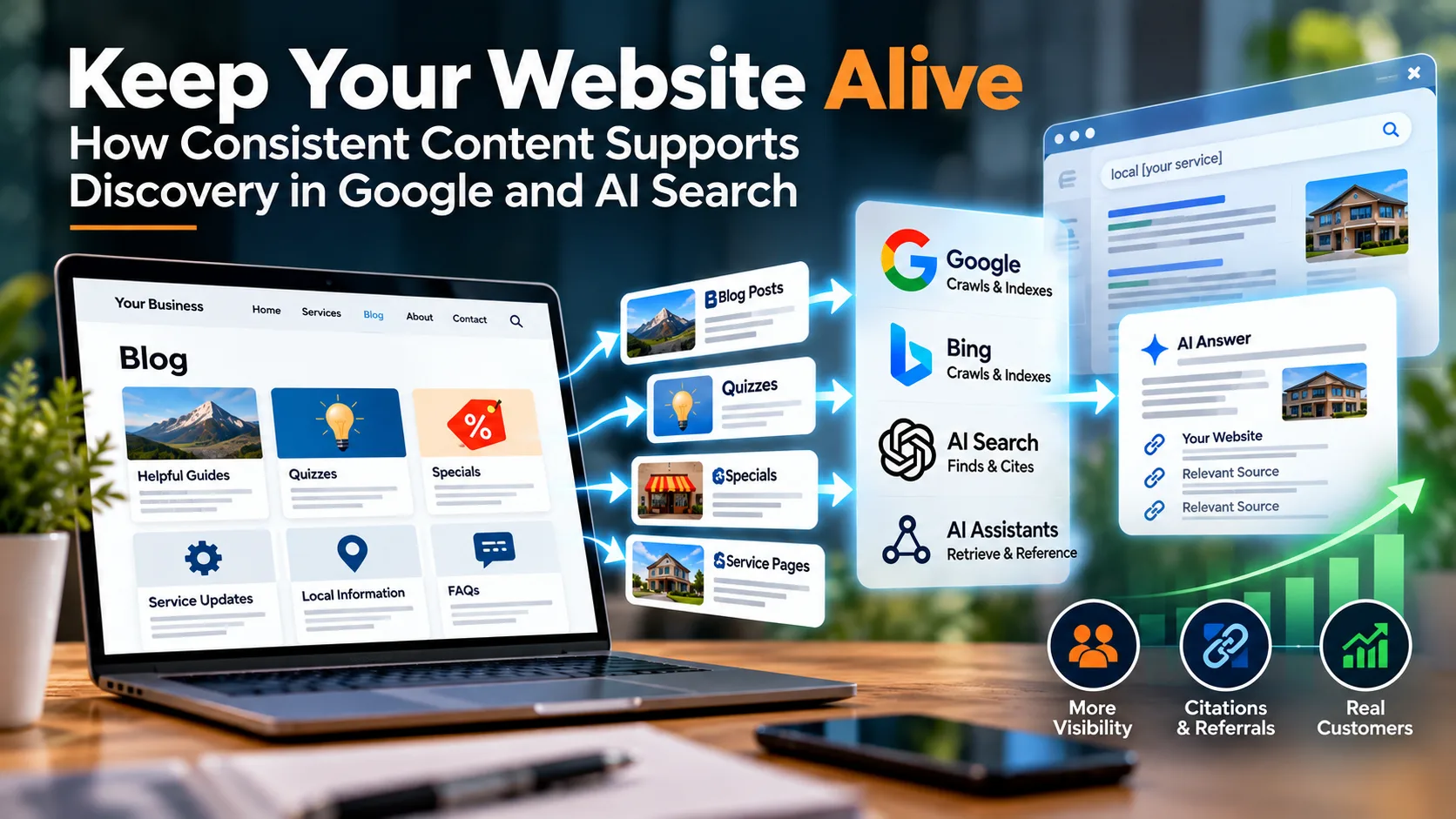

Keep Your Website Alive: How Consistent Content Supports Discovery in Google and AI Search
A practical, first-person guide to publishing useful content, connecting it to service pages, verifying indexing, managing AI crawlers, and measuring what happens next.
Your website needs a steady drip of attention
I regularly encourage business owners to keep a steady drip of useful information flowing to their websites. Not daily changes for the sake of appearances, and certainly not a flood of forgettable AI-generated posts. I mean real updates that reflect what the business knows, offers, solves, and learns.
A website can launch beautifully and then sit untouched while the business continues to evolve. Customers ask new questions. Services change. Promotions come and go. A team develops experience that would help the next customer. If none of that makes its way online, the website tells an increasingly incomplete story.
My objective is to give both people and discovery systems worthwhile reasons to return. When I publish a blog post, a quiz, a timely special, a case study, or a better service description, I also want to know whether it connects to the rest of the site, whether search engines can discover it, and whether it eventually contributes to meaningful visibility. That's an ecosystem, not a publishing calendar.
Does regular publishing make Google crawl more often?
Potentially, but there is no appointment book for Googlebot. Google's own crawling guidance explains that a fast-changing news homepage might be revisited within minutes, while a page unchanged for years may go a month between visits. Those are illustrations of variable behavior, not promised intervals for your website [1].
Google makes crawling decisions based on more than the last modified date: URL importance, past changes, relevance, demand, links, server responses, and available crawl capacity all matter. New URLs offer discovery opportunities; editing one URL can influence how that URL is revisited over time. Neither guarantees that Google will revisit every other page on your domain more often.
I don't recommend changing an adjective every Tuesday or simply refreshing a displayed publication date. Google explicitly warns that artificial freshness adds no value [2]. Improve content because a real customer would benefit, and treat any change in crawl behavior as something to observe rather than assume.
What counts as a meaningful content drip?
For a local business, consistency can mean publishing two useful articles a month, improving service FAQs, announcing genuine seasonal offers, adding a customer-focused quiz, updating availability, or documenting a solved problem. A manageable cadence beats a demanding schedule that leads to thin content.
A plumbing business, for example, might publish a guide to water-heater warning signs, a tankless-versus-tank comparison, and a maintenance FAQ. Those pieces serve different questions and can each link to its water-heater installation page. The service page is no longer isolated; readers and crawlers can follow relevant pathways to it.
A quiz is another example. It should have an accessible explanatory landing page that people and crawlers can understand; a JavaScript-only interactive experience does not necessarily communicate its purpose or key answers to every retrieval system. Specials need visible dates and should be retired or updated when they expire.
Create, connect, discover, verify, improve
I use a simple cycle to explain how this work should fit together: CREATE useful material; CONNECT it to closely related pages; make it DISCOVERABLE through navigation and sitemaps; VERIFY crawling and indexing; IMPROVE what underperforms; and MEASURE business results.
Internal links are especially important. Relevant articles can point to core service pages, related articles, and the appropriate next step. They help visitors move from a question to a solution and help crawlers discover URLs and interpret their relationships. Links should make sense in the paragraph, not be sprinkled around merely to increase a link count.
An XML sitemap is a useful map of intended canonical, indexable URLs, but it is not a substitute for navigable internal links. Keep its entries accurate and its lastmod values tied to meaningful page changes, not cosmetic edits [3]. Check that the site is accessible, responsive, reliable, and not accidentally blocked.
Publishing is not the same as getting indexed
This is where I see many businesses stop one step too early. A page can be live and included in a sitemap without being indexed. Google may know a URL but have not crawled it yet ('Discovered - currently not indexed'), or it may have crawled it and decided not to index it ('Crawled - currently not indexed'). Indexing decisions are not automatic approvals.
That's why I recommend a coverage analysis. I built a tool to help compare a site's intended URL inventory with available indexing evidence, so we can investigate missing or unexpected URLs instead of assuming publication equals visibility. An apparent gap in an export is a lead for investigation, not proof Google has never heard of the URL; Search Console reports can have scope and timing limitations.
Review sitemap completeness, canonical choices, noindex directives, robots.txt, response codes, internal links, duplicates, and content usefulness. Use URL Inspection for specific URLs and request recrawling where appropriate, understanding that Google does not guarantee timing or inclusion [5]. Recheck after changes rather than repeatedly clicking a submission button.
Online Presence Readiness Assessment
Is your business ready to market online?
Answer 20 quick questions while we scan your website for tracking, ad pixels, structured data, search basics, speed and contact paths. Get a scored readiness report, free.
Why this matters for AI-assisted discovery
AI has made discovery more complicated, not less dependent on sound foundations. Some providers operate training crawlers; others run search-oriented bots that help surface pages in answers; and some systems retrieve a URL on demand during an individual request. These functions should not be conflated.
For example, OpenAI documents distinct roles for GPTBot, OAI-SearchBot, and ChatGPT-User [6]. A model-training crawl is not evidence that your site will be cited. A live fetch is not the same as durable index inclusion. Other services have their own policies and mechanisms, and these can change.
Google's AI search features rely on Google's existing search systems and eligibility requirements [4]. Other assistants may use independent indexes, search partners, or live retrieval. I cannot dictate which sources an assistant will cite, and neither can a business owner. What I can do is make useful answers easy to find, technically accessible, internally connected, and supported by clear evidence. Traditional SEO creates opportunities for AI discovery, but it cannot guarantee an AI citation or click.
Should you allow or block AI bots?
For a typical public business site that wants to be found, my starting position is not to block legitimate search and AI retrieval crawlers indiscriminately. But the correct policy depends on what the owner wants their content used for and whether a crawler is creating operational problems.
robots.txt is a standard way to tell cooperative crawlers which URLs they should not request. It is not a security wall. A noncompliant scraper can ignore it, and confidential content requires authentication or other server-side protection. Avoid the blanket rule 'User-agent: *' followed by 'Disallow: /' unless preventing compliant crawling is truly the objective.
Consider training-related permissions separately from search access. GPTBot and OAI-SearchBot serve different documented purposes [6]. Google-Extended is a use-control token, not an independent crawling bot; restricting it does not remove a website from ordinary Google Search [1,8]. Do not assume that one blocked training agent blocks all pathways by which an AI provider might encounter public content.
If traffic is abusive, investigate the offending sources and apply targeted CDN or firewall measures rather than disabling discovery for everyone. For genuinely private pages, use authentication, access rules, and appropriate rate limits. Cloudflare offers crawler-specific management tools, with capabilities that vary by plan [7].
How do I know which bots are visiting?
Look in two places for two different answers. CDN and hosting request logs tell you which HTTP requests reached your infrastructure. Analytics tools help you understand human visits and business effects, but many crawlers never execute GA4's JavaScript, so their activity may not appear as sessions.
In Cloudflare, review the AI crawler controls and any bot analytics available to your plan. In hosting or web-server logs, examine timestamp, requested path, status code, claimed user agent, IP or network, and request volume. Watch for bursts, repeated login or API requests, and elevated 403, 404, 429, or 5xx responses. A large number of requests alone does not prove abuse.
Never give a supposedly friendly crawler a free pass based solely on the User-Agent field; it can be spoofed. Use provider-published verification methods or your CDN's verified-bot signals where available. Cross-check Google Search Console Crawl Stats and page indexing reports. Then use GA4 and lead tracking to assess downstream activity without confusing crawler requests with customers.
| Where to look | What it tells you |
|---|---|
| CDN and hosting request logs | Which HTTP requests reached your infrastructure |
| Google Search Console | Crawl Stats and page indexing reports |
| GA4 | Human visits and business effects |
A practical review rhythm for small businesses
I prefer a simple, sustainable routine. When new content is published, check its canonical URL, HTML visibility, meaningful internal links, and sitemap presence. After enough time has passed for processing, inspect indexing evidence and correct concrete problems. Periodically review coverage patterns, crawl errors, and significant bot anomalies.
Keep a brief record: URL, publication or significant-update date, sitemap status, indexing evidence, related service-page links, action taken, and result. For bot incidents, note verified identity, volume, targeted paths, response pattern, mitigation, and whether the issue subsided.
Don't turn crawler monitoring into busywork. A small service business may not need to study logs every week; a busy store or a site facing repeated attacks might. Match the monitoring cadence to actual risk, content activity, and the decisions the data can support.
The business result is what matters
At Released Solutions, I think about this through our ROCK approach: Review what the data actually says, Optimize technical and user-experience problems, Create information people need, and Kickstart appropriate promotion. The content drip is most useful when those activities reinforce each other.
An increasing count of crawler requests is not a lead-generation metric. More indexed pages are not automatically more customers. Even an AI citation may produce no click, and GA4 generally cannot show the prompt that led an assistant to mention a business. Track the chain of evidence: discovery, indexing, impressions, referral activity when identifiable, inquiries, qualified leads, and sales.
My advice is simple: don't publish a website and hope discovery takes care of itself. Keep giving it meaningful attention. Connect each new piece to the services that matter. Verify that search engines can find and evaluate it. Protect it without accidentally hiding it. And judge the work by whether it helps real people and ultimately your business.
Frequently asked questions
Does weekly posting guarantee a weekly Google crawl?
No. Meaningful change can inform Google’s recrawl decisions, but neither weekly crawling nor indexing is guaranteed.
Do new blog posts automatically improve service-page rankings?
No. Useful related content and internal links can support discovery and understanding, but ranking improvements are not guaranteed.
Does being indexed by Google guarantee a ChatGPT citation?
No. AI products use different discovery and retrieval methods, and citation selection is outside the site owner’s direct control.
Should I block GPTBot but allow OAI-SearchBot?
That may fit a site that wants ChatGPT search discovery while opting out of OpenAI training crawling, subject to the provider’s current documented controls and your objectives.
Can GA4 show all AI crawler requests?
No. Request logs are better for crawler activity; GA4 is designed around tagged visitor interactions and may not record bots that never execute JavaScript.
Make your next update count
Before your next post goes live, ask: Will this help a real visitor? Does it support an important service or solution? Can a crawler reach and understand it? How will I verify discovery and indexing? What outcome would make the effort worthwhile?
Is Your Website Being Discovered?
Publishing new content is only part of the job. Let Released Solutions help you review content connections, sitemap coverage, indexing evidence, and the technical issues that may be hiding important pages.
Sources and further reading
[1] Google: Things to know about web crawling: https://developers.google.com/crawling/docs/about-crawling
[2] Google: Myths and facts about crawling: https://developers.google.com/crawling/docs/myths-about-crawling
[3] Google: Build and submit a sitemap: https://developers.google.com/search/docs/crawling-indexing/sitemaps/build-sitemap
[4] Google: AI features and your website: https://developers.google.com/search/docs/appearance/ai-features
[5] Google: Ask Google to recrawl URLs: https://developers.google.com/search/docs/crawling-indexing/ask-google-to-recrawl
[6] OpenAI: Overview of crawlers: https://developers.openai.com/api/docs/bots
[7] Cloudflare: Manage AI crawlers: https://developers.cloudflare.com/ai-crawl-control/features/manage-ai-crawlers/
[8] Google: Crawlers and fetchers: https://developers.google.com/crawling/docs/crawlers-fetchers/google-common-crawlers