

Google's Map Pack: Why Your Business Isn't Showing Up and What You Can Do About It
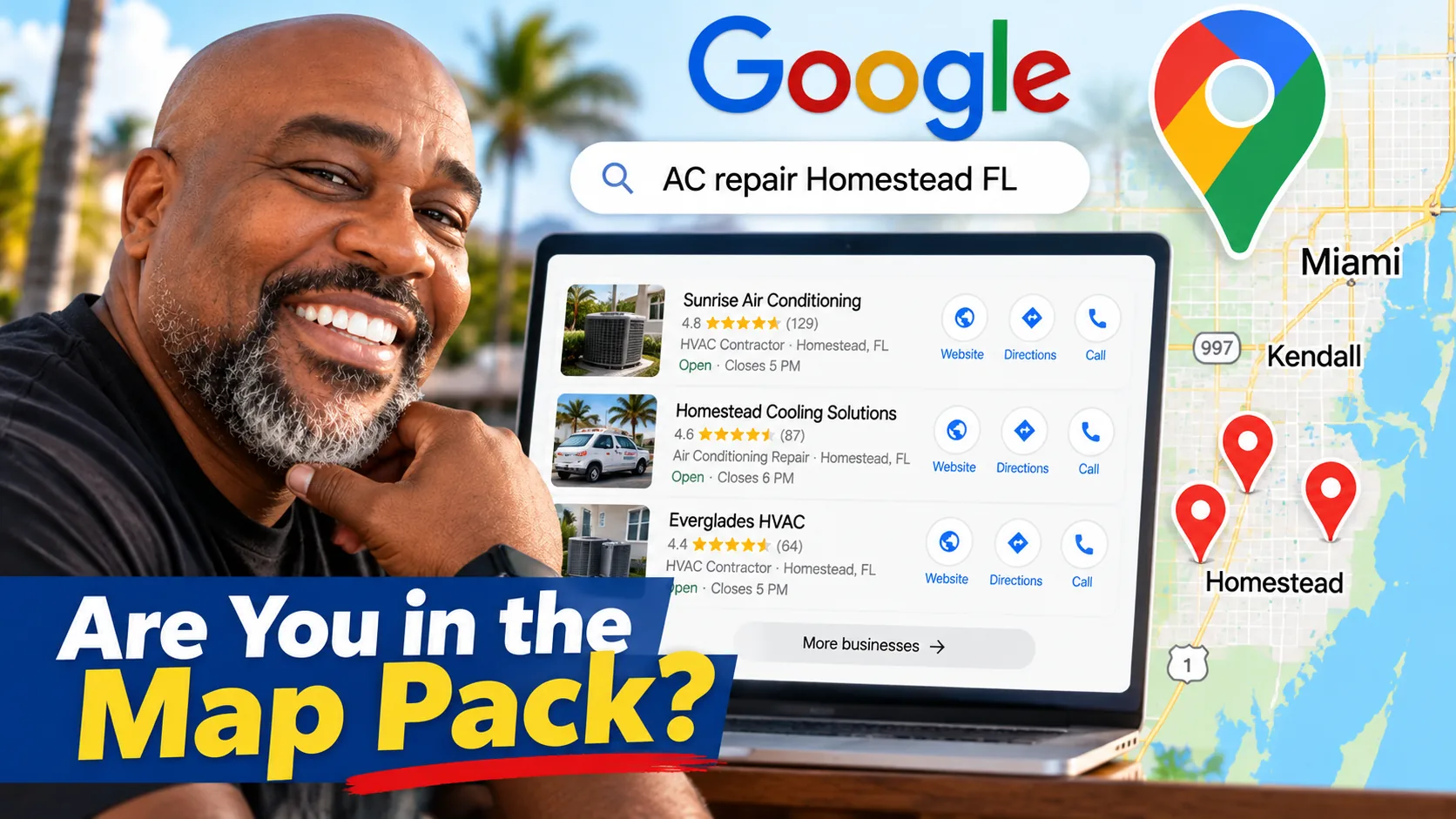
You search Google for a service you need. Before you reach the usual website results, you see a map and several nearby businesses with star ratings, hours, directions, and a button to call. That familiar section is Google’s Map Pack, sometimes called the Local Pack or 3-Pack.
For a small business, this placement can put you in front of someone who is ready to take action. But being visible in the Map Pack is not as simple as claiming a Google Business Profile or adding your city to every page of your website.
The goal is not to win one Google search on your own phone. The goal is to become easier to find in your real market and turn that visibility into customers.
What Is Google’s Map Pack?
The Map Pack is the map-based cluster of local business results Google may display for searches such as “AC repair Homestead,” “coffee near me,” or “dentist open now.” It often shows approximately three businesses, though the presentation and number of results can vary by query and device.
A listing may show a business name, rating and review count, location or service area, hours, directions, and ways to visit the website, call, or book. The underlying information draws on Google Business Profiles and other signals.
Why Your Business Appears for Some Searches but Not Others
Google identifies three main foundations for local rankings: relevance, distance, and prominence. Understanding the difference makes local SEO far less mysterious.
| Factor | What it means | What a business can do |
|---|---|---|
| Relevance | How closely a business matches the search. | Describe actual services accurately in the profile and on the website. |
| Distance | How close the business is to the search location. | Keep location information accurate; do not expect content to eliminate geography. |
| Prominence | How established or well known a business appears. | Earn genuine reviews, useful mentions and links, and a credible web presence. |
Imagine a roofing contractor in Homestead. Someone searching from Florida City may see a different Map Pack than someone searching from Kendall, even when both type the same phrase. Search results reflect location and context; there is no single permanent “number one” position across Miami-Dade County.
A new city page on your website does not move your physical business closer to searchers in that city.
Your Google Business Profile Is the Starting Point
A Google Business Profile (GBP) helps Google and customers understand who you are, what you provide, and how to reach you. Review the essentials before spending money on more elaborate tactics.
Claim and verify the profile using an account the business controls.
Use your actual business name, an eligible location or service-area setup, and accurate contact information.
Choose the category that best describes your core service, plus appropriate additional categories.
Maintain services, hours, special hours, website links, photos, and relevant customer-facing attributes.
Check for duplicates, outdated details, or edits that misrepresent the business.
Business models matter. A storefront, home-based service provider, and mobile contractor may have different address-display requirements. A virtual mailing address does not automatically make a business eligible for a Google profile at that location.
Your Website Is Evidence Behind Your Google Business Profile
One of the biggest missed opportunities is treating the GBP and website as unrelated marketing tools. They should tell the same story. Your profile may list water heater installation, but a useful page explaining that service gives potential customers a much better reason to trust you and contact you.
A strong local-business website should include a homepage that explains the primary service and market, dedicated pages for important services, a contact or location page with accurate information, and useful content about legitimate service areas. Each page should answer questions, provide genuine proof, and make the next action clear.
Structured data such as LocalBusiness schema can help search engines interpret factual business details. A fast, usable mobile experience helps visitors call, request a quote, or book. Neither schema nor mobile speed should be presented as a guaranteed Map Pack ranking shortcut.
For a Homestead HVAC provider, a page about AC repair should explain what happens during a service visit, what problems the company handles, where it genuinely serves customers, and how to request help. Publishing dozens of nearly identical pages with only city names changed is not the same thing as serving those communities well.
Reviews Matter, but There Is No Magic Number
Google states that more reviews and positive ratings can help local ranking. Reviews also help people decide whom to call. The right approach is to make review requests an ordinary, honest part of customer service, not a contest to manufacture five-star ratings.
After a real transaction or completed job, invite the customer to share honest feedback.
Make it easy with a direct review link, without requiring a rating or specific wording.
Ask customers consistently rather than requesting reviews only from people you think are happy.
Respond courteously to praise and criticism without disclosing private information.
Compare your review profile with genuine local competitors instead of chasing a universal monthly quota.
Sample request: “Thanks for choosing [Business Name]. If you would like to share an honest review of your experience, here is our Google review link: [link]. We appreciate your feedback.”
Do not pay for reviews, offer discounts in exchange for them, selectively solicit positive reviews, or ask customers to include specified services or keywords in what they write. Those practices conflict with Google’s review policies.
Know Whom You Are Competing Against
Search for a priority service in your actual market, for example “landscaper Homestead FL.” Record the businesses appearing in the Map Pack, then repeat the analysis from several relevant geographic points. Look at their service categories, review profile, website usefulness, local credibility, and proximity.
The business in the third position can be a useful comparison, but do not treat a single screenshot as a permanent competitive benchmark. Capture the date, query, and approximate search location, then look for trends across repeated checks.
Local Search Coverage Review
See exactly where customers can find you, and where they cannot.
We measure how your business shows up on Google Maps from 49 spots around your location, in Google search, in AI assistants like ChatGPT and on your website. No passwords and no access to your accounts.
A Practical 90-Day Map Pack Improvement Plan
| Period | Practical priority |
|---|---|
| Week 1 | Audit GBP ownership, eligibility, categories, services, hours, and links; establish a baseline. |
| Weeks 2 to 4 | Correct core listings and improve the homepage, contact page, and highest-value service pages. |
| Month 2 | Introduce a compliant review-request routine; add authentic visual proof; monitor customer actions. |
| Month 3 | Review geographic visibility, improve useful local content, earn legitimate local mentions, and prioritize remaining gaps. |
This is a working plan, not a promise that rankings will change in 90 days. Competition, geography, profile history, and the quality of execution affect outcomes.
Measure Customers, Not Just Map Rankings
A business owner can search their own company name and celebrate seeing it in the Map Pack. That is a starting observation, not a reliable report on what potential customers across the market see. Look at Google Business Profile performance trends, meaningful website actions, calls, inquiries, appointments, and whether leads become paying customers.
For example, imagine Business A receives 100 visits and five inquiries that produce one customer, while Business B receives 60 visits and eight inquiries that produce three customers. These are hypothetical illustrations, not benchmarks. The more visible company is not necessarily generating more business.
Connect appropriate website events to GA4 and, where possible, follow leads through a CRM or a simple tracking process. GBP interaction metrics and analytics tools can provide useful directional evidence, but attribution will not be perfect. Use multiple signals instead of assuming every call or sale can be traced precisely to the Map Pack.
How the Released Solutions ROCK Plan Fits
At Released Solutions, we use the ROCK approach to put local search improvements into a practical operating sequence: Review, Optimize, Create, and Kickstart.
| ROCK step | Map Pack and website application |
|---|---|
| Review | Assess GBP, local visibility, competitors, website relevance, and available performance data. |
| Optimize | Correct GBP information and improve technical, mobile, and local website fundamentals. |
| Create | Develop useful service content, legitimate local pages, and clear conversion paths. |
| Kickstart | Put the agreed improvements into action and establish a measurement and refinement rhythm. |
A one-time profile cleanup provides a foundation. Ongoing competitive analysis, reputation management, content improvements, and measurement are separate continuing activities. No legitimate provider can promise a permanent Map Pack position.
The Bottom Line
Your Google Business Profile tells people about your business. Your website provides more evidence of what you do. Real customer experiences and recognition across your community help establish trust. Together, they can strengthen your local presence, but they cannot erase distance.
The bigger objective is straightforward: help the right local customer find your business, understand why you are a good fit, and take the next step.
Is Your Business Ready to Compete in Google’s Map Pack?
Released Solutions’ ROCK Plan provides a structured way to review your Google Business Profile, website, and local search foundations, then identify improvements tied to meaningful customer actions.