

Guest Wi-Fi in 2026: How Small Businesses Can Turn Wi-Fi Into a Better Customer Experience
There was a time when "social Wi-Fi" was the big idea. A customer connected to Wi-Fi, checked in through a social network or provided a social identity, and the business gained exposure or information in return.
That idea helped businesses see Wi-Fi as more than an internet connection. But the 2026 opportunity is broader and more responsible.
Guest Wi-Fi can be part of the customer experience, a first-party relationship, a loyalty program, a CRM workflow and a measurement strategy. At the same time, privacy expectations, consent, security and platform changes mean businesses should be careful about what they collect and why.
The goal should not be to squeeze marketing data out of someone who needs internet access. The goal should be to make connecting useful, secure and transparent, then give customers a clear opportunity to build a deeper relationship with the business if they choose.
Guest Wi-Fi can improve the customer experience, strengthen first-party relationships, support loyalty and provide business insights, but only when it is designed around consent, security and clear customer value.
The Modern Guest Wi-Fi Journey
I think about the modern journey this way:
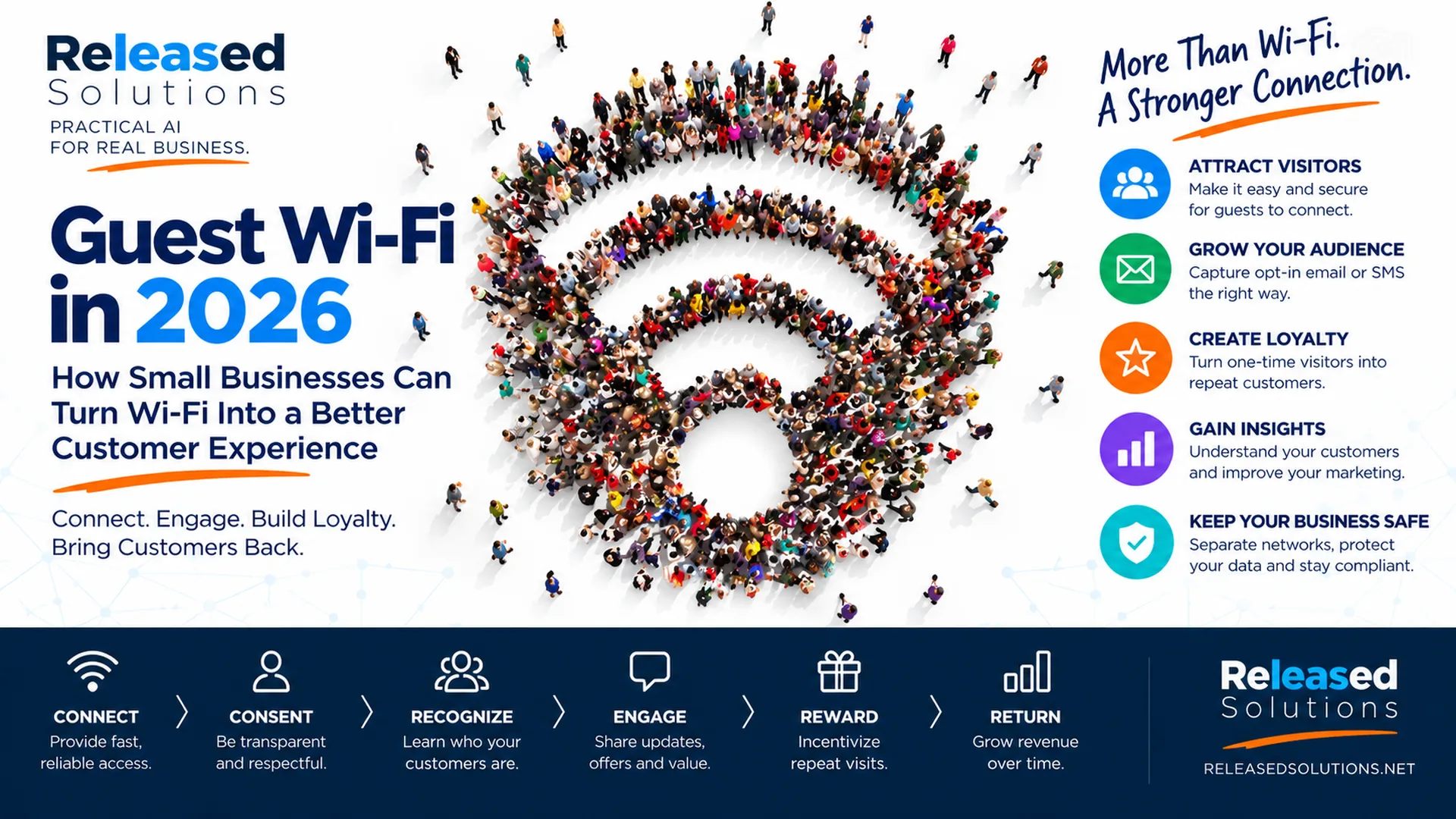
CONNECT : fast, reliable, appropriately separated guest access. CONSENT : clear terms and optional marketing permissions. RECOGNIZE : voluntarily identified customers connected to a first-party relationship. ENGAGE : relevant info, offers, service or communication. REWARD : repeat customers get a reason to continue. RETURN : measure retention, loyalty and revenue.
The technology should support the journey rather than becoming the journey itself.
What Is Guest Wi-Fi in 2026?
Guest Wi-Fi is a wireless network offered to customers, visitors or guests separately from the network used for sensitive business operations. Depending on the setup, customers may connect with a shared password, accept terms, use a captive portal, authenticate through another service or voluntarily provide information such as an email address or mobile number.
A captive portal is the page or interface presented during connection. It can communicate terms, explain privacy practices, provide access instructions or offer optional ways to engage with the business. The important word is optional.
A visitor connecting to Wi-Fi is not automatically asking to receive marketing. Design the portal so each choice is deliberate.
Utility First, Then Marketing
Make the connection experience fast and clear. Marketing consent comes as a separate, optional step.
Security Before Cleverness
Guest traffic should be separated from business systems. FTC and NIST guidance is clear on network segmentation.
Relationship, Not Data Grab
The goal is a useful first-party relationship, not the maximum amount of personal information you can extract at connect time.
Design the Program Around the Business, Not the Portal
Nine Ways to Build Guest Wi-Fi Into a Real Customer Experience
START WITH THE CUSTOMER EXPERIENCE
Before thinking about data, think about why guests need Wi-Fi. A restaurant customer may want to work while eating. A waiting room may have visitors sitting for a while. A salon client may spend an hour or more. A hotel guest expects connectivity. Make the connection simple. A complicated portal with multiple required fields, confusing passwords and several screens of marketing language turns convenience into friction. The Wi-Fi experience reflects the business.
SEPARATE GUEST TRAFFIC FROM BUSINESS SYSTEMS
Guest Wi-Fi should not casually share the same trusted network environment as critical business systems. The FTC advises that guest/customer Wi-Fi should be separate from and not connected to the business network, and that the primary business network should be limited to business-owned, operated or managed devices. NIST's wireless-LAN security guidance similarly emphasizes secure design, deployment, configuration, maintenance and monitoring across the WLAN lifecycle. Guests need internet access. Guests generally do not need access to your internal business systems.
SEPARATE WI-FI ACCESS FROM MARKETING CONSENT
A visitor connecting to Wi-Fi is not automatically asking to receive marketing. That distinction should shape the captive portal. If the business wants to invite someone to join an email list, receive text messages or enroll in a loyalty program, make that choice clear and obtain the permission appropriate for that channel and use case. Do not hide marketing enrollment inside the act of getting online. Requirements for email, SMS, privacy notices and consent can vary by jurisdiction and use case, so configure the system around the laws and platform policies that actually apply.
USE GUEST WI-FI TO STRENGTHEN FIRST-PARTY RELATIONSHIPS
When customers voluntarily identify themselves or join a program, guest Wi-Fi can become a useful first-party touchpoint: inviting a visitor to join a loyalty program, offering an email signup, connecting a recognized customer to a CRM profile, providing a relevant offer or giving members a faster return experience. The objective is not to collect as much information as possible. It is to create a useful direct relationship, which is exactly what a well-designed customer loyalty program uses to compound over time.
SOCIAL MEDIA CAN PLAY A ROLE, BUT IT IS NOT THE STRATEGY
The original social Wi-Fi idea made social networks the center of the experience. I would not design the 2026 strategy that way. Social platforms change their APIs, login policies, privacy controls and product features. Your customer relationship should not depend entirely on a third-party platform continuing to support a particular login or check-in feature. Use social as one channel, and build the long-term relationship around assets the business can control: website, CRM, customer data, loyalty and permission-based communication.
CONNECT WI-FI TO LOYALTY WHEN THERE IS REAL VALUE
Guest Wi-Fi and loyalty work especially well together because both recognize repeat customers. A business might let loyalty members use a simpler connection experience, provide member benefits during a visit, or invite a new guest to join the loyalty program after connecting. But the loyalty offer needs to be worth something. Do not ask for five pieces of personal information just to provide a weak coupon. A useful loyalty program gives customers a reason to continue the relationship. Wi-Fi supports that program; Wi-Fi is not automatically the reward.
USE AI AFTER YOU HAVE A LEGITIMATE CUSTOMER RELATIONSHIP
Once a business has appropriate first-party customer information, AI can help analyze patterns, identify segments, summarize behavior, suggest offers or find groups more likely to return. A business may discover that certain customers visit frequently but have never joined the loyalty program, or that a particular offer performs better with repeat visitors. But AI does not erase the rules around privacy, consent or data security. The fact that software can combine data does not automatically mean the business should combine it. Use AI to make a legitimate customer relationship more useful, not to make customers feel watched.
MEASURE BUSINESS OUTCOMES, NOT WI-FI LOGINS
A dashboard showing thousands of Wi-Fi sessions may look impressive. But what did those sessions do for the business? Better questions: how many guests voluntarily joined the loyalty program, how many opted into an appropriate marketing channel, how many returned, did recognized customers visit more frequently, did a Wi-Fi-driven offer lead to purchases or appointments, did the program increase customer lifetime value, how many people opted out, is the captive portal creating unnecessary abandonment or support requests? Wi-Fi connections are activity. Retention, revenue, referrals and customer experience are outcomes.
KEEP THE TECHNOLOGY MAINTAINABLE
Guest Wi-Fi can involve routers, access points, captive-portal software, identity providers, CRM integrations, email/SMS tools, loyalty platforms, analytics and automation. Document it. Know who owns the network equipment and cloud management account. Know which vendor runs the captive portal. Know where customer information goes. Know which integrations are active. This follows the same rule I use for agency-managed technology in the ownership-vs-access guide: your partner can manage the system; your business should understand and retain control of the critical assets.
A dashboard full of sessions does not prove the program is creating better customers. Measure what actually moves the business forward.
A Practical Guest Wi-Fi Framework
For a small business, I would build the experience around six stages:
| Stage | What it means | What to measure |
|---|---|---|
| CONNECT | Fast, reliable and appropriately separated guest access. | Connection success, time to online, portal abandonment. |
| CONSENT | Explain relevant terms and make optional marketing permissions clear. | Opt-in rate per channel, opt-outs, complaints. |
| RECOGNIZE | Connect voluntarily identified customers to a useful first-party relationship. | Loyalty match rate, CRM linkage. |
| ENGAGE | Provide relevant information, offers, service or communication. | Offer engagement, message response. |
| REWARD | Give repeat customers a reason to continue the relationship. | Reward redemption, repeat-visit lift. |
| RETURN | Measure whether the experience contributes to retention, loyalty and revenue. | Return frequency, customer lifetime value, referrals. |
The pipeline is the same for a restaurant, salon, waiting room or hotel; only the specific values and thresholds change. Wire this into your broader digital marketing system so a Wi-Fi visit becomes one signal among many.
Customer Experience
Fast, clear connect. The portal reflects the business, so make it feel competent.
First-Party Data + Loyalty
Optional identification connects a Wi-Fi visit to a CRM and loyalty relationship.
Insights
Segments, offers and patterns you can act on. AI amplifies once the relationship is real.
Security
Segmented network per FTC/NIST guidance. Guest traffic stays out of business systems.
The Takeaway
The old social Wi-Fi idea was useful because it challenged businesses to see Wi-Fi as more than a utility. That part was right.
But in 2026, the opportunity is bigger than asking someone to check in on social media.
Guest Wi-Fi can improve the customer experience, strengthen first-party relationships, support loyalty, provide useful business insights and create opportunities for relevant follow-up. It can also create privacy and security problems if the business collects information carelessly or fails to separate guest access from critical systems.
So the strategy is not "give us your social profile and we will give you Wi-Fi."
It is:
Connect the Customer Experience to the Rest of Your Marketing
Released Solutions helps small businesses connect websites, CRM, loyalty, automation, analytics, AI and digital marketing so individual customer touchpoints can work together as one measurable system.
If your guest Wi-Fi is disconnected from your CRM, loyalty and follow-up today, we can help you wire it in so a visit becomes the beginning of the relationship, not the end.
Connect. Then earn permission to continue the conversation.
Kenneth Durrum, Released Solutions