
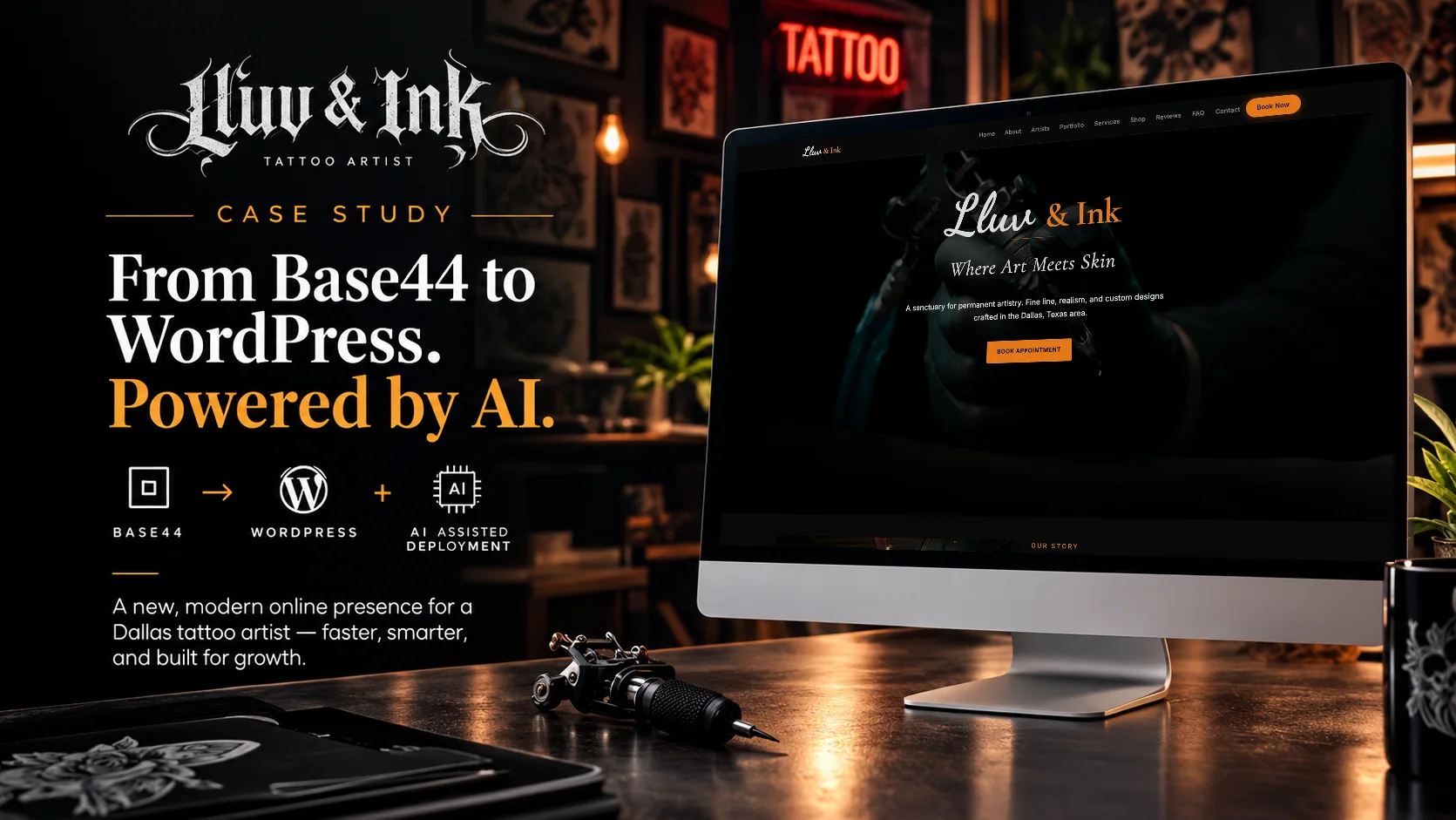
From Base44 to WordPress: what a vibe-coded site really costs
A new Dallas tattoo studio built her first website on Base44, then found the exit priced two tiers above what she could afford. We rebuilt it in WordPress in one week at full design parity and removed every recurring software cost.
See the live site →Full disclosure: the client is my niece. Aaliyah Moss opened Lluv & Ink, a single-artist tattoo studio in Dallas, and came to me for help with a website. She had already started building one.
She had gone to Base44, an AI app builder, on the reasonable assumption that it would be cheaper and easier than hiring anyone. She was right about the start. The free plan produced a design she genuinely loved, and she got there without writing a line of code.
The problem arrived later, and it was not a design problem. It was an arithmetic problem.
TheChallenge
Base44's free plan includes 25 message credits a month. Every time the AI builds or changes something, it spends credits. For a business with no revenue yet, that ceiling arrives quickly, and the site stops moving.
She was ready to step up one tier, to Starter at $16 a month. What she kept being steered toward was Builder, at $40. Then she went looking for the door.
She assumed she could download the site and take it somewhere cheaper. That is where it stopped. Getting your source code out of Base44 runs through GitHub sync, and GitHub sync is not on the Starter plan. It starts on Builder, the same $40 tier she was already being pushed toward, and two and a half times the one she had budgeted for.
To be fair to Base44: they do not hold your work hostage. Their own documentation is explicit that you own your code, your data and your users, and that two-way GitHub sync exports the full source to your own repository at any time. That is true. It is simply true on a plan she could not justify for a studio that had not taken its first booking. The wall was not the platform being broken. The wall was the exit being priced above her budget.
She had also not anticipated the second meter. Base44 bills integration credits separately from message credits: 100 a month on free, 2,000 on Starter. Every action an integration takes draws that allowance down. A booking system, a contact form and an email service are exactly the kind of thing a working studio site needs, and exactly the kind of thing that consumes those credits.
TheAnalysis
Before recommending anything, the question worth answering is not which platform is better. It is what this particular business actually needs, and what each option costs over the years it will be running.
Metered platforms versus unmetered hosting
This is the structural difference, and it is the one most people discover late. On a credit-metered platform, the cost of your site scales with how much it does. An integration that fires fifty thousand times costs more than one that fires ten times. On traditional hosting it costs exactly the same. For a marketing site with a booking flow, a contact form and email, that difference compounds every month, forever.
What she actually needed
One artist, one studio. A marketing site that shows the work, a booking flow that captures appointments, and an email address that reaches her. No storefront, no memberships, no multi-staff scheduling. Nothing on that list requires a metered platform.
What $40 a month buys elsewhere
This is the comparison that settled it. Entry-level shared WordPress hosting starts at a few dollars a month on introductory terms. Read the renewal rate before you sign, because introductory pricing is its own trap and the whole point of this exercise is to look at the real number rather than the advertised one. Even so, the gap is not close: the plan she was being pushed toward costs several times what it costs to host the same site yourself, and hosting does not meter how often your booking form runs.
Why WordPress, specifically
Two reasons that mattered to her more than any feature list. First, she did not have to give up the way she had been working: she can still describe a change in plain language and have AI make it, and she can also edit a page the ordinary way. Second, the skill transfers. WordPress runs a large share of the web, so the help, the tutorials and the people who know it are everywhere, and none of it is tied to one company's roadmap or pricing page.
TheSolution
Capturing the design she already loved
The Base44 site was a single-page React application, which means there is no set of pages to save. We rendered it in a headless browser, captured every section including the parts hidden behind accordions and carousels, and pulled out the real assets, the copy, the prices and the FAQ answers into a content inventory. That inventory, not a screenshot, is what the rebuild was assembled from.
Rebuilding it, AI-assisted
The home page was reconstructed as eleven sections matching the original layout, on a free theme, with a custom plugin carrying the brand: the two-typeface logo, the palette, the spacing scale and a bespoke footer. Typography is self-hosted, so the site makes zero external font requests. The design parity is not approximate. It is the same site.
The booking flow, rebuilt
Base44's five-step flow became a booking system with eight services and their pricing tiers, from a thirty-minute touch-up to a multi-session sleeve. Payment happens in the studio rather than online, by her choice, so the booking captures the appointment and nothing else. Email was authenticated properly and forwards to the inbox she already reads.
Handing it back
The part that matters most for a business this size: she was set up to keep working the way she likes. She can describe a change to an AI assistant and apply it herself, without a credit meter running and without asking anyone's permission.
TheResults
She owns the site outright, and her recurring software bill is a domain registration.
The site is new, so there is nothing honest to say yet about search performance. That is not what this rebuild was for. What it bought her is a fixed, near-zero cost base and no ceiling on what the site is allowed to do.
The tier she was considering is highlighted. Export sits one tier further up, at $480 a year. Monthly billing runs roughly 20% higher than the annual rates shown. Pricing and plan features change; these were the published figures when this was written.
Five plugins, every one of them a free tier, on a free theme, plus one custom plugin written for the studio. Booking, security, search settings, email delivery and the page builder. No licence renewals, no seat counts, no credits.
Vibe coding is a genuinely good way to start. The question nobody asks early enough is what it costs to leave.
Stuck on a platform you have outgrown?
We move sites off metered platforms without losing the design you already paid for.