
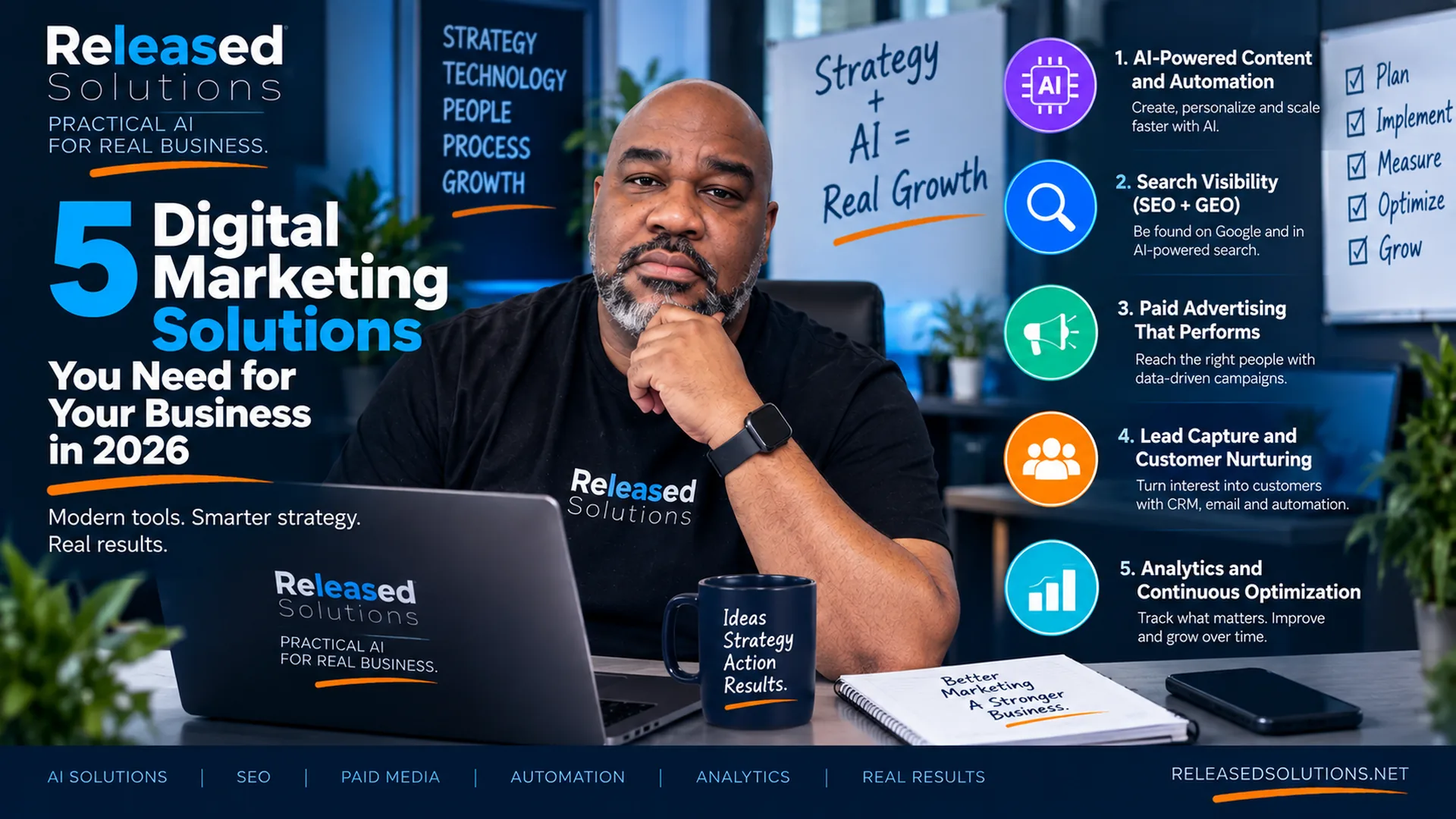

5 Digital Marketing Solutions Every Small Business Needs in 2026
The original idea behind this article was simple: businesses need a core set of digital marketing solutions if they want to compete online.
That is still true. But the list has changed.
A modern small business is no longer choosing between having a website, posting on social media or running a few ads. Search is changing. AI is changing how customers research companies and how businesses create and analyze marketing. Advertising platforms are becoming more automated. Customer journeys cross multiple channels. Privacy changes make measurement more complicated. And customers expect businesses to respond faster than ever.
So if I were building the digital foundation for a small business today, I would not start with a collection of disconnected tools. I would build five connected capabilities.
Reach the right people, give them a reason to trust and choose the business, make it easy to take action, follow up consistently and learn from the results.
The Five Connected Capabilities
The tools inside each category will continue to change. The business capabilities are what matter.
AI gives you leverage across research, content, analysis and automation. VISIBILITY is your website and search presence, the heart of complete web presence management. ACQUISITION is paid advertising to create or capture demand. FOLLOW-UP is CRM and marketing automation. MEASUREMENT is analytics, attribution and continuous optimization.
Together they run the modern loop: ATTRACT / ENGAGE / CAPTURE / NURTURE / CONVERT / MEASURE / IMPROVE.
Capabilities, Not Tools
Platforms change every year. The capabilities behind them stay the same: reach, trust, action, follow-up, measurement.
Account ≠ Solution
Having Facebook is not a social strategy. Installing a CRM is not a follow-up system. Value comes from how each piece supports the customer journey.
System, Not Stack
The five pieces get much more valuable when they are connected. Isolated tools multiply cost. Connected capabilities multiply results.
The Five Solutions: Capabilities, Not Tools
The Five Digital Marketing Solutions
Not five tools. Five capabilities that need to work together for the modern small-business marketing system to actually produce customers.
AI-POWERED MARKETING AND CONTENT SYSTEMS
AI belongs on the modern list, but not because every business needs to publish more AI-generated content. The real advantage is leverage. AI can help a small business research customers, organize ideas, develop content, compare positioning, create variations of advertising creative, summarize data, automate repetitive tasks and accelerate work that once consumed hours. The important distinction is between using AI to produce more material and using AI to make the marketing system smarter. I prefer the second approach. If your team is still catching up on AI fundamentals, how to learn AI for small business is a good starting point, and my note on 10 reasons I use AI for website development shows what "AI as coworker" actually looks like in production.
A HIGH-PERFORMING WEBSITE AND SEARCH PRESENCE
Your website is still one of the few digital assets your business controls. Social reach can change. Ad costs can rise. Search interfaces evolve. AI assistants shift discovery. Your website remains the place where your business can explain its value, establish credibility, capture demand and create a measurable customer experience. A 2026 site should be fast, mobile-friendly, secure, easy to navigate, persuasive and designed around meaningful actions. It also needs to be discoverable: Google Search Central states its existing SEO best practices remain relevant for AI Overviews and AI Mode, with no additional special technical requirements. Think of it as search visibility, not a single acronym.
PAID ADVERTISING AND AUDIENCE ACQUISITION
Organic visibility is valuable, but businesses often need to create demand or capture demand now. That is the role of paid media. Google, Microsoft, Meta and other channels can put a business in front of people based on search intent, interests, geography and behavior. The modern difference is automation: Google's AI Max and Performance Max use machine learning across targeting, creative, bidding and delivery. Automation does not remove the need for strategy. The business still needs clear conversion goals, accurate tracking, strong creative, appropriate landing pages, budget controls and someone evaluating whether platform-reported performance is translating into real customers. Match the channel to the audience, not the trend.
CRM, FOLLOW-UP AND MARKETING AUTOMATION
One of the biggest marketing leaks happens after the lead arrives. A form is submitted. Nobody responds quickly. A call is missed. An estimate is never followed up. A customer buys once and disappears. That is why CRM and automation belong in the core stack. A CRM organizes leads, customers, conversations, opportunities and follow-up. Automation supports that process with email, SMS where appropriate, reminders, lead routing, appointment communication, nurture sequences and internal tasks. The purpose is not to automate the relationship out of the business. It is to make sure important opportunities do not depend entirely on someone remembering what to do next. This becomes even more important as AI makes lead generation and content production faster, because generating more opportunities does not help if the business cannot consistently manage them. See our marketing funnel strategy for how this connects to the wider customer journey.
ANALYTICS, ATTRIBUTION AND CONTINUOUS OPTIMIZATION
The fifth solution keeps the other four honest. Google Analytics 4 lets businesses identify key events, which Google defines as actions particularly important to the business, and use them to evaluate marketing performance across channels. GA4 attribution also recognizes something small-business owners see in real life: a customer may see social content, search for the company later, click an ad and return directly before converting. Do not give one platform all the credit. Google also uses modeled key events in some situations where conversions cannot be directly observed because of privacy or technical limits. Modern analytics is not perfect surveillance. It is a decision-making system built from observed and, in some cases, modeled information. The goal is not perfect data. It is enough trustworthy data to make better decisions.
The business defines the audience, standards, expertise, offer and desired outcome. AI helps execute, analyze and refine the work.
The Caveman Marketing Quiz
How much of your marketing is still hunting by hand?
Rate 15 statements and see which of five stages your marketing is in, from The Hunter to The AI-Augmented Entrepreneur.
The Five Should Work as One System
AI helps the business research, create, analyze and automate. The website and search presence create a credible destination and long-term discoverability. Paid advertising creates or captures demand. The CRM and automation system turns interest into organized follow-up. Analytics tells us what is actually working and where the system needs improvement.
ATTRACT / ENGAGE / CAPTURE / NURTURE / CONVERT / MEASURE / IMPROVE. No single platform owns that entire journey.
What About Social Media, Email, SEO and Content?
They are still important. They simply live inside the larger system. Social and content create awareness and demand. Email nurtures and retains. SEO supports search visibility. Video educates and demonstrates. Local marketing connects digital activity with physical markets.
Having Facebook is not a social strategy. Installing a CRM is not a follow-up system. Publishing a website is not conversion optimization. Paying for Google Ads is not customer-acquisition strategy. Buying an AI subscription is not AI transformation.
Where I Would Start
A small business does not need to implement everything at once. Start by identifying the biggest constraint.
| If the biggest problem is… | Start with… |
|---|---|
| People cannot find you | Visibility and acquisition (solutions 2 and 3). |
| People visit but do not convert | Website, offer and conversion experience (solution 2). |
| Leads arrive but disappear | CRM and follow-up (solution 4). |
| Team is overwhelmed with repetitive marketing work | AI and automation leverage (solutions 1 and 4). |
| Nobody can explain which marketing produces customers | Measurement and attribution (solution 5). |
The order should follow the business problem, not the newest marketing trend.
AI Leverage
Coworker, not novelty. Research, content, creative, analysis and automation across the system.
Visibility + Acquisition
Website performance and search + paid media that creates or captures demand.
Follow-Up
CRM and automation so leads do not disappear between form fill and revenue.
Measurement
GA4 key events, attribution and CRM outcomes. Enough trustworthy data to make better decisions.
The Takeaway
The five digital marketing solutions I would prioritize in 2026 are different from a traditional list of websites, social media accounts and advertising channels.
Today, a small business needs capabilities that work together:
- AI-powered marketing and content systems.
- A high-performing website and search presence.
- Paid advertising and audience acquisition.
- CRM, follow-up and marketing automation.
- Analytics, attribution and continuous optimization.
Technology will keep changing. The specific platforms will change with it. The goal stays remarkably consistent: reach the right people, give them a reason to trust and choose the business, make it easy to take action, follow up consistently and learn from the results.
Build the Right Digital Marketing System for Your Business
Released Solutions helps small businesses connect AI, websites, search visibility, paid media, CRM, automation and analytics around measurable business goals.
If your marketing today feels like a stack of disconnected accounts, we can help you connect the five capabilities so the whole system moves the business forward.
Reach. Trust. Action. Follow-up. Measure. Everything else is a tool.
Kenneth Durrum, Released Solutions