
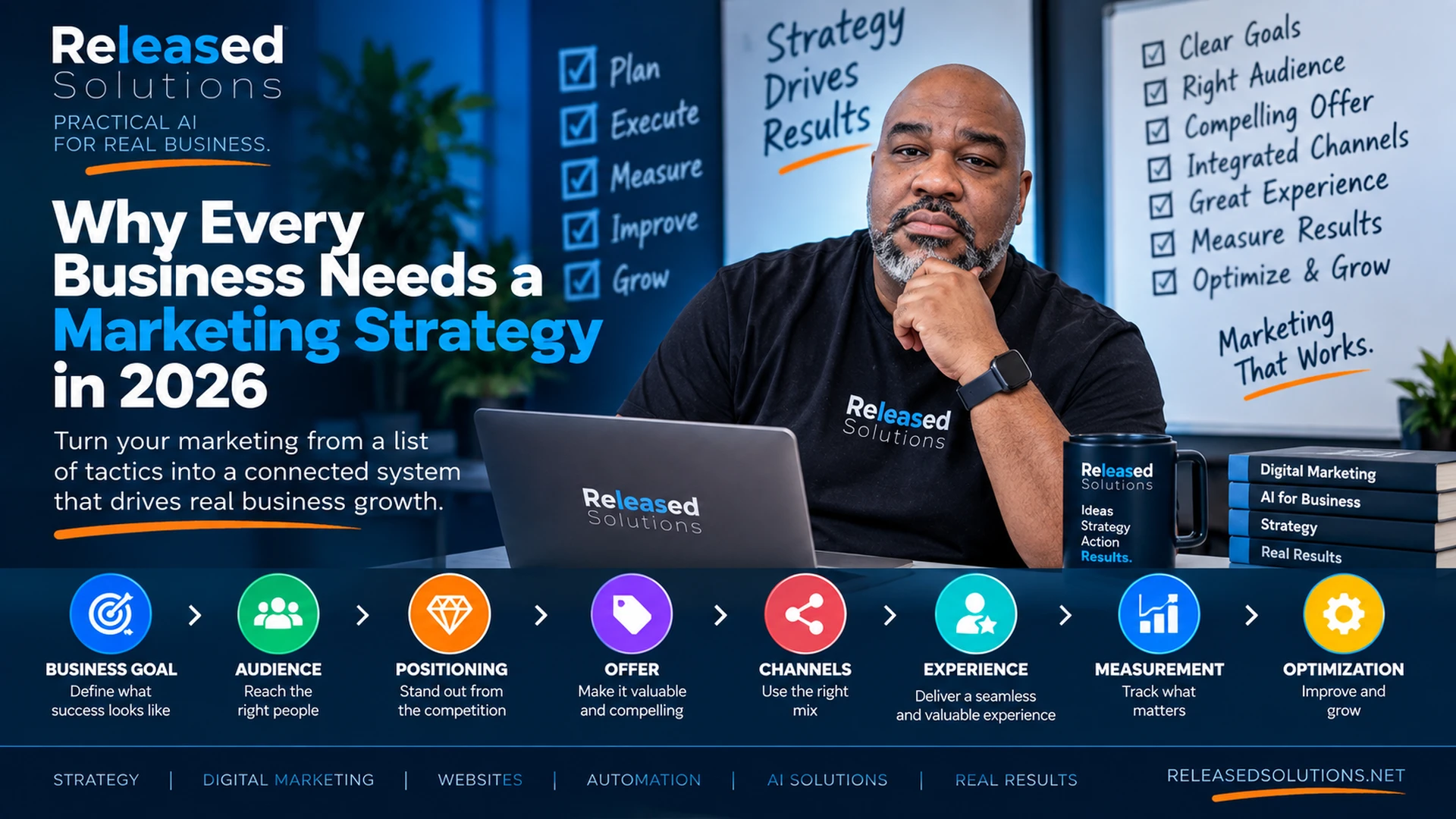

Why Every Business Needs a Marketing Strategy in 2026
Small-business owners have access to an extraordinary number of marketing tools. We can run Google Ads, publish to social media, improve SEO, build email campaigns, automate follow-up, use AI to create content, track behavior in analytics and connect customer data to a CRM.
That sounds like progress. But more tools can also create more disconnected activity.
A business can be doing all of those things and still have no clear marketing strategy.
That is why I think the importance of marketing strategy has actually increased. The challenge is no longer finding something we can do. The challenge is deciding what deserves our time and money, how the pieces should work together, and what business result they are supposed to produce.
Marketing tactics create activity. Marketing strategy determines whether that activity is moving the business toward the right goal.
A Modern Marketing Strategy Is a Connected Business System
A social media calendar is not a marketing strategy. Neither is an SEO campaign, a Google Ads account, an email list, a new website or an AI content system.
Those are tactics and tools.
Strategy answers the questions that come before them: What are we trying to accomplish? Who are we trying to reach? Why should that customer choose us? What offer are we making? Which channels make sense for that audience and objective? What experience happens after someone responds? How will we know whether it worked?
Google's own advertising guidance begins with a similar principle: identify and prioritize the specific goals you want to achieve, then manage campaigns based on those goals. The tool should follow the objective, not the other way around.
The GOAL tells us what success looks like. The AUDIENCE tells us who matters. POSITIONING explains why we are a credible and relevant choice. The OFFER gives someone a reason to act. CHANNELS determine where we communicate. EXPERIENCE determines what happens after the click, call or visit. MEASUREMENT tells us what actually happened. OPTIMIZATION uses that evidence to improve the system.
The sequence matters. If we jump directly to channels, we can become very busy without becoming more effective.
Direction Beats Volume
More posting, more platforms and more tools do not equal more strategy. Direction is what turns activity into progress.
Connected, Not Isolated
Channels, website, sales, CRM and measurement should serve the same business objective. Isolated tactics compete for attention instead of compounding.
Cycle, Not One-Time Doc
Strategy is a working system: execute, measure, learn, improve, repeat. A plan in a folder is not a strategy.
Walk the Eight Parts in Order
The Eight-Part Strategy System
Walk each part in order. If we jump directly to channels, we can become very busy without becoming more effective.
START WITH THE BUSINESS GOAL
Marketing should serve a business objective: qualified leads, ecommerce revenue, filled appointments, repeat purchases, a new service, a new market, retention. The important part is specificity. "We need more marketing" is not a goal. "We need 40 qualified consultations per month at an acquisition cost the business can support" gives us something we can design and measure. This is also where budget becomes strategic. A target without enough resources to reach it is not a plan. A budget without an expected outcome is not a strategy either.
DEFINE THE AUDIENCE BEFORE CHOOSING THE CHANNEL
The best marketing channel depends on the people we need to reach and the problem they are trying to solve. A customer actively searching Google for an urgent service is behaving differently from someone discovering a new brand in a social feed. An existing customer receiving an email is different again. The strategy should define the audience, their needs, their level of awareness, their likely objections and what would make them take the next step. Then we decide which channels give us the best opportunity to reach them.
BUILD POSITIONING, NOT JUST PROMOTION
Promotion answers, "What are we selling?" Positioning answers, "Why should this customer consider us?" A business needs a clear way to communicate its value, credibility and difference. That can come from expertise, specialization, convenience, service, proof, experience, price, process, location or another meaningful advantage. Without positioning, marketing tends to become a stream of interchangeable claims: great service, quality work, competitive pricing.
MAKE THE OFFER CLEAR
Marketing creates a bridge between customer interest and action. The offer is what sits on that bridge. An offer does not always mean a discount. It can be a consultation, demonstration, appointment, estimate, trial, download, reservation, product bundle or simply a clearly presented product with a strong reason to buy. The important question is whether the customer understands what happens next and why taking that step is worthwhile.
CHOOSE A CHANNEL MIX THAT SUPPORTS THE STRATEGY
A modern business may use paid search, paid social, organic search, social media, email, SMS, video, direct outreach, partnerships, local marketing and other digital marketing channels. The strategy does not require using all of them. It requires understanding the job each channel performs. Search may capture existing demand. Social content may build familiarity. Paid social may introduce an offer to new audiences. Email continues the relationship. SEO creates durable visibility. Remarketing reconnects with people who already showed interest.
It is the one where the channels support the same business objective and customer journey.
TREAT THE CUSTOMER EXPERIENCE AS PART OF MARKETING
Marketing does not end when someone clicks an advertisement, and it should not depend on chasing customers one at a time either. The website, landing page, phone call, form, scheduling process, email response, sales conversation and customer service experience all influence whether marketing turns into revenue. That means website development, conversion optimization, automation and sales follow-up are not separate from marketing performance. They are part of the marketing funnel. A campaign can generate qualified demand and still appear to fail if calls go unanswered, forms are ignored, scheduling is difficult or the website does not reinforce the promise made in the advertisement.
MEASURE WHAT MATTERS TO THE BUSINESS
One of the biggest advantages of modern digital marketing is measurement. One of its biggest traps is measuring everything without deciding what matters. Google Analytics 4 recognizes that customers can interact with multiple marketing touchpoints before completing a meaningful action, and its attribution reports help businesses understand those paths. Impressions, clicks, engagement and traffic can help diagnose performance. Leads, appointments, purchases, revenue, customer acquisition cost and retention move us closer to business impact. The right KPI is the one that helps us make a better decision.
OPTIMIZATION IS PART OF THE STRATEGY, NOT AN EMERGENCY RESPONSE
A marketing strategy should not be written once and placed in a folder. Markets change. Customer behavior changes. Competitors change. Search behavior changes. Creative wears out. Offers lose strength. New channels and technologies appear. AI makes experimentation faster, but faster production does not eliminate the need for judgment. In fact, when businesses can produce more content, more ads and more variations, a strategy becomes even more important because it tells us what is worth producing and why. The plan should create a cycle: execute, measure, learn, improve and repeat.
The Caveman Marketing Quiz
How much of your marketing is still hunting by hand?
Rate 15 statements and see which of five stages your marketing is in, from The Hunter to The AI-Augmented Entrepreneur.
What a Marketing Strategy Prevents
A clear strategy helps prevent several expensive habits. It also gives the business a way to say no. That may be one of strategy's most valuable functions. There will always be another marketing idea. A strategy gives us criteria for deciding whether that idea deserves resources.
| Expensive habit | What strategy prevents |
|---|---|
| Chasing every new platform | Choose channels based on the audience and objective, not the hype cycle. |
| Changing campaigns too quickly | Give tests enough time to produce reliable evidence. |
| Measuring vanity metrics as if they were revenue | Track leads, appointments, purchases, revenue, CAC and retention. |
| Publishing content with no purpose | Every asset should map to an audience, stage and next step. |
| Sales and marketing operating separately | One system: shared goals, shared measurement, shared follow-up. |
| Spending on the wrong buying behavior | Match spend to how the customer actually decides and buys. |
The Role of AI in a 2026 Marketing Strategy
AI deserves a place in the modern marketing system, but it should not sit at the top of it.
AI can help research audiences, explore positioning, generate creative variations, analyze data, draft content, automate repetitive work and accelerate testing. What it cannot do by itself is decide what your business should become, which customers you want to serve, what tradeoffs you are willing to make or what success means for you. If your team is still catching up on AI fundamentals, my note on how to learn AI for small business is a good next read.
Give it a clear assignment inside a clear strategy and it can multiply your capacity. Give it no direction and it can simply help you produce more disconnected activity, faster.
Goal + Audience
Specific business outcome and the specific people needed to reach it.
Positioning + Offer
Why choose us and what to do next. Both stated in the customer's language.
Channels + Experience
The right mix, wired to a landing, sales and follow-up experience that keeps the promise.
Measure + Optimize
KPIs that map to business outcomes. Then a cycle of test, learn and improve.
The Takeaway
A marketing strategy is important because marketing has become too complex to manage as a collection of unrelated tactics.
The objective is not to be everywhere. It is not to use every tool. It is not even to generate the most activity.
The objective is to build a connected system that moves the right audience from awareness to action and gives the business enough measurement to improve that system over time.
When those pieces work together, marketing becomes more than promotion. It becomes part of how the business grows.
Build a Marketing System Around Your Business Goals
Released Solutions helps small businesses connect strategy, websites, paid media, SEO, content, analytics, automation and AI around measurable business objectives.
If your marketing today feels like a stack of disconnected tactics, we can help you connect the pieces so the whole system moves the business forward.
Direction beats volume. Strategy is the direction.
Kenneth Durrum, Released Solutions