
Why a Marketing Funnel Still Belongs in Your Strategy in 2026
Marketing funnels have been declared dead more times than I can count.
The criticism usually starts with a fair observation: customers do not move through marketing in a perfectly straight line. They search, leave, return, read reviews, see an ad, ask a friend, visit your website again, subscribe to an email, compare competitors, and sometimes convert weeks later.
That does not make the funnel useless. It means the funnel should not be mistaken for a literal map of every customer's behavior.
For a small business, a marketing funnel is still one of the most useful ways to organize strategy because it forces you to answer a practical question: What needs to happen between someone first becoming aware of us and that person becoming a customer, returning, and recommending us?
The customer journey can be messy. The funnel is the business framework you use to organize messages, offers, measurement, and follow-up around that journey.
The Modern Funnel Is a System, Not a Triangle
The old funnel was often shown as a wide top that narrowed to a sale. That picture is useful, but incomplete.
A modern funnel should account for what happens after the first conversion. Retention, repeat purchases, reviews, referrals, and advocacy can create the next wave of awareness. In practice, the funnel behaves more like a connected growth system than a one-way chute.
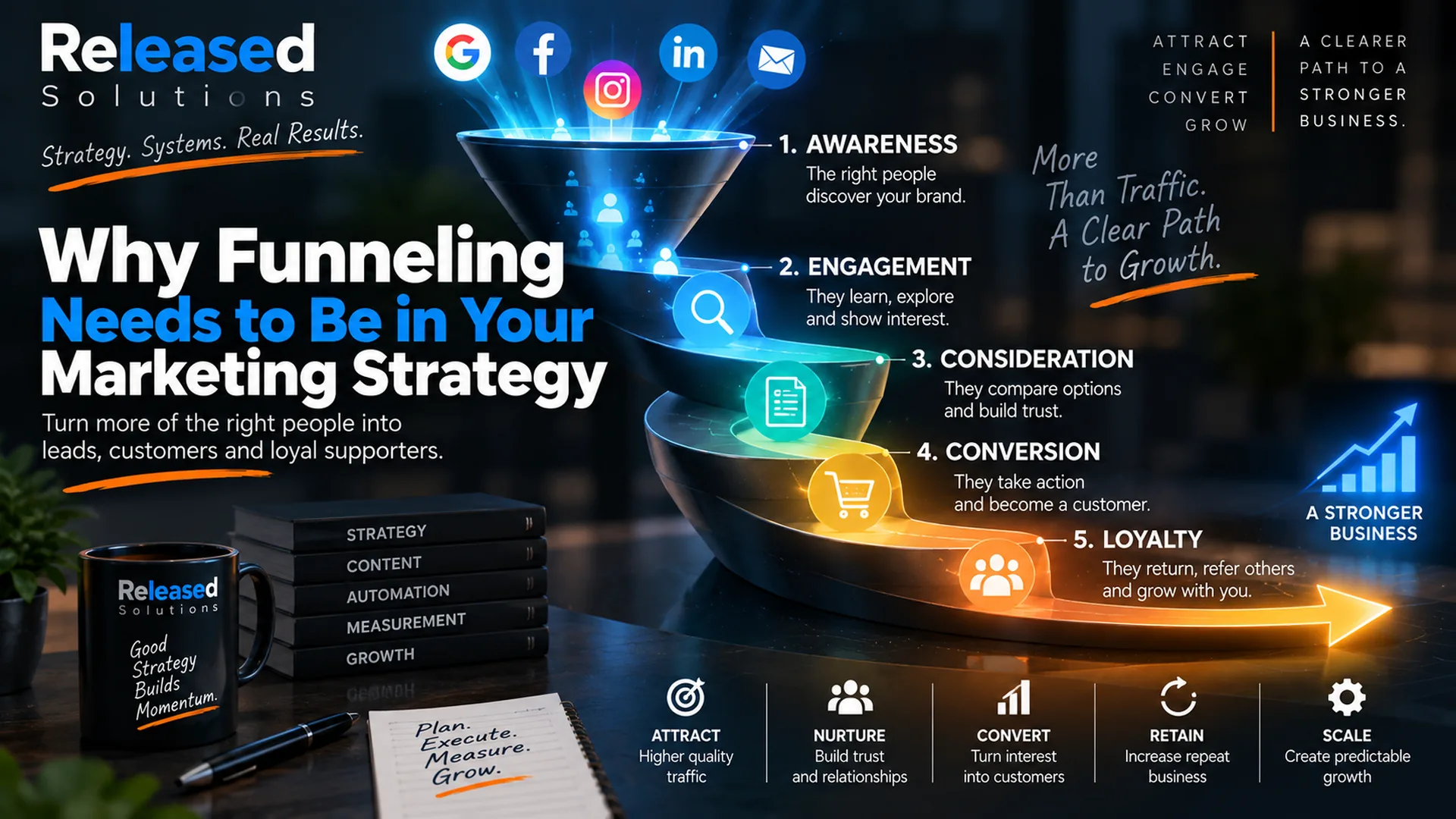
| Stage | Customer mindset | Business job | Useful measures |
|---|---|---|---|
| 1. Awareness | I may have a problem or need. | Get discovered by the right people. | Reach, impressions, new users, search visibility, qualified traffic |
| 2. Engagement | This might be relevant to me. | Earn attention and give the person a reason to continue. | Engaged visits, content interaction, video views, email signups, return visits |
| 3. Consideration | Can I trust this business and is it right for me? | Answer questions, reduce uncertainty, and prove value. | Service/product views, reviews, comparison content, lead starts, calls, assisted touchpoints |
| 4. Conversion | I am ready to take the next step. | Make the desired action clear, easy, and measurable. | Leads, purchases, appointments, conversion rate, CPA/CPL, revenue |
| 5. Loyalty | Was this worth it, and should I come back? | Deliver value, follow up, and make repeat business easier. | Repeat purchases, retention, reviews, referrals, customer value |
1. Awareness: Attract the Right People, Not Just More People
Awareness can come from Google Search, paid advertising, social media, AI citations, local listings, referrals, video, events, email forwards, partnerships, and other sources.
The objective is not maximum traffic. It is qualified attention. Ten thousand visitors who have no realistic reason to buy can be less valuable than 500 people who match the problem your business solves.
Treating impressions, followers, or website sessions as the business result. They are inputs. The question is whether the right people are entering the system.
2. Engagement: Give Attention Somewhere to Go
Once someone discovers the business, the next job is to help that person understand why they should keep paying attention.
This is where educational content, useful landing pages, email subscriptions, videos, FAQs, social proof, tools, guides, and strong service pages matter. Different visitors need different amounts of information before they are ready to act.
A funnel gives that content a purpose. Instead of publishing because "we need content," you can ask which stage the content is designed to move forward.
3. Consideration: Build Trust Before Asking for the Sale
Consideration is where many small-business funnels become thin. The business runs an ad, sends someone to a page, and immediately asks for a sale or consultation.
Some customers are ready. Many are not.
They may need reviews, examples, pricing context, a comparison, a case study, a demonstration, an explanation of your process, or simply another interaction with the brand. The goal is to reduce uncertainty without creating unnecessary friction.
4. Conversion: Make the Next Action Obvious and Measurable
Conversion is not always a purchase. It may be an appointment, quote request, phone call, reservation, application, form submission, trial, download, or another action that moves the relationship forward.
The business should define which actions actually matter and measure them consistently. Google Analytics 4 supports funnel explorations that show how users progress through defined steps and where they abandon the process. Google specifically documents funnels for lead generation and ecommerce behavior. That makes funnel thinking something you can test with actual behavior rather than a diagram on a whiteboard.
Do not optimize a campaign around every click or scroll simply because the action is easy to measure. Connect measurement to meaningful business outcomes.
5. Loyalty: The Funnel Does Not End at the Sale
Acquiring a customer and then disappearing is expensive marketing.
The post-conversion experience can include onboarding, service communication, email/SMS follow-up with proper consent, loyalty, customer support, review requests, replenishment reminders, renewals, referrals, and useful content.
A satisfied customer can return, spend more, leave a review, refer someone else, or create word-of-mouth that feeds awareness at the top of the system.
Funnel View
Organizes people by relationship or readiness stage. Helps the business plan content, offers, and KPIs. Asks: What should we do at this stage?
Customer Journey View
Maps the actual touchpoints and experiences people have. Reveals that real behavior is rarely linear. Asks: What is the customer actually doing?
You Need Both
GA4's Funnel Exploration lets you define and analyze steps and abandonment. Path Exploration lets you examine the sequences of pages and events users actually take. Define the funnel. Then investigate how real people move around it.
Do Not Give the Last Click All the Credit
A funnel also helps explain why last-click thinking can distort marketing decisions.
A person might discover the business through social media, later search Google, read a blog post, return through an email, and finally convert after clicking a branded ad.
Google Ads explicitly notes that customers may interact with multiple ads before converting and that last-click attribution ignores earlier interactions. Its data-driven attribution model can distribute conversion credit across contributing ad interactions based on account data.
The lesson for a small business is not that every touchpoint deserves equal credit. It is that the final click may not be the only marketing activity that created the customer.
If you turn off every activity that does not appear as the last click, you can accidentally remove the marketing that creates demand earlier in the journey.
How Content Fits Into the Funnel
| Stage | Content examples | Primary purpose |
|---|---|---|
| Awareness | Search articles, social posts, videos, educational content, local/AI visibility | Get discovered |
| Engagement | Guides, FAQs, newsletters, useful tools, explainer videos | Earn more attention |
| Consideration | Case studies, reviews, comparisons, process pages, demos | Build trust and reduce uncertainty |
| Conversion | Landing pages, offer pages, booking, checkout, quote/request forms | Make action easy |
| Loyalty | Onboarding, customer education, email/SMS, loyalty, support content | Create repeat value and advocacy |
How Paid Advertising Fits Into the Funnel
Paid advertising does not belong only at the bottom of the funnel.
Search campaigns can capture existing demand. Social and video campaigns can introduce the business before someone is actively searching. Remarketing can re-engage people who showed interest. Conversion-focused campaigns can pursue leads or purchases.
The important part is matching the campaign objective, creative, landing experience, and KPI to the stage you are trying to influence.
This is also why I do not like judging every campaign by the same metric. Awareness activity may be evaluated differently from a lead-generation campaign, while both still need to connect to the larger business goal.
Build the Funnel Backward From the Business Goal
The easiest way to build a practical funnel is to start at the bottom.
If the business needs 20 new customers, ask how many qualified leads are normally required to produce those customers. Then ask how many total leads are needed to create those qualified leads. Then estimate how much qualified traffic is required to create the leads. See Digital Advertising Campaign Planning for the full backward-math approach.
20 customers ÷ 25% qualified-lead close rate = 80 qualified leads
If 50% of incoming leads are qualified, ~160 total leads are required.
These are hypothetical planning assumptions, not industry benchmarks. Use your own data.
Marketing Budget Calculator
What will your revenue goal really cost in ads?
Work backward from your revenue goal to the customers, leads, clicks and monthly ad budget it takes, using 2026 benchmarks for 23 industries.
Audience Fit
Are the right people entering the system? Fix upstream when the wrong audience is landing.
Trust Depth
Do we have proof, reviews, examples, and a process story? Consideration usually breaks here.
Conversion Clarity
Is the next action obvious, easy, and measurable? Match the ask to the stage.
A Simple 2026 Funnel Framework
Six stages, in the order I use them when I sit down with a small business to plan a quarter. Not every business needs every stage equally, and the order can loop back on itself when a customer refers someone new.
ATTRACT
Bring the right audience into your ecosystem through search, advertising, social, referrals, content, and other discovery channels.
ENGAGE
Give people useful reasons to spend more time with the business.
NURTURE
Answer questions, build trust, and continue the relationship when someone is interested but not ready.
CONVERT
Make the appropriate next action easy, clear, and measurable.
RETAIN
Deliver value after the sale and create reasons to return.
AMPLIFY
Turn satisfied customers, reviews, referrals, and advocacy into new awareness.
Give Every Stage a KPI
| Stage | Primary KPI questions |
|---|---|
| Awareness | Are the right people seeing and finding us? |
| Engagement | Are they consuming enough value to continue? |
| Consideration | Are they showing intent and building trust? |
| Conversion | Are they taking meaningful actions at an acceptable cost? |
| Loyalty | Are customers returning, staying, reviewing, and referring? |
Review the funnel as a system. A weak conversion rate may be a landing-page problem, but it can also be an audience problem upstream. A lead-quality problem may be caused by an offer attracting the wrong people. A retention problem can make an otherwise efficient acquisition campaign unprofitable.
The funnel helps you diagnose where the problem actually lives.
Automation and AI Should Support the Funnel, Not Replace It
Automation can route leads, trigger follow-up, score intent, personalize messages, and keep opportunities from falling through the cracks. AI can help create content, analyze patterns, support campaign optimization, and accelerate execution.
But automation cannot fix a funnel that has no clear offer, no meaningful conversion, no follow-up process, and no definition of a qualified customer.
The strategy still comes first.
It cannot decide what the system should accomplish unless the business has defined the goal, customer, offer, and conversion path.
Marketing Funnel Planner
The six-stage framework, KPI questions, and backward-math worksheet in one printable PDF. Free download, no form.
The Takeaway
The marketing funnel is not valuable because every customer follows it neatly from top to bottom.
It is valuable because your business needs a structure for attracting attention, earning trust, converting demand, following up, and creating repeat value.
Map the customer journey to understand what people actually do. Use the funnel to decide what your marketing should do about it.
Last fact-check: September 2026
Build the System, Not Just the Campaign
Released Solutions helps small businesses connect strategy, websites, content, advertising, analytics, CRM, and automation into measurable customer-acquisition systems.
If your marketing today is a stack of one-off campaigns without a system behind them, we can help you connect the funnel to the outcome.
Isolated campaigns get attention. Systems win customers.
Kenneth Durrum, Released Solutions