

Google Review Automation: The Follow-Up Your Business Is Missing
Google review automation should be part of the customer journey, not something a business remembers to do when it needs more reviews. The opportunity is to ask customers for honest feedback at the right time, avoid repeatedly bothering loyal customers, and address problems when something goes wrong.
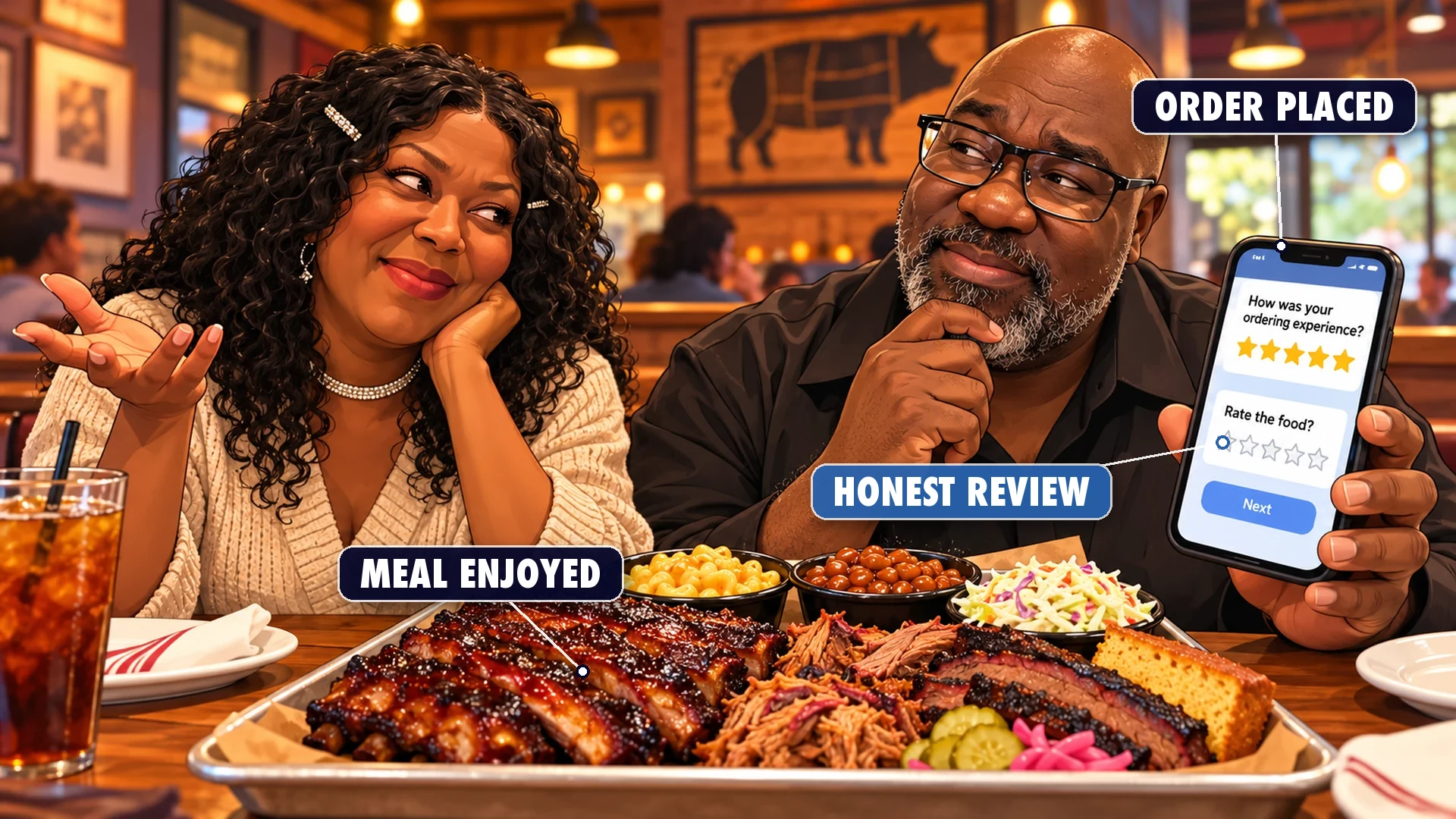
I recently had an experience ordering barbecue from one of my favorite restaurants that reminded me how much opportunity businesses are leaving on the table. And it started with my wife asking a very reasonable question.
Why Was I Being Asked to Review Food I Hadn't Eaten Yet?
I love a good barbecue place, and there's one my family has been ordering from for years. We've ordered over the phone plenty of times, so we already know the food is good. This time, I placed the order online.
During the ordering process, I was asked to rate my experience. Everything had gone smoothly, so I gave the ordering experience five stars. Then the system directed me to rate the food.
My wife looked at me and said, "How are they going to ask you to rate the food and experience when we haven't even eaten yet?" She had a point!
I could tell them the website worked. I could tell them the ordering process was easy. But I couldn't honestly evaluate the food from an order that hadn't even arrived.
Now here's where it gets interesting. We have been customers of this restaurant for years. We love the place, and we've ordered there numerous times. Yet despite all those previous experiences, I had never left a review. Until today.
That got me thinking about how many other customers are doing business with companies they genuinely appreciate but never think to leave a Google review. And how many businesses are missing the opportunity simply because they aren't asking at the right time?
What Is the Difference Between Rating an Order and Reviewing the Business?
An ordering experience and a completed customer experience are two different things. Businesses should recognize that distinction when designing their review workflows.
Think about a restaurant. You might have a fantastic experience placing the order online, only to discover later that your food arrived cold or something was missing. Or perhaps the ordering process was frustrating, but the meal itself was excellent.
Both experiences provide valuable information. The business should want to know whether its ordering system works properly. It should also want feedback about the food, service, accuracy, and overall experience. But those questions belong at different points in the customer journey.
There's another distinction worth understanding. A rating submitted inside a restaurant's ordering software isn't necessarily a public Google review. The ordering platform may collect private feedback, while Google's own review system operates separately.
A business needs to understand which system is asking the question, where the answer is stored, and what happens afterward. Otherwise, it might believe it is collecting Google reviews when it is actually collecting internal customer satisfaction ratings. Both are useful, but they serve different purposes.
When Should a Business Ask Customers for Google Reviews?
The right moment is generally after the customer has had a genuine opportunity to experience the product or service. That moment will be different depending on the business.
For a restaurant, placing the order is not the same as eating the food. For a contractor, scheduling an appointment is not the same as completing the work. A well-designed automation should follow the actual customer journey.
Consider these examples:
Confirm the order, complete pickup or delivery, and allow enough time for the customer to enjoy the meal before sending a follow-up.
Request feedback after the job is completed, not when the estimate is accepted.
Follow up after the customer has received the service or reached a meaningful milestone.
Consider the difference between completing a purchase and allowing the customer to receive or use the product.
Trigger appropriate follow-up after the appointment is completed rather than immediately after booking.
Notice what all these examples have in common. The review request is tied to the customer experience, not simply to a transaction appearing in a database.
That distinction is important because scheduled automation and triggered business workflows work best when the system understands what event should start the process.
How Can You Automate Google Review Requests After a Sale?
Most businesses already have some way of identifying completed transactions. The opportunity is to connect that information to a customer follow-up process. A basic workflow could involve seven steps.
Identify the completed transaction
The system recognizes that an order was fulfilled, an appointment was completed, or a service was finished. That event starts the workflow.
Check the customer record
The automation identifies the customer and verifies whether an appropriate communication channel and permissions are available. It also checks whether the customer has recently received a review invitation.
Check previous review activity
If the business has verified that the customer already left a Google review, the system should generally avoid asking again. If review completion cannot be verified, the system should apply reasonable limits rather than repeatedly sending invitations.
Wait for the appropriate moment
Timing depends on the experience. A restaurant might wait until after the meal. A service business might follow up after the work is completed and the customer has had time to evaluate it.
The system should not ask customers to evaluate something they haven't experienced.
Send the review invitation
An eligible customer receives a simple, neutral message thanking them for their business and inviting an honest Google review. The message contains the business's official Google review link.
Handle customer feedback
If the business receives a complaint or identifies a poor public review, a separate service recovery workflow can notify the appropriate employee. This process should not interfere with the customer's opportunity to leave an honest Google review.
Measure what happened
The business records which invitations were sent, which customers declined further messages, and how its overall Google review count changes. Where available, it can also measure message delivery and link clicks.
Just remember that clicking a review link does not prove a customer submitted a review. The entire process should be designed around customer experience, not simply generating another automated message.
What If Your Business Doesn't Have an Online Ordering System?
You do not need online ordering to automate customer follow-up. Businesses that take telephone orders, serve walk-in customers, or perform services at customer locations can build similar workflows.
My barbecue restaurant provides a perfect example. For years, we ordered by phone. The restaurant had opportunities to ask for a review during those transactions, but nothing prompted me to leave one.
Now imagine if the restaurant had collected my email address, with appropriate permission, and connected it to its order management process. Once an order was completed, the business could send an appropriate follow-up inviting me to share my experience.
The same principle applies to businesses without sophisticated software. A small business might collect customer information through:
- A basic order form.
- A service completion form.
- An appointment or booking system.
- A point-of-sale receipt.
- A customer database or CRM.
- A paper form that employees enter into a digital system.
The business should clearly explain how customer information will be used and honor communication preferences. Even simple form data routed into a spreadsheet can demonstrate how existing tools connect. Email and text workflows also need to comply with applicable marketing and privacy requirements.
For businesses that aren't ready for automation, Google's official review QR code can be displayed on receipts, invoices, or appropriate customer communications. I have covered additional uses for these tools in my guide to QR codes for small businesses.
The important part is creating a repeatable process.
Should You Keep Asking Loyal Customers for Google Reviews?
No. A good review automation system should remember confirmed reviewers and avoid repeatedly asking them to review the same business.
Imagine someone who orders from their favorite restaurant every Friday. They left a Google review months ago, giving the restaurant five stars and explaining why they love the food. Does that restaurant need to ask them for another Google review every Friday?
Of course not. Yet a poorly designed automation could do exactly that. This is why a customer database and review history matter.
An intelligent workflow should distinguish between a customer who has never received a review invitation, someone recently invited, and someone whose review has been confirmed. There is a limitation, however.
The Google Business Profile review API provides review information to authorized applications, but it does not automatically connect every Google reviewer to a customer's email address or transaction history. Businesses cannot assume that every review can be matched reliably to a customer record.
The system may need customer confirmation, authorized review data, or manual verification. When a match cannot be established, reasonable communication limits are especially important.
The objective is to make the customer feel appreciated, not harassed.
What Should Happen When Someone Leaves a Low-Star Review?
Negative feedback should trigger an appropriate customer service response. It should never be used as a reason to prevent customers from receiving a Google review invitation.
This is an important distinction. Suppose a customer reports that their food arrived cold. The business should want someone to investigate the problem, contact the customer when appropriate, and determine what went wrong.
That complaint could trigger a service recovery workflow. A public one-star review might similarly notify the manager, create a follow-up task, and prompt a professional response.
But the business must not design a system that asks customers to rate their experience privately and sends only the five-star customers to Google. Google specifically prohibits selectively soliciting positive reviews or discouraging negative ones under its review and rating manipulation policies.
Offering discounts or other incentives in exchange for reviews, review changes, or review removal is also prohibited. The solution is to separate two objectives.
- Review collection: Give eligible customers a fair opportunity to share an honest public review.
- Customer service recovery: Identify dissatisfied customers and work to resolve their concerns.
Both processes can operate together. And if the business learns something useful from a complaint, that information should influence future service improvements.
Why Should You Examine Google's Actual Review Form?
Google's review experience may collect more than a star rating and written comment. Depending on the business, Google can ask customers about specific services or aspects of their experience.
This is another part of the process I recommend business owners investigate. Google explains in its documentation about reviews for service businesses that certain businesses can receive ratings for individual aspects of a customer experience.
Google may also ask reviewers which services or tasks the business performed. That information can come from the business's service list, its website, or other sources Google considers authoritative.
Here's the important part. The business does not control Google's review questions. Google decides which questions appear, and business owners cannot simply redesign Google's review interface.
However, owners can make sure their Google Business Profile categories, services, and other business information accurately describe what they do. I recommend that small business owners examine the actual review experience associated with their business.
Start by looking at the official review link and the questions Google presents to genuine customers. Review the services and categories listed on the Business Profile, and compare those details with what the business really offers.
If customers are being asked about services the business no longer provides, or if important services are missing from the profile, that deserves attention. Do not assume that correcting a service list will guarantee particular review questions. The business can improve its information, but Google controls the form.
The goal is to understand the customer experience from beginning to end. And while you're examining the review process, take another look at how customers discover the business through Google's Map Pack and local search.
Google confirms that review volume and positive ratings can contribute to local rankings, although reviews are only one part of its ranking systems.
Why Are Specific, Genuine Customer Reviews More Useful Than Calling Yourself the Best?
A business owner can call their restaurant the best barbecue in town all day long. That is advertising. A real customer describing the brisket they ordered, the price they paid, or whether the meal was worth the money gives another person something more concrete to evaluate.
The same applies beyond restaurants. A homeowner might describe whether a contractor arrived on time and explained the estimate. A retail customer might discuss product quality and value. A client might describe how clearly a professional explained the service. These are examples of the kinds of details customers may choose to share, not instructions for what to write.
Google says authentic reviews help people make informed choices, and it confirms that review quantity and positive ratings can contribute to local ranking. What Google does not promise is that a mention of a particular dish, price, or keyword will improve a business's ranking.
AI search adds another reason to care about genuine, specific experiences. Depending on the system and the sources it retrieves, a review, listing, or third-party page might contribute evidence about what customers actually experienced. That is different from proving that any particular AI platform reads every Google review or ranks businesses by the words in those reviews.
I've written about the related possibility of AI-generated summaries drawing on customer reviews. The opportunity is to earn credible evidence rather than rely entirely on what the business says about itself.
But don't turn this into keyword coaching. Google's rules prohibit businesses from requesting that reviewers include specific content. Invite customers to share an honest experience in their own words, then listen to the details they voluntarily provide.
Could Better Automation Double Your Google Review Count?
It could, depending on how many review opportunities your business currently misses. But I would never promise that automation alone will double your reviews.
Consider a hypothetical example. A business completes 100 customer transactions each month. Currently, only 30 customers receive review invitations, and six submit reviews. That represents a 20% response rate among invited customers.
Now imagine that a workflow audit identifies more eligible customers who should be receiving invitations. If the business increases appropriate invitations to 60 customers and maintains the same hypothetical response rate, it would receive 12 reviews instead of six.
That would double the number of monthly reviews without requiring additional transactions. Of course, actual results will vary.
Not every transaction represents a unique customer. Some customers have already reviewed the business, some may decline communications, and others simply may not respond.
The point is not to chase a guaranteed percentage. The point is to identify legitimate opportunities that the business may already be missing. And you cannot identify those opportunities without examining the process.
How Would I Audit a Business's Google Review Workflow?
I would start by following the customer journey from the first interaction through completion and follow-up. Before recommending new software, I would want to understand what the business already uses.
Here are the questions I would investigate.
Where does the customer journey begin?
Does the customer submit an online order, call the business, walk through the door, or schedule an appointment? The starting point tells us what information the business has available.
When is the experience actually complete?
An order placed is not necessarily an order fulfilled. We need to identify the event that makes a review invitation appropriate.
Is customer contact information being collected?
Does the business collect email addresses or telephone numbers with appropriate permission? Where is that information stored, and can it be connected to completed transactions?
What happens after the transaction?
Does the customer receive a receipt, thank-you message, satisfaction survey, or review invitation? Are those communications delivered at the correct stage?
Does the system remember previous customers?
Can it identify someone who was recently invited to leave a review? Can it recognize verified reviewers and avoid sending unnecessary requests?
What does Google ask customers about the business?
Look at the actual Google review experience and the business information associated with it. Make sure the business understands what Google controls and what can be improved in its own Business Profile.
How are complaints handled?
Does negative feedback create an actionable task? Or does it sit unanswered in an inbox until someone notices?
What results are being measured?
How many completed transactions occur? How many customers are eligible for follow-up? How many invitations are delivered?
How many new Google reviews appear over time, and how quickly are customer concerns resolved? Those answers can reveal missed opportunities without requiring the business to purchase an entirely new technology platform.
The Caveman Marketing Quiz
How much of your marketing is still hunting by hand?
Rate 15 statements and see which of five stages your marketing is in, from The Hunter to The AI-Augmented Entrepreneur.
Where Does AI Fit Into Review Automation?
AI can help analyze customer feedback and identify service problems, but the basic automation does not require artificial intelligence. Sending a review invitation after a completed transaction is something ordinary workflow automation can already accomplish.
AI becomes more interesting when the business starts collecting meaningful feedback. For example, AI could help summarize recurring complaints, identify patterns in customer experiences, or organize feedback by service type.
It could alert a manager when multiple customers mention the same issue. It might also prepare a suggested response for an employee to review before posting.
But I would not allow an AI system to invent facts about a customer experience or make commitments on behalf of the business without appropriate authorization. The goal is to improve how the business understands and responds to customers.
That can also strengthen a broader customer follow-up and lead nurturing strategy. After all, customers do not stop being valuable the moment they complete their purchases.
Frequently Asked Questions About Google Review Automation
Can I automate Google review requests without a CRM?
Yes. A business can begin with its existing order forms, customer records, email tools, or review QR codes. A CRM can make the process easier to manage, but it is not the only possible starting point.
Can I customize the questions Google asks reviewers?
No. Google controls its review interface and determines which additional questions appear. Businesses can maintain accurate categories, services, and attributes, but they cannot directly customize Google's review form.
Should I ask customers for reviews immediately after checkout?
Only when the customer has already had a genuine opportunity to evaluate the experience being reviewed. It may be appropriate to ask about the checkout process immediately, but feedback about the delivered product or completed service belongs later in the journey.
Can I automatically detect customers who already left reviews?
Sometimes an existing review can be verified and matched to a customer, but Google does not provide a guaranteed transaction-to-review match. A responsible workflow should acknowledge that limitation and use reasonable frequency controls.
Can I send unhappy customers into a separate workflow?
Yes. You can create a customer service recovery process for complaints and poor satisfaction ratings. However, you cannot selectively withhold Google review invitations from unhappy customers while soliciting public reviews only from satisfied customers.
Should I ask reviewers to mention a dish, a price, or a service?
No. Invite customers to write honest reviews in their own words rather than coaching them to include specific details or keywords. The most convincing specifics are the ones customers choose to share without prompting.
Closed Mouths Don't Get Fed
My barbecue experience reminded me of something simple. I had been a satisfied customer for years, but I had never left that restaurant a review. It wasn't because I disliked the restaurant. Nobody had given me a well-timed reason to think about sharing my experience.
And when the ordering system finally did prompt me, part of the experience was being evaluated before it had even happened. Imagine how many businesses are in that same situation.
They may have loyal customers who return every week, contractors who finish excellent jobs, or service professionals who consistently deliver good results. But nobody has connected the completed transaction to an appropriate customer follow-up.
I believe many businesses could find meaningful opportunities simply by reviewing their existing customer journey. They don't necessarily need new customers, expensive software, or complicated technology to begin improving their review process.
They need to identify where the experience ends, when the follow-up should begin, and what happens when the customer responds. I've always said that closed mouths don't get fed.
But when your business processes dozens or hundreds of transactions, you shouldn't have to depend on someone remembering to ask every single time. Build the workflow. Make it respectful. Give customers an opportunity to share their honest experiences.
A handful of good reviews tells people you've made some customers happy. A steady stream of honest reviews helps people understand why.
Could Your Business Be Missing Review Opportunities?
At Released Solutions, I help businesses identify opportunities through ongoing online presence management for small businesses by examining the processes and systems they already use. A customer journey and review workflow audit can uncover missed follow-ups, disconnected systems, repetitive messages, and opportunities to respond more effectively to customer feedback.
Sometimes the most valuable improvement isn't building something new. It's connecting what your business already has.
Last fact-checked: October 24, 2026.