
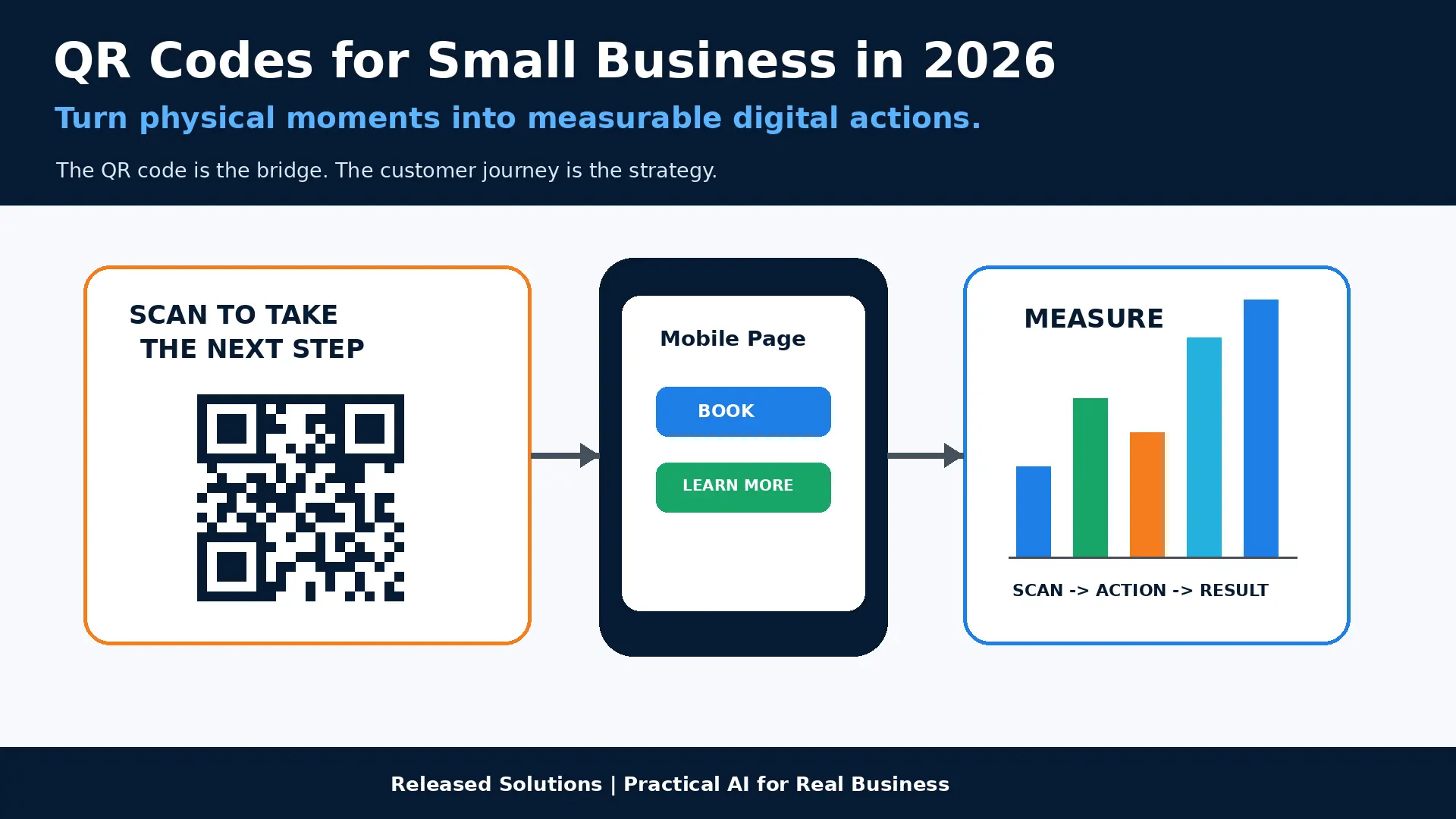

QR Codes for Small Business in 2026: Turn Physical Moments Into Measurable Digital Actions
QR codes used to feel like a novelty. Today they are simply part of how customers move between physical and digital experiences. A customer sees a table tent and opens a menu. A homeowner scans a sign and requests an estimate. An event attendee scans a badge and registers. A customer scans a receipt and leaves feedback. A product owner scans packaging and opens instructions. A nonprofit supporter scans a display and reaches a donation page.
The technology is not the interesting part anymore. The customer journey is.
A QR code is not the campaign. It is the bridge between a physical moment and the digital action you want the customer to take.
My framework: PHYSICAL MOMENT → SCAN → MOBILE EXPERIENCE → ACTION → MEASUREMENT → IMPROVEMENT.
Start With the Action, Not the Code
Putting a QR code on every surface without a clear reason is not innovation. It is clutter. Design for the customer's job, then choose the bridge.
| Stage | What has to happen |
|---|---|
| PHYSICAL MOMENT | A real-world context where the customer would want a next step (menu, sign, packaging, event). |
| SCAN | A well-printed code with contrast, quiet zone, safe placement and readable alternative. |
| MOBILE EXPERIENCE | A fast, trustworthy, mobile-friendly landing page that matches the physical promise. |
| ACTION | A clear next step: book, order, register, review, download, donate, save contact. |
| MEASUREMENT | Scans + UTM + GA4 + CRM tie the physical touchpoint to a real business outcome. |
| IMPROVEMENT | What the data says about placement, message and destination that we should change. |
Physical to Digital Is a System
The moment, the code, the landing page, the action and the measurement all have to work together.
Static vs. Dynamic Is a Business Choice
Dynamic redirects offer flexibility but add vendor and domain dependency. Static codes are simpler but harder to change.
Trust Belongs on the Destination
Customers cannot see a URL inside a QR code. Recognizable domains and clean pages are how the code earns trust.
PHYSICAL MOMENT, SCAN, MOBILE EXPERIENCE, ACTION, MEASUREMENT, IMPROVEMENT
Static vs. Dynamic QR Codes
The physical technology is boring. The system around it is not.
| Characteristic | Static | Dynamic / managed redirect |
|---|---|---|
| Destination | Encoded directly; generally cannot be changed after printing. | Redirect layer can allow destination changes. |
| Tracking | Use tagged destination URLs and web analytics; the code itself may not provide scan analytics. | Provider may add scan analytics on top of web analytics at the destination. |
| Longevity | No redirect-vendor dependency when it points directly to a domain you control. | Depends on continued control of redirect / service / domain. |
| Best fit | Stable destinations and simple long-lived use cases. | Campaigns where destinations, tests or scan-level reporting may need to change. |
| Key warning | A wrong printed destination usually means reprinting. | Understand vendor lock-in, domain ownership, pricing and what happens if service ends. |
Eight Ways Small Businesses Actually Use QR Codes in 2026
The first question is not where can we put a QR code? Ask what useful action a customer would want to take at this physical moment.
MENUS, SERVICE LISTS AND PRODUCT INFORMATION
Restaurants helped make QR codes familiar, but the idea extends beyond menus. A salon links to services. A contractor links to project examples. A manufacturer links to specifications. A retailer links to product details. A museum links to deeper information. The important part: the destination is designed for the phone. Do not make someone scan a code and then fight with a desktop PDF or tiny website.
REVIEWS AND CUSTOMER FEEDBACK
A QR code can shorten the distance between a good experience and the place a customer can share it: a receipt, counter card, follow-up material. Do not use QR codes for manipulative review practices. Google prohibits incentives in exchange for reviews, discouraging negative reviews, or selectively soliciting positive ones. The code should make authentic feedback easier, not decide what the customer is allowed to say.
APPOINTMENTS, REGISTRATIONS AND EVENTS
QR codes work when the customer is already physically present and needs to complete a digital step. Event registration, appointment booking, check-in, class schedules, waitlists, RSVPs, tickets. A printed invitation or sign can connect directly to the appropriate action instead of asking someone to remember and type a URL later.
LEAD CAPTURE FROM SIGNS, VEHICLES AND PRINT
A yard sign, vehicle, direct-mail piece, brochure, trade-show display, property sign or storefront window can create interest when the customer cannot immediately have a conversation. A QR code provides the next step, but the landing page should match the context. A roofing sign might lead to a mobile estimate request. A real-estate sign might lead to property details. Do not send every scan to the home page. See also website engagement.
WI-FI, CONTACT INFORMATION AND CONVENIENCE
QR codes can remove small points of friction. A Wi-Fi QR code helps guests connect without typing a long password. A vCard-style code helps someone save contact information. A location QR code opens directions. A support code opens a help page. Convenience is a legitimate marketing benefit because good customer experience is part of marketing.
PACKAGING, INSTRUCTIONS AND POST-PURCHASE SUPPORT
A QR code on packaging can connect the customer to setup instructions, how-to videos, warranty information, care instructions, replacement parts, support, registration, reorder pages and related products. A small physical label becomes a much larger digital support experience, and the digital information can evolve without printing an entire manual into the box.
NONPROFIT DONATIONS AND COMMUNITY CAMPAIGNS
A nonprofit can use QR codes at events, signs, printed materials and presentations to shorten the path to a donation, volunteer form, registration page or campaign story. The destination still needs to earn trust: use the organization's recognizable domain, explain what the action is, and make the donation or registration experience mobile-friendly. A QR code can remove typing. It cannot replace credibility.
PAYMENTS NEED EXTRA TRUST
QR-based payment experiences can be convenient, but money raises the security stakes. The customer should know who is being paid. Use a trusted payment provider or the business's secure payment experience. Avoid improvised payment flows or unfamiliar domains. Businesses should also inspect public QR codes for tampering, because scammers have covered legitimate codes with malicious replacements. The FTC has specifically warned consumers about unexpected QR codes leading to spoofed sites or malware.
If the QR code says SCAN TO BOOK, the customer should not land on a generic home page and hunt for the booking button. Match the destination to the physical promise. The bridge worked; do not let the landing page fail.
Make Each Scan Measurable
One of the strongest reasons to use a web URL behind a QR code is measurement. UTM parameters make each physical touchpoint identifiable, and GA4 Traffic Acquisition can read that campaign data. Related: AI citations and GA4 conversions.
| Layer | What it tells you |
|---|---|
| QR platform / UTM | Which physical touchpoint produced the scan and click. |
| Landing page (GA4) | What the visitor did on the page: engagement, scroll, key events. |
| Key event | Booking, form submission, purchase, download, donation. |
| CRM | Whether the lead progressed to a real customer. |
| Customer / revenue | The business outcome the physical placement actually produced. |
A code with 1,000 curiosity scans and zero useful actions may be less valuable than a code with 100 scans and 20 qualified leads. Measure the job the code was created to perform.
The Landing Page Is More Important Than the QR Code
The QR code takes seconds to create. The destination deserves more attention.
| Landing page checklist | What to verify |
|---|---|
| MOBILE | Designed for phones first, not squeezed from a desktop layout. |
| FAST | Loads quickly on cellular, not only on office Wi-Fi. |
| MATCHED MESSAGE | Headline matches what the physical piece promised. |
| CLEAR NEXT STEP | One primary action, obvious in the first screen. |
| TRUST | Recognizable brand, business info, HTTPS, professional design. |
| MINIMAL FRICTION | Ask only for what the moment justifies. |
Print, Placement and Real-World Testing
QR codes need enough visual clarity for a camera to read them. Test the real application rather than trusting a single universal inch measurement.
| Print + placement basic | What to test in real conditions |
|---|---|
| CONTRAST | Dark code, light background, not embedded in a busy graphic. |
| QUIET ZONE | Preserve the blank margin around the symbol. |
| REAL-WORLD SIZE | Test at actual scanning distance, not on-screen only. |
| DISTANCE | Sign viewed from the sidewalk needs a bigger code than a table tent. |
| LIGHTING | Test under the lighting where the code will actually appear. |
| MULTI-DEVICE TEST | iPhones, Androids, older cameras. |
| SAFE PLACEMENT | Never require scanning while driving, climbing or standing in traffic. |
Not everyone can or wants to scan. Include a readable short URL or another way to complete the action. A branded short path like releasedsolutions.net/guide is more confidence-building than an opaque string. QR code + readable destination is often stronger than QR code alone.
QR Security and Trust
A QR code hides the destination until the device interprets it. That makes QR phishing (sometimes called quishing) possible. FTC and CISA have warned about malicious QR codes leading to spoofed sites or malware. Use domains customers recognize. Avoid unnecessary redirect chains. Protect the account controlling dynamic codes with MFA. Inspect codes placed in public spaces for stickers or tampering.
| Security checkpoint | Why it matters |
|---|---|
| RECOGNIZABLE DOMAIN | Customers should not be led to random unfamiliar domains. |
| MFA | The account controlling dynamic codes is now a business asset. |
| PUBLIC-CODE INSPECTION | Physical codes can be covered by malicious stickers; inspect regularly. |
| NO UNNECESSARY REDIRECTS | Chains of redirects make phishing easier to hide. |
| VERIFY PAYMENT DESTINATION | A QR code does not make a payment page trustworthy. |
QR Codes, NFC and Short URLs Solve Related Problems
| Bridge | When it fits |
|---|---|
| QR code | Print, signage, packaging, receipts, event materials, low-cost, works with the camera. |
| NFC tap | Compatible devices, close-range tap experiences, hardware-driven interactions. |
| Short URL | Spoken advertising, radio, video overlays, business cards, when the user must type or say it. |
Sometimes the strongest execution uses more than one option: SCAN THE QR CODE or VISIT example.com/offer. Do not trap the customer inside the technology. Related: short links.
AI can brainstorm physical touchpoints, draft landing-page copy, create campaign variations, suggest UTM naming, analyze results and develop instructions. It does not replace understanding the customer moment, choosing the right action, building the destination or measuring what happens next.
When a QR Code Is the Wrong Choice
| When a QR code is the wrong choice | Because... |
|---|---|
| The customer is already on the website. | A normal link works better. |
| The user must scan from the phone showing it. | Give them a tappable link instead. |
| The placement makes scanning unsafe. | A parking-lot or traffic-facing sign is not the moment. |
| The destination adds no value. | A QR code that leads to a page that says the same thing as the sign is clutter. |
| The campaign cannot maintain the destination. | A dead-linked code damages trust more than helps it. |
| You cannot explain why the customer should scan. | Novelty is not a strategy. |
PURPOSE what customer action should happen? CONTEXT where will the person see the code? DESTINATION is the page mobile, trustworthy and matched to the promise? DOMAIN will the customer recognize it? TRACKING UTM, campaign, dynamic analytics? DESIGN contrast and quiet space? PLACEMENT safe and comfortable at the real distance? ALTERNATIVE readable URL when appropriate? SECURITY account control, MFA, code inspection? TESTING real print, multiple devices? MEASUREMENT business action after the scan, not just scan counts? MAINTENANCE who keeps the destination alive?
Menus and Product Info
Not just restaurants: salons, contractors, retailers, manufacturers and attractions all have real reasons for a scan-to-detail experience.
Reviews, Registrations, Lead Capture
Signs, vehicles, tents, direct mail and trade-show displays turn interest into a specific mobile next step.
Wi-Fi, Support and Payments
Convenience and support are marketing. Payments are more sensitive; verify the destination and use trusted providers.
Measurement That Matters
Scan → landing page → engagement → key event → CRM → revenue. Track the job the code was created to do.
The Takeaway
QR codes are useful because they make a physical moment actionable. That is all. And that is powerful.
A menu becomes interactive. A sign becomes measurable. Packaging becomes support. A receipt becomes feedback. A trade-show display becomes lead generation. A printed campaign becomes trackable.
The best QR strategy is not about putting more black-and-white squares into the world. It is about designing a better bridge. Physical moment, useful digital destination, clear action, measurable result. Then improve what happens on the other side of the scan.
Want to Connect Your Offline Marketing to Measurable Digital Results?
Released Solutions helps small businesses connect websites, analytics, QR campaigns, advertising, CRM and customer journeys so physical marketing can lead to useful, measurable digital action.
Related reading: online marketing strategy, social media optimization, email marketing for small business.
Want to Connect Your Offline Marketing to Measurable Digital Results?
Released Solutions helps small businesses connect websites, analytics, QR campaigns, advertising, CRM and customer journeys so physical marketing can lead to useful, measurable digital action.
A QR code without a useful destination is decoration. A QR code with a matched landing page and clear next step is a bridge.
Kenneth Durrum, Released Solutions