

Lead Nurturing in 2026: How to Turn Interest Into Customers Without Automating the Relationship Away
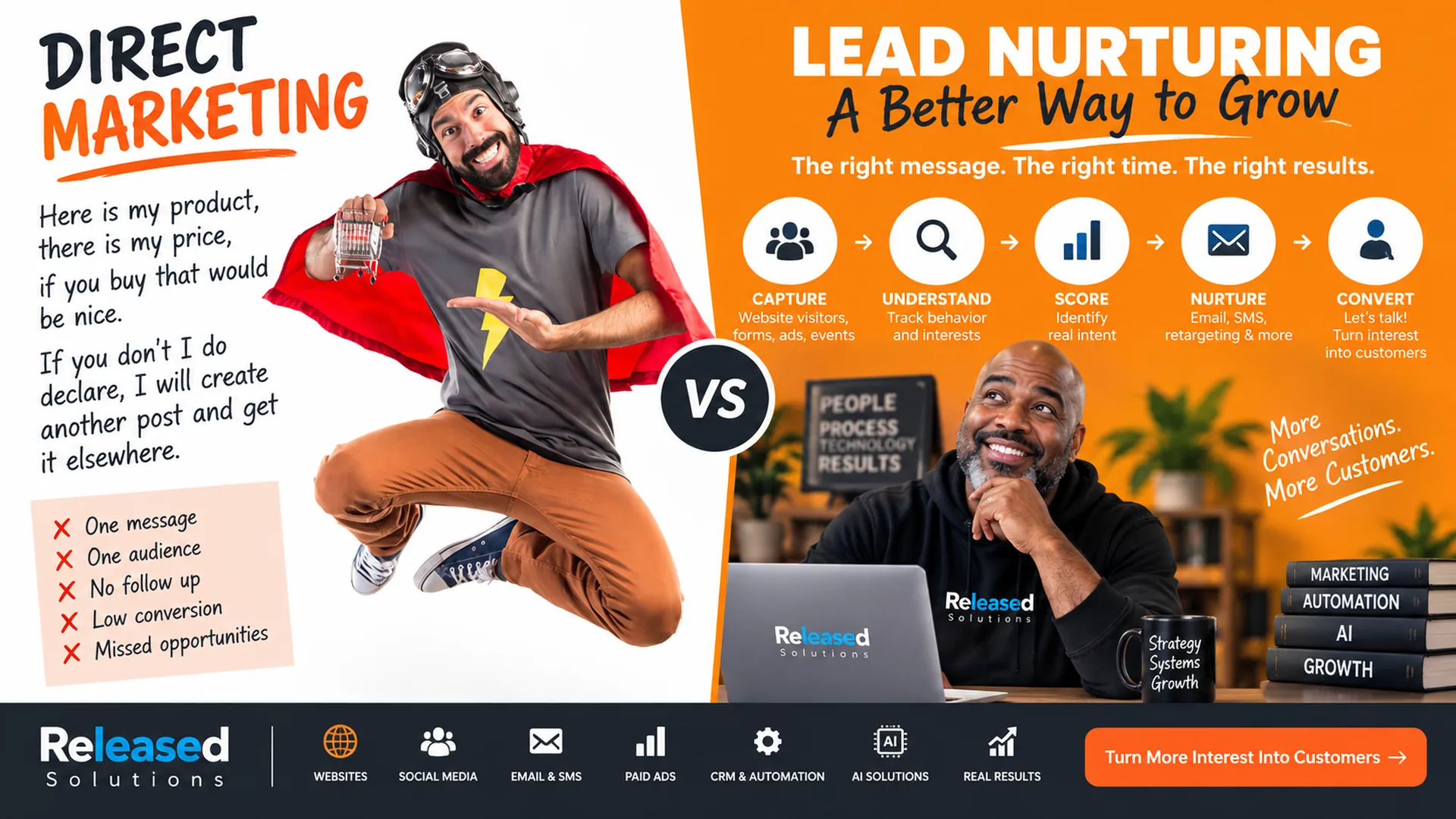
The original version of this article used a deliberately ridiculous direct-marketing rhyme: "Here is my product, there is my price, if you buy that would be nice." The joke still works because the mistake is still common.
A business gets someone's attention, immediately asks for the sale, gets no response, and then repeats the same pitch somewhere else.
That is not lead nurturing. It is repetition.
Modern lead nurturing is the system between "I am interested" and "I am ready." It helps a business understand the lead, continue the relationship, recognize buying intent, and involve a real person when the timing is right.
The goal is not to automate more messages. The goal is to make sure the right person gets the right follow-up at the right time, without good opportunities falling through the cracks.
Direct Marketing and Lead Nurturing Are Not the Same Job
Direct-response marketing can be useful when a person is ready to act. A strong offer, clear price, and obvious call to action can convert demand that already exists.
The problem is assuming every person who notices the business is already at that stage.
A first-time website visitor may be researching. A guide downloader may be educating themselves. A returning visitor may be comparing providers. Someone who repeatedly visits pricing, submits a consultation form, or replies with a specific question is behaving differently.
The Released Solutions Lead Nurturing Framework
Seven steps, in the order I use them when a business asks how to stop losing leads between "interested" and "closed."
CAPTURE
Collect the lead and the context around it. Source, form, page, offer, campaign, and any known customer information should enter the CRM cleanly.
UNDERSTAND
Use explicit information and behavioral signals to understand what the person appears to care about. One download should not automatically equal sales readiness.
SCORE
Combine fit, engagement, and intent so the team can prioritize. Scores should be transparent enough that a person can understand why a lead became important.
NURTURE
Deliver useful follow-up based on stage and interest. Email, SMS, content, retargeting, and sales tasks can all play a role, but relevance matters more than message volume.
DETECT INTENT
Watch for meaningful changes: a pricing-page visit, repeat website activity, a high-intent form, renewed engagement, or a direct question.
HAND OFF
When the lead demonstrates enough intent, stop hiding behind automation. Route the opportunity to the right person with the context needed for a useful conversation.
LEARN
Measure what moved leads forward, what caused disengagement, how quickly people were contacted, and which sources actually produced customers. Feed the answer back into steps 1-6.
Capture More Than an Email Address
Lead nurturing starts with data quality. If the CRM only knows a name and email address, the system has very little context for deciding what should happen next.
Capture what is useful and appropriate: lead source, campaign, form, service interest, location, company, page context, and other information the prospect intentionally provides. Connect website and campaign activity where your technology and privacy practices allow it.
The objective is not to collect everything. It is to collect enough context to make the next interaction more useful.
Lead Scoring Should Answer More Than "Did They Click?"
A useful scoring model usually needs more than engagement. Separate the ideas of fit, engagement, intent, and recency.
| Signal type | Examples | Question it helps answer |
|---|---|---|
| Fit | Company size, geography, role, service need, budget range | Does this person or organization resemble a customer we can actually serve? |
| Engagement | Email clicks, content downloads, repeat visits, event participation | Is the person paying attention? |
| Intent | Pricing visits, consultation requests, service/product page visits, replies, repeat high-value actions | Is the person moving closer to a buying conversation? |
| Recency | How recently the meaningful activity occurred | Is the interest fresh enough to deserve priority? |
Salesforce's current lead-nurturing guidance describes AI systems using explicit information such as role and company size alongside implicit signals such as website activity and engagement. It also emphasizes that scoring criteria should be transparent and understandable.
Recency deserves special attention. A pricing-page visit this morning is not equivalent to a pricing-page visit nine months ago. Modern scoring systems should account for intent decay so stale activity does not keep a lead artificially hot.
A lead can earn priority through behavior, but inactivity should eventually reduce that priority.
Good Automation
Send requested information, record the source, create a follow-up task, remind the team, route a qualified lead, update lifecycle stage, and suppress irrelevant messages.
Bad Automation
Send the same sequence to everyone, ignore replies, keep selling after a meeting is booked, continue promotional SMS after the context changes, treat every click as buying intent.
Better Automation
Use rules and AI to assist prioritization, then create explicit human-takeover points. The workflow should know when to hand the conversation to a person.
AI Can Make Nurturing Smarter, but It Needs Boundaries
Workflow automation is excellent at repeatable work: enrolling the right record, sending an appropriate message, updating CRM fields, creating tasks, routing a lead, alerting a salesperson, and maintaining consistent follow-up.
HubSpot's current workflow platform, for example, describes high-intent actions such as demo requests and pricing questions as triggers that can start automated nurture processes, routing, and task creation.
But automation becomes a problem when the workflow keeps talking after the prospect has clearly asked for a human conversation. That is why the three automation levels above matter, and why the human takeover points below matter more.
AI can analyze engagement patterns, summarize history, recommend next actions, help segment leads, and draft personalized communication. Salesforce's 2026 guidance describes AI lead nurturing as combining scoring, dynamic segmentation, personalized outreach, and real-time prioritization.
That does not mean the AI should own the relationship. Clean CRM data matters. Scoring logic matters. Privacy and consent matter. And the business needs clear boundaries for which touchpoints can be automated and which should involve a person.
The best use of AI is often to help the human understand what happened before the conversation begins. Summarize the history. Rank the signals. Suggest a next action. Then let the person take the call.
Lead Capture Readiness
If 50 people filled out your form this week, would every one get a fast, relevant reply?
Answer 16 quick questions and scan your lead page to see whether your offer, form, follow-up and tracking are ready before you spend more on traffic.
Build Human Takeover Points Into the Workflow
These are the moments where automation should pause and a real person should pick up the conversation.
Fit Signals
Role, industry, company size, geography. Does this look like a customer you can serve?
Engagement Signals
Opens, clicks, downloads, repeat visits. Is the person paying attention over time?
Intent Signals
Pricing visits, demo requests, specific questions, repeat high-value actions. Time to hand off.
Recency Signals
How fresh is the activity? Decay old scores so a nine-month-old visit does not read as urgent.
A Practical Small-Business Nurture Stack
You do not need every layer on day one, and you should not add a new tool because it exists. Start with a website that captures cleanly, a CRM that holds the record, a workflow that routes urgent leads, and a person who owns the conversation. Add the rest when the volume justifies it.
| Layer | Job |
|---|---|
| Website, landing pages, and forms | Create the conversion and capture useful context. |
| CRM | Maintain the contact record, source, stage, ownership, and history. |
| Workflow automation | Move data, send messages, create tasks, route leads, and trigger alerts. |
| Email and SMS | Deliver timely follow-up where consent and context support it. |
| Behavior and scoring | Identify engagement, intent, fit, and recency. |
| AI assistance | Summarize, classify, recommend, personalize, and help prioritize. |
| Sales / human follow-up | Handle questions, discovery, objections, proposals, and relationship building. |
| Analytics | Measure progression, speed, source quality, and revenue outcomes. |
Lead Nurturing Workflow Planner
The seven-step framework, scoring signal grid, human-takeover checklist, and stack layers in one printable PDF. Free download, no form.
What Should a Lead Nurturing Sequence Actually Say?
A nurturing sequence should not be five versions of "Are you ready to buy yet?"
The content should reduce uncertainty and help the prospect make a decision. Depending on the business, that can include an answer to the question that brought them in, a useful guide, an explanation of process, a relevant case study, a comparison, a common objection, a demonstration, a reminder, or an invitation to talk.
The message should change as the person's behavior changes.
Measure Progress, Not Just Email Opens
Email opens and clicks can be useful engagement signals, but they are not the business outcome.
Measure the journey: lead response time, progression between stages, qualified-lead rate, meetings or consultations, opportunities, conversion rate, sales cycle, source quality, reactivation, and ultimately revenue or customer value. For the conversion side of the journey, see 5 Steps to Improve Your Website Conversion Rate.
Different stages deserve different KPIs. Early-stage leads may be evaluated on engagement and progression. High-intent leads should be evaluated on speed, contact, opportunity creation, and conversion.
The Biggest Lead Nurturing Mistakes
Treating every lead the same. A guide download and a quote request should not enter identical workflows.
Scoring without decay. Old activity can make a dead lead look hot.
Automating without ownership. Every qualified lead should have a clear person or team responsible for the next action.
Sending without listening. Replies, bookings, objections, and changes in status should alter the workflow.
Building too much too early. A small business can begin with a few meaningful triggers and handoffs before building complex AI scoring.
Measuring activity instead of outcomes. A busy automation is not automatically a productive automation.
Start Simple, Then Make the System Smarter
A small business does not need enterprise complexity on day one.
Start with the moments that matter most: what happens after a form is submitted, how quickly high-intent leads are contacted, what information is sent next, who owns the opportunity, when a lead should be reactivated, and how results are measured. See Online Presence Management for how these pieces fit into a broader marketing system.
Once those basics work, add scoring, branching, AI assistance, retargeting, deeper segmentation, and more sophisticated lifecycle automation.
Technology should make the relationship easier to manage. It should not make the relationship feel less human.
The Takeaway
Lead nurturing is not a drip campaign. It is not a CRM feature. It is not AI sending personalized emails at scale.
It is a business process for recognizing that interest develops over time.
Capture the lead. Understand the context. Score the signals. Nurture with relevance. Detect intent. Hand the opportunity to a person. Learn from the outcome.
Turn More Interest Into Customers
Released Solutions helps small businesses connect websites, CRM systems, automation, email/SMS, paid media, AI, and reporting into practical lead-nurturing workflows.
If your leads are landing somewhere and going quiet, we can help you find where the process is dropping them and rebuild the follow-up around real customer intent.
Automate the repetition. Keep the relationship.
Kenneth Durrum, Released Solutions