
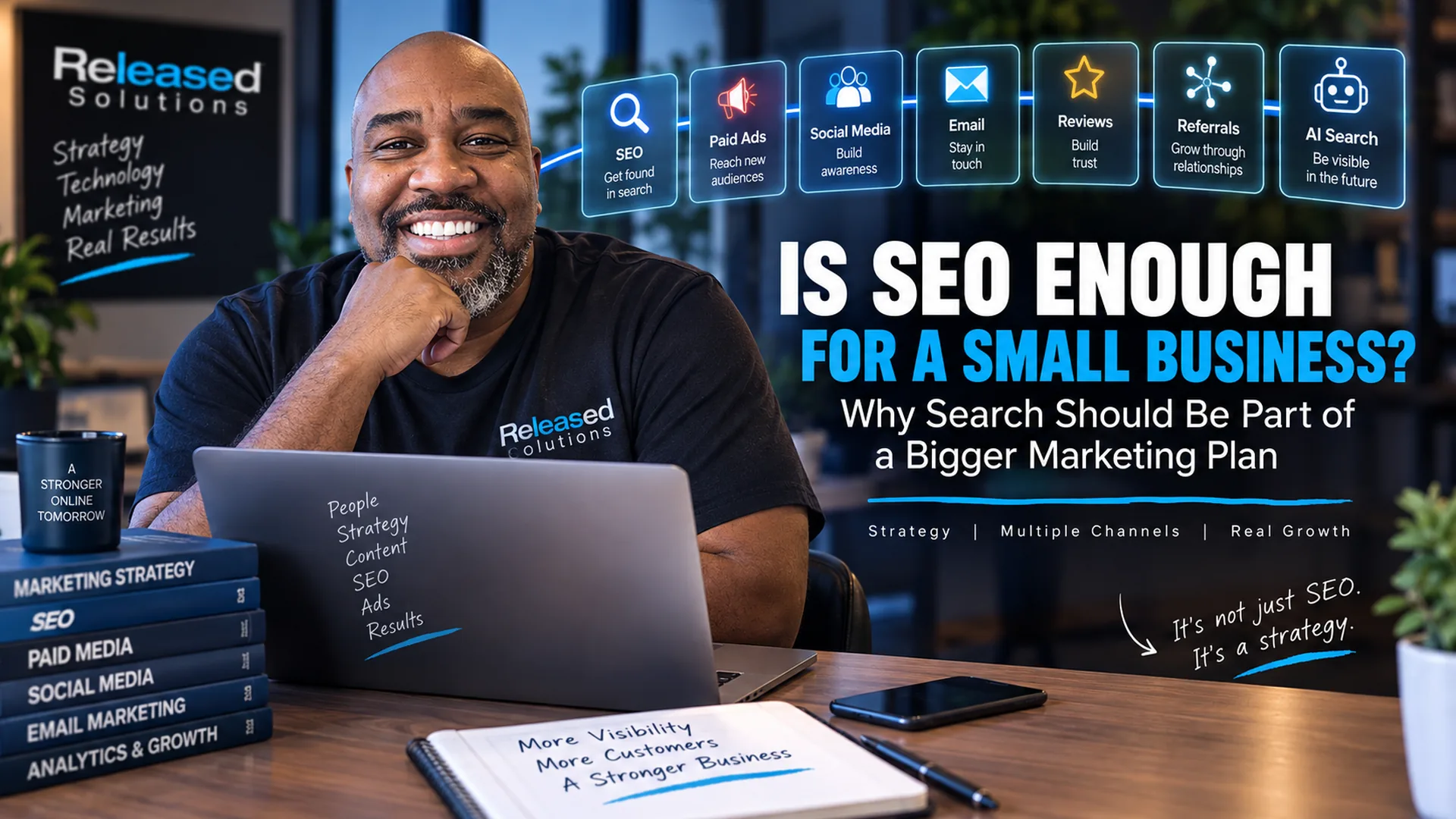

Is SEO Enough for a Small Business? Why Search Should Be Part of a Bigger Marketing Plan
I have been saying some version of this for years: SEO should be part of your marketing plan, but it should not automatically become the entire marketing plan.
My original article tried to prove that point with a simple traffic calculation. I assumed a 3% search click-through rate and a 3% website conversion rate, then worked backward from a target number of leads.
The instinct was right. The math was too rigid.
There is no universal 3% click-through rate or 3% website conversion rate that every small business should use. Performance changes by industry, search intent, ranking position, geography, device, offer, competition, website experience, brand recognition, and dozens of other variables.
SEO Still Matters. A Lot.
SEO is not dead, and AI has not made search optimization irrelevant.
Google's own guidance for AI Overviews and AI Mode says the same foundational SEO practices remain relevant. Pages still need to be crawlable, indexable, technically sound, useful, reliable, and eligible to appear in Google Search before they can become supporting links in Google's AI search experiences.
That makes SEO part of the foundation for both traditional search visibility and Google's evolving AI experiences.
But "SEO matters" and "SEO should do everything" are two very different statements.
SEO can capture existing demand. It cannot manufacture unlimited search demand.
Imagine there are a finite number of qualified people in your market actively searching this month for the exact service you sell.
Better SEO can help you become more visible to those people. Better content can help you rank for more relevant questions. Local SEO can improve your visibility around geographic intent. Stronger search snippets can improve the chance that someone chooses your result.
But SEO cannot force another 10,000 qualified people to suddenly search for a service they were not already thinking about.
That is where the rest of the marketing system matters.
Demand Capture and Demand Creation Are Different Jobs
I find this distinction useful when explaining channel strategy to small-business owners.
Demand capture reaches people who are already expressing intent. Search is one of the clearest examples. Someone searches for an urgent-care clinic, accountant, contractor, attorney, restaurant, marketing agency, or software solution because a need already exists.
Demand creation introduces, educates, reminds, demonstrates, or builds familiarity before that active search happens. Social media, video, display advertising, community activity, partnerships, email, direct outreach, public relations, and other forms of marketing can all participate in creating or strengthening demand.
A healthy marketing plan can do both. If you only create demand but give people no good way to find and verify you later, you waste opportunity. If you only capture existing demand, growth may be limited by how much qualified demand already exists.
A Better Small-Business Marketing Framework
Think of marketing in six stages. Not every business needs every channel at every stage, but every business benefits from knowing which stage a given effort is supposed to move.
BE DISCOVERED
SEO, local search, business listings, AI discovery, referrals, social profiles, advertising, and other visibility channels help the right people encounter the business.
BUILD TRUST
Your website, content, reviews, expertise, brand consistency, case studies, social proof, and reputation help people decide whether you deserve consideration.
CREATE DEMAND
Content, social media, video, paid media, email, partnerships, events, and outreach can educate audiences and create reasons to pay attention before they are ready to buy.
CAPTURE INTENT
Organic search, paid search, local results, AI citations, direct visits, branded search, landing pages, and clear calls to action capture people when interest becomes active.
CONVERT
The website, offer, sales process, forms, calls, scheduling, follow-up, and user experience turn attention into leads, customers, patients, members, or sales.
RETAIN
Email, CRM automation, service quality, remarketing, customer communication, reviews, loyalty, and follow-up help keep customers engaged and generate repeat business or referrals.
Search Console: Google Search Visibility
Impressions, clicks, click-through rate, position, queries, pages, devices, countries, and other search-performance data. Google says AI Overviews and AI Mode are included in Search Console's overall Web search traffic.
GA4: Channels and Sessions
Traffic acquisition reports compare organic, paid, social, email, referral, direct, and now AI Assistant channels. GA4 helps show how sessions and key events arrive from each channel.
Your Business System: The Real Outcome
CRM, call tracking, scheduling, ecommerce, or sales system. This is where you confirm what actually became a real business result. A channel that produces fewer visits but more customers can beat a channel with a mountain of low-intent traffic.
SEO Participates in More Than One Stage
One reason I no longer like describing SEO as a single traffic channel is that good search work supports several stages of the customer journey.
An educational article can introduce your expertise. A service page can capture high-intent searches. A well-maintained Google presence can reinforce trust. Structured, useful content can become a source that search engines and AI systems surface. Technical SEO can make sure the content is actually accessible to search systems.
So SEO is not disappearing. The measurement environment around search is expanding.
Google Analytics now includes an "AI Assistant" default channel for traffic arriving from sources such as ChatGPT, Gemini, DeepSeek, Copilot, and Grok. Google's AI Overviews and AI Mode are excluded from that GA4 channel because those experiences remain part of Google Search.
For a small business, this is another reason not to judge the entire marketing plan from one ranking report. Look at Search Console, GA4, and your business system together.
Stop Planning SEO Around One Keyword
The original version of this article advised assigning one or two target keywords to each page. That reflects an older way of thinking about SEO.
Pages still need a clear topic and purpose, and keyword research remains useful. But a useful page can naturally answer a group of closely related questions, concepts, and search intents.
Google's current guidance emphasizes helpful, reliable, people-first content and says the same fundamentals apply to its AI search experiences. I would rather build the best page we can for a real customer question than force every paragraph around a single keyword count.
Start With the Business Goal, Then Work Backward
This is the part of the old article I would absolutely keep. Do not begin with traffic. Begin with the business outcome.
If a company wants 20 new customers per month, the planning conversation should work backward from that goal. How many qualified opportunities are required? How many leads normally become customers? How many website visits, phone calls, appointments, consultations, store visits, or other actions typically produce those leads? Which channels have historically produced those opportunities?
The numbers should come from the business's own data whenever possible, not a universal benchmark pulled from an article. If you would rather work with a coach on this, digital marketing coaching is one way to think through it.
AI Assistant Channel
GA4 tracks ChatGPT, Gemini, DeepSeek, Copilot, and Grok as its own channel.
AI Overviews in Search
Google's AI Overviews and AI Mode are included in Search Console's Web search traffic.
Topical Pages Win
One page per keyword is out. Answer a real customer question completely.
People-First Content
Google says the same helpful, reliable, people-first fundamentals apply to AI Search.
The Best Channel Mix Depends on the Business
A plumber responding to emergency searches has a different marketing problem than a luxury clothing brand creating desire. A neighborhood restaurant has a different customer journey than a B2B manufacturer. A medical practice has different restrictions and conversion points than an ecommerce store.
Some businesses should invest heavily in SEO. Others need paid search because waiting for organic visibility would slow growth. Some need strong local visibility and reviews. Others need social content, video, email nurturing, events, partnerships, outbound sales, or marketplace visibility.
There is no responsible marketing strategy that begins with, "Every business should spend the same percentage on SEO." The strategy should follow the customer, the economics, the competitive environment, and the data.
Suppose a business wants 20 new customers in a month.
If its actual historical close rate is 25%, it would need roughly 80 qualified leads to produce 20 customers. If 10% of qualified website visitors become leads, 80 leads would require roughly 800 qualified visits.
Where can those 800 qualified visits realistically come from?
| Channel | Example contribution to 800 qualified visits |
|---|---|
| Organic search | ~300 |
| Paid search | ~175 |
| Social and paid social | ~100 |
| Email and returning | ~75 |
| Referrals and partners | ~100 |
| AI assistants, local, direct, other | ~50 |
These numbers are only an example. Your actual mix could look completely different. The business goal determines the required opportunity. The channel mix determines how we pursue it.
Marketing Budget Calculator
What will your revenue goal really cost in ads?
Work backward from your revenue goal to the customers, leads, clicks and monthly ad budget it takes, using 2026 benchmarks for 23 industries.
Paid Advertising and SEO Should Not Be Enemies
I have always loved running ads, and I also spend a significant amount of time working on technical SEO. I do not see those disciplines as competing religions.
Paid search and digital advertising can put a business in front of high-intent prospects while organic visibility is still developing. Advertising can test offers and messaging quickly. SEO can build durable discoverability around topics and services that matter. Remarketing can reconnect with people who discovered the business through search but were not ready to act.
The right question is not "SEO or ads?" It is "What job does each channel need to perform?"
Social, Email, Reviews, and Referrals Fill Gaps Search Cannot
Social media can create familiarity before someone searches. Email can nurture people who already know the business. Reviews can reduce uncertainty when someone is comparing options. Referral relationships can create opportunities that search volume never captures.
Someone may see a social post, hear about the business from a friend, search the company name on Google, read reviews, visit the website, leave, return through an email, and finally schedule a call. Marketing rarely happens in the neat single-channel sequence that reporting dashboards make us wish it did.
Measure the System, Not Just the Ranking
Rankings still matter, but they are one signal. Look at Search Console for query and page visibility, GA4 for how sessions and key events arrive across channels, and your CRM, scheduling, or sales system for the actual business result.
A channel that produces fewer visits but more customers can be more valuable than a channel that produces a mountain of low-intent traffic.
So, Is SEO Enough?
Sometimes SEO can become the dominant acquisition channel for a business. That is very different from deciding in advance that it should be the only one.
SEO works best as part of a larger system that makes the business discoverable, credible, memorable, measurable, and easy to choose. The mix does not have to be complicated. A small business may only need a strong website, local SEO, useful content, Google Ads, reviews, email follow-up, and consistent measurement. Another business may need a completely different combination.
The objective is not to be everywhere. The objective is to be present in the places that matter at the stages that matter.
What I Would Change From My Original Advice
I would keep the central conclusion: do not expect SEO to carry the entire marketing plan without first doing the math. But I would throw away the universal 3% assumptions. I would stop planning pages around rigid one-keyword formulas. I would add paid media, social, email, reviews, referrals, local visibility, AI discovery, conversion optimization, CRM follow-up, and retention to the conversation. And I would measure the entire journey rather than celebrating traffic that never becomes business.
SEO is important. Strategy is bigger.
Final Thought
Do not ask whether SEO is the only marketing plan your business needs.
That is the question a growing small business should be asking. If you would rather have someone help connect the pieces, that is what Online Presence Management is built for.
Build the Marketing Plan Around the Goal
Released Solutions helps small businesses connect SEO, paid advertising, content, websites, analytics, automation, and online presence management into a marketing system built around measurable business goals.
If you have traffic but not enough leads, ads without reliable tracking, SEO without a conversion strategy, or several marketing channels that are not working together, it may be time to look at the whole system.
SEO is important. Strategy is bigger.
Kenneth Durrum, Released Solutions