
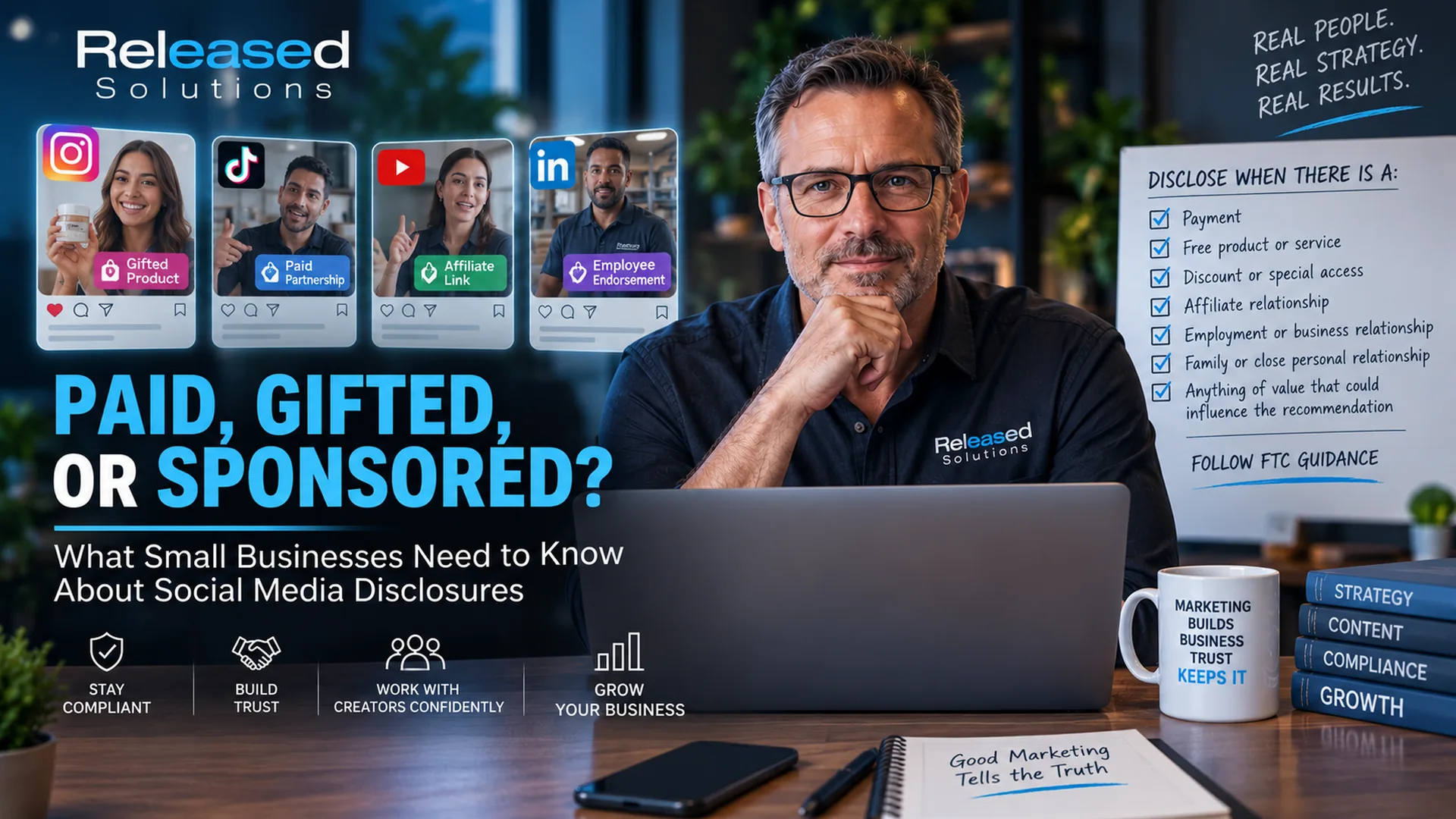

Paid, Gifted, or Sponsored? What Small Businesses Need to Know About Social Media Disclosures
When I first wrote about branded content on social media, the conversation was heavily focused on Facebook's branded-content tools and the mechanics of labeling a paid relationship on a platform.
The underlying issue was important. The instructions were not built to age well.
Platforms change. Menus move. Twitter becomes X. Creator tools get renamed. New formats appear. Affiliate marketing grows. Employees become brand advocates. Businesses send free products to creators. AI makes it easier to generate testimonials and even synthetic personalities.
But the basic marketing question has remained surprisingly consistent:
That is the question small businesses should learn to ask.
Branded Content Is Bigger Than a "Paid Partnership" Label
Social media platforms use terms such as branded content, paid partnership, sponsored content, creator partnerships, and affiliate content. Those platform labels matter, but they are not the whole compliance picture.
The Federal Trade Commission's Endorsement Guides apply longstanding truth-in-advertising principles to endorsements and testimonials, including social media. The FTC revised those guides in 2023 to address modern advertising practices more directly.
A key concept is the material connection. The FTC describes this as a relationship between an endorser and a marketer that could affect the weight or credibility people give the endorsement.
That connection is not limited to a cash payment.
When Should a Relationship Be Disclosed?
Here are six common material connections small businesses run into. If any of these describes a person promoting your business, there is likely something to disclose.
You Paid the Creator
If your business pays someone to promote, recommend, demonstrate, or feature your product or service, the relationship should be made clear to the audience.
You Gave Them Something Free
A free product, free service, trip, meal, event access, or other perk can create a material connection. The FTC specifically tells influencers to disclose free or discounted products and services.
You Gave Them a Discount or Special Access
A meaningful discount, exclusive access, or another benefit may matter to how an audience evaluates the recommendation.
They Earn Through an Affiliate Relationship
If the person can receive a commission or other benefit when people buy through a link or code, the financial relationship should be disclosed clearly.
They Work for Your Business
Employees promoting their employer can have a material connection that audiences may not otherwise understand. Employment relationships are specifically included in FTC disclosure guidance.
They Are Family or Have a Personal Relationship
Family and personal relationships can matter too. The question is whether knowing about that relationship could affect how a reasonable consumer evaluates the endorsement.
Did the person receive money, products, services, discounts, commissions, employment, special access, or another meaningful benefit or relationship connected to the endorsement?
If yes, ask whether an ordinary viewer would clearly understand that relationship from the post itself.
If the relationship is not already obvious, disclose it clearly and conspicuously.
This is a practical screening question, not a substitute for legal advice.
What Does "Clear and Conspicuous" Mean on Social Media?
The disclosure should be easy for ordinary people to notice and understand.
The FTC advises putting the disclosure with the endorsement itself and making it hard to miss. A disclosure hidden on a profile page, buried at the end of a long post, placed after a "more" expansion, or mixed into a pile of hashtags can be easy for consumers to overlook.
Simple language often works best. The FTC gives examples such as "Ad," "Advertisement," and "Sponsored." A straightforward sentence can be even clearer: "Thanks to ABC Company for the free product."
Hashtags are not automatically the problem. #ad or #sponsored can be useful when they are prominent and understandable. The problem is burying the disclosure or using vague shorthand that an ordinary person may not understand. Terms such as "sp," "spon," or "collab" may be too ambiguous.
The Format Matters Too
A disclosure that works in a written post may not work in a video, Story, Reel, livestream, podcast clip, or image. Put the disclosure where people actually experience the endorsement, not somewhere you hope they will eventually find it.
Written and caption posts
Put the disclosure high in the caption where readers see it before the "more" expansion. Do not bury it under a stack of hashtags. Simple wording such as "Ad" or "Sponsored" is fine when it is clearly visible.
Image, Story, and Reel content
The FTC recommends making the disclosure visible on the image itself when needed, and giving viewers enough time to notice and read it. A caption alone may not be enough for format-first content.
Video, livestream, and podcasts
Disclosures should appear in the video, not only hidden in the description. Audio plus on-screen text is more likely to be noticed. Livestreams may need the disclosure repeated because viewers can enter at different points.
Do Not Assume the Platform's Paid Partnership Tool Is Enough
Use platform disclosure tools when the platform requires them. Meta, for example, says branded content involving an exchange of value, including gifted products, requires its paid partnership label.
But the FTC warns businesses and influencers not to assume that a platform's built-in tool automatically satisfies every disclosure obligation. The FTC looks at whether the disclosure is actually clear and conspicuous in context, including placement, readability, and clarity.
Safer workflow: follow the platform's branded-content requirements and make the relationship clear in the content itself.
What About Affiliate Links?
Affiliate marketing is a common place where businesses and creators can become too casual about disclosure.
If someone earns a commission when a follower purchases through a link or promotional code, that financial incentive can affect how consumers evaluate the recommendation.
Do not assume that "affiliate link" buried somewhere on a website or profile is enough for every social post. The relationship should be clear where the endorsement and link are presented.
A useful disclosure does not have to sound like a legal document. It has to communicate the relationship.
Employees, Owners, Friends, and Family Can Create Disclosure Issues Too
Influencer marketing makes people think about celebrities and creators, but the same principle can apply much closer to home.
If an employee enthusiastically recommends the company they work for without making the employment relationship apparent, consumers may evaluate that recommendation differently than they would if they knew the person worked there.
The FTC's guidance identifies employment, personal, and family relationships as possible material connections. That means a small business should have a policy for employees and people closely connected to the business who post endorsements, reviews, or promotional content.
Transparency is not something that should be left entirely to the influencer.
Establish
Set disclosure requirements before content is produced. Reviews, employees, affiliates, and creators all follow the same rules.
Brief
Put the requirements in the campaign brief or agreement. Specify wording, placement, format, and platform tools.
Review
Look at the actual content before or shortly after it goes live. Verify the disclosure is close to the endorsement and easy to notice.
Address
When a disclosure is missing or unclear, fix it. Repeat problems belong in your internal marketing policies, not in future campaigns.
Reviews and Testimonials Now Deserve Their Own Compliance Conversation
Social media endorsements overlap with another major area of marketing: reviews and testimonials.
The FTC's Consumer Reviews and Testimonials Rule covers, among other things, fake or false reviews, including certain AI-generated fake reviews, buying reviews conditioned on positive or negative sentiment, and some insider reviews that fail to disclose the reviewer's connection to the business.
What that means for your business: AI has made it technically easy to manufacture reviews, testimonials, profile photos, and persuasive marketing copy. Easy does not mean acceptable.
Do not ask AI to invent satisfied customers. Do not buy fake reviews. Do not condition incentives on a customer giving you a positive review. And do not make an insider endorsement look like an independent customer's opinion.
Trust is difficult to build and remarkably easy to damage.
Who Is Responsible: The Influencer or the Business?
Do not assume disclosure is only the creator's problem.
FTC guidance makes clear that influencers have responsibilities, but marketers also have obligations. A business working with endorsers should educate them about disclosure expectations and monitor the content being produced on its behalf.
Compliance works better when it is part of the campaign process rather than something somebody remembers after the post goes live.
A Practical Small-Business Disclosure Checklist
Before approving sponsored, gifted, affiliate, employee, testimonial, or creator content, walk through this list:
✓ Is there a material connection between the person and the business?
✓ Would an ordinary viewer already understand that relationship?
✓ Is the disclosure close to the endorsement and hard to miss?
✓ Is the wording simple and understandable?
✓ Does the disclosure work in the actual format, such as video, image, Story, livestream, or written post?
✓ Are we also using any disclosure tool required by the platform?
✓ Is the endorsement truthful and based on the person's real experience?
✓ Are any performance, health, financial, or other objective claims supported?
✓ Are employees, affiliates, and creators following the same campaign rules?
✓ Has someone on the business side actually reviewed the campaign for these issues?
Good Marketing Does Not Need to Hide the Relationship
Some businesses worry that a disclosure such as "Sponsored" or "I received this product for free" will weaken the recommendation. That is the wrong way to look at it.
If the recommendation only works when the audience misunderstands the relationship, that is not a strong marketing strategy.
A transparent creator partnership can still be persuasive. An employee can still genuinely love the company. A customer can receive an incentive to provide honest feedback when the incentive is structured appropriately and disclosed where required. An affiliate can sincerely recommend a product while explaining that they may earn a commission.
Transparency gives the audience the information needed to evaluate the message for themselves.
What I Would Change From My Original Branded Content Advice
My original article spent too much time teaching people where to click inside Facebook. Today, I would teach the principle first.
Platforms will continue changing. The FTC's guidance will continue evolving. New creator formats and AI-generated content will create new questions. But a business that understands material connections, truthful endorsements, clear disclosure, platform requirements, and basic campaign oversight is much better prepared for those changes.
Do not build your compliance strategy around a screenshot of a social media menu. Build it around transparent marketing.
The Takeaway: Tell People When the Relationship Matters
Paid. Gifted. Discounted. Affiliate. Employee. Family. Business partner.
The label may change, but the question remains the same: Is there a relationship that people should know about when deciding how much weight to give this recommendation?
If there is, make it clear.
Use the platform's disclosure tools when required. Put understandable disclosure with the endorsement. Train the people promoting your business. Monitor campaigns. Keep reviews and testimonials honest.
That is not just about staying on the right side of advertising rules. It is good marketing because good marketing should not depend on hiding the truth.
Need Help Building a Social Media Strategy That Protects the Brand?
Released Solutions helps small businesses build practical digital marketing systems across websites, social media, content, advertising, analytics, and marketing technology.
If your business is working with creators, employees, affiliates, reviews, or sponsored content and your marketing process has grown faster than your internal guidelines, we can help you organize the strategy and workflow.
Good marketing should not depend on hiding the truth.
Kenneth Durrum, Released Solutions