
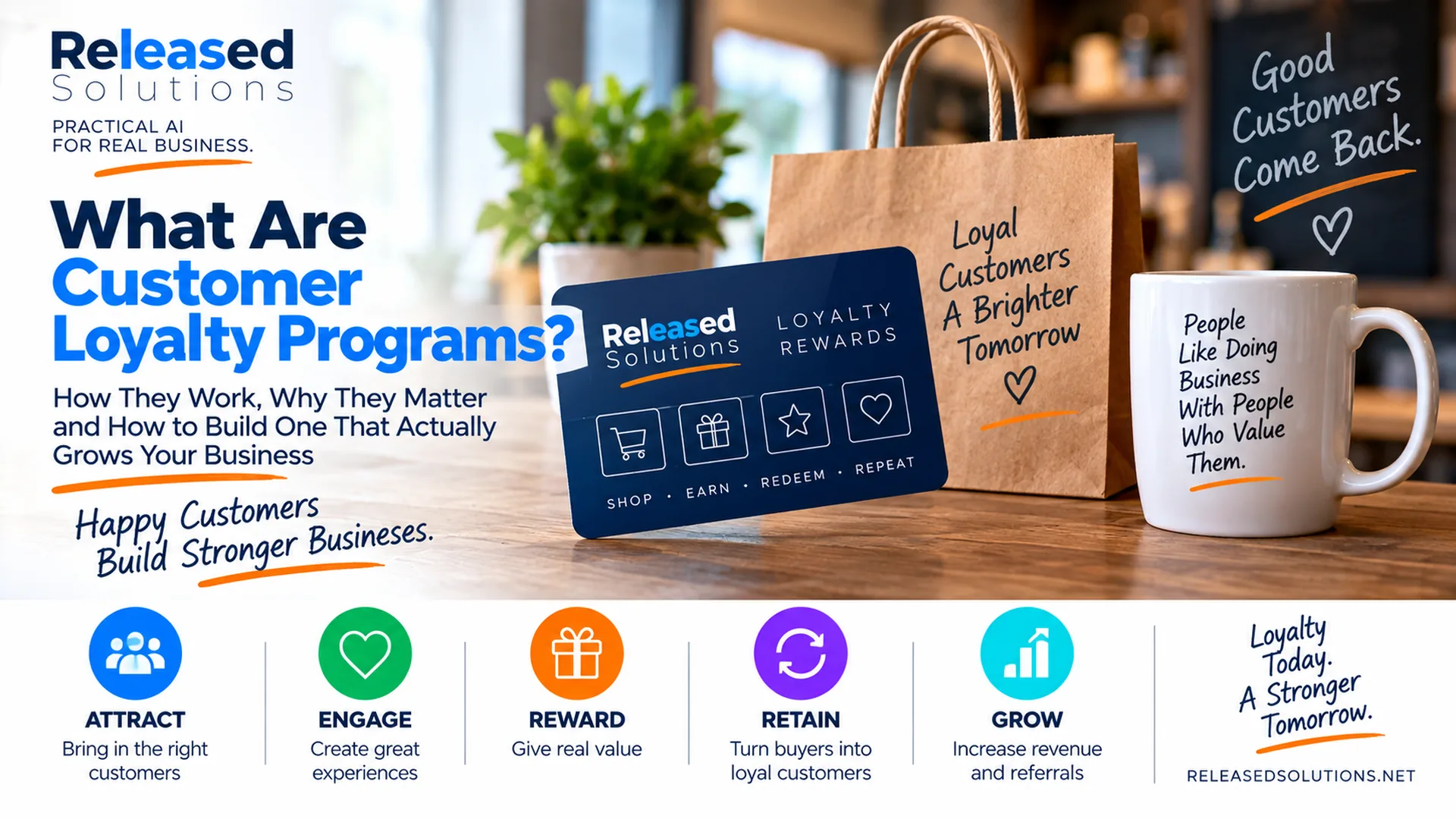

What Are Customer Loyalty Programs? How to Build Loyalty That Actually Grows Your Business
When most people hear "customer loyalty program," they think of points, punch cards, discounts or a free item after a certain number of purchases.
Those are loyalty mechanics. They are not loyalty itself.
A customer is loyal when choosing your business again feels easier, more valuable or more rewarding than starting over with someone else. A strong loyalty program helps create that preference by recognizing the relationship and giving the customer a reason to continue it.
That distinction matters in 2026 because loyalty programs are becoming much more connected to customer data, CRM systems, automation, personalization and AI.
The goal is no longer simply: buy ten and get one free. The goal is to turn a transaction into a relationship the customer wants to continue.
A strong loyalty program helps create that preference by recognizing the relationship and giving the customer a reason to continue it.
What Is a Customer Loyalty Program?
A customer loyalty program is a structured system that rewards, recognizes or provides additional value to customers for continuing to engage with a business.
That can include points, discounts, cash back, free products, early access, exclusive experiences, member pricing, priority service, referrals, personalized offers or recognition based on the customer's relationship with the company.
The best program depends on the business.
A coffee shop may use visits and rewards. A service business may reward referrals or repeat appointments. An ecommerce company may use tiers, early product access and personalized offers. A B2B company may build loyalty around service levels, education, priority support or account benefits.
The mechanism should fit the reason customers choose the business in the first place.
The Loyalty Equation Has Changed
Modern loyalty sits at the intersection of value, experience, recognition, data and trust. Customers still appreciate rewards, but a program that makes people do too much work for too little value can become another marketing obstacle.
Salesforce's current loyalty guidance emphasizes personalized experiences, real-time customer data, AI and reducing friction. Its research also shows that many programs remain heavily points-based even as brands try to create broader experiences. Deloitte's 2026 retail outlook similarly describes loyalty and omnichannel experience as areas retailers are strengthening while AI-powered personalization expands.
For a small business, that does not mean copying a major retailer's technology stack. It means understanding the direction: loyalty is moving from a static rewards ledger toward a customer relationship system.
Relationship, Not Ledger
The database is a byproduct. The point is a customer who chooses to continue buying, referring and coming back.
Value Exchange, Not Data Grab
When you ask for information, give something obvious in return. Otherwise the program feels like homework the customer has to do.
Connected, Not Isolated
Loyalty gets stronger when it connects to CRM, email, POS, ecommerce and service. Fragmented programs make customers feel like strangers.
Design the Program Around the Business, Not the Software
Seven Ways to Build Loyalty That Actually Grows the Business
START WITH A REASON TO COME BACK
Before choosing software, decide what behavior the program should encourage. Another purchase? A return appointment? A subscription renewal? A referral? Then ask what the customer gets in return. A loyalty program works best when the value exchange is obvious. The customer should not need a calculator, a spreadsheet or a paragraph of fine print to understand why participation is worthwhile. Simple is often an advantage.
USE FIRST-PARTY AND ZERO-PARTY DATA INTENTIONALLY
First-party data comes from interactions customers have directly with the business: purchases, website activity, service history, engagement. Zero-party data is information a customer intentionally provides, such as preferences, interests or a birthday. That information can make marketing more relevant, but the exchange has to feel fair. Do not collect data simply because the software allows it. Collect what helps create a better relationship, protect it appropriately and be transparent about how it is used.
CONNECT LOYALTY TO YOUR CRM AND CUSTOMER JOURNEY
A loyalty program becomes more useful when it does not live in isolation. Connect it, where practical, to the CRM, ecommerce platform, appointment system, point-of-sale system, email platform or other systems involved in the customer relationship. That makes it possible to recognize that the person opening an email, making a purchase, requesting service and redeeming a reward is part of the same relationship. If your team needs help wiring these systems, that is exactly what digital marketing coaching is for.
USE AI TO IMPROVE RELEVANCE, NOT TO MAKE LOYALTY FEEL ROBOTIC
AI can make loyalty programs more useful when it helps identify patterns and make timely decisions: segmentation, offer ideas, churn signals, next-best actions, personalized communications and analysis of which rewards actually work. Deloitte reported in its 2026 retail outlook that 67% of surveyed retail executives expected AI-driven personalization capabilities within the next year. But personalization has a line: a customer should feel understood, not watched. If your team is still ramping on AI fundamentals, how to learn AI for small business is a good starting point.
MAKE THE EXPERIENCE WORK ACROSS CHANNELS
Customers do not think in marketing channels. They think about the business. Someone may discover you on social media, visit the website, call, buy in person, receive an email and return through a search result. A loyalty program that only recognizes one of those interactions can make the relationship feel fragmented. Modern loyalty should support the customer journey wherever practical, so an offer earned online can be used in person and email offers reflect what the customer has already purchased. You do not need every channel. You need the channels your customers actually use to work together.
REWARD MORE THAN SPENDING
Purchase frequency and revenue matter, but spending is not the only behavior that can create value. Depending on the business, a loyalty program can recognize referrals, reviews, renewals, appointments kept, subscriptions, community participation, educational milestones or other meaningful engagement. This gives small businesses room to design loyalty around their actual business model. A professional service firm probably should not imitate a coffee-shop punch card.
MEASURE WHETHER THE PROGRAM CREATES BETTER CUSTOMERS
A loyalty program is not successful because people enrolled. Enrollment is the beginning. Measure what members do afterward: purchase or visit frequency, retention length, average order value, referrals, reward earn / redeem rates, program cost, which rewards change behavior vs. discount purchases that would have happened anyway, customer lifetime value and re-engagement of inactive members. The goal is stronger customer economics, not a bigger database of members.
AI, Personalization and the Line Between Helpful and Creepy
AI can make that system smarter when it helps identify patterns and make timely decisions. It can assist with segmentation, offer ideas, customer-service context, churn signals, next-best actions, personalized communications and analysis of which rewards are actually working. But personalization has a line. A customer should feel understood, not watched. AI should help the business recognize useful context and respond more intelligently. It should not encourage invasive personalization, expose private information or replace human judgment.
Use AI to recognize useful context and respond more intelligently. It is a coworker inside the system, not a replacement for human judgment or the customer's sense of being treated respectfully.
Do Small Businesses Need a Loyalty App?
Usually, no. An app can be useful when customers interact frequently enough to justify installing one and when the app provides ongoing value beyond storing a digital card. But a small business can run an effective loyalty system through a CRM, ecommerce platform, POS system, email/SMS tools, customer portal or a dedicated loyalty platform without building a custom mobile app.
| Situation | Do you need a loyalty app? |
|---|---|
| Frequent, high-engagement customers (daily / weekly) | Maybe. Only if the app provides ongoing value beyond storing a card. |
| Infrequent purchase cadence (once a quarter or less) | Usually no. A CRM + email/SMS + POS integration is enough. |
| Service business with appointments | Rarely. Focus on CRM, scheduling and follow-up automation. |
| Ecommerce with a growing repeat customer base | Consider a loyalty platform integrated with the store, not a custom app. |
| B2B relationships | No. Loyalty here is service level, education, priority support and account benefits. |
Start with the relationship and workflow. Choose technology after you understand what the program needs to accomplish.
A Practical Loyalty Framework
I would build a small-business loyalty program around seven questions:
VALUE: what does the customer receive? BEHAVIOR: what action are we encouraging? DATA: what information do we genuinely need? EXPERIENCE: how easy is it to participate? PERSONALIZATION: how can we make the relationship more relevant? AUTOMATION: what should happen consistently without relying on memory? MEASUREMENT: is the program creating more valuable, longer-lasting customer relationships?
If those seven pieces work together, the loyalty technology becomes much easier to choose.
Loyalty then becomes part of the same digital marketing system that acquires customers in the first place, instead of a separate rewards silo.
Attract
Give a clear reason to opt in. Value exchange should be obvious in one sentence.
Engage
Recognize behavior across channels. Not every interaction has to earn a point.
Reward + Retain
Reinforce behavior that actually creates value on both sides. Watch the redeem rate.
Grow
Referrals, reviews, upgrades and lifetime value. Not just enrollment counts.
The Takeaway
Customer loyalty programs still include points, rewards and discounts. But in 2026, the opportunity is much larger.
A good loyalty program creates a direct relationship with customers, gathers useful first-party information, improves personalization, supports consistent follow-up and gives the business a measurable way to strengthen retention.
AI can make that system smarter. CRM and automation can make it more consistent. Data can make it more relevant. But none of those technologies creates loyalty by itself.
Customers come back when the relationship continues to deliver value.
Build a Customer Relationship That Keeps Creating Value
Released Solutions helps small businesses connect CRM, automation, AI, websites, analytics and digital marketing around the complete customer journey, including what happens after the first sale.
If your loyalty program today is a punch card stapled to a marketing plan, we can help you connect it to the systems that actually turn repeat behavior into revenue.
Build a Customer Relationship That Keeps Creating Value
Released Solutions helps small businesses connect CRM, automation, AI, websites, analytics and digital marketing around the complete customer journey, including what happens after the first sale.
If your loyalty program today is a punch card stapled to a marketing plan, we can help you connect it to the systems that turn repeat behavior into revenue.
Loyalty is not a points balance. It is a relationship the customer chooses to continue.
Kenneth Durrum, Released Solutions