

AI Citations Can Convert: How to Measure AI Traffic and Conversions in GA4
For a while, the conversation around AI search has focused on one question: Are you being cited? That matters, but it is not the business outcome I care about most.
Recently I have been spending more time inside Google Analytics 4 reviewing traffic from AI assistants and looking at what happens after the citation. Are people clicking through? Which pages are they landing on? Are they engaging? Most importantly, are they completing the actions that matter to the business?
The answer is yes. When the content is properly optimized and the website gives the visitor a clear reason to take the next step, AI traffic can produce real conversions. That changes the way small businesses should think about AEO, GEO, AI search, and even traditional SEO.
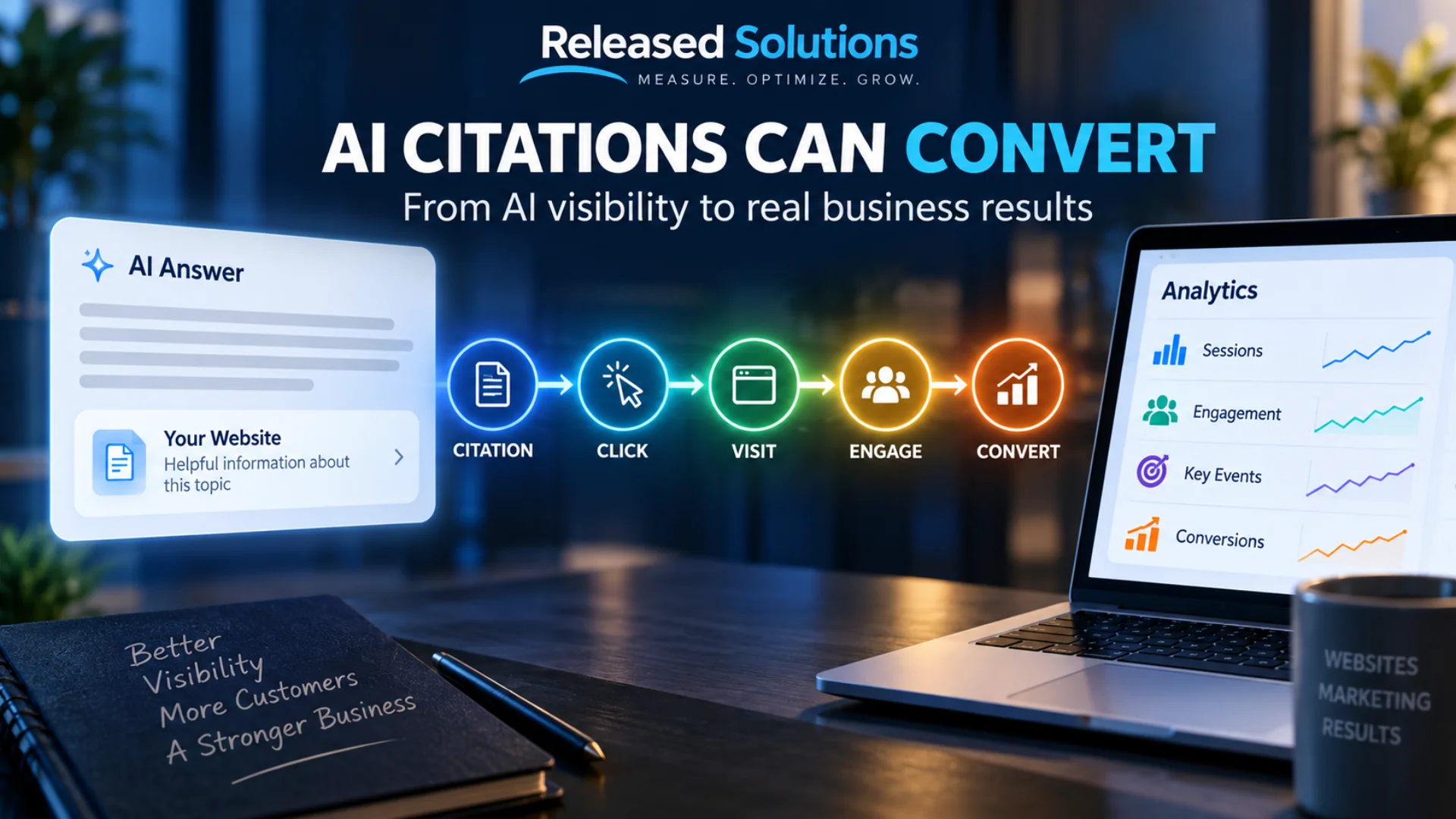
An AI citation is not the finish line. It is the top of a measurable customer journey.
The Better Question: What Happens After the AI Citation?
It is easy to treat AI visibility like a new version of rankings. A business sees its name in ChatGPT, Gemini, Copilot, Perplexity, or another AI experience and considers that a win. It can be a win, but visibility by itself does not tell us whether the channel is producing business value.
I prefer to separate the opportunity into three layers.
This is the same discipline we should apply to every other marketing channel. Impressions are not clicks. Clicks are not conversions. And citations are not customers.
Once you start measuring the full path, AI stops being a novelty and becomes another acquisition channel that can be evaluated against real business goals.
GA4 Is Making AI Traffic Easier to See
Google Analytics 4 now includes an AI Assistant channel in its default channel grouping. Google describes this as traffic arriving from sources such as ChatGPT, Gemini, DeepSeek, Copilot, and Grok. That makes it easier to separate at least some AI assistant traffic from the general referral bucket.
There is an important distinction. Google's AI Overviews and AI Mode are excluded from the GA4 AI Assistant channel. Those experiences are part of Google Search, so I use Search Console alongside GA4 rather than expecting one report to tell the whole story.
OpenAI also gives publishers a useful tracking signal. ChatGPT Search referral links automatically include utm_source=chatgpt.com, which makes inbound traffic from ChatGPT easier to identify in analytics.
Search Console Now Adds the Visibility Side of the Picture
The other half of the measurement problem is knowing whether your content is appearing inside Google's generative search experiences before a visitor ever reaches the site.
Google introduced dedicated generative AI performance reporting in Search Console in 2026, with reporting for visibility in features such as AI Overviews and AI Mode. Google says those insights were rolled out to all websites worldwide by August 31, 2026.
That gives us a much more useful measurement model. Search Console helps answer whether the content is being surfaced. GA4 helps answer what visitors do after they reach the website. A clean technical foundation, including why every small business needs a sitemap, is what lets both reports actually see your pages.
| Layer | What to measure | Primary tool | Business question |
|---|---|---|---|
| Visibility | Generative AI impressions, citations, mentions | Search Console and AI monitoring | Are we appearing? |
| Acquisition | Sessions, source/medium, landing pages | GA4 | Are people visiting? |
| Engagement | Engaged sessions, time, page path | GA4 | Are they finding the visit useful? |
| Conversion | Key events, leads, bookings, purchases | GA4 and CRM | Are visits producing business outcomes? |
Why Properly Optimized Content Can Convert From AI
When I say content is properly optimized, I do not mean adding a few question headings, forcing FAQ schema onto a page, or creating an AI-specific version of every article.
Google's own current guidance is much closer to the way I approach the problem: strong SEO fundamentals still matter because Google's generative experiences are built on its Search index and ranking systems. A page still needs to be discoverable, crawlable, indexable, useful, and technically sound.
But conversion requires more than being retrievable. The content also has to help the right person at the right moment.
Be Technically Discoverable
If a page cannot be crawled, indexed, or understood, it has fewer opportunities to become a source in search or AI experiences. This is why I continue to review Search Console indexing issues, page errors, internal linking, schema validation, and other technical SEO signals. It ties directly to the practitioner findings I covered in Google ranking factors in 2026.
Answer a Real Question With Useful Expertise
Generic information is easy for AI systems to summarize from many sources. Stronger content brings experience, examples, judgment, original explanation, and a clear point of view. That gives both the reader and the retrieval system a reason to value the page.
Create a Reason to Click
An AI answer may satisfy the simple part of the question. The website needs to offer the next level: a deeper explanation, a calculator, a service, an assessment, an example, a process, a local answer, a comparison, or another resource worth visiting.
Match the Landing Page to Intent
The visitor should immediately see that the page continues the conversation they started with the AI assistant. Clear headings, trust signals, strong page experience, and focused calls to action matter just as much here as they do with paid search or organic search.
Track the Business Action
If forms, calls, bookings, purchases, downloads, or other outcomes are not configured as GA4 key events and connected to the broader reporting process, you may have AI-driven conversions and never know it.
The Measurement Discipline in Four Words
Cut through the tools and the acronyms and the four repeated verbs are simple: appear, arrive, engage, convert. Everything below is how you actually watch each one.
Four checkpoints
If the numbers do not move on all four, the AI story is incomplete.
Appear
Arrive
Engage
Convert
How I Review AI Traffic in GA4
I am increasingly treating AI traffic the same way I would evaluate any emerging acquisition source. The goal is not to create a vanity dashboard. The goal is to understand whether the source is producing useful visits and business outcomes.
1. Start with Traffic acquisition and review the Session default channel group. Look for the AI Assistant channel and compare it with Organic Search, Referral, Paid Search, and other channels.
2. Drill into Session source / medium. This helps identify which AI platforms are sending traffic rather than treating every AI visit as one category.
3. Review landing pages. Which articles, service pages, resources, or local pages are earning the click? The landing page often tells you more about user intent than the source alone.
4. Compare engagement. Look at engaged sessions, engagement rate, time on site, and the next pages visited. A small amount of AI traffic can still be valuable if the visitors are highly qualified.
5. Review key events and conversions. Lead forms, bookings, phone actions, purchases, registrations, and other meaningful events are where the business value becomes visible.
6. Compare Search Console generative AI visibility with GA4 behavior. If visibility is increasing but visits are not, the content may answer the question without giving the user a reason to click. If visits are arriving but not converting, the landing page or offer may be the next problem to solve.
What AI Conversion Data Can Tell You
Once AI traffic is tied to engagement and conversion data, optimization becomes much more practical.
You can begin asking questions such as: Which topics create AI-assisted leads? Which landing pages convert AI visitors best? Are AI visitors more likely to enter through educational content or service pages? Which calls to action work for visitors who already received part of the answer before they reached the website? Do AI visitors move through the site differently from traditional organic visitors?
Those are better questions than simply asking whether the brand appeared in an AI response. They help determine what to create, what to improve, what to measure, and where to invest next.
Do Not Optimize for Citations in Isolation
The temptation with every new marketing trend is to optimize for the newest visible metric. Years ago it was rankings. Then it was followers. Then impressions. AI citations can become the next vanity metric if we are not careful.
A citation can be valuable. It can build awareness, reinforce authority, and introduce a business to someone who may never have found it through a traditional blue link. But if the goal is growth, the work cannot stop at the citation.
The website still has to earn the visit. The content still has to build trust. The page still has to make the next step obvious. The analytics still have to capture the action.
That is why I see AEO and GEO as additions to a broader search and conversion strategy, not replacements for SEO. Technical SEO helps create the retrieval foundation. Strong content earns relevance and trust. Conversion optimization turns attention into action. Analytics tells us whether any of it is actually working. If you want the fuller mental model, my article on SEO, AEO, GEO, AIO and SXO walks through how those layers connect.
A Practical AI Measurement Checklist for Small Businesses
✓ Verify that Google can crawl and index the pages you want surfaced.
✓ Review Search Console indexing and structured data issues regularly.
✓ Use the Search Console generative AI performance report to monitor visibility in Google's AI search experiences.
✓ Confirm that GA4 is collecting the traffic sources and landing-page data you need.
✓ Review the AI Assistant channel and individual AI sources in GA4.
✓ Configure meaningful business actions as key events, not just page views.
✓ Compare AI traffic with other acquisition channels based on engagement and conversion quality.
✓ Improve the pages that receive AI traffic so the next step is clear and useful.
The Metric That Matters Is What Happens Next
AI search is changing discovery, but the basic business question has not changed: Did the marketing activity help create a customer?
We now have better tools for answering that question. Search Console can show more of the visibility occurring inside Google's generative search experiences. GA4 can identify AI assistant traffic and show us what those visitors do. Proper conversion tracking can connect those visits to actual outcomes.
That is where I believe the opportunity is for small businesses. Do not chase AI citations just to say you were cited. Build content worth retrieving, make the website worth visiting, and measure whether the visit turns into something valuable. This is exactly the discipline we build into Online Presence Management: the connective tissue between visibility, visit, and conversion.
Because when the content, website, tracking, and customer journey are aligned, AI visibility can become measurable business growth.
Want to Know Whether AI Is Sending You Real Customers?
Released Solutions can help connect technical SEO, Search Console, GA4, and conversion tracking so you can see which visibility is turning into real business results.