

The Website Redesign Loop: Why Your Website Still Isn't Generating Leads
You are on your third or fourth website.
The colors were not quite right. The photos did not feel quite right. A friend thought the buttons should be somewhere else. So you changed it. Maybe you rebuilt the whole thing.
Everyone loved it.
And eventually someone asked the question that actually matters: Where are the leads?
If this feels familiar, I want you to consider something before you start website number five.
If the data proves me wrong, great. We follow the data. I do not need my opinion to win. I need the business to win.
The Website Redesign Loop, Explained
Websites become the scapegoat when leads slow down. Colors change. The photos change. Everyone gets excited about the new version. Then someone asks about leads and the same conversation starts again. That is the loop. ROCK is the way out of it.
Design Is Not the Enemy
Good design still matters. But a business website has a job, and that job is measurable.
Diagnose the System, Not the Screenshot
Traffic problem or conversion problem? Follow-up problem? The answer changes everything the redesign would have done.
Data Beats the Process
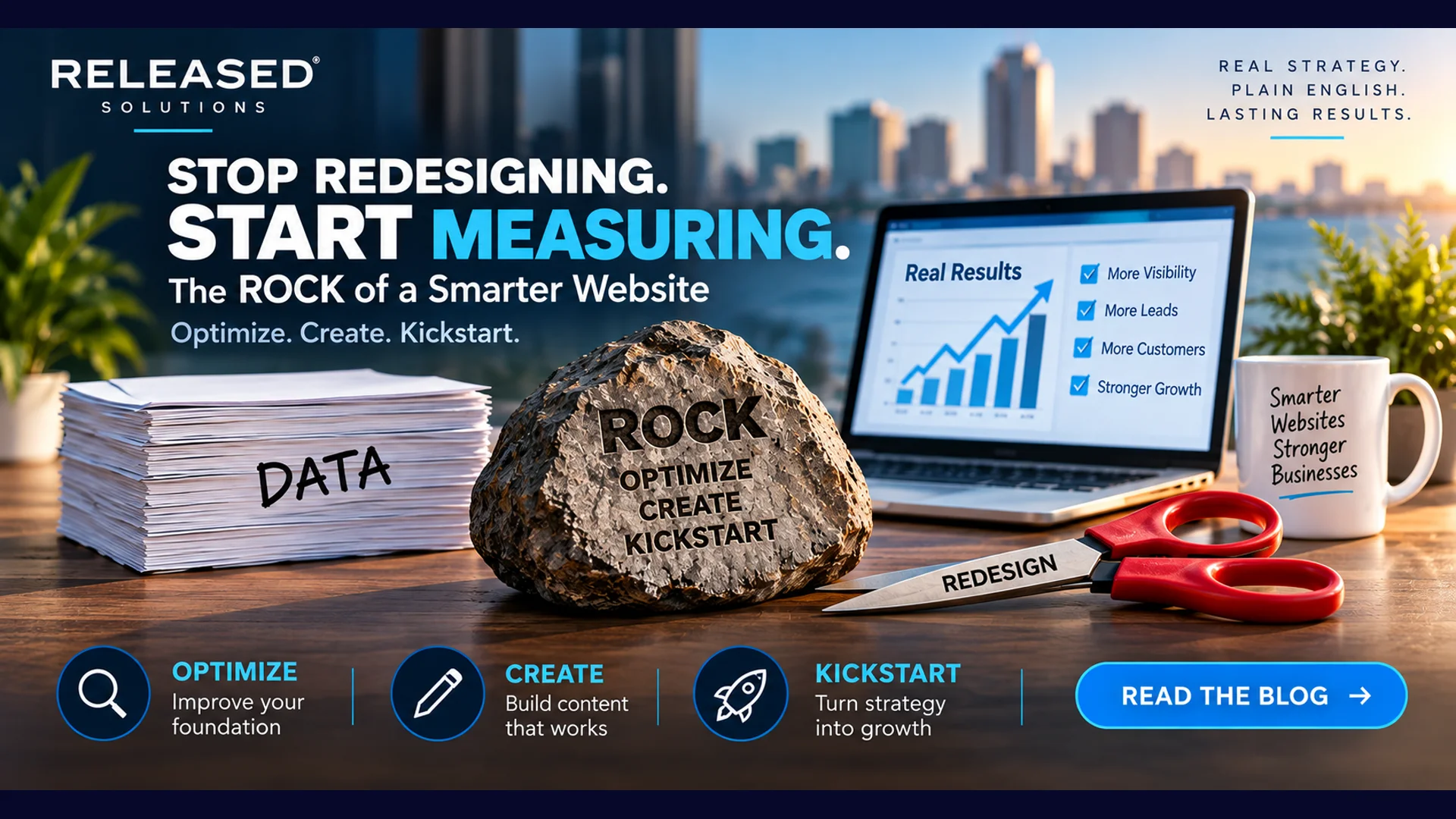
Rock crushes scissors. Paper covers rock. When the numbers prove me wrong, I move on. The business wins, not the opinion.
ROCK: REVIEW, OPTIMIZE, CREATE, KICKSTART
You May Not Have a Website Problem. You May Be in a Loop.
I call it the Website Redesign Loop.
Results disappoint. The website gets the blame. Cosmetics get changed. Everyone gets excited. Then the results disappoint again.
I am not against good-looking websites. Design matters. Your website should represent your business well. But I do not believe looking good is the ultimate goal of a business website.
A business website is a tool. For most businesses, that means something measurable eventually needs to happen: calls, form submissions, appointments, purchases, qualified leads, or revenue.
That is a very different conversation from, "I do not like that blue."
An opinion can be a hypothesis. It is not evidence. If the evidence says change the photo, change the photo. If moving the button improves conversions, move the button. If the numbers prove my idea wrong, great. We follow the data. I do not need my opinion to win. I need the business to win.
Your Friend Is Not Your Analytics
Another pattern I see is the number of outside voices that get pulled into a website project.
A spouse, employee, friend, colleague, or trusted adviser looks at the site and says, "I do not like that picture," "that button should move," or "I like this other website better."
There is nothing wrong with asking people you trust for input. Trusted voices are valuable. The problem starts when subjective input is treated as equal to evidence from the market.
When a website is not generating leads, I want to diagnose the system. Are enough of the right people getting there? Where did they come from? Are they engaging? Are they converting? Are the leads qualified? Is the problem actually happening after the handoff?
Traffic and conversion are not the same problem. Five qualified visitors and zero leads is not the same diagnosis as five thousand qualified visitors and zero leads. That is why measurement comes first.
Traffic Is a Lever, Not a Wish
Organic search, social media, referrals, email, paid search, paid social, and other channels are different acquisition levers.
Referrals can be excellent. Organic visibility can be powerful. Social can create awareness and engagement. Paid advertising can intentionally put an offer in front of a defined audience and give us faster feedback.
None of those channels is a moral position. They are tradeoffs. What matters is knowing which lever we are pulling, what it costs, what we expect it to do, and what evidence will tell us whether it is working.
Sometimes I call the opposite approach caveman marketing: dragging customers in one at a time through sheer effort while ignoring the system that could help make customer acquisition more repeatable.
Hope has a place. Prayer has a place. In business, though, hope and prayer still need a strategy.
Before You Redesign Again, ROCK What You Have
This is one reason I developed a process I call ROCK: Review, Optimize, Create, Kickstart.
The name is intentional. Think about rock-paper-scissors.
Scissors represents the arts-and-crafts approach to website marketing: cut this, clip that, paste something over here, swap the picture, move the button, change the color. It feels active because everyone can participate. But activity is not the same thing as strategy. ROCK crushes scissors: a defined process is stronger than random cutting and pasting. But paper covers ROCK, and paper represents the facts: the numbers, the analytics, the evidence. My process does not outrank the data.
That is the point. We are not trying to make my opinion win or your friend's opinion lose. We are trying to create a process where the market gets a vote.
The Four Stages of ROCK
REVIEW
Review means lifting the hood before we start replacing parts. I want to know what is already happening. Is Google Analytics 4 installed and collecting useful information? Is Google Search Console connected? Can we see search impressions and clicks? Are important pages indexed? Are conversions or key events being measured? Are there obvious page-performance or technical issues? Is appropriate structured data in place and valid? I am often surprised by how many businesses have launched websites without this foundation. You do not need to become an expert in these tools. But somebody responsible for your marketing needs to know how to use them.
OPTIMIZE
Optimize is bigger than making the website prettier. Yes, optimization can include design. We may simplify a page, improve navigation, clarify a headline, strengthen a call to action, adjust imagery, improve mobile usability, or make the path to conversion easier. But optimization also means installing or correcting the measurement foundation when it is missing. Analytics, Search Console, conversion tracking, indexing checks, page performance, and structured data give us instruments we can use to make decisions. AI can help translate recurring measurement into plain English: what changed, what appears to be working, where a problem may be developing, and what deserves a closer human look. That is a use of AI I care about. Not changing the website colors every time someone visits. Using AI to help explain reality. Related: how AI citations can drive measurable conversions.
CREATE
Once we can see what is happening, creation becomes more purposeful. Create does not automatically mean build another website. It may mean improving a landing page, answering a customer question, adding a missing service page, building campaign content, or updating an older article that no longer reflects the market. Content should remain useful, current, technically sound, and aligned with the questions prospective customers are asking today. That still includes SEO, but discovery is broader now. Answer engine optimization, generative and AI discovery, and the search experience itself all matter. Related: SEO, AEO, GEO, AIO and SXO and what Google ranking factors actually tell us.
KICKSTART
Then we give the system a chance to work. Kickstart means intentionally generating activity through the channels that make sense for the business. That can include organic search, social media, email, partnerships, referrals, and paid advertising. I am particularly comfortable with paid campaigns because they allow us to intentionally put an offer in front of an audience and begin collecting signals. Did the right people arrive? Did they engage? Did they convert? What did the acquisition cost? What happened after the lead was generated? Kickstart is not the finish line. It produces new information.
ROCK Is a Cycle, Not a Makeover
Review informs Optimize. Optimize reveals what we need to Create. Create gives us something meaningful to Kickstart. Kickstart produces new information, and that information sends us back through the process again.
That is a living marketing system. It is very different from rebuilding a website every year or two because somebody got tired of the colors.
And when the data says the image is wrong, the button is weak, the page is confusing, or the offer is not connecting, then we make the cosmetic change. But this time we are changing it for a reason.
Five Questions to Ask Before Website Number Five
| Question | Why it matters |
|---|---|
| What counts as a conversion for this website? | You cannot measure lead performance without defining what a lead actually is. |
| Do we have a reliable baseline for traffic, leads, conversion rate, and acquisition cost? | Without a baseline, every change is a guess. With one, every change is a test. |
| Can we explain where our visitors are coming from using actual data? | Traffic and conversion are different problems. Fix the right one. |
| Are the foundational measurement and search tools properly installed and reviewed? | GA4, Search Console, conversion tracking, indexing, structured data. All checked, all working. |
| What evidence says the website itself needs to be rebuilt rather than optimized, expanded, or better promoted? | A rebuild is expensive. It is also the wrong prescription when the diagnosis was never done. |
If you cannot answer those questions yet, I would not start with another redesign.
Show Me the Numbers
When clients eventually say, "I need numbers. I need patients. I need leads," that is not the moment I want us to begin talking about measurement. That conversation should have happened at the beginning.
Strategy first. Measurement first. Agree on what success means. Agree on the key performance indicators. Understand what a customer or lead can reasonably cost. Then use design, content, technology, and promotion to support that objective.
So before you build website number five, do not show me the colors first. Show me the numbers.
Let's review what is happening. Optimize the foundation. Create what is actually missing. Kickstart the system. Then listen to what the market tells us. If the evidence says you need website number five, we will know why we are building it and what success is supposed to look like.
Those are the businesses I work best with.
REVIEW
GA4, Search Console, indexing, conversions, structured data, page performance. Look at the foundation before you replace parts.
OPTIMIZE
Fix the measurement foundation first. Use AI to translate signals into plain English. Then optimize what the data says needs it.
CREATE
Purposeful content, landing pages, service pages, updated older articles. SEO, AEO, GEO, AIO, SXO. Findable and useful.
KICKSTART
Push the system. Organic, social, email, referrals, paid. Measure the acquisition cost. Kickstart produces new information, not a finish line.
The Takeaway
The Website Redesign Loop feels productive because everyone is doing something. New colors. New photos. New homepage. New excitement. Then, months later, the same question comes back: where are the leads?
Design is not the enemy. Guessing is. ROCK crushes scissors. Paper covers ROCK. A process beats cosmetic tinkering, and the data beats the process. That is the order I try to keep every website decision in.
Before you build website number five, do not show me the colors. Show me the numbers.
Before You Build Website Number Five, Find Out What the Numbers Say
If your website looks good but you still cannot explain where your traffic comes from, what converts, or what a lead should cost, the next step may not be another redesign. Released Solutions can help review the foundation, identify what is missing, and build a measurable path forward.
Before You Build Website Number Five, Find Out What the Numbers Say
If your website looks good but you still cannot explain where your traffic comes from, what converts, or what a lead should cost, the next step may not be another redesign. Released Solutions can help review the foundation, identify what is missing, and build a measurable path forward.
Design is not the enemy. Guessing is. Rock beats scissors. Paper covers rock. Data wins.
Kenneth Durrum, Released Solutions