

How to Communicate With Customers During a Health Outbreak or Public Health Disruption
The original version of this article was written for one crisis: COVID-19. The communication lesson was bigger than the virus.
A future disruption could involve influenza, RSV, COVID-19, a foodborne illness, measles, norovirus, a localized exposure, a public-health advisory, or another outbreak we cannot predict today. A business may need to change hours, close temporarily, move appointments, alter service, protect employees, or simply reassure customers that operations remain normal.
The disease changes. The communication responsibility does not.
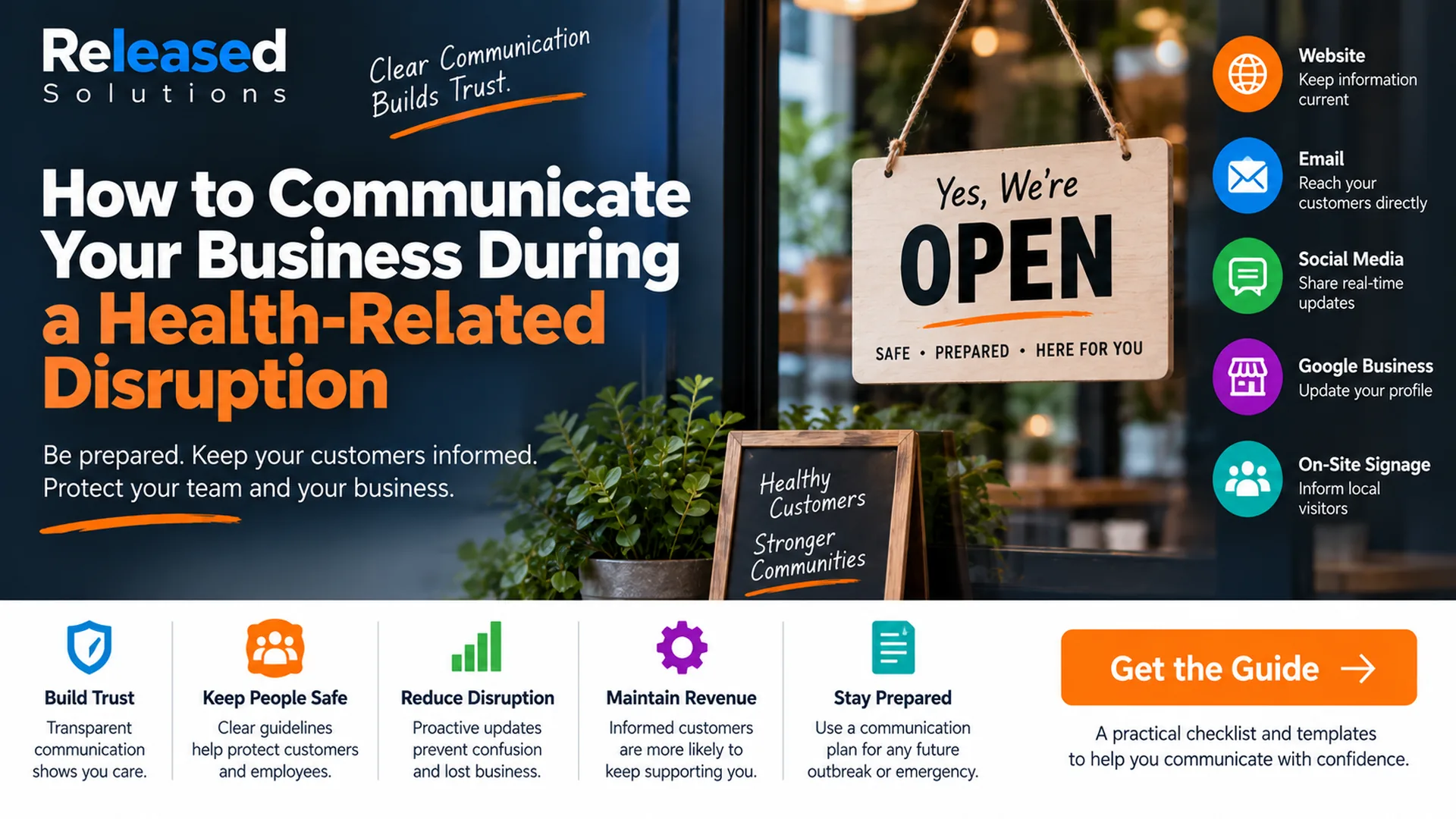
When people are uncertain, they look for clear information from the businesses they plan to visit. Your website, Google Business Profile, social channels, email, text messaging, and physical location can either reinforce one clear message or create six different versions of the truth.
The goal is to be useful, accurate, timely, and credible.
The Six Principles Behind Good Outbreak Communication
| Principle | What it means for a small business |
|---|---|
| Be first | Do not let customers learn about a meaningful operational change from an outdated listing or rumor. |
| Be right | Separate confirmed facts from assumptions. Link health guidance to the responsible authority. |
| Be credible | Correct mistakes, avoid exaggeration, and keep updates consistent across channels. |
| Express empathy | Recognize the disruption customers, employees, or families may be experiencing. |
| Promote action | Tell people exactly what they should do: reschedule, use pickup, call first, enter through another door, or follow official guidance. |
| Show respect | Communicate without blaming employees, customers, communities, or affected individuals. |
What Your Status Update Should Answer
A useful business status update should answer the questions a customer is likely to have before contacting or visiting you.
What happened or what condition has changed? Is the business open? Have hours or services changed? What should customers do differently? What actions is the business taking? What is still unknown? When will the next update be posted? Where can customers find authoritative health information?
Add "Last updated: [date/time]" to any rapidly changing status page or notice. Customers need to know whether they are reading today's information or last week's.
Build One Source of Truth
During an evolving situation, the website should become the primary source for the business's operational status. Social posts, email messages, Google updates, and signs should point people back to that source when more detail is needed.
This reduces the chance that an old Facebook post, an outdated Google listing, and a new email all tell customers something different. See Online Presence Management for how to keep those channels aligned even outside a crisis.
CDC outbreak communication guidance similarly recommends a central internet resource for changing facts and says other communications should be based on that source.
Update These Channels in a Defined Order
| Channel | What to update | Why |
|---|---|---|
| Website / status page | Open/closed status, hours, affected services, customer instructions, timestamp, next update | Your controlled source of truth |
| Google Business Profile / local listings | Hours, temporary closure where appropriate, service availability | People may see this before visiting your website |
| Email / SMS | Direct update to affected customers; appointment or order instructions | Best for people with an existing relationship and proper consent |
| Social media | Short current update plus link to the source of truth | Fast distribution and easy sharing |
| Phone / voicemail | Recorded status, alternate service instructions | Helps customers who call instead of searching |
| On-site signage | Open/closed status and instructions at the physical location | Catches customers who did not see digital updates |
| Staff / internal channels | Approved message, escalation process, spokesperson | Prevents employees from improvising conflicting answers |
A small business does not need every communication platform. It does need the platforms customers actually use to agree with each other.
Example: Temporary Service Change
"As of [date/time], our business remains open, but [service/hours/location] has changed while we respond to [public-health situation]. Customers with [appointments/orders/reservations] should [specific action]. We are following current guidance from [local/state health authority or CDC as appropriate]. We will update this page again by [date/time], or sooner if our operating status changes."
Example: Temporary Closure
"As of [date/time], we are temporarily closed while we address [brief operational/public-health reason]. Customers with scheduled services should [rescheduling/refund/contact instruction]. We will post our next operating update by [date/time]. For health information about the current situation, please use [authoritative source]."
Example: Business Is Open
"We are open during our normal hours as of [date/time]. We are monitoring [local outbreak/advisory] and will update customers here if our hours, services, or entry procedures change. For current public-health information, please refer to [authoritative source]."
What Not to Say
| Avoid | Use instead |
|---|---|
| 'There is absolutely no risk.' | Explain what is known, what actions are being taken, and where customers can find official guidance. |
| Speculation about who caused the situation | Stick to operational facts and verified public-health information. |
| Medical advice outside your expertise | Point customers to public-health authorities or their healthcare professional. |
| Names or identifying details of affected employees or customers | Protect privacy and disclose only what is legally and operationally appropriate. |
| A promise that operations will return to normal on a date you cannot guarantee | Give the next review/update time instead. |
| Copying an old pandemic template without checking it | Use current guidance for the specific outbreak, location, and business type. |
Do Not Turn Your Business Into a Public-Health Authority
Your business should communicate what it controls: operating status, hours, services, appointments, safety procedures, customer instructions, and when information will be updated.
For disease transmission, prevention, vaccination, treatment, or community risk, use current information from the CDC and the relevant state or local health department.
CDC maintains current outbreak information and respiratory illness data that can change by disease, region, and season. That is why this article should never contain a permanent list of disease-specific rules.
Prepare the Communication System Before You Need It
The best time to decide who can edit your website, change Google hours, send an emergency email, or update the phone message is not after a disruption starts.
Create a lightweight communication plan now.
| Preparation item | Decision to make now |
|---|---|
| Owner | Who has authority to approve a public update? |
| Spokesperson | Who speaks for the business if media or customers call? |
| Website access | Who can publish a status notice quickly? |
| Google / local access | Who can change hours or status? |
| Email / SMS | Which list is appropriate and who can send? |
| Social accounts | Who has credentials and approval? |
| Staff notification | How are employees told before or at the same time as customers? |
| Health authority links | Which local, state, and federal sources will be used? |
| Update cadence | When will the situation be reviewed and the public message refreshed? |
| Recovery | Who removes emergency notices and restores normal listings? |
A Simple Status Message Framework
STATUS → IMPACT → ACTION → SOURCE → NEXT UPDATE
Status: What is happening now? Impact: What has changed for customers? Action: What should they do? Source: Where does authoritative health information come from? Next update: When will you communicate again?
Prepare
Owners, access, spokesperson, cadence, and health-authority sources decided before anything happens.
Publish
Website as the source of truth. Timestamp every update. Every other channel points back.
Repeat
Google, social, email, phone, signage, and staff internal all say the same thing at the same time.
Close the Loop
Remove or archive emergency notices when normal operations resume. A stale message is still misinformation.
When the Situation Ends, Communicate That Too
Emergency messages often linger online long after they are useful. When normal operations resume, update the status page, Google listing, social profiles, phone message, and signage.
Keep an internal record of what was communicated and when, but remove or clearly archive customer-facing emergency notices that could create future confusion.
Closing the communication loop is part of the response.
Health Disruption Communication Checklist
The six principles, channel-update order, status framework, and prep checklist in one printable PDF. Free download, no form.
The 2026 Takeaway
COVID-19 taught businesses how quickly operating conditions can change. The long-term lesson is not to keep a coronavirus page alive forever.
The better approach is to build a reusable outbreak and health-disruption communication system.
Know who owns the message. Maintain access to your digital channels. Use your website as the source of truth. Update the places customers actually check. Say what you know and what you do not know. Give people a clear action. Link medical and public-health claims to authoritative sources. Tell customers when you will update them again.
Last fact-check: September 2026
Keep Your Online Presence Ready Before a Disruption Happens
Released Solutions helps small businesses keep websites, social channels, local listings, email, and digital systems current and coordinated.
If your website, Google listing, social profiles, and phone message do not currently agree with each other on quiet days, they will not agree during a crisis. We can help you build the system now.
One clear message. One controlled source of truth. Every channel repeats it.
Kenneth Durrum, Released Solutions