
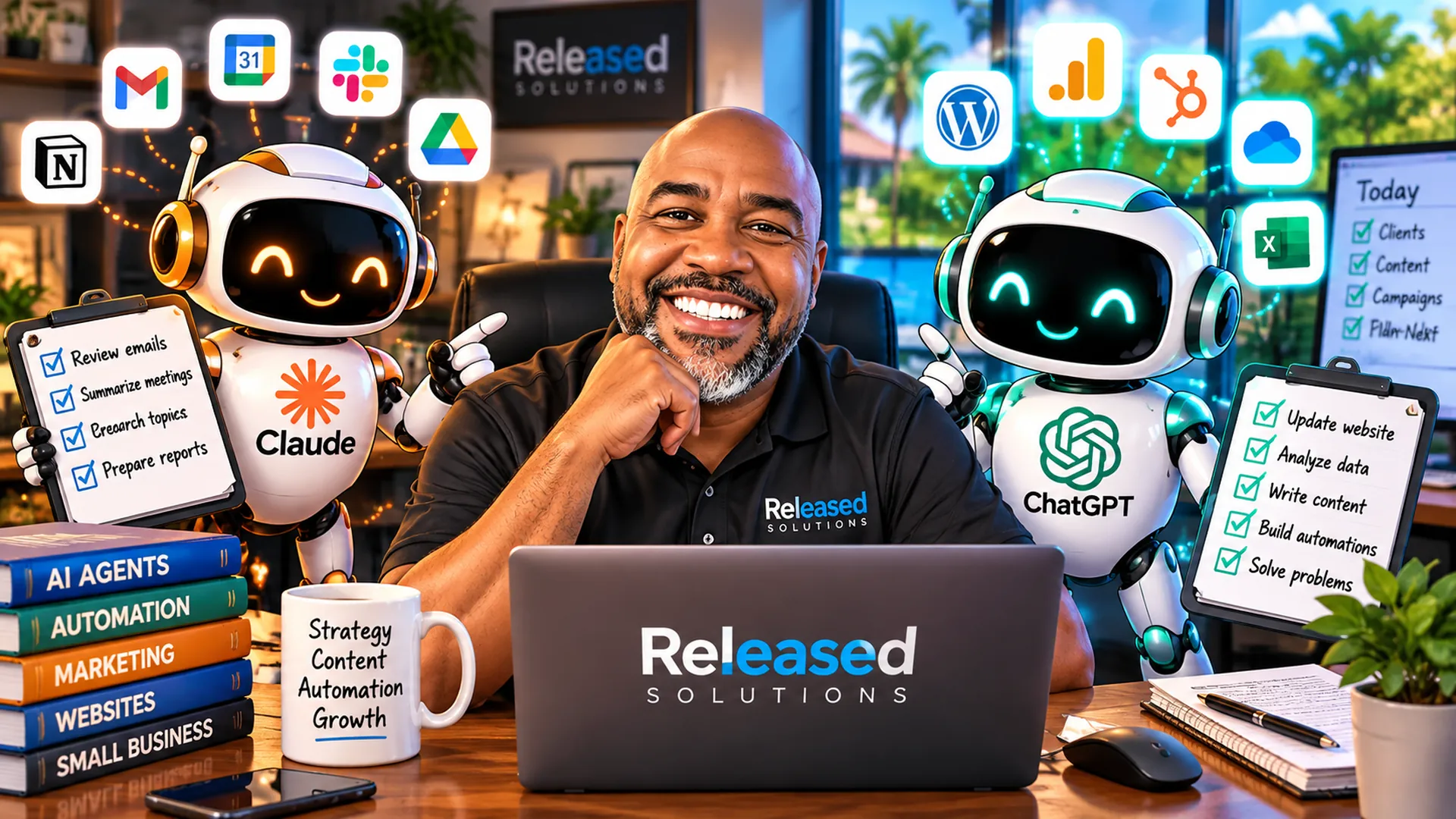

Claude Duet vs ChatGPT: What Actually Changed?
Anthropic introduced Claude Duet on October 21, 2026, promising an AI assistant that works while you're away, watches your connected business applications, and asks permission before taking important actions.
Sounds impressive. But here's my question: Isn't that what I'm already doing with ChatGPT?
I already use AI to help write emails, research problems, work with documents, perform desktop tasks, and access information across connected applications.
So when I read about this announcement, my first reaction wasn't that I needed another AI subscription.
I wanted to understand what had actually changed.
As it turns out, the bigger story isn't Claude versus ChatGPT. It's how AI assistants are evolving from tools that wait for instructions into systems that help identify, organize, and perform work with less supervision.
And that distinction matters to anyone running a business.
What Is Claude Duet?
Claude Duet is Anthropic's new proactive AI assistant, introduced as a research preview on October 21, 2026. It can examine information in connected applications, prepare work, and continue completing assignments after you close the app.
According to Anthropic's official Claude Duet announcement, the assistant can:
- Prepare a morning briefing using connected email and calendar information.
- Check connected applications periodically for developments requiring attention.
- Draft responses and prepare administrative work.
- Coordinate tasks across multiple business applications.
- Create reports, presentations, dashboards, and other business documents.
- Continue working using a cloud-based computer.
- Request approval before taking sensitive actions.
During its initial research preview, Claude Duet is available through a waitlist for US Claude Pro and Max subscribers.
The important feature isn't that Claude can work with an email or create a presentation.
We've been doing those things with AI for some time.
What interests me is that Claude Duet is designed to recognize when work needs to be done without requiring a new conversation every time.
Am I Already Doing This With ChatGPT?
Yes, to a significant extent. ChatGPT already supports connected applications, memory, desktop workflows, scheduled tasks, and autonomous work through different product experiences.
I spend a considerable amount of time working with AI. As a systems analyst, software developer, and digital marketer, I'm constantly moving between research, client communications, documents, websites, and business systems.
ChatGPT has become part of that process.
I can discuss a client problem, review information, prepare an email, work through technical decisions, and use connected applications without manually moving every piece of information between programs.
On the desktop, the capabilities extend further.
Through ChatGPT Work, supported workflows can interact with files, websites, applications, and connected services. Work can also continue delegated tasks after I've stepped away.
I've previously discussed how I can direct AI work from my phone while away from the office.
What once required me to sit at my desk can now be initiated or reviewed from practically anywhere.
But there's an important distinction.
When I open ChatGPT and ask it to accomplish something, I'm usually initiating the work.
Even when I schedule recurring tasks, I've defined what I want monitored and when.
A proactive assistant introduces another possibility.
What happens when the AI notices something I didn't know I needed to ask about?
How Is Claude Duet Different From ChatGPT Work and Dots?
Claude Duet overlaps substantially with capabilities OpenAI has already introduced. The biggest differences concern how the products organize work, identify new tasks, and handle access and approvals.
To understand the comparison, we need to separate three ChatGPT experiences.
| AI experience | What it primarily does | How work begins |
|---|---|---|
| ChatGPT conversations | Answers questions, analyzes information, drafts content, and uses available tools | You initiate a conversation or request |
| ChatGPT Work | Completes multi-step assignments using applications, files, browsers, and computer tools | You delegate work or configure scheduled or triggered tasks |
| ChatGPT dots | Takes ongoing responsibility for objectives, researches proactively, and works across connected applications | You establish goals and permissions; the assistant can also identify opportunities |
| Claude Duet | Monitors connected information, prepares briefings, identifies work, and executes tasks through its cloud computer | You delegate work, or Duet identifies something requiring attention |
This is why I wouldn't describe Claude Duet as the first AI assistant capable of working independently.
On September 29, 2026, OpenAI announced dots, its always-on AI agents.
A dot can maintain context, use connected applications, investigate developments, and continue working toward established goals.
In other words, Claude Duet and ChatGPT dots are pursuing very similar objectives.
There are differences in product design, availability, supported integrations, interfaces, and oversight. But the underlying direction is much the same.
And we shouldn't confuse that with a claim that one company's AI model is automatically smarter than another.
The practical comparison is about the work each product can reliably perform.
What Does Proactive AI Actually Mean for a Business?
Proactive AI means an assistant can examine authorized information, recognize something that may require action, and bring it to your attention without waiting for you to ask the exact question.
Think about hiring someone to help manage your office.
On their first day, you give them an assignment.
They complete it, return to your desk, and ask what's next.
That might describe how many of us first experienced ChatGPT.
Now imagine that same employee has been working with you for months.
They understand your priorities, know which clients need attention, recognize an overdue invoice, and notice that tomorrow's meeting is missing important preparation.
Instead of waiting for you to ask, they walk into your office with a list of what needs attention.
That's the difference we're moving toward.
Consider a hypothetical business morning.
You have a customer who hasn't responded to a proposal, an invoice that's overdue, and a meeting later in the day.
A traditional AI workflow might require you to issue three separate requests.
A proactive system could potentially identify all three situations through authorized connections, prepare a follow-up message, summarize the outstanding invoice, and assemble a meeting briefing.
You review the recommendations and authorize the next steps.
Some of these capabilities can also be implemented through scheduled automation and triggered business workflows.
The difference is that an agent may have more flexibility to interpret the situation and determine what work should follow.
Of course, identifying a problem doesn't mean the AI has identified the correct solution.
That's where experience and human judgment remain important.
Does ChatGPT Already Have Access to My Entire Digital Ecosystem?
No. ChatGPT and Claude Duet can access information through authorized connections, available tools, and explicitly permitted computer or browser sessions. That doesn't mean either assistant automatically sees everything you own or operate.
This distinction is easy to overlook because connected AI can feel remarkably well informed.
When I ask ChatGPT about something we've previously discussed, it may have relevant context from memory or earlier conversations.
When I authorize an application connection, it can use the information and actions permitted by that integration.
That creates the impression of an assistant who understands my entire business.
But access has boundaries.
For example, an AI assistant might have permission to read information in Google Drive without having access to every folder on my computer.
A connection to Gmail doesn't automatically provide access to my accounting software.
And remembering something from a previous conversation is not the same as checking the current information in the system where it originated.
These differences matter.
An assistant can have excellent memory and still be operating from outdated information.
Similarly, an assistant may be capable of performing an action but lack the necessary authorization.
That's why I believe business owners should understand their AI's permissions just as carefully as they understand an employee's access.
Our AI privacy checklist for small businesses covers many of the habits that help establish these boundaries.
Why Is Claude Duet Asking Permission for Certain Actions?
Claude Duet is designed to pause before consequential actions, including sending messages, making payments, signing documents, and deleting information. Anthropic also restricts certain activities entirely.
This is probably the most important part of the announcement for business owners.
According to Anthropic's October 23 security explanation, Claude Duet uses a separate automated system to evaluate proposed actions.
That check operates outside the model performing the task.
The goal is to reduce the possibility that information encountered while working, including malicious instructions hidden inside websites or messages, can convince the agent to take unauthorized actions.
Anthropic also describes additional restrictions. Certain financial activities, such as transferring money between bank accounts or trading securities, are prohibited even with approval.
Those four frequently mentioned approval categories are therefore not the entire security policy.
OpenAI also provides action controls and approval mechanisms for its agents. Its documentation for ChatGPT dots explains that users can configure rules governing actions while underlying safeguards remain in effect.
Neither product should be treated as incapable of making mistakes.
I would organize autonomous business work into four categories.
Actions the AI can perform automatically
Reading authorized information, organizing documents, preparing summaries, researching topics, and drafting internal recommendations are examples of activities that may be appropriate for autonomous execution.
Actions requiring approval
Sending customer communications, making purchases, publishing consequential website changes, or entering business commitments may require human authorization.
Actions the AI should never perform
Certain operations should be prohibited through enforceable permissions and technical controls, regardless of what an instruction or prompt requests.
Actions requiring verification
Even after an authorized action has been performed, the business should confirm the expected outcome.
For example, an agent might report that it updated a website or prepared a customer record.
Did the update actually occur?
Was the correct record modified?
Did the process execute twice?
Can the operation be reversed?
These questions are not reasons to avoid automation.
They're reasons to build it properly.
As I've discussed in my approach to trusting and verifying AI-generated work, confidence in an AI assistant should come from reviewing its results, not simply accepting its responses.
Should Small Business Owners Switch to Claude Duet?
Not necessarily. If your current AI already handles your routine work effectively, Claude Duet may provide a different experience without immediately delivering a better business outcome.
I use multiple AI tools because different products can be useful for different responsibilities.
But adding another assistant should solve a problem, not become another problem to manage.
I would start by asking four questions.
What work am I still repeating?
Look for activities that consume time without requiring a new strategic decision every time.
Examples include organizing information, reviewing routine reports, identifying unanswered messages, or preparing updates.
Can my existing AI already perform that work?
Before purchasing or configuring another service, investigate the capabilities already available in your current subscriptions.
ChatGPT Work, scheduled tasks, connected applications, and dots may already address some of your requirements, depending on your plan and access.
Does the work require an AI agent?
Not every recurring activity needs an intelligent assistant.
Some processes work better with conventional automation that follows predictable rules.
A scheduled report doesn't necessarily need an AI making decisions about when to run it.
What happens when the AI makes a mistake?
Identify which actions are reversible, which require approval, and how you will verify the outcome.
If the AI is going to interact with customers, financial information, or production websites, those controls should be established before you rely on unattended execution.
The objective isn't to automate everything.
It's to automate the right work while maintaining appropriate oversight.
The Caveman Marketing Quiz
How much of your marketing is still hunting by hand?
Rate 15 statements and see which of five stages your marketing is in, from The Hunter to The AI-Augmented Entrepreneur.
What Does This Mean for the Future of AI in Business?
Claude Duet and ChatGPT dots illustrate a larger transition: AI companies are increasingly building systems intended to take responsibility for ongoing work, rather than simply respond to individual prompts.
The distinction matters because businesses operate continuously.
Customer inquiries arrive.
Invoices become overdue.
Appointments change.
Website problems appear.
Campaign performance fluctuates.
Most owners don't have the time to examine every system throughout the day.
AI agents offer the possibility of recognizing some of these developments, preparing appropriate responses, and bringing decisions to the owner when necessary.
This is particularly interesting to me because it aligns with the kind of AI-managed online presence we've been building toward at Released Solutions.
The real opportunity isn't simply generating another piece of content or completing another administrative task.
It's connecting the systems businesses already use so they can become easier to manage and improve.
But I wouldn't recommend handing an AI the keys to the entire business and walking away.
The assistant still needs direction.
It needs boundaries.
And it needs someone who understands whether the work is producing the intended result.
Frequently Asked Questions About Claude Duet and ChatGPT
Is Claude Duet better than ChatGPT?
Not necessarily. Claude Duet and ChatGPT offer overlapping capabilities, and the better choice depends on the applications you use, the work you need completed, available features, and your preferred controls. A product announcement alone cannot establish which system will perform your particular workflow more reliably.
Can ChatGPT work while I'm away from my computer?
Yes. ChatGPT Work can perform supported cloud tasks after you leave, and scheduled tasks can execute recurring work. ChatGPT dots can also continue working toward ongoing objectives when available to your account. Local computer tasks may require the computer to remain online.
Does Claude Duet check my email continuously?
No. During the research preview, Anthropic says Claude Duet checks connected accounts periodically, generally every few hours. Important messages may arrive between checks.
Does Claude Duet need my permission before sending an email?
Yes. Anthropic says Claude Duet requests approval before sending messages. Its security framework also applies restrictions to other sensitive and consequential actions.
Can ChatGPT dots perform the same kind of proactive work?
Yes. OpenAI describes dots as agents that can investigate information proactively, work across connected applications, and continue pursuing assigned objectives. Their capabilities and availability depend on account eligibility, configured connections, and permissions.
Do I need both Claude Duet and ChatGPT?
Probably not for every business. Start by identifying the specific tasks you want automated. Compare how each assistant performs those tasks, what access it requires, and how its work will be verified before deciding whether multiple subscriptions are worthwhile.
Ready to Make AI Useful, Not Just Interesting?
You don't need to become a software developer to benefit from AI automation. You do need to understand which business processes deserve attention, which systems need to communicate, and which decisions should remain yours.
At Released Solutions, we help businesses evaluate those opportunities and turn appropriate workflows into practical solutions.
Claude Duet is an interesting development, but I don't believe the future belongs to whichever company introduces the most impressive assistant.
It belongs to the businesses that figure out how to put these assistants to work responsibly.
A capable employee doesn't become valuable because they can operate every tool in the office.
They become valuable because they understand the work, recognize what needs attention, and know when to ask for help.
Our AI assistants are beginning to work much the same way.
Last fact-checked: October 24, 2026.