
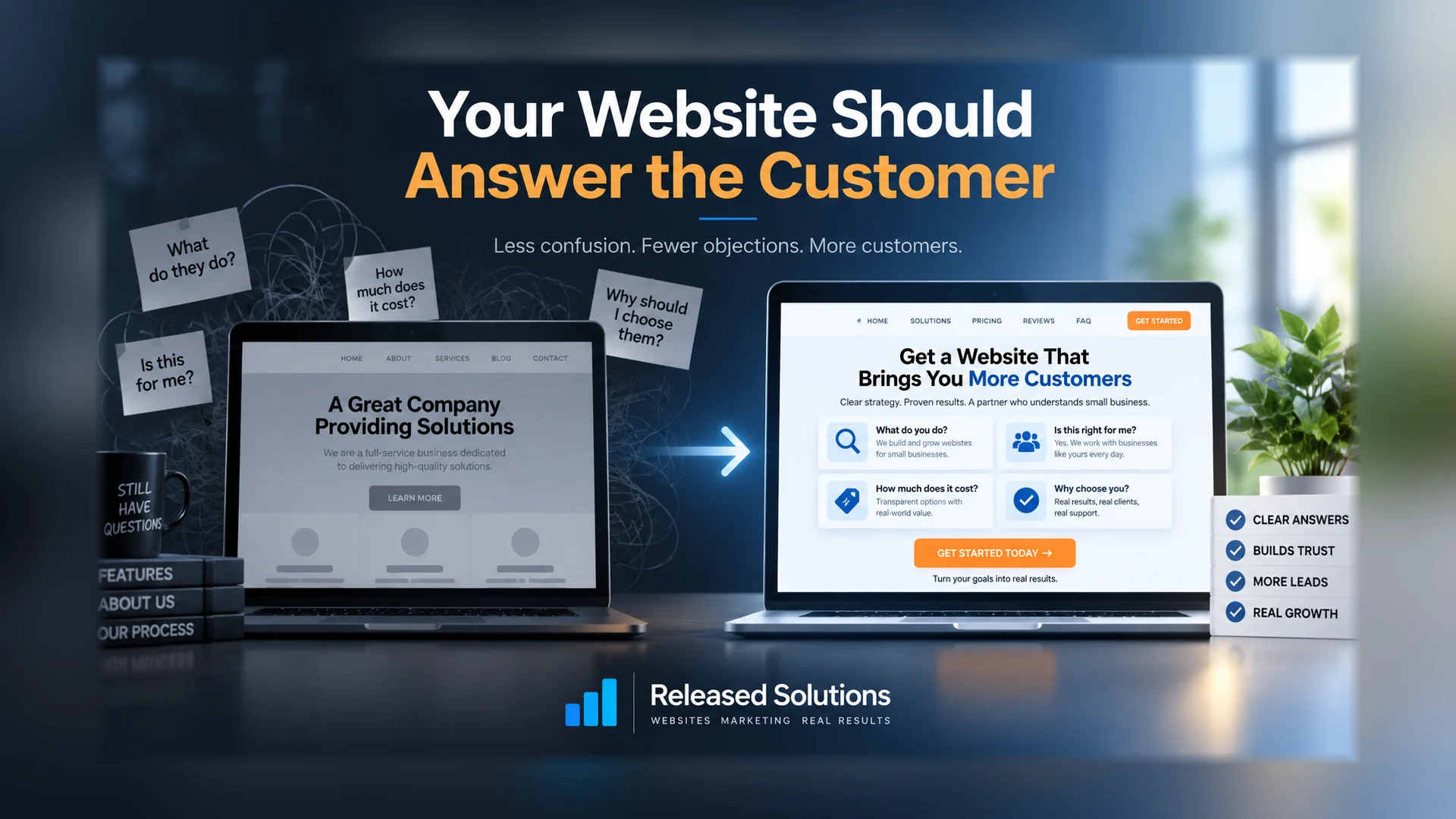

Your Website Isn't Supposed to Describe Your Business. It's Supposed to Answer the Customer.
Your website can be technically sound, beautifully designed, optimized for search, connected to analytics, and fed by paid advertising. It can even earn traffic from AI citations.
But none of those things guarantee that a visitor will take the next step.
That final part depends on whether the page answers the questions forming in the customer's mind: Is this for me? Do you understand my problem? Why should I trust you? What happens next? What will this cost me in money, time, effort, or risk?
A recent LinkedIn post from Email Marketing Tips, credited to dailycopywriter on X, presented nine useful copywriting tactics for email, SMS, landing pages, and ads. I agree with the tactics, but I think there is a bigger lesson for small-business websites.
Traffic Creates Opportunity. The Message Creates Movement.
I spend a lot of time looking at the mechanics around marketing: Google Ads, social campaigns, SEO, technical SEO, GA4, conversion tracking, website performance, and the systems that move a lead from one step to the next.
Those systems matter. But there is a point where the technology has done its job. A person has arrived.
At that moment, your website has to do more than say who you are. It has to connect what you do to what the visitor needs.
This is why getting more traffic is not always the fastest path to more business. If the right people are already arriving but the message is vague, company-centered, difficult to scan, or weak on proof, buying more clicks can simply buy more missed opportunities.
Nine Ways to Turn Website Copy Into Customer Answers
Use Competitor Complaints as Research
One of the strongest ideas in the original list is to study the complaints customers leave about competitors. I would not use that research to attack another company. I would use it to understand where buyers feel friction.
If reviews repeatedly mention slow response times, confusing pricing, poor communication, difficult onboarding, or lack of support, those complaints are market research. They tell you what people are afraid of experiencing again.
Your copy can answer those fears directly with clear processes, expectations, response policies, service boundaries, and proof.
Replace Generic Calls to Action With Clear Outcomes
Buttons such as Learn More, Submit, Get Started, or Buy Now are not always wrong. They are simply easy to use without thinking about what the visitor is actually being asked to do.
A stronger call to action reduces uncertainty. It can explain the next step, the value of that step, or the commitment required.
For a service business, Schedule a Discovery Call may be clearer than Get Started. For a guide, Download the Website Checklist tells the visitor exactly what happens next.
Be Specific Enough to Be Believable
Vague claims create work for the reader. Fast service, great quality, affordable pricing, and excellent support sound positive, but they do not answer much.
Specificity gives the customer something to evaluate. Explain what is included, what the process looks like, who the service is for, what happens after contact, what you measure, and what the customer should expect.
Specific does not mean inventing impressive numbers. It means replacing empty adjectives with useful facts.
Give Price the Context It Needs
Price by itself can feel expensive, cheap, confusing, or meaningless because the visitor has no frame of reference.
Good copy explains what the price represents. That may include the scope, the time saved, the support included, the cost of continuing with the problem, or the difference between a one-time project and ongoing management.
The goal is not to disguise price. It is to help the customer understand what they are comparing.
Research the Customer Before You Rewrite the Page
Many businesses rewrite their websites by sitting in a room and deciding what sounds better. That is usually backwards.
Start with customer calls, sales conversations, reviews, support questions, search queries, form submissions, CRM notes, email replies, and the questions people ask before buying.
The language customers use to describe their problem is often more useful than the language the business uses to describe its service.
Use More Than One Kind of Proof
Testimonials are useful, but proof can take many forms: case studies, recognizable client relationships, before-and-after examples, process screenshots, certifications, years of experience, measurable results, samples of work, and clear explanations of how you operate.
Different customers need different forms of reassurance.
A visitor who does not know you is not only asking whether you are good. They are asking whether there is enough evidence to feel comfortable taking the next step.
Treat Copywriting as Objection Handling
This may be the most important principle in the entire list.
Every sales conversation contains objections. The website should not wait for a phone call to answer all of them.
If customers repeatedly ask about timing, contracts, complexity, support, cost, ownership, migration, training, or whether a service works for a business their size, those questions belong somewhere in the content.
Strong copy does not pressure the customer past an objection. It gives the customer enough useful information to evaluate the objection.
Write for Scanning, Not Just Reading
People do not approach most business websites like novels. They look for headings, short sections, key phrases, lists, visual cues, pricing, proof, and the next action.
Classic Nielsen Norman Group usability research found that web users commonly scan rather than read every word. The practical lesson still holds: make the important information easy to find.
Use meaningful headings, shorter paragraphs, bullets when they help, strong hierarchy, and enough white space that the customer can locate an answer without digging for it.
Sell the Change, Not Just the Product
A service description explains what you provide. Benefit-oriented copy explains what becomes easier, faster, safer, clearer, more profitable, or less frustrating because of it.
That does not mean abandoning features. Features matter because they support the outcome.
The better structure is often: here is the problem, here is what we do, here is why that matters to you, here is proof, and here is the next step.
The Customer Answer Test
When I review a small-business website, I like to think about the page from the visitor's side of the screen.
Within a reasonable amount of time, can the page answer these five questions?
1.Do you understand the problem I am trying to solve?
2.Is this service meant for someone like me?
3.Why should I believe you can help?
4.What do I need to know before I contact you?
5.What exactly happens if I take the next step?
If the answers exist but are buried, the problem may be structure. If the answers are vague, the problem may be copy. If the answers are missing, the problem may be strategy.
And if the business cannot answer those questions internally, rewriting the website is probably not the first job. Clarifying the offer is.
What This Has to Do With SEO, Ads, Social Media, and AI
This is where copywriting stops being a writing exercise and becomes part of the marketing system.
SEO can help someone discover the page. Advertising can buy the click. Social media can create familiarity. Email can bring someone back. AI citations can introduce a business in a completely new discovery environment.
But once that visitor arrives, the page still has to help them understand, trust, and act.
That is why I do not separate website copy from conversion optimization, audience strategy, analytics, or online presence management. They are different parts of the same customer journey.
More visibility creates more chances to be considered. Better answers improve what happens after consideration begins.
SEO
SEO can help someone discover the page.
Ads
Advertising can buy the click.
Social Media
Social media can create familiarity.
AI
AI citations can introduce a business in a completely new discovery environment.
A Better Way to Review Your Website Copy
Do not start by asking, Does this sound professional?
Start by asking whether the page is useful to someone making a decision.
✓ Circle every claim that could apply to almost any competitor.
✓ Highlight every customer question the page clearly answers.
✓ Mark every place where proof supports a claim.
✓ Review every call to action and make sure the visitor knows what happens next.
✓ Look for objections your sales team answers repeatedly but your website ignores.
✓ Scan the page on a phone and see whether the main ideas are easy to find.
✓ Compare the language on the page with the language real customers use.
Then change one thing at a time and measure what happens. Better marketing is rarely one giant rewrite. It is usually a series of clearer decisions.
Your Website Has a Sales Job Even When Nobody Is Selling
Your website is often having the first sales conversation before you ever speak with the customer.
It is answering questions at night, after a referral, between meetings, from a search result, after an ad click, or while someone compares you with three alternatives.
That conversation should not sound like a brochure written about the company.
It should sound like a business that understands the customer well enough to anticipate what they need to know.
Describe what you do, absolutely. But do not stop there.
Answer the customer.
Need a Website That Answers Better Questions?
Released Solutions helps small businesses connect website messaging, conversion strategy, SEO, analytics, advertising, and Online Presence Management so the traffic you earn has a better chance to turn into meaningful action.
Traffic is an opportunity. Clarity is what helps turn that opportunity into action.
Kenneth Durrum, Released Solutions