

8 Ways to Turn Your Website Into a Lead Generation and Customer Support System in 2026
In 2017, telling a small business that its website should generate leads and support customers was forward-looking advice.
In 2026, that should be the minimum expectation.
A modern business website is connected to search, AI discovery, advertising, analytics, CRM, automation, email, SMS, customer service and the rest of the online presence. It should not simply explain who you are. It should help the right people discover you, understand what you do, decide whether they trust you, take the next step, receive follow-up and get help after becoming a customer.
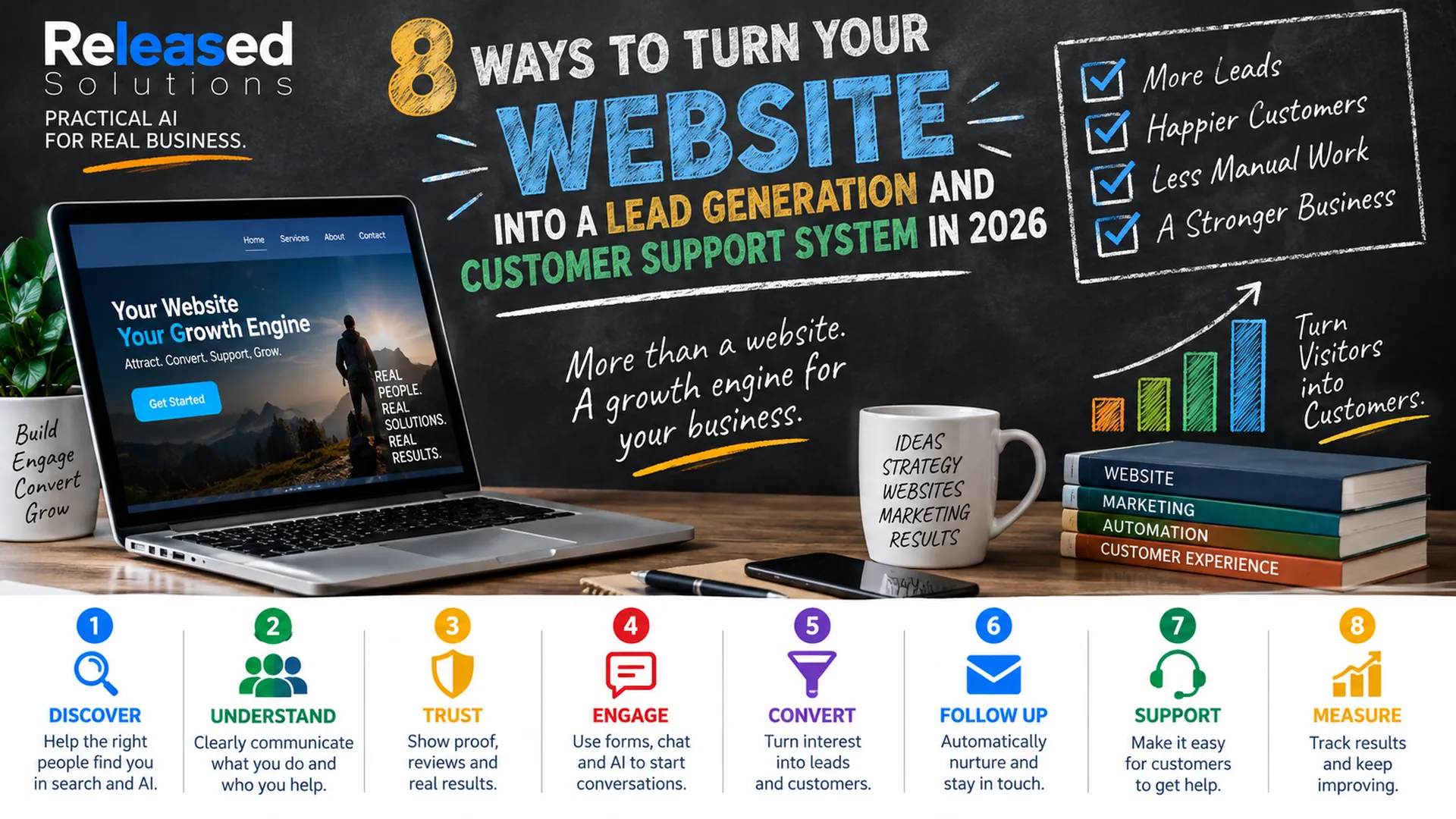
I use this customer journey: DISCOVER → UNDERSTAND → TRUST → ENGAGE → CONVERT → FOLLOW UP → SUPPORT → MEASURE. The website becomes valuable when those pieces work together.

It should help identify, educate, convert, route, support and measure the customer relationship.
Why the Website Is Not Just a Brochure Anymore
The website used to be the first stop on a linear path: someone searched, arrived, read a paragraph, and either called or left. That path still exists, but it is one of many.
Now a customer may find you through an AI-generated answer, arrive from a review site, click through a paid campaign, follow a Google Business Profile listing, land on a helpful article, revisit through email or return through a customer portal. They arrive with different questions, at different stages, from different channels.
The website has to serve all of those journeys and pass what it learns into the CRM, the calendar, the ticket system and the reporting stack so the business can actually respond.
DISCOVER the business through search, AI, local, ads and referrals. UNDERSTAND what it does within seconds of arriving. TRUST the evidence before converting. ENGAGE in whatever way suits the visitor. CONVERT through low-friction next steps. FOLLOW UP in CRM and automation. SUPPORT the customer after the sale. MEASURE the whole thing.
That is the website's job description in 2026.
System, Not Sales Page
The website is one part of a customer operating system that also includes search, AI, CRM, automation and support.
Continuity, Not Handoff
The customer should not feel a gap between the website and the people responsible for helping them.
Outcomes, Not Sessions
Traffic is not the goal. Qualified leads, appointments, purchases and repeat customers are.
The Eight-Stage Customer Journey a Modern Website Runs
Eight Jobs a Modern Website Must Do
DISCOVER: HELP THE RIGHT PEOPLE FIND YOU
Lead generation starts before someone reaches the website. Your pages need to be discoverable through the channels your customers use. That still includes traditional SEO: crawlable pages, useful content, clear titles, internal links, technical quality and pages that answer real search intent. But discovery now includes AI-assisted search experiences and AI assistants too. See SEO, AEO, GEO, AIO and SXO for how these overlap. Publish clear, useful and credible information that can be understood by customers, search engines and AI systems. Then measure what happens using Search Console, GA4 and CRM data.
UNDERSTAND: MAKE IT IMMEDIATELY CLEAR WHAT YOU DO
A visitor should not need to solve a puzzle. Within the first moments on an important page, they should be able to understand what the business does, who it is for, what problem it solves, why to keep reading and what to do next. Clear communication improves both customer experience and conversion, and it gives search and AI systems stronger information about the business. Use specific service language, useful headings, supporting details, FAQs, examples and obvious next steps. The website should reduce uncertainty, not create more of it.
TRUST: GIVE PEOPLE EVIDENCE BEFORE ASKING THEM TO CONVERT
People rarely convert because a website says, "We are the best." They look for evidence. Trust can come from authentic customer reviews, testimonials, case studies, credentials, professional affiliations, real examples of work, clear policies, useful educational content, accurate business information, transparent process explanations and a website that works correctly. Do not manufacture trust with fake reviews or misleading claims. The FTC's Consumer Reviews and Testimonials Rule addresses deceptive practices involving fake and false reviews and testimonials.
ENGAGE: GIVE VISITORS BETTER WAYS TO START A CONVERSATION
A contact form is useful. It should not necessarily be the only way a customer can interact. Engagement options can include click-to-call, appointment scheduling, live chat, AI-assisted chat, quote requests, product questions, service-area checks, downloads, email signup, SMS opt-in, customer portals and interactive tools. AI can help answer routine questions, gather context, route inquiries or make business information easier to access. But an AI assistant should not invent answers, hide the path to a human or become a barrier between the customer and the business.
CONVERT: DESIGN THE WEBSITE AROUND MEANINGFUL ACTIONS
Traffic is not the goal. A business outcome is. Every important page should have a logical next step: call, schedule, request a quote, buy, visit, apply, subscribe, start a chat, download a resource or join a loyalty program. Match the call to action to the visitor's stage. Conversion optimization is the work of reducing friction between customer intent and the appropriate next action, which includes mobile usability, page speed, form design, message clarity, trust, accessibility and a strong offer.
FOLLOW UP: CONNECT WEBSITE LEADS TO CRM AND AUTOMATION
A website can generate a lead and still fail the business if nothing useful happens next. Does the right person receive the form? Does it enter the CRM? Is the source recorded? Does the customer get confirmation? Is there a follow-up task? CRM and automation can help route leads, trigger acknowledgements, create tasks, segment contacts, support email or SMS follow-up and make missed opportunities visible. This is where account ownership matters too: the CRM, automation and analytics that carry the customer forward should belong to the business.
SUPPORT: LET THE WEBSITE HELP EXISTING CUSTOMERS TOO
A website should not stop being useful after the sale. Customer support content can reduce friction for both the customer and the business: FAQs, knowledge bases, appointment information, order status, customer portals, service instructions, troubleshooting, forms, billing information, downloads, policies, AI-assisted support and clear ways to reach a human. Good self-service does not mean hiding customer support. It means letting customers solve simple problems quickly while preserving a clear path to human help when they need it.
MEASURE: CONNECT WEBSITE ACTIVITY TO BUSINESS RESULTS
A lead-generation website should be measurable. Pageviews alone are not enough. Which channels bring qualified visitors? Which landing pages generate leads? Which forms are completed? Are AI referrals producing engagement or leads? What happens after a lead enters the CRM? Google Analytics, Search Console, advertising platforms, call tracking and CRM data can each show part of the journey. The important work is connecting them. Measurement turns the website from something the business owns into something the business can improve.
The Capabilities Behind the Journey
Each capability supports one or more stages of the customer journey. Missing a capability is not fatal on its own, but missing several at once turns the website into a bottleneck the business cannot see.
| Capability | What it does for the customer journey |
|---|---|
| Search + AI | Makes the business findable through Google, AI answers and referrals. |
| Trust | Brings authentic reviews, credentials and evidence into the conversion journey. |
| Conversion | Reduces friction between intent and the next meaningful action. |
| CRM | Captures the lead, records the source and continues the relationship. |
| Automation | Acknowledges, routes and follows up without the request going stale. |
| Support | Helps existing customers get answers without hiding a path to a human. |
| Analytics | Connects activity to leads, appointments, sales and cost per result. |
AI Changes the Website, but It Does Not Replace the Fundamentals
AI touches almost every stage of this system. It can help research customer questions, support content development, make website information easier to navigate, assist chat and support, help segment leads, analyze analytics, help create marketing variations and summarize customer conversations.
But AI does not replace the need for accurate information, a clear offer, trust, a working conversion path, human accountability or measurement. I view AI as a coworker inside the system.
It does not repair a broken customer journey by itself. If the underlying process is broken, adding AI simply gives the broken process more technology.
DISCOVER: can the right people find us? UNDERSTAND: can they quickly grasp what we do? TRUST: is there credible evidence? ENGAGE: can they interact in the way that suits them? CONVERT: is there a clear, low-friction next action? FOLLOW UP: does the lead enter a responsive system? SUPPORT: can existing customers get help? MEASURE: can we connect activity to outcomes and improve?
If one stage is weak, adding more traffic may simply send more people into the same problem.
Discover + Understand
Findable through search, AI and referrals. Clear enough to make sense in the first ten seconds.
Trust + Engage
Real evidence, real reviews and multiple ways to start the conversation the visitor wants.
Convert + Follow Up
Low-friction next steps wired to CRM, automation and human follow-up. No lead disappears into an inbox.
Support + Measure
Self-service and human paths after the sale. Analytics that connect activity to real business outcomes.
The Takeaway
A website can still be a lead-generation and customer-support superstar. But the job description is much bigger than it was in 2017.
The modern website should help people discover the business, understand it, trust it, engage, convert, receive follow-up, get support and move through a customer journey the business can actually measure.
Your website should not just generate leads. It should help identify, educate, convert, route, support and measure the customer relationship.
Turn Your Website Into a Working Part of the Business
Released Solutions helps small businesses connect websites, search, AI, advertising, CRM, automation, analytics and customer support so the website becomes part of a measurable customer journey.
Turn Your Website Into a Working Part of the Business
Released Solutions helps small businesses connect websites, search, AI, advertising, CRM, automation, analytics and customer support so the website becomes part of a measurable customer journey.
Prefer to start with the broader picture? Read our overview of online presence management.
Turn the website into a system the business can improve, not just a page it can rewrite.
Kenneth Durrum, Released Solutions