
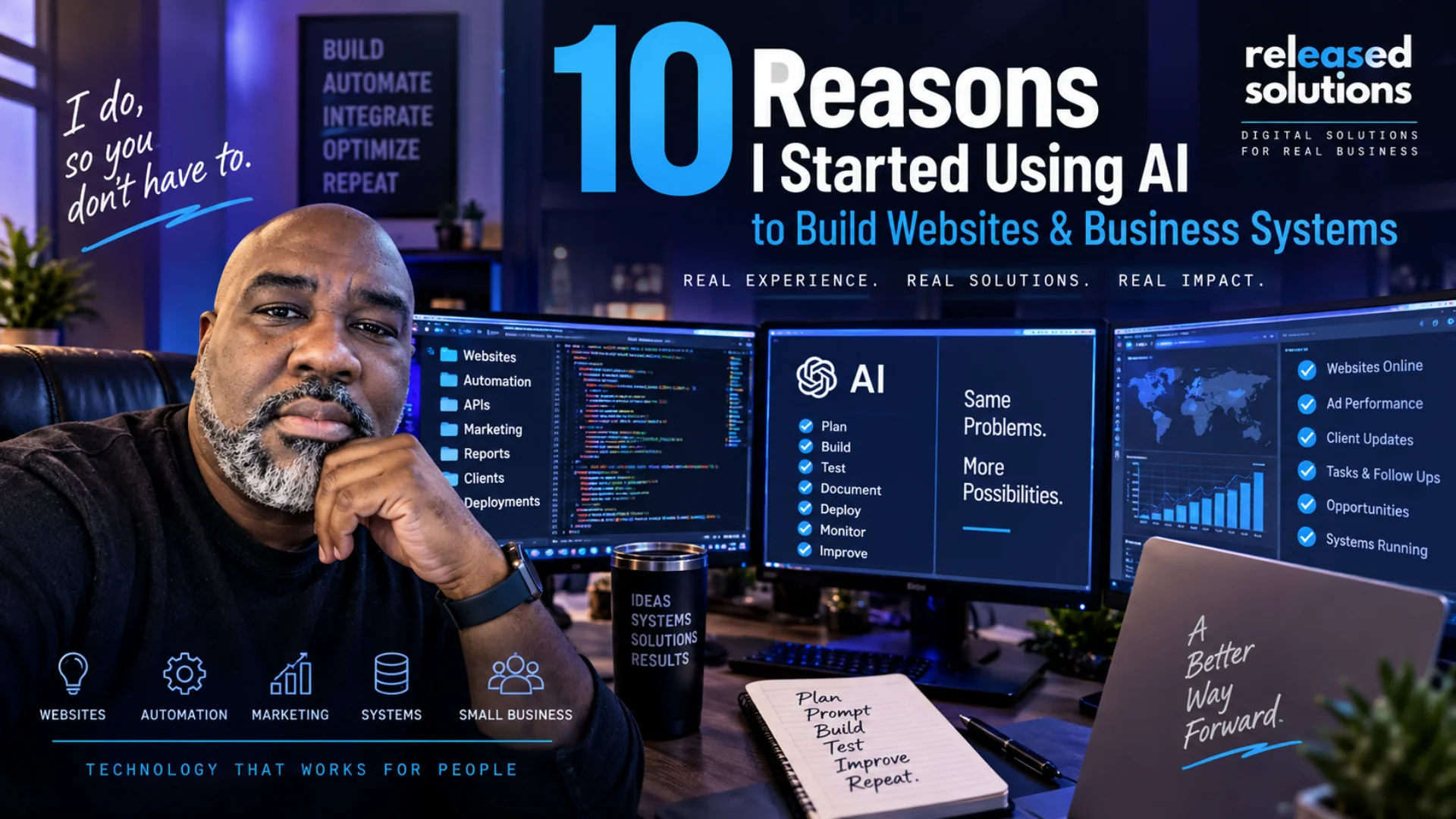

10 Reasons I Started Using AI to Build Websites and Business Systems
AI didn't teach me how to solve business problems. It removed many of the barriers between the problems I could see and the solutions I knew businesses needed.
I didn't start developing when AI showed up.
Long before ChatGPT, I was building solutions with AppleScript. I was tied to a scripting editor, banging away at the keyboard until I could make something happen.
Over time, AppleScript turned into PHP, shell scripting, JavaScript and other technologies. My skills improved. My projects became more complicated. And somehow, eventually, I usually got the job done.
But it wasn't always pretty.
My GitHub repositories weren't particularly organized. Code ended up in different places. Sometimes I lost something I had previously written. Sometimes I recreated something because I forgot I had already solved the problem. Other times a codebase became so bogged down that starting over seemed easier than figuring out where everything went wrong.
Development took time.
And time eventually became one of the biggest limitations on what I could build.
That's an important part of this story because AI didn't turn me into a developer. It changed the kind of developer, and problem solver, I could become.
Released Solutions Started With an Idea That Was Difficult to Scale
There's another piece of history behind why AI became so important to me.
I started Released Solutions because I wanted to do exactly what the name says: release solutions into businesses.
The problem was economics.
A small business could have a legitimate operational problem that technology could solve, but nobody wanted to have a conversation about building a $20,000 custom system.
And I understood why.
The business might eventually see the return on that investment, but the owner had to put on their "big picture" hat, spend a lot of money upfront and trust that the efficiencies would eventually produce a return. That was a difficult proposition.
If I estimated a custom development project at 90 days and billed development at $150 per hour, many small-business clients couldn't justify it.
So I adapted.
Released Solutions moved more heavily into digital marketing and what I called Marketing as a Service. SaaS products had already solved many of the problems my clients faced. Instead of building everything from scratch, I could assemble existing tools, WordPress, plugins, automation platforms and other services into affordable solutions. It worked.
But there was always something that bothered me. Sometimes I wasn't asking a client to describe their perfect system. I was helping them describe a system that fit within the technology I knew we could affordably deploy.
Then AI showed up.
My November 2022 Experiment That Changed Everything
I discovered ChatGPT in November 2022 while listening to a conversation on Clubhouse. Within 24 hours, I was building with it.
One of my clients operated a multi-location restaurant business receiving hundreds of customer reviews. Buried inside those reviews was incredibly valuable information about customer service, food quality, individual locations and the company's online reputation.
The information was there. The challenge was doing something useful with it.
I wanted to pull the reviews into Airtable, categorize them, assist with responses and create reporting processes that could help the business identify patterns and improve customer retention.
Before AI, I probably would have proposed something approaching a 90-day project. I would have researched the APIs, hand-coded much of it and potentially combined my development with existing automation tools. And before promising any unfamiliar integration, I would have spent my own time learning it. I don't particularly like learning on somebody else's dime.
That philosophy is important to me. If I'm telling a client I can solve something, I want to know I can deliver it. But it also created a business problem. Every unfamiliar API represented hours of research, reading, testing and experimentation that I might have to absorb before I could even determine whether the project made financial sense.
AI changed that calculation almost immediately. And that shift maps onto the real cost of AI for small business: the subscription price is the easy number, but the transformation is what changes what your business can actually afford to build.
10 Reasons I Use AI to Build Websites and Business Systems
AI Made Custom Development Affordable Again
This is probably the most important reason I started using AI for development. AI changed the economics.
Something that once required weeks or months of research, development and experimentation could suddenly move much faster. That doesn't mean development became free. It doesn't mean every application can be built in an afternoon. And it certainly doesn't mean testing, security, QA and good architecture stopped mattering.
What changed was the amount of human development time required to get from an idea to something testable. For a small-business owner, that's enormous. I could begin looking again at custom solutions that previously made no financial sense.
That brings Released Solutions surprisingly close to where I originally wanted the company to be: solving business problems with technology without requiring every client to have an enterprise-level technology budget.
AI Removed My Fear of What I Didn't Know
I know what I know. I also know that I don't know everything. That second part matters.
Before AI, there were plenty of times when I could see a potential solution but didn't know the shortest route to build it. Maybe there was an API I had never used. Maybe another technology already solved 80% of the problem. Maybe there was a development approach I simply hadn't encountered yet.
Not knowing didn't necessarily mean I lacked the ability to figure it out. It meant figuring it out required time. And because I didn't want a client financing my education, sometimes that investment became my responsibility.
AI dramatically lowered that barrier. Today, I walk into conversations relatively fearless. There are still real limitations. Access can be one. Getting a client to provide the right access can sometimes be another. But technologically, I'm much more comfortable saying: Tell me what you want. Let's start there.
I Can Finally Ask Clients to Describe Their Perfect Setup
This may be one of the biggest changes in how I consult with businesses. For years, WordPress development often meant selecting the right combination of plugins. There's nothing inherently wrong with that. I still use WordPress. I still have favorite plugins and third-party platforms. I'm not interested in reinventing a wheel simply because AI makes it possible.
But plugins created boundaries. A project could easily accumulate $500 or more in recurring annual plugin expenses. Then there were licenses, updates, compatibility considerations and the ongoing responsibility of keeping track of everything.
Custom-building a feature might have produced a better solution, but historically the development cost could easily exceed the price of the plugin. So the plugin won. That also influenced client conversations. Instead of saying, "Describe the perfect system," I might guide the conversation toward what I knew was available.
AI flipped that process around. Today, I want the client to dream first. Tell me how you wish this worked. Tell me what happens now. Tell me what should happen instead. Tell me what would make your life easier.
I'm not promising to beam anybody onto a spaceship or another planet. But I want to start with the ideal outcome and then determine, sometimes in real time with AI helping me, whether and how we can build it. That's a very different conversation.
More Reasons, More Reach
AI Made Me Spend More Time Planning Before I Code
This sounds backward. AI made development dramatically faster, so you might expect me to spend less time planning. I've actually moved in the opposite direction.
One of my biggest frustrations before AI was scope creep. Specifications changed. Details disappeared. Clients remembered something halfway through development. I remembered something halfway through development. Market pressure created unrealistic deadlines, and moving quickly sometimes meant important details weren't documented consistently enough.
Now I incorporate AI at the very beginning of projects. I conduct recorded client interviews. I give the transcript to AI. We identify gaps. AI helps develop follow-up questions. Sometimes I have AI interview me about the project as well. Then we work through phases, requirements, dependencies and, importantly, what is not included.
The specifications become better before development begins. That has helped me slow down scope creep while simultaneously speeding up delivery. There's an irony there that I love: the faster AI allows me to build, the more willing I am to spend time thinking before I build.
APIs Stopped Being a Barrier
I wasn't afraid of APIs because I couldn't understand them. I was hesitant because learning an unfamiliar API properly represented an investment. Not all APIs are created equal.
Before promising an integration to a client, I might need to read the documentation, understand authentication, test endpoints, figure out limitations and work through the inevitable quirks. I preferred doing that on my time rather than experimenting at a client's expense.
AI changed how quickly I can explore those systems. Today, APIs, and increasingly MCP support, are actually things I look for when evaluating software.
I still use third-party platforms. I still recommend WordPress. I still use established software when established software is the smartest answer. AI didn't make me anti-software. It made me pro-integration. If I'm bringing another platform into the collective, I want to know how well it can communicate with everything else.
AI Gave Me More Arms, and More Eyes
At one point I described AI as giving me six additional arms. I may have underestimated it.
On a normal day, I can have 15 or more terminal sessions running. I operate Released Solutions while also subcontracting my expertise to other organizations. I may be deploying a website, providing technical support across more than 100 websites, managing advertising campaigns, developing a new system, documenting work, tracking time and making sure clients are billed accurately.
Each session becomes another branch of what I'm doing. More importantly, I can move between those branches without completely losing where I was.
AI helps maintain context. It helps document. It helps remind. It helps research. It helps develop. It helps analyze. It also holds me accountable.
I have systems that give me daily briefs and tell me what deserves attention. One morning, for example, my briefing alerted me that advertising spend had crept roughly 2% beyond a weekly allocation trend I was watching. That's something I want to know before it becomes a surprise that I have to explain later.
So maybe AI didn't give me six arms. Maybe it's eight arms and four extra eyes. I'm still counting.
The last three before the mistakes talk
AI Helps Me Shoot Trouble Instead of Troubleshoot
I've always liked saying that I'm more interested in shooting trouble than troubleshooting. Traditional troubleshooting begins after something breaks. I would rather identify the conditions that lead to the problem and shoot the trouble before it gets there.
AI has made that philosophy much more practical. I recently developed a system that gives me a daily briefing across more than 100 websites I'm responsible for helping maintain.
Instead of manually combing through error logs looking for patterns, I can monitor uptime, identify unusual conditions, document incidents and build safeguards around problems we've already encountered.
When something fails, I don't only want it fixed. I want to know: Why did it happen? Has it happened before? What else could it affect? Can we detect it earlier next time? Can recovery be automated safely? What safeguard can we put in place so it doesn't repeat?
The same thinking applies to advertising. I've spent years building campaign reporting systems in FileMaker, spreadsheets, Airtable and other platforms. The recurring problem was that eventually the system became overwhelming for the client, or for me. AI has helped me change that. I can collect a tremendous amount of information while simplifying what the human actually sees. Instead of another massive dashboard, give me the right brief at the right moment so I can make a decision.
That's where AI becomes much more interesting to me than simply generating content.
AI Made Me a Better Developer, Not Just a Faster One
Fast is an understatement. But speed isn't the part I'm most excited about. I'm learning more.
I explore more technologies because the cost of exploration has dropped. I investigate approaches I previously might not have had time to investigate. When AI gets something wrong, and it absolutely does, I have to understand why.
Sometimes I have to go read the API documentation myself. Good. Sometimes the problem was bad code. Sometimes it misunderstood what I wanted. Sometimes I didn't provide enough context. Sometimes my prompt wasn't mature enough. Those failures become learning opportunities.
Prompt quality matters more than most people realize. If you want a template you can start using this week, take a look at 5 Prompts to Help Guide AI. And if you're thinking about how a small-business owner should actually approach the discipline of learning AI, the ordered path in How to Learn AI for Small Business is a good starting point.
And because I tightly supervise projects in phases and modules, I can usually stop a bad direction before it travels too far. I've even used one AI platform to check the work of another. I tell them about each other, too. I hope there's no jealousy. Sometimes I'll have AI help me write the prompt I'm going to give another AI because better instructions reduce the opportunity for misunderstanding.
My measure of success isn't simply how quickly I can tell AI to produce something. Increasingly, I look at how efficiently we reached the right answer.
AI Made My Experience More Valuable, Not Less
I recently had a client question the value of AI-assisted development. His thinking was understandable. If I was "vibe coding" his website with AI, why couldn't he just do it himself? And shouldn't it cost less because AI was helping?
So I invited him into the process. We vibe coded together, live.
He watched me communicate with AI. He heard the terminology I used. He watched the decisions I made, the details I provided and the things I recognized because I already had years of experience in development, websites, automation, systems and marketing.
It didn't take long for him to recognize the difference. Having access to AI and knowing how to direct AI are not the same thing. After that, I was able to vibe code in peace.
That's also why I don't believe beginners should assume AI eliminates the value of experience. Someone can burn through enormous numbers of tokens while learning very little. There's still a DIY mentality of: "Why should I pay somebody? AI can do it." Maybe it can.
But what is your time worth? Do you understand what you're building? Do you know what questions you haven't asked? Do you recognize bad architecture? Do you know when something creates a security problem? Do you know what happens when the generated code fails six months from now?
AI can help bridge knowledge gaps. It doesn't magically give someone decades of experience. I know that I don't know everything. But I also know what I know. That still matters.
Affordable Custom Development
Fearless Integrations
More Arms and Eyes
Better, Not Just Faster
A Word About AI Making Mistakes
Is AI ever wrong? Oh yes.
I've been responsible for bad code releases written by humans, including myself. I've also seen AI produce bad code. I'm not sure which one makes more mistakes.
Humans have traditionally had months to build, test and refine software, so many of our mistakes get discovered before anyone sees them. AI can produce enormous amounts of work in minutes. That doesn't mean everything it produces should be released in minutes.
This is where I think our expectations need to change. If AI turns something that once required months into something that can be developed in days or weeks, we don't have to convert every saved hour into an earlier launch date. Use some of that time to review. Test. Verify. Challenge assumptions. Monitor. Improve.
I still build in phases and modules because that gives me opportunities to QA what AI and I are building together. I don't need to personally rewrite every line AI generates. If that were the requirement, much of the efficiency would disappear. But I do need enough oversight, architecture, testing and validation to take responsibility for what gets released. Ultimately, that ownership still belongs to me.
Almost Everything Feels Possible Again
This may be the most personal reason. I've never been more excited about development.
I sometimes joke that I want a time machine. I wish today's technology existed when I was learning to build systems. But there's another way of looking at it. I have all of those years of experience now, at the exact moment tools have arrived that can multiply what I'm capable of doing with that experience. That's pretty exciting too.
For the first time, I can increasingly see problems and begin developing solutions before someone brings the problem to me. Previously, someone would present a problem and I would see the solution. Today, AI-assisted monitoring, analysis and development allow me to identify patterns and see where trouble may be heading. Sometimes I joke that I've traveled into the future and come back.
That's really what I want to provide to clients. Not AI for the sake of saying we use AI. Not automation simply so humans can be removed. And certainly not a completely autonomous system designed to make me irrelevant. I want to remain the person in the middle. I want to help small-business owners adopt these technologies faster and more responsibly.
Because ultimately, my job hasn't changed nearly as much as the tools have. I solve problems for people. AI simply helps me solve more of them.
Coming Full Circle at Released Solutions
When I look at what AI has changed for me, I keep coming back to the name of my company. Released Solutions. That's what I wanted the business to be from the beginning.
The problem wasn't a lack of businesses needing solutions. The problem wasn't a lack of ideas. Often, the problem was simply that custom development didn't make financial sense for the businesses I wanted to help. So I pivoted. Marketing platforms, SaaS products, WordPress, automation tools and existing technology gave me ways to solve those problems without building everything myself.
Now AI has changed the equation again. We don't need to custom-build everything simply because we can. I still believe in using proven technology when it solves the problem well. But we're no longer as constrained by what somebody else already decided to build.
That's the exciting part. We can begin somewhere different: What do you want to happen? Then we can determine the smartest way to make it happen. Maybe that's WordPress. Maybe it's an existing SaaS platform. Maybe it's an API. Maybe it's automation. Maybe it's custom development. Maybe AI participates throughout the entire system. Usually, it's some combination.
The technology isn't the destination. The solution is.
What Could AI Help Your Business Build?
If there's a process inside your business that has always bothered you, don't start by asking what software you should buy. Start by describing the perfect setup.
What happens today? What takes too long? What gets forgotten? Where does information get stuck? What do you wish happened automatically? What would you want to know before it became a problem?
That's the conversation I want to have. At Released Solutions, AI has given us an opportunity to return to our roots: finding practical ways to use technology to solve real business problems, without automatically assuming the answer requires an enterprise-sized development budget.
If I could go back in time and sit next to the version of myself working inside that AppleScript editor, I know exactly what I would tell him:
"Almost everything is possible. Keep thinking the way you do, and now tell this tool what you want to happen next."
And then I'd probably get out of his way. He has a lot of work to do.
— Kenneth Durrum · Released Solutions