
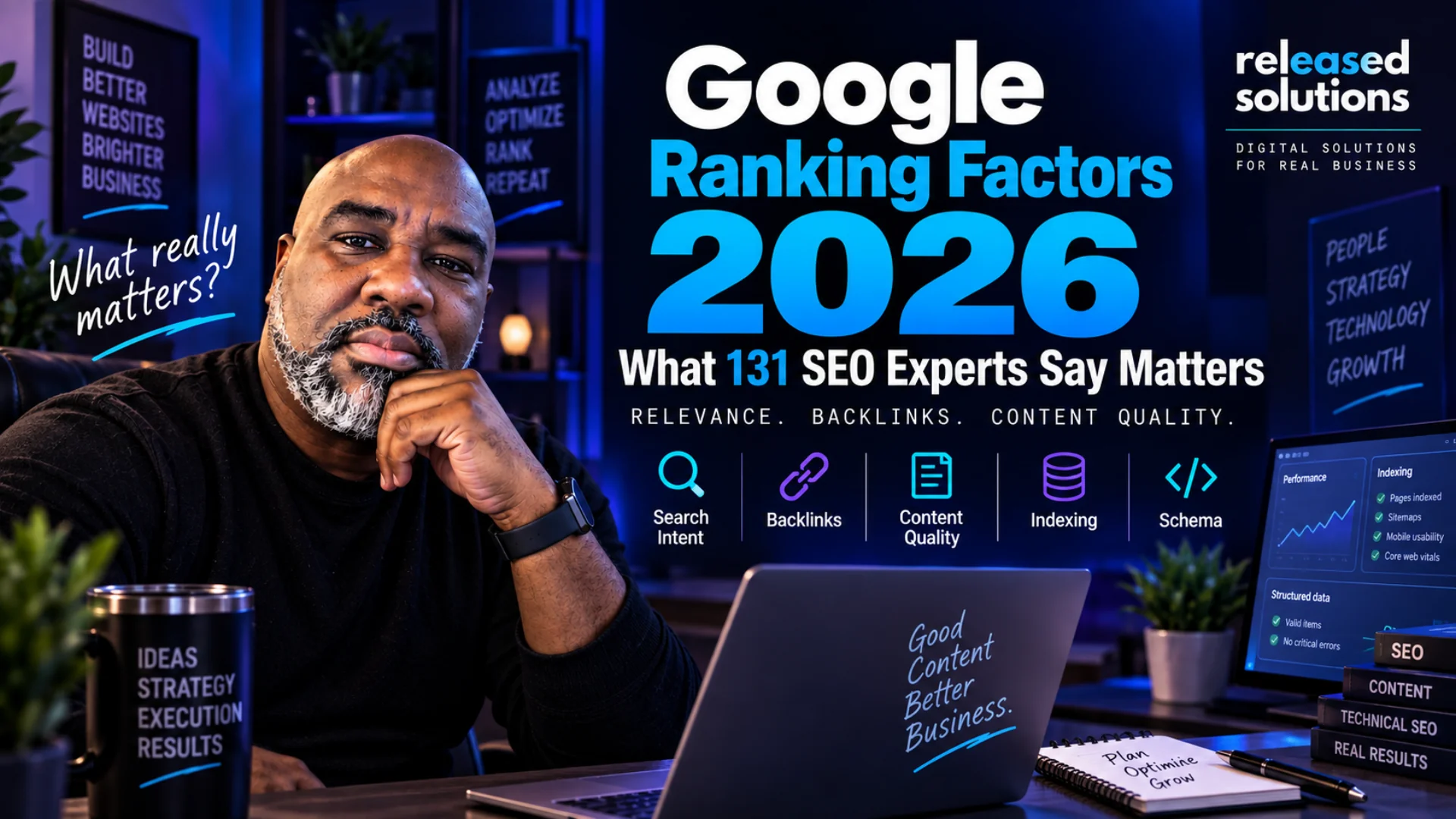

Google Ranking Factors in 2026: What 131 SEO Experts Say Matters
If you own a small business, you have probably heard dozens of explanations for how to rank higher on Google.
Use more keywords. Get backlinks. Write longer articles. Improve your website speed. Add schema. Publish more often. Build authority.
And now, with AI reshaping search, we can add an entirely new collection of acronyms, strategies and opinions to the pile.
So when I came across a new 2026 survey asking 131 SEO professionals what they believe actually matters for Google rankings, I paid attention.
The survey, conducted by Zyppy, asked SEO professionals to evaluate 103 potential ranking factors. Altogether, the respondents contributed 13,665 individual ranking-factor evaluations.
Their top three answers were surprisingly straightforward:
Authority and trust, user behavior, brand signals, satisfaction, technical SEO, topical authority and internal links followed behind them.
But there is an important qualification. This is not Google publishing its algorithm. It is a survey of experienced SEO professionals describing what they believe has the greatest impact based on their experience.
I actually find that distinction useful. Rather than giving us another mythical SEO checklist, the survey gives us a picture of what experienced people working in search are seeing in the field. And much of it lines up with what I have been paying closer attention to myself.
The Eight Findings That Stood Out
Search Intent Beat Keywords
The highest-rated individual factor in the entire survey was search intent match. That means understanding what somebody is actually trying to accomplish when they type something into Google. That is different from simply putting the right keyword on a page.
If someone searches for "How much does a small business website cost?" they probably do not want a 2,000-word history of website development. They want to understand pricing, what affects pricing, what they should expect to pay, what should be included, and the tradeoffs between different levels of investment.
A page can be perfectly optimized around the phrase small business website cost and still disappoint the person who lands on it. That is the distinction between matching a keyword and satisfying intent.
For a small business, this is an important shift in thinking. SEO should not begin with, "What keyword can we rank for?" It should increasingly begin with, "What question is our customer trying to answer?" Then build the best possible answer.
Backlinks Are Not Dead
Every few years somebody announces that backlinks do not matter anymore. Apparently, SEO professionals have not received the memo.
Backlinks were the second most commonly selected top-three ranking factor, chosen by 54.8% of respondents.
But there is an important difference between modern link building and the old idea of accumulating links anywhere you can get them.
Links from trusted websites. Links from topically relevant websites and pages. Links from websites that have actual visitors and audiences. Spammy links, on the other hand, were viewed very negatively.
For a small business, that means link building should increasingly resemble relationship building, public relations, expertise and reputation building rather than simply purchasing SEO links.
AI Did Not Kill Content. It Raised the Standard.
This may be the most interesting part of the survey.
Content quality finished third overall. But when the researchers examined what respondents considered high-quality content, two things stood out: original research and first-party data.
That matters enormously in the age of AI. AI can summarize what already exists incredibly well. It can organize information, help develop ideas, and help businesses create better content faster. I use AI extensively myself.
But if 500 businesses ask AI to write an article about the exact same subject using the same information already available online, we should not be surprised when those 500 articles begin sounding remarkably similar.
The survey reflects that problem. Respondents viewed scaled AI-generated content with little additional value negatively, while AI-assisted content that received substantial human review and contributed something useful or unique was viewed more favorably.
The distinction is important. The problem is not necessarily AI. The problem is commodity content.
If your business can contribute experience, examples, observations, customer questions, original photos, internal data, testing, research or expertise that does not exist everywhere else, your content becomes harder to duplicate.
Brand, Satisfaction, and Technical Foundation
Your Brand Is Becoming Part of SEO
Brand signals ranked sixth in the survey, while authority and trust ranked fourth. That should get the attention of small-business owners who still think SEO happens entirely inside a website. It does not.
Google is trying to understand entities. Who is this company? What does it specialize in? Do people look for it by name? Is it mentioned elsewhere? Do other websites trust it? Does its content consistently cover the subjects it claims expertise in? Does its online reputation support those claims?
SEO, reputation management, content marketing, public relations and branding are becoming increasingly interconnected.
That also helps explain why I do not believe businesses should think about SEO, AEO, GEO, AIO and SXO as completely separate marketing disciplines. In my recent article about SEO, AEO, GEO, AIO and SXO, I discussed how those labels increasingly describe different layers of the same visibility problem.
Your business needs to be understandable to people, search engines and increasingly AI systems. A recognizable, trusted brand helps all three.
User Satisfaction Matters After the Click
One of the more interesting findings involved user behavior. Respondents ranked satisfaction and task completion highly.
In plain English: did the person find what they needed?
That forces us to look beyond rankings. Imagine ranking number one for a keyword but sending visitors to a confusing page where they cannot find the answer, cannot identify the next step and leave frustrated. Was that really a successful search result? Probably not.
A better SEO strategy asks whether the page answers the question, is easy to understand, can be navigated easily, offers an obvious next action, works properly on mobile, and lets the visitor accomplish what brought them there.
This is where SEO begins overlapping with user experience and conversion optimization. Traffic alone is not the goal. Useful traffic accomplishing useful things is.
Technical SEO Is the Infrastructure
Technical SEO ranked eighth among the top factors at 17.5%. At first glance, somebody might look at that number and decide technical SEO is not particularly important. I would draw almost the opposite conclusion.
The survey describes technical SEO as foundational. Respondents generally characterized crawling, indexing and site health as table stakes: technically perfect SEO will not rescue mediocre content, but technical problems can absolutely prevent good content from performing.
This part resonates with the work I have been doing recently. I have been spending more time inside Google Search Console reviewing page indexing issues and structured-data or schema errors. Not because fixing a schema warning magically moves a page from position 30 to position 1. That is not how this works.
I am looking for something more fundamental: can Google properly crawl, index and understand what we built?
Google's Page indexing report is designed to show which URLs Google knows about, which are indexed and why certain pages may not be indexed. It also helps site owners watch for unexpected drops or spikes and understand the reasons behind non-indexed pages.
Is Google finding important pages? Is Google crawling them? Are they being indexed? Is Google selecting the canonical URL we expect? Are important pages accidentally blocked? Are URLs being classified as duplicates for a valid reason? Did something change after a website update?
Those are not theoretical SEO questions. They are operational questions. And a clean sitemap keeps the discovery layer honest.
Schema and Internal Links
Schema Errors Give Us Another Diagnostic Layer
I am also increasingly paying attention to structured data.
Schema markup helps machines better understand certain information contained on a webpage. Depending on the page, that might include things such as articles, products, breadcrumbs, organizations, events and other supported structured-data types.
Google Search Console provides rich-result reports showing structured data Google has detected and whether those items contain critical or non-critical problems. Google also provides tools for validating fixes after errors have been corrected.
Again, I do not treat schema as a magic ranking button. I treat it as another piece of the site's technical communication layer.
If we are increasingly building websites not only for human readers but also for search engines and AI systems trying to understand what those pages represent, clarity matters. That includes content structure, site architecture, internal links, structured data, indexability and consistency.
Internal Linking Deserves More Attention
Internal linking rounded out the survey's top ten factors. It is also one of the few SEO tools completely under the website owner's control.
An internal link helps visitors discover related information. It also helps search engines understand relationships between pages.
A website containing 100 isolated pages is not necessarily the same thing as a website containing 100 intentionally connected pages covering related subjects.
That is one reason I increasingly think in terms of topics and content ecosystems rather than individual blog posts. One article should naturally lead into another. A service page should connect to supporting educational material. Educational content should reinforce expertise around the services the business actually provides. Important pages should not be buried several layers deep with almost nothing pointing toward them.
Four Themes That Rose to the Top
Cut through the 103 factors and here is what practitioners are actually pointing at: match intent, earn real backlinks, publish original work, and make sure Google can technically see it. Everything downstream depends on those four.
The four to remember
Four takeaways worth putting in front of your team.
Match the Intent
Earn Real Backlinks
Publish Original Work
Get the Technical Foundation Right
So What Should a Small Business Actually Do?
The biggest mistake would be turning this survey into another 103-item SEO checklist. Small-business owners do not need 103 priorities. They need the right priorities. I would simplify the findings into a much more practical framework.
That last point matters to me. SEO should not simply be a series of things we claim we did.
"We optimized the page." "We added schema." "We published an article." "We submitted the sitemap."
Okay. What happened? Did Google crawl it? Did it get indexed? Are impressions increasing? What queries are triggering it? Which pages are gaining visibility? Are important pages dropping out of the index? Did structured-data errors appear? Did Google choose a different canonical page than the one we expected?
Measurement turns SEO from a checklist into an operating process.
The Bigger Lesson From the Survey
After reviewing the research, my biggest takeaway is not that relevance finished first or backlinks finished second.
It is that SEO continues moving away from tricks and toward evidence of usefulness, authority and understanding.
You need content that satisfies the person searching. You need enough authority and trust for Google to take your site seriously. You need a technically sound website that search engines can access and understand. Increasingly, you also need information that contributes something genuinely useful instead of merely repeating what already exists.
That is actually good news for small businesses.
You do not need to become a giant media company publishing 100 articles per month. You need to understand your customers better than most of your competitors do.
Answer the questions they actually ask. Demonstrate real experience. Build a site that works correctly. Develop genuine authority around the subjects connected to your business. Then measure what happens.
Because whether we are talking about traditional SEO, AI search, answer engines or whatever acronym gets invented next, the objective remains remarkably consistent:
Want to Know What Google Is Actually Seeing on Your Website?
A website can look perfectly fine to a business owner while Google Search Console is telling a very different story.
Indexing problems, technical issues, structured-data errors, weak internal relationships and content gaps can all affect how effectively your website communicates with search engines.
Released Solutions helps businesses look beyond the appearance of the website and understand what is happening underneath it.
If you want a clearer picture of how your website is being discovered, understood and measured, contact Released Solutions to start the conversation.
Zyppy: Google Ranking Factors Expert Survey 2026. Published September 9, 2026. The survey reports 131 SEO professionals, 103 potential ranking factors and 13,665 ratings. Percentages in this article refer to the share of respondents who selected a factor among their top three, not Google's algorithmic weighting.
Search Engine Land: Google's top ranking factors, according to 131 SEO professionals. Published September 9, 2026. Used as secondary industry coverage and interpretation of the Zyppy survey.
Google Search Console: Page indexing report. Used to verify descriptions of indexing status, non-indexed reasons, canonical monitoring and troubleshooting.
Google Search Console: Rich result report overview. Used to verify descriptions of valid and invalid structured data items and fix validation.