
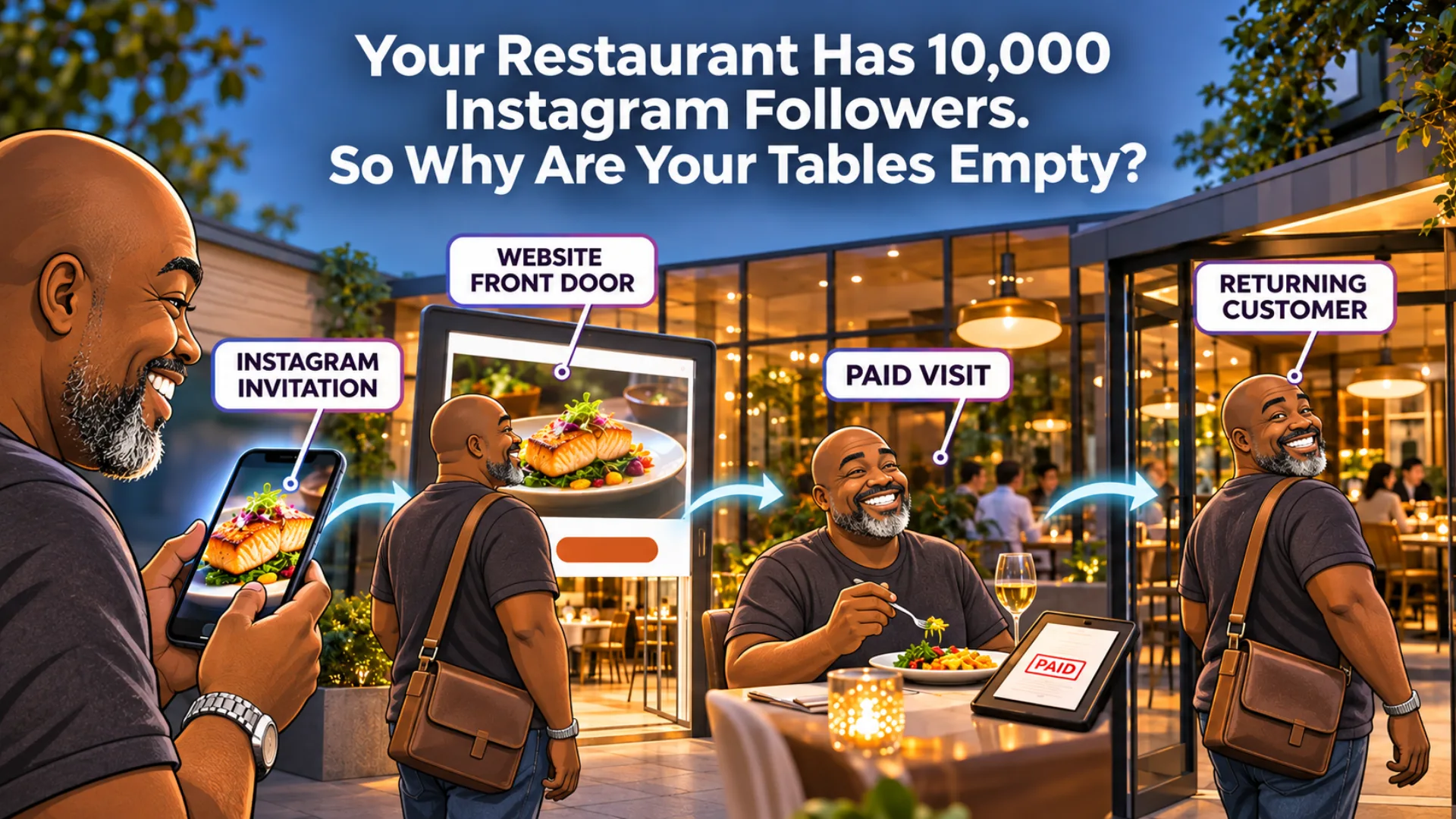

Your Restaurant Has 10,000 Instagram Followers. So Why Are Your Tables Empty?
Instagram Marketing for Restaurants: When Followers Don't Become Customers
A restaurant can have thousands of Instagram followers, beautiful food photography, entertaining videos, and posts that generate hundreds of likes. Yet none of that guarantees customers are walking through the door, ordering food, or coming back for another meal.
Don't get me wrong. I think Instagram can be an excellent marketing tool for restaurants. But Instagram popularity and restaurant profitability are two very different things.
The question I would ask any restaurant owner is simple: Are you building an audience, or are you building a customer base?
Because those are not necessarily the same thing.
Does Having 10,000 Instagram Followers Mean 10,000 People See Your Restaurant?
No. Having 10,000 Instagram followers does not mean 10,000 people see every post. It doesn't even mean the people seeing your content live close enough to become customers.
According to Socialinsider's 2026 Instagram Reels research, organic reach varies by account size and content format.
For accounts with 10,000 to 50,000 followers, the study reported these average reach rates:
| Instagram content | Average reach rate |
|---|---|
| Reels | 7.10% |
| Carousels | 6.40% |
| Single images | 5.50% |
Here's what that means.
Hypothetical example: A restaurant with 10,000 followers achieving a 7.10% reach rate would reach approximately 710 accounts with a Reel.
Not 10,000. Approximately 710.
And that number can include people who don't follow the account. It doesn't tell us how many of those people live nearby, are interested in dining, or will spend money at the restaurant.
Now here's where it gets interesting.
A restaurant can create a wildly popular video that reaches thousands of people in other cities or countries. That's wonderful exposure, but how many of those viewers are going to drive across the country for Tuesday's lunch special?
This is why I believe restaurants need to understand the difference between reaching people and reaching potential customers.
A smaller audience of local people who actually visit your restaurant can be more valuable than a large audience that simply enjoys watching your food videos.
Is Instagram a Replacement for a Restaurant Website?
Instagram can help customers discover a restaurant, but it should not be the only place they can learn about the business, make reservations, view the menu, or place an order.
Think about it this way.
Imagine opening a restaurant and spending your entire advertising budget inviting people to dinner. Your advertising is beautiful. The photographs look delicious. People are talking about your restaurant.
But when potential customers arrive, there's no clear entrance, no menu posted, and nobody explaining how to get a table.
That's what relying exclusively on Instagram can feel like to a customer.
They see a delicious dish, but where's the price? Is it still available? What time does the restaurant close? Can they make a reservation? Is the menu buried in a post from three months ago?
Perhaps the answer is somewhere in the Instagram feed. Or maybe they need to send a direct message and hope someone responds before they get hungry enough to go somewhere else.
A good restaurant website doesn't need to be elaborate or expensive. It needs to answer the questions customers have and make the next step easy.
That might mean a mobile-friendly menu with current prices, accurate hours and location, appealing food photography, and clearly visible reservation, ordering, and contact options.
Your website also gives you a destination to connect with Google Search, Google Maps, email marketing, online advertising, and other ways people discover businesses.
Google's own Business Profile documentation explains how restaurants can provide menu, reservation, and ordering links directly from Search and Maps.
You want customers to find you wherever they're looking, not just wherever you happen to be posting.
This is part of building a complete online presence management strategy, rather than depending on a single platform.
What Should Restaurants Actually Post on Instagram?
Restaurants should create content that gives nearby customers a reason to visit, order, share the experience, or come back.
Food photography is important. People eat with their eyes long before they eat with their mouths. But repeatedly posting pictures of completed dishes is not necessarily an Instagram marketing strategy.
I'd start by giving each content format a specific job.
| Content format | Marketing purpose | Restaurant example |
|---|---|---|
| Reels | Introduce the restaurant to new people | Show a chef preparing a signature dish |
| Carousels | Help customers explore and remember menu options | Five popular lunch dishes with current prices |
| Stories | Encourage timely action and direct responses | Today's special with a reservation or ordering link |
| Photos | Showcase food, people, and atmosphere | A signature dish or a customer experience shared with permission |
Socialinsider's 2026 research also found that Reels generated higher average engagement than carousels or images for the restaurants and cafés in its study.
But I wouldn't automatically tell every restaurant to post nothing but Reels.
The better question is what each format accomplishes for that restaurant.
A Reel might introduce your restaurant to somebody new. A carousel might help them choose what to order. A Story might remind them there's a special tonight.
And your website can help them finish what they started.
Why Should Your Restaurant's Instagram Calendar Follow Your Business Calendar?
Because the goal isn't simply to keep Instagram entertained. The goal is to help your restaurant succeed.
Suppose your restaurant is packed on Friday and Saturday but struggles to fill tables on Tuesday and Wednesday.
Would it make sense to spend most of your marketing effort promoting Friday night?
Maybe not.
I'd want to understand what makes Tuesday different. Is it a lack of awareness? Are customers looking for a lunch option? Could a family meal, a particular dish, or a convenient reservation experience help?
Then I'd build the content around that opportunity.
Here's a hypothetical weekly plan for a restaurant open Tuesday through Sunday.
| Day | Suggested activity | Business objective |
|---|---|---|
| Monday | Preview Tuesday's lunch offerings | Generate interest before a slower shift |
| Tuesday | Carousel showing lunch choices and prices | Encourage lunch visits |
| Wednesday | Reel showing preparation of a signature dish | Reach potential new customers |
| Thursday | Stories featuring weekend options | Encourage advance reservations |
| Friday | Reel showing the atmosphere or weekend special | Support weekend demand |
| Saturday | Customer experience photo or Stories | Build trust and encourage sharing |
| Sunday | Brunch promotion or next week's preview | Support repeat and future visits |
This isn't some secret formula for pleasing Instagram's algorithm. It's an example of aligning marketing with actual restaurant operations.
You can adjust the days, content, and frequency based on staffing, customer behavior, and business needs.
And you don't need a professional film crew following the chef around with a camera every time somebody makes a sandwich.
One short filming session can produce a preparation video, a finished dish photograph, and several Stories.
The point isn't to post more. It's to make your posting more purposeful.
How Do You Know Whether Instagram Is Bringing Customers Into Your Restaurant?
Start by connecting marketing activity to actual visits and purchases.
Likes, shares, views, saves, and follower growth can help explain how content performs. But they don't automatically tell you whether the restaurant made money.
I often tell business owners that marketing measurement should follow the customer beyond the advertisement.
For a restaurant, that means understanding the journey from Instagram to reservation, from reservation to an actual visit, and from that visit to a paid check.
You can start with a few practical tracking methods.
Tracked reservation and ordering links. Campaign tags called UTMs can identify Instagram traffic in compatible analytics systems. For example, a restaurant might use utm_source=instagram and utm_campaign=weekend_special to distinguish visits from a particular promotion.
However, tagged links don't automatically guarantee that the booking or point-of-sale system records the source. The integration needs to be tested.
Campaign-specific identifiers. A restaurant can associate a promoted special or campaign with a POS entry so staff can record relevant transactions. This doesn't necessarily require a discount.
A simple customer question. When a first-time guest's source isn't already known, the host can ask, "How did you hear about us?"
That's it. No lengthy questionnaire. No interrogation about which Reel they saw, when they saw it, or whether they liked and subscribed.
And if the restaurant is busy or the customer doesn't want to answer, move on.
The guest came for a good meal, not to participate in a marketing research study.
What Should a Restaurant Measure Besides Instagram Likes?
I'd begin with a manageable scorecard that connects campaigns to restaurant activity.
| Measurement | What it tells you |
|---|---|
| Instagram-attributed visiting parties | How many parties can be associated with Instagram |
| Diners actually served | How many guests were present, not just booked |
| Paid sales | Revenue connected with identifiable visits |
| Marketing cost | What the restaurant spent to generate the activity |
| Performance of targeted shifts | Whether the periods being promoted improved |
| Repeat visits | Whether identifiable new customers returned |
There's an important distinction between a reservation and a customer who actually showed up.
And there's another distinction between a customer who showed up and a customer who generated profitable business.
Hypothetical example: Suppose an Instagram campaign is associated with 12 additional recorded parties on a Tuesday night. That's useful information.
But what if total Tuesday night customer traffic remained unchanged compared with comparable Tuesdays?
The campaign may have influenced where some customers came from without demonstrating that overall demand increased.
That's the difference between attribution and incrementality.
Attribution helps answer which customers or sales were associated with Instagram.
Incrementality asks whether the marketing actually produced additional business that otherwise wouldn't have occurred.
Both questions matter, and they aren't interchangeable.
Are Instagram Customers Coming Back for Another Meal?
This is where I think restaurant marketing gets especially interesting.
Getting somebody to try a restaurant once is valuable. Getting them to return, tell their friends, and develop a habit of visiting can be much more valuable over time.
So instead of stopping your measurement at the first reservation or first meal, I'd want to know what happens over the following 30, 60, and 90 days.
Imagine a restaurant identifies 100 first-time diners whose initial visits were attributed to Instagram.
Here's a hypothetical example of what it might discover:
| Customer measurement | Result |
|---|---|
| First-time Instagram-attributed diners | 100 |
| Returned within 30 days | 18 |
| Returned within 60 days | 29 |
| Returned within 90 days | 36 |
These are cumulative results. The 36 diners who returned within 90 days include those who returned within the earlier windows. The example assumes all 100 customers have completed the full observation period.
Now we're learning something that Instagram likes alone could never tell us.
We can begin asking whether customers who discover a restaurant through Instagram are becoming regulars.
We can also examine how much they spend, how quickly they return, and whether their behavior differs from customers who discovered the restaurant through Google, recommendations, or other sources.
There are limitations, of course.
If you can identify only customers who made reservations, your repeat-visit numbers represent those identifiable customers, not every person who walked into the restaurant.
And if someone first discovered the restaurant through Instagram but returned because they loved the food, we shouldn't give Instagram all the credit for that return.
That's why I recommend keeping the original discovery source separate from what prompted a particular later visit.
Can Restaurants Track Customers Without Making Them Uncomfortable?
Absolutely. And they should.
I wouldn't want a restaurant requiring every walk-in customer to provide a phone number, join a loyalty program, or explain their social media habits just to get a table.
Much of the tracking can happen behind the scenes through properly configured links, reservation records, and existing customer systems, with appropriate privacy practices.
For other guests, a quick, optional question can help fill in some blanks.
Ideally, the restaurant would maintain separate records for booking source, first reported discovery source, the first verified visit, and subsequent identifiable visits.
If the information isn't available, mark it unknown.
Don't turn missing data into a guessed answer. Don't assume a guest never returned just because the restaurant couldn't identify them.
Most importantly, don't make the customer experience worse in pursuit of better analytics.
The whole purpose of marketing is to attract and keep customers. Making customers uncomfortable to measure how well you're doing would be a rather spectacular way to miss the point.
Restaurant Marketing Checkup
What's really keeping tables empty?
Answer 15 quick questions to find the three marketing problems costing you the most guests, and see how your Google reviews compare with local competitors.
Does a Restaurant Need an Expensive Website or Marketing System to Do This?
No. It needs a useful foundation, a practical strategy, and a way to understand what's working.
A small restaurant doesn't need to start with a custom mobile application, an expensive loyalty platform, or an elaborate marketing dashboard.
It might start with a well-built website, accurate business listings, a working online menu, reliable reservation or ordering options, and a simple monthly marketing report.
As the restaurant grows, additional technology may make sense.
For example, we've explored when a mobile app can help a restaurant generate additional business. But an app isn't automatically the first or best investment for every restaurant.
Likewise, improving online ordering and delivery can be more immediately useful than adding another social media platform.
I believe the starting point should always be the same: identify the business problem, understand what is already working, and build what's missing.
Then measure whether the improvements are actually helping.
That's how marketing becomes a business function rather than an endless collection of promotional activities.
How Can Restaurants Start Measuring Instagram Marketing in the Next 30 Days?
I wouldn't try to solve everything at once. I'd begin with four practical steps.
Week 1: Review the customer journey.
Open the restaurant's Instagram profile as though you're a first-time customer. Can you find the menu, business hours, location, reservation options, and ordering information without searching through dozens of posts?
Try the same thing using Google Search and Maps. Fix the gaps that make it difficult for customers to take action.
Week 2: Connect the marketing links.
Create properly tagged Instagram links for the website, reservations, or ordering.
Make a test booking and confirm what information actually reaches the restaurant's systems. If campaign attribution can't be carried through the booking provider, document that limitation rather than assuming the tracking works.
Week 3: Promote a specific business opportunity.
Choose a shift, offering, or customer need worth promoting.
Create a small amount of purposeful content and record the resulting reservations, completed visits, and sales where possible.
Week 4: Review the business results.
Compare the promoted shift with similar periods, accounting for obvious differences such as holidays, weather, or special events.
Look at the guest response, actual sales, and marketing costs. Begin tracking identifiable first-time customers so you'll eventually know which ones come back.
Thirty days won't tell you everything, particularly about long-term retention. But it can reveal weaknesses in the customer journey and help you start collecting meaningful evidence.
You can also use our Restaurant Marketing Checkup to begin reviewing your restaurant's marketing foundation.
Frequently Asked Questions About Instagram Marketing for Restaurants
Is Instagram enough to market a restaurant?
Instagram can be a valuable starting point, especially for a new restaurant with limited resources. However, depending exclusively on Instagram can leave gaps in search visibility, customer information, reservations, ordering, and control over the business's online presence.
How many Instagram followers does a restaurant need to be successful?
There is no universal number. A restaurant with a modest but locally relevant audience can generate meaningful business, while a restaurant with thousands of followers may struggle to convert attention into visits.
Are Reels better than regular Instagram posts for restaurants?
Reels can be particularly useful for discovery, while carousels, images, and Stories can serve other purposes. Restaurants should evaluate formats based on the customers and business actions they produce, not just how many views or likes they receive.
How can a restaurant tell whether Instagram generated sales?
Use tracked reservation or ordering links, campaign identifiers, and optional guest-source questions. Where supported, connect those records to completed visits and paid checks, while keeping unidentifiable visits separate.
How do restaurants measure repeat customers from Instagram?
Identify first-time Instagram-attributed customers through existing reservation, POS, or loyalty records, then measure verified repeat visits after 30, 60, and 90 days. Report the tracking coverage and avoid treating unidentified customers as nonreturning customers.
Your Instagram Followers Are Not Your Restaurant's Finish Line
I want to return to the idea of Instagram being an invitation and your website being the front door.
An invitation can get somebody interested. A clear front door helps them find their way inside. But neither guarantees they'll enjoy the meal or want to return.
That's the job of the restaurant and the experience it delivers.
Marketing should support that entire journey.
It should help the right people discover the business, make it easy for them to become customers, and give the owner enough information to understand whether those customers are coming back.
I don't want restaurant owners to stop celebrating a successful Reel or an increase in Instagram followers. Those can be encouraging signs.
I just want them to ask one more question.
"That's great. Now what did it do for the restaurant?"
Because Instagram can make your restaurant look busy. Your reservation book and cash register help tell you whether it actually is.
And your returning customers tell you whether the business is building something worth coming back for.
Ready to Find Out Whether Your Restaurant Marketing Is Working?
Your restaurant may already be doing some things very well. The opportunity is to identify what's bringing in customers, what's making them return, and where your marketing effort could be more productive.
Start with the Restaurant Marketing Checkup and take a closer look at the connection between your online presence and the business happening inside your restaurant.