
Social Media Audience Strategy for Small Business in 2026: Organic Reach, Paid Retargeting, and the Right People
Originally published as three separate articles on Facebook retargeting, Facebook organic reach and Facebook audience optimization. Consolidated and rewritten September 2026 as one hub around the actual question small businesses are trying to answer: how do I reach the right people on social media, and what do I do with the ones who already know something about my business?
Small businesses ask me two questions about social media, usually in the wrong order. The first question is how do I reach more people? The second question, when it comes at all, is who am I actually trying to reach? The second question is the one that decides whether the first one is worth answering.
This is the guide I wish I could hand a small-business owner on day one. It covers the whole audience question on Facebook, Instagram, Threads and Meta advertising in 2026: how to know who your content is actually for, how to earn organic reach on a platform that has stopped giving it away, how to reconnect with people who already showed interest, and how to keep all of that legal, human and honest.
The framework has three moving parts. KNOW YOUR AUDIENCE is the strategy layer. ORGANIC REACH is how you get seen by the people who already follow you and by the ones the algorithm decides to introduce you to. PAID RETARGETING is how you continue the conversation with the people who already know something about you. When those three layers agree with each other, small budgets go a lot further than they should.
The Three Layers of a Social Media Audience Plan
More reach is not automatically better reach. Reach the right people, with content worth their attention, then reconnect deliberately with the people who cared. That is the plan. The rest of this page unpacks what that actually looks like in 2026, across the three layers that most small-business social media plans get wrong.
Know Your Audience
Decide who this content is actually for before you write it. Use customer conversations, search data and CRM history instead of demographic stereotypes.
Organic Reach
Publish the small number of pieces that deserve the reach available in 2026, in the formats Meta is actually pushing. Reels, Groups, comments and DMs matter more than post frequency.
Paid Retargeting
Reconnect with the people who already showed interest. Move the story forward with the next ad; do not just repeat the first one at higher volume.
KNOW / ORGANIC / PAID
Part 1: Know Your Audience
Facebook used to have a feature called Audience Optimization for Posts. Page administrators could tag preferred audience interests on an organic post and use audience restrictions to limit who saw it. That tutorial reached the end of its useful life years ago. The interface changed. Recommendation systems, creative signals, audience behavior and advertising algorithms decide who sees what today, not Page-level checkboxes.
But the marketing idea underneath the old feature is still right: more reach is not automatically better reach. The goal is to reach people who are likely to care about what you are saying, give them something worth paying attention to, and learn from how the right audience responds.
Here is the five-step process I run when a client asks why their content is not landing with the right people.
1. Know who you actually want to reach
"Everyone" is not an audience strategy. A local urgent-care clinic, a luxury clothing brand, a machine-tool dealer, a nonprofit, a restaurant, a consultant and an ecommerce company may all use Facebook or Instagram, but the people they need to influence are very different.
Start with the business outcome. Who needs to notice this content? Existing customers? Prospects who do not know the company yet? Local residents? Decision-makers in a specific industry? Past website visitors? People considering a particular service? The clearer the audience, the easier it becomes to decide what to say.
2. Understand what that audience cares about
Audience optimization starts before the post is written. Listen to sales conversations. Review customer questions. Read comments and messages. Look at Search Console queries, website behavior, CRM notes, reviews, social insights, ad performance and the questions your team hears repeatedly.
Do not confuse what the company wants to announce with what the audience wants to know. A business may want to post "We offer Service X." The audience may be wondering, "How do I know whether I need Service X?" That second question usually creates the better piece of content.
3. Create for the audience, not for the algorithm
Algorithms matter, but trying to reverse-engineer every platform update is not a durable content strategy. Create content that is relevant to the audience and appropriate to the platform: short video, a useful image, a strong opinion, an explanation, a customer story, a demonstration, an FAQ, a behind-the-scenes look, a comparison, or a link to deeper content on your website. Give the recommendation system good material to work with by giving people something worth responding to.
4. Measure who responds and what happens next
Engagement is useful, but engagement alone is not the business goal. Use Page and post insights to understand content performance. Look at reach, views, reactions, comments, shares, follows, clicks and video behavior where they are meaningful. Then connect social performance to the next stage: did people visit the website, search for the brand, send a message, complete a form, call, buy, register or come back later through another channel?
The best-performing post is not always the one with the biggest visible engagement count. A smaller post that reaches the right people and produces qualified actions can be more valuable than a larger post that produces likes and nothing else.
5. Use the data to improve the next piece of content
Audience optimization is a feedback loop. Notice which subjects resonate with which audiences. Compare formats. Look for recurring questions. Pay attention to what generates useful conversations instead of empty reactions. Then make the next post smarter. Over time, the goal is not to build a giant audience that ignores you. It is to build stronger relevance with the people who matter to the business.
Part 2: Organic Reach: Getting Seen by the Fans You Already Have
When I originally wrote about reaching more Facebook fans, I described Facebook as being like the Wizard of Oz. There was a guy behind the curtain. I called him Mr. Algorithm, and he did not work in the best interest of small businesses. That guy is still there. He just runs on machine learning now, considers more signals per second than a small business will ever see, and is even more selective about which Page posts he shows for free.
Meta continues to describe Facebook, Instagram, Threads and Messenger as one connected family of services. Advantage+ has taken over more and more of the audience and delivery decisions. Reels dominate short-form attention. Groups still earn some of the strongest organic reach on the platform. Pages, by themselves, do not.
The modern question is not how do I get my Page to reach every fan. It is what kind of content and cadence deserves the reach that is actually available, and how do I amplify the pieces that work. My 2026 framework for that job is UNDERSTAND → CREATE → PUBLISH → ENGAGE → MEASURE → AMPLIFY.
The newsfeed has not gotten more generous
A Facebook fan spends around 30 to 60 minutes a day across app and web, and sees hundreds of pieces of content in that window. Each post is competing for something like 5 to 15 seconds of attention, often less when short-form video dominates. Reels, suggested content from Pages the user does not follow, Marketplace, Groups and sponsored placements all compete for the same limited surface. Organic reach for a typical Page post is frequently in the low single digits as a share of Page followers.
That is not a bug you can fix with a boost button. It is the operating assumption you build a plan around.
Six moves that still work
Understand who is actually seeing you. Before writing a single post, look at what Meta already knows about your audience. Business Suite Insights shows follower demographics, time-on-page trends and post-by-post reach. Audience Insights for advertisers can help profile the customer segments you actually want to reach. Reach is only useful when the people you reach match the business you run.
Create content that deserves a share. Meta rewards content that gets watched, commented on, saved and shared. Vanity posts about the business rarely earn any of those. Content that answers a question, tells a story, teaches a customer, shows a real result or invites a small action tends to earn more. In 2026 that increasingly means short-form vertical video: a 15- to 60-second Reel with captions and a clear point often out-performs a static image from the same business.
Publish a real format mix. Meta gives different formats different runway. Reels get pushed to non-followers more aggressively than static Page posts. Live video concentrates real-time attention. Stories keep the Page visible above the feed. Text posts, links, photo posts and carousels each fit different moments. A Page that only publishes one format leaves reach on the table.
Hold a healthy cadence. Two to four pieces of content per day is a working target for a small business, provided the pieces are worth publishing. That works out to about 14 to 28 pieces per week. The point is not to hit a number for its own sake. It is to give the algorithm enough signal to find the right people and to give returning fans a reason to keep the Page in their habit.
Treat comments and DMs as content. Meta's systems treat meaningful interactions between people as one of the strongest signals. A Page that responds to comments, DMs and reviews within a reasonable window keeps threads alive. Groups routinely out-perform Pages here because comments and follow-up conversations happen inside them. If your Page has an active audience, treat the inbox as an editorial job, not a nuisance.
Measure the signals Meta actually uses. Reach and impressions are easy to look at. They are not the whole story. In Business Suite, I care more about video plays and average watch time, follow rate from non-followers, saves, shares and meaningful comments. In GA4 and CRM, I care about whether Facebook traffic actually books, buys or contacts the business. Vanity numbers are a temperature check; business outcomes are how you know the plan is working.
Part 3: Paid Retargeting: Reconnecting With People Who Already Showed Interest
When I originally wrote about Facebook retargeting, the idea was easy to explain: someone visits your website, the Facebook Pixel recognizes the visit, and you can show that person another ad later. That concept is still valid. What changed is the system around it.
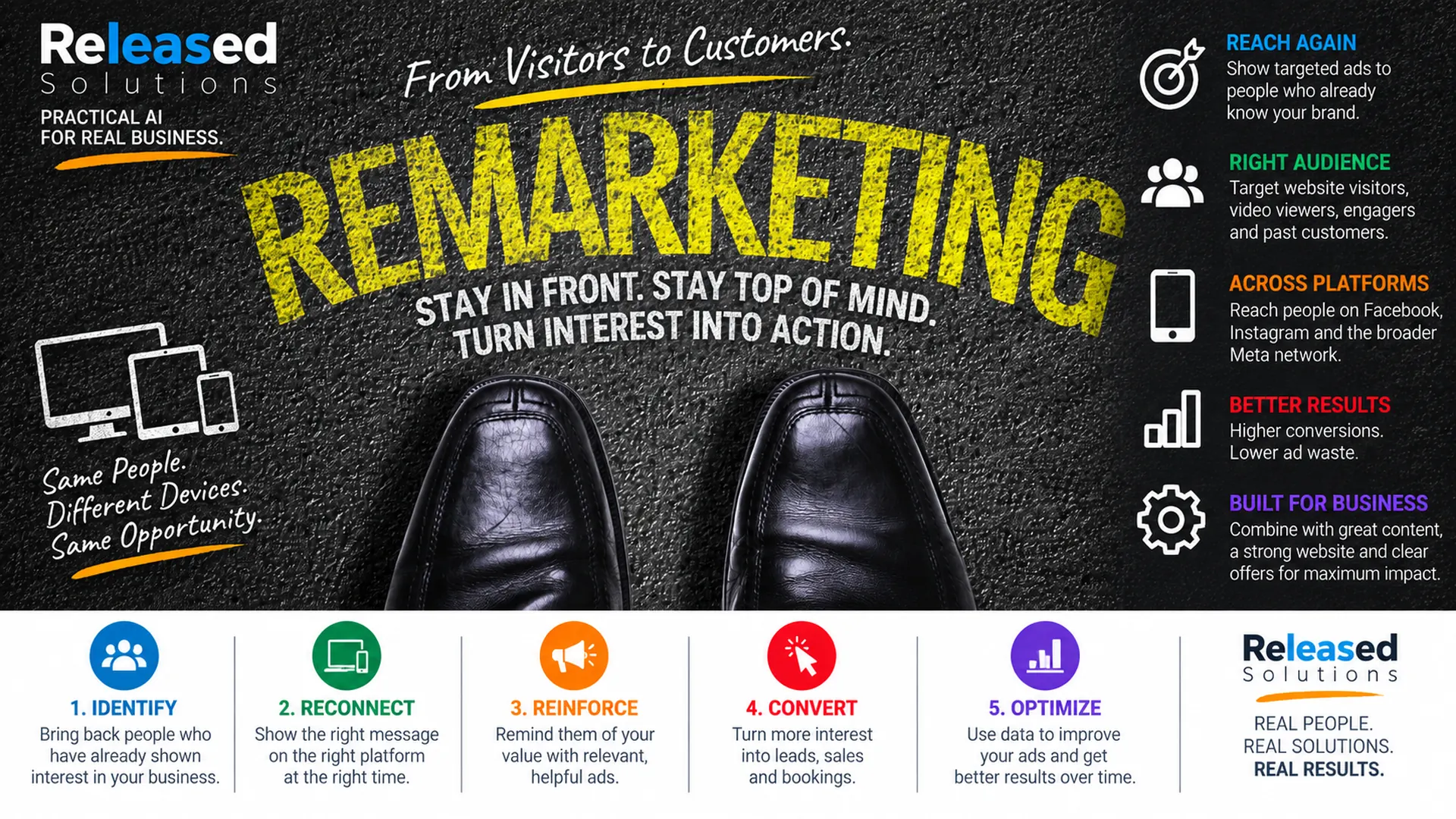
Today, Meta advertising can use website activity, customer lists, app activity, video viewing, social engagement and other eligible signals to help businesses reconnect with people who already know something about them. Browser privacy changes and signal loss also mean businesses should think beyond a single browser pixel. For small businesses, the modern strategy is IDENTIFY → RECONNECT → REINFORCE → CONVERT → OPTIMIZE. Retargeting is not about following people around the internet. It is about using appropriate first-party and platform signals to continue a customer journey that already started.
Retargeting vs. remarketing
People use the terms retargeting and remarketing somewhat interchangeably. Retargeting usually describes advertising to people based on prior behavior. Remarketing is often used more broadly for reconnecting with known prospects or customers, including customer-list and CRM audiences. For a small-business owner, the terminology matters less than the strategy. The important question is: what legitimate signal tells us this person already has a relationship or demonstrated interest, and what message should come next?
The five stages of a modern Meta retargeting system
1. IDENTIFY: Build audiences from real signals. Meta Custom Audiences can be built from website visitors, engagers, video viewers, lead-form interactions, customer or prospect lists, app activity and past customers. Someone who read one blog post is different from someone who viewed pricing, started checkout or submitted a lead form. The better the audience definition, the more useful the next message can be.
2. RECONNECT: Pixel is still useful, but it is not the whole measurement plan. The Meta Pixel remains an important browser-based tool for measuring website activity and building website audiences. But browser-side measurement has limits. That is why Meta also provides Conversions API, which allows businesses to send eligible event data to Meta from server, website platform, CRM or other business systems. Meta recommends using Conversions API alongside the Pixel when appropriate, not as a replacement.
3. REINFORCE: The second ad should move the story forward. Retargeting fails when the business simply shows the same ad again. A person who already knows the brand may need a different message: a testimonial, a case study, a product demonstration, an FAQ, an objection answer, a stronger explanation of value, a reminder, an appointment invitation, a limited offer when appropriate or a complementary product or service. This is frequency with progression: the customer should feel like the conversation is moving forward.
4. CONVERT: Match the audience to the next action. Not every retargeting audience should receive the same call to action. A recent website visitor may need education. A cart abandoner may need a reminder. A prior customer may be ready for a related service or a loyalty program. Someone who watched most of a video may be ready for a deeper piece of content or a consultation. A lead who already entered the CRM may need sales follow-up more than another generic awareness ad.
5. OPTIMIZE: Use first-party data and better measurement. Your CRM, customer list, lead records, purchases and other direct customer relationships can help create a more resilient marketing system when they are collected and used appropriately. No advertising platform sees the entire customer journey perfectly. Compare platform reporting with website analytics, CRM outcomes, calls, bookings, purchases and other business evidence whenever possible.
Meta Advantage+ and where the strategy lives now
Meta's advertising system has moved a large share of decisions from the advertiser to its machine-learning systems. Advantage+ campaigns and audience expansion can reach beyond the audiences you explicitly select when Meta predicts that doing so will improve results. That does not mean strategy disappears. It means strategy lives in different places. Creative, offers, landing pages, conversion events, exclusions and business goals matter more than fiddling with hundreds of tiny audiences. Advantage+ works best when the creative is proven, the offer is clear and the measurement is honest. That is why the organic side of the plan matters even for businesses that plan to spend on Facebook: the ads amplify what the audience already responds to. Boost what works. Do not boost what did not.
Part 4: Privacy, Consent, and Not Stereotyping People
Two things get treated as afterthoughts but really shouldn't be: what your data practices actually are, and whether your audience assumptions are honest.
Privacy and consent
Retargeting and audience building involve customer and visitor data, so privacy cannot be an afterthought. Businesses should understand what data is collected, which platforms receive it, what consent requirements apply, how customer lists are handled and what disclosures belong in the privacy experience. A cookie banner by itself is not a complete privacy strategy. Neither is installing Conversions API. The correct implementation depends on the business, the data, the jurisdiction and the technologies involved. Collect the data you actually need. Use it for legitimate purposes. Protect it. And do not assume that because an advertising platform technically accepts a signal, the business automatically has permission to send it.
Do not turn audience targeting into stereotyping
Good audience strategy is about relevance, not making lazy assumptions about people. Use actual customer information, research, conversations, performance data and legitimate business context. Avoid deciding that an entire demographic must think, behave or buy the same way. In advertising, also respect platform rules, privacy obligations and the lawful use of customer data. Meta's Customer List Custom Audiences terms require advertisers to have the necessary rights, permissions and lawful basis for data they provide. The fact that a platform can target something does not automatically mean it is the right strategic or legal choice.
Part 5: Beyond Facebook: The Same Question, More Places
The three older articles this hub replaces were all Facebook-first. The strategic question is much broader. On LinkedIn, the audience may be defined by professional context and the conversations your market is already having. On Instagram and TikTok, creative format and interest-driven discovery can matter enormously. Email lets you segment people based on the relationship you already have with them. Search captures people expressing intent in real time. Your website lets you create different paths for different needs.
The channels change. The strategic question stays remarkably consistent: who are we trying to help, influence, educate or convert, and what would make this useful to them?
One more thing worth naming out loud: Facebook is a channel, not a customer database. Fans, followers, video viewers and Group members belong to Meta's ecosystem. That is fine as long as the business also captures its own signals: email, SMS, CRM and website engagement. Meta can change reach, formats and rules again tomorrow. A business with an owned audience keeps its customers when it does.
Know Your Audience
Decide who this is for before writing it. Customer conversations, CRM history and search data beat demographic assumptions.
Create + Publish
Reels, carousels, live and text at a 2 to 4 per day cadence. The formats Meta pushes and enough signal for the algorithm to find the right people.
Identify + Reconnect
Custom Audiences from website visitors, engagers, video viewers, lead-form interactions and customer lists. Frequency with progression, not repetition.
Measure + Amplify
Vanity numbers as a temperature check, business outcomes as the answer. Amplify the organic winners; do not boost what did not earn attention.
The Takeaway
The Takeaway
Reach is a means, not a goal. A million impressions from people who do not care can be less useful than a much smaller audience filled with the right prospects, customers, partners or community members. Understand who you are trying to reach. Create content that is worth their time. Publish it at a healthy cadence in the formats the platform is prioritizing. Engage in the comments and DMs. Measure what the business actually gets. When a piece earns attention, spend a little money to send it further. And when someone already knows you, do not restart the conversation; move it forward.
KNOW / ORGANIC / PAID. Earn the attention. Amplify what earned it. Move the conversation forward.
Last fact-check: September 2026.
Need a Social Strategy Built Around the Right Audience?
Released Solutions helps small businesses connect content, social media, paid advertising, websites, CRM, analytics and online presence management around measurable business goals. If your social channels are active but not producing useful engagement, qualified traffic or business opportunities, the problem may not be how often you post. It may be who you are trying to reach and what you are giving them.