

Do You Need an Online Marketing Strategy in 2026? Yes, but AI Changes How Fast You Can Execute
The original question behind this article is still the right one: does a small business really need an online marketing strategy?
Yes. In fact, AI makes strategy more important, not less important.
Artificial intelligence can help a business research faster, create faster, analyze faster, test faster and automate more of the work between an idea and execution. But speed without direction is still just speed. If the audience is wrong, AI can help you reach the wrong audience faster. If the offer is weak, AI can produce more versions of a weak offer. If the tracking is broken, AI can optimize around incomplete information.
The opportunity in 2026 is to combine a clear marketing strategy with AI-assisted execution and human judgment. That is where an agency that genuinely embraces AI can create a major advantage for a small business.
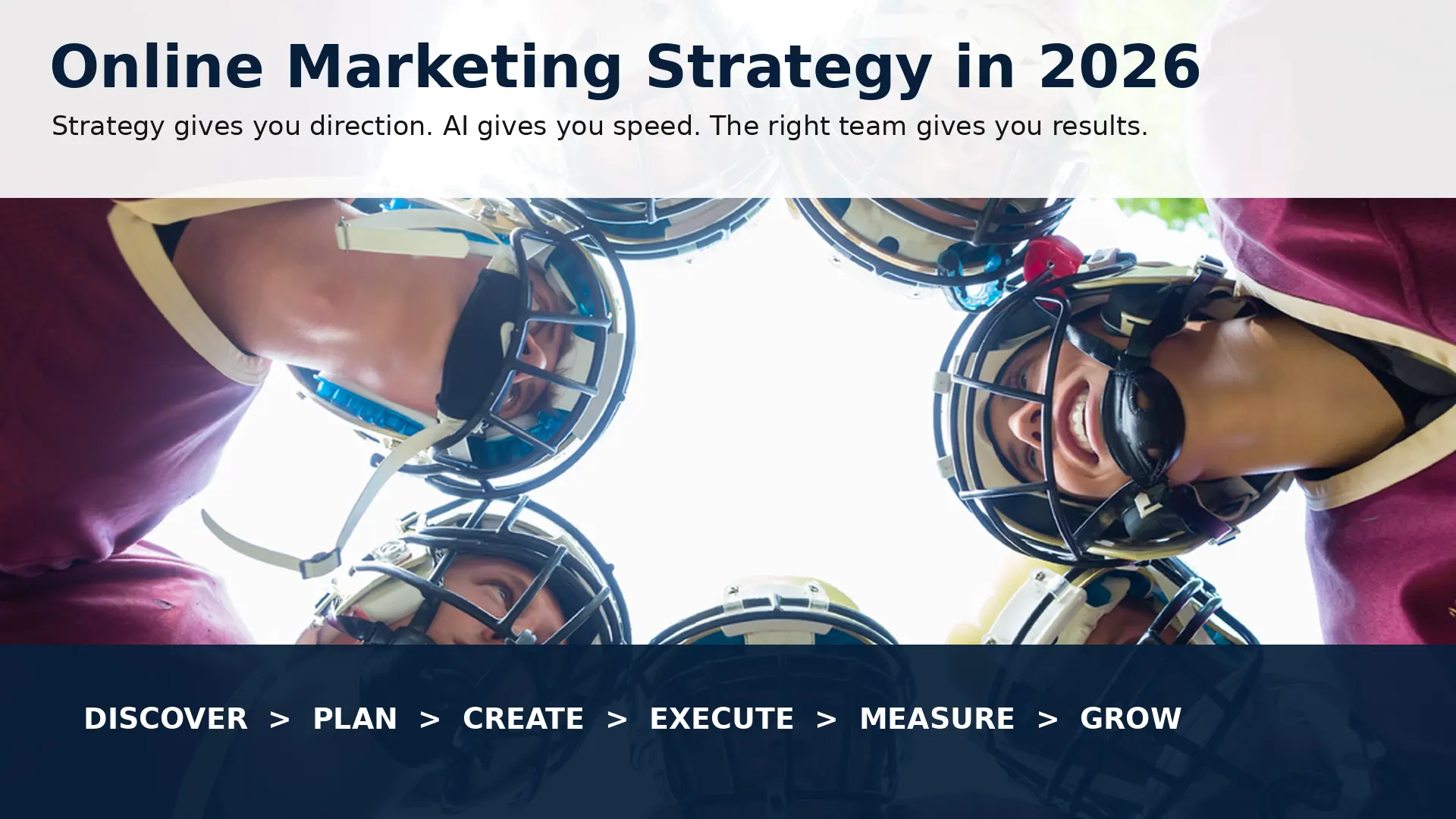
My framework is: DISCOVER → PLAN → CREATE → EXECUTE → MEASURE → GROW.

The right team gives you judgment, accountability and execution. Together they can operate like a much bigger marketing department.
Think of Marketing Strategy Like a Team Huddle
The football huddle image from the original article still works. A team does not walk onto the field with eleven players independently deciding what play to run. There is a goal. There is a play. There are assignments. There is a quarterback reading what is happening. There are adjustments after the snap.
Marketing should work the same way. Your website, SEO, AI discovery, advertising, social media, email, CRM, automation, content and analytics should not operate as unrelated activities. They should support the same business objective.
| Channel | Job in the plan |
|---|---|
| Website | The connected hub where visitors decide, convert and enter the CRM. |
| SEO / AEO / GEO | Discovery through search engines and AI answer experiences. |
| Paid media | Creating discovery on demand and amplifying what already works organically. |
| Content | Something worth being found for, cited by AI and read by real people. |
| CRM / automation | Continuing the customer relationship after the first form fill. |
| Analytics | Connecting activity to leads, appointments, sales and cost per result. |
AI can make the team faster. Strategy makes sure everyone is running the same play.
Strategy Is a Multiplier
AI multiplies what the plan tells it to do. If the plan is wrong, AI just multiplies the wrong thing faster.
Workflows, Not Tools
An agency that redesigns its workflows around human plus AI collaboration moves differently from one that occasionally uses ChatGPT.
Judgment Still Wins
AI accelerates the work. Business judgment, brand decisions, legal responsibility and customer understanding still belong to the humans in the room.
DISCOVER, PLAN, CREATE, EXECUTE, MEASURE, GROW
Six Stages of a Modern Online Marketing Strategy
DISCOVER: UNDERSTAND THE BUSINESS BEFORE CHOOSING THE TACTICS
A good online marketing strategy starts before the ad account, website redesign or social calendar. Understand what the business sells, who the best customer is, what problem you are solving, what makes the offer different, where the customer looks for help, what a customer is worth, how long the buying cycle is, what budget is available, what the business can operationally support, and how we will know whether marketing worked. AI can accelerate this discovery: organizing research, summarizing customer interviews, analyzing reviews, comparing competitors, clustering search themes, identifying recurring objections and turning messy notes into useful strategic questions. But AI should not invent the answers.
PLAN: BUILD THE CUSTOMER JOURNEY BEFORE BUILDING THE CAMPAIGN
A customer may discover the business through Google, ChatGPT, a social post, a video, an ad, reviews, the website, a chatbot, or through branded search after leaving and returning. The plan needs to account for discovery, evaluation, conversion and follow-up: SEO, AEO and GEO, paid search, Meta and social advertising, content, email and SMS, CRM, reviews, local listings, chatbots and AI assistants, retargeting, automation and analytics. The goal is not to use every channel: it is to choose the channels that fit the customer journey and connect them around the same business objective. See how people find your content for how discovery layers overlap in practice.
CREATE: AI CAN DRAMATICALLY REDUCE THE TIME BETWEEN STRATEGY AND PRODUCTION
This is where AI has changed agency work the most. A marketing team can now move from a strategy discussion into drafts, concepts and variations much faster: research summaries, content outlines, blog drafts, ad variations, email drafts, landing-page copy, image concepts, video concepts, FAQ content, sales scripts, campaign briefs, audience hypotheses, reporting summaries and technical documentation. Google itself is building generative AI deeper into advertising production, and its 2026 Asset Studio updates are designed to generate and refine multiple creative assets from a marketing brief, brand guidance, website and campaign goals. The advantage is reducing the distance between idea, execution, feedback and the next improved version. See why I use AI for website development for how this looks in the technical work too.
EXECUTE: CONNECT THE CHANNELS INSTEAD OF MANAGING THEM AS ISLANDS
Execution is where strategy becomes visible. The website needs to match the campaign. The ad needs to match the landing page. The form needs to connect to the CRM. The CRM needs a follow-up process. The content needs internal links. Search content needs to be understandable to people, search engines and AI systems. Analytics needs to capture meaningful actions. Retargeting needs a reason to move the conversation forward. A disconnected collection of tools creates activity. A connected strategy creates a customer journey.
MEASURE: AI CAN HELP US UNDERSTAND THE DATA FASTER
Marketing platforms produce a lot of data: Google Ads, Meta, Bing, GA4, Search Console, CRM, call tracking, forms, email, social platforms and AI referral traffic. The challenge is not more dashboards: it is finding the useful signal. AI can help summarize large datasets, compare time periods, identify anomalies, organize Search Console issues, surface patterns and help marketers ask better questions. I have also been reviewing GA4 to understand how AI citations and referrals are driving visits and conversions. We can increasingly ask whether AI discovery sends visitors who actually become leads or customers. AI helps accelerate the analysis. Human judgment still decides what the business should do about it.
GROW: TURN MARKETING INTO A CONTINUOUS LEARNING SYSTEM
The old campaign model was plan, launch, wait, report, repeat. AI-enabled marketing can operate more continuously: research informs the plan, the plan creates content and campaigns, performance creates data, data creates new questions, new questions create tests, tests improve the next version. McKinsey's 2026 research increasingly describes AI as part of a continuous growth engine rather than a one-time productivity tool. For a small business, the practical version does not need to be complicated: a strategy, reliable measurement, a process for learning and the ability to change when the evidence tells us something new.
The Caveman Marketing Quiz
How much of your marketing is still hunting by hand?
Rate 15 statements and see which of five stages your marketing is in, from The Hunter to The AI-Augmented Entrepreneur.
What AI Makes Faster and What It Does Not
The promise is not that AI makes marketing effortless. The promise is that AI can remove friction from work that previously consumed time, giving the team more room to focus on strategy, quality and results.
| What AI makes faster | What AI does not eliminate |
|---|---|
| Research and synthesis. | Business judgment. |
| First drafts and creative variations. | Customer understanding. |
| Analysis and reporting. | Brand decisions. |
| Documentation. | Legal and compliance responsibilities. |
| Brainstorming and idea generation. | Creative direction. |
| Technical troubleshooting. | Technical verification. |
| Content repurposing. | Human relationships. |
| Workflow automation. | Budget constraints. |
| Cross-platform data pulls. | Platform learning periods. |
| Weekly reporting summaries. | The need for real-world results. |
The agency still owns understanding the client, checking the facts, protecting the brand, reviewing the creative, verifying the tracking, respecting privacy, watching the budget, measuring results, explaining what happened and making the next decision. AI can be a coworker. The agency still has to lead the work.
What to Look for in an AI-Enabled Marketing Agency
I would not choose an agency because its website says AI. I would ask how AI actually changes the work: how the agency uses AI in research, how it protects client data, how humans review AI-generated work, how AI helps create or test faster, how AI is used in analytics, how the agency prevents generic content, how it verifies facts, how it connects AI work to the CRM and customer journey, how it measures whether the faster workflow produces better business results, and who owns the accounts, data, prompts, automations and technical assets. See how to learn AI for small business for the underlying skill set.
The goal is not to hire the agency with the most AI tools. Hire the partner that combines strategy, technology, human judgment and AI into a better operating system for marketing. That is the kind of digital marketing partner a modern small business benefits from.
DISCOVER: understand the business, customer, market and opportunity. PLAN: choose the customer journey, channels, goals, budget and KPIs. CREATE: use human creativity and AI assistance to produce the content, campaigns and experiences required by the plan. EXECUTE: connect website, search, advertising, social, CRM, automation and follow-up. MEASURE: track business outcomes, diagnose problems and learn from the data. GROW: scale what works, improve what does not, and keep adapting as customer behavior changes.
DISCOVER → PLAN → CREATE → EXECUTE → MEASURE → GROW.
Discover + Plan
Understand the business and design the customer journey before touching an ad account or content calendar.
Create + Execute
AI-assisted content, campaigns and technical execution connected across website, search, social and CRM.
Measure + Grow
Analytics, CRM outcomes and continuous learning that lets the marketing system compound over time.
Human Judgment
Brand decisions, legal responsibility, customer understanding and accountability stay with the humans in the room.
The Takeaway
Yes, your small business still needs an online marketing strategy. AI did not make strategy obsolete. It made execution faster. That increases the value of knowing what you are trying to accomplish.
A business working with an agency that embraces AI can potentially move from research to creation, testing, analysis and iteration much faster than older workflows allowed. But the advantage does not come from AI alone. It comes from the combination.
Strategy gives you direction. AI gives you speed. The right team gives you judgment, accountability and execution.
Want a Marketing Strategy That Can Move at AI Speed?
Released Solutions helps small businesses connect strategy, websites, search, advertising, content, CRM, automation, analytics and AI so the marketing system can learn and move faster without losing human judgment.
Want a Marketing Strategy That Can Move at AI Speed?
Released Solutions helps small businesses connect strategy, websites, search, advertising, content, CRM, automation, analytics and AI so the marketing system can learn and move faster without losing human judgment.
Strategy is direction. AI is speed. The right team is the judgment that turns them into results.
Kenneth Durrum, Released Solutions