
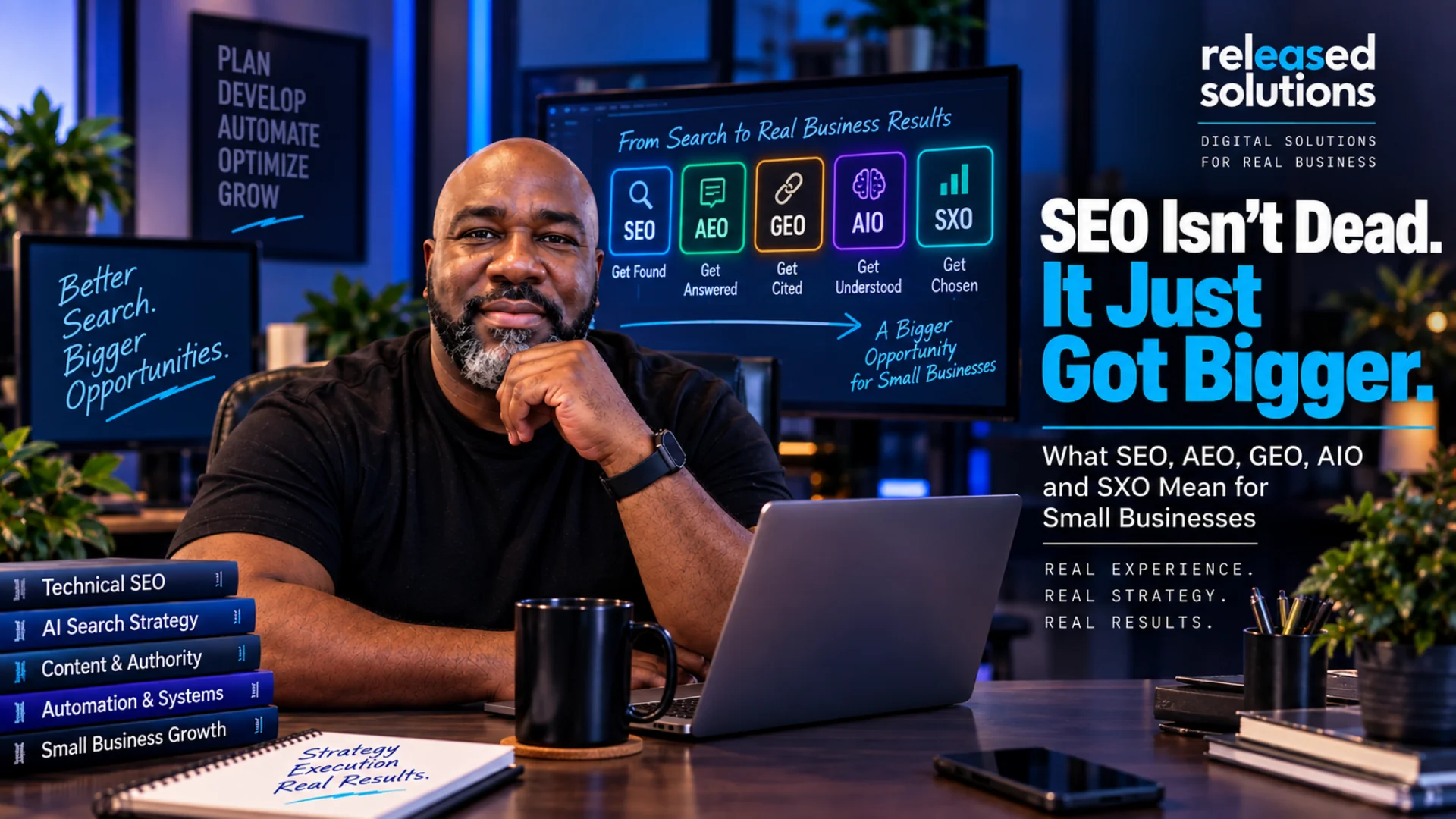

SEO Isn't Dead. It Just Got Bigger.
What SEO, AEO, GEO, AIO and SXO Mean for Small Businesses
Every few years, somebody declares that SEO is dead.
Social media was going to kill it. Voice search was going to kill it. Zero-click searches were going to kill it. Now artificial intelligence is supposedly finishing the job.
I don't see it that way. I work with this stuff every day.
For more than 12 months, I have worked as a contract partner with Scepter Marketing in a DevOps role that includes technical SEO. That means dealing with the things businesses rarely see when everything is working correctly: crawling and indexing problems, site migrations, redirects, structured data, page architecture, Search Console issues, analytics, performance problems and all the technical details that determine whether search engines can properly understand a website.
And despite the fact that I will readily admit that I love running ads, SEO keeps pulling me back in.
Why? Because paid advertising can put you in front of someone today, but your organic digital foundation determines whether your business can continue to be found, understood, trusted and chosen tomorrow.
Artificial intelligence has not made that foundation less important. It has made the opportunity built on top of it much larger.
Search Has Changed. The Foundation Hasn't.
Traditional SEO was often explained with a fairly straightforward objective:
That process still matters. Google continues to describe Search as beginning with crawling, moving through indexing, and then serving results. Google's Search Essentials also continue to emphasize crawlable pages, useful content, accessible links and a technically sound website — and that's exactly why sitemaps still matter.
What has changed is everything happening around that foundation. People aren't only typing ten blue-link searches anymore. They're asking Google AI Mode complicated questions. They're reading AI Overviews. They're asking ChatGPT, Copilot and other assistants to research something for them. They're asking follow-up questions rather than starting a new search. They're comparing businesses before ever reaching a website.
And increasingly, AI systems are deciding which sources are worth retrieving, referencing or using to support an answer.
That means today's digital visibility looks more like this:
That's where all of these new acronyms come from.
Five Acronyms, One Digital Strategy
I recently came across a graphic that separated today's search environment into SEO, AEO, GEO, AIO and SXO. I liked the concept. But I would change one important thing.
I don't see these as five completely separate marketing disciplines. I see SEO as the foundation, with the others describing additional ways that good information can be discovered and used.
Google itself now makes essentially the same point. Its current guidance says that SEO best practices remain foundational for its generative AI experiences and specifically cautions businesses against assuming they need a completely separate bag of AEO or GEO tricks.
So let's remove some of the jargon.
Meet the Five
This is still the foundation. SEO is about making it possible for search engines to discover, crawl, understand and appropriately surface your website.
Site structure. Crawlability. Indexation. Internal linking. Page titles and headings. Content relevance. Canonical URLs. Redirects. Mobile usability. Page performance. Structured data. Image optimization. Sitemaps.
This is why I keep telling business owners that technical SEO isn't glamorous until something breaks. You can write the best article in your industry, but if the page is accidentally set to noindex, buried behind poor navigation, duplicated across several URLs or inaccessible to a crawler, the brilliance of the article won't matter very much.
AI doesn't eliminate that problem. Google specifically says that content must still be indexed and eligible to appear in Search before it can be used as a supporting source in AI Overviews or AI Mode.
SEO gets you into the conversation.
This is the idea of making your information easy to use when somebody asks a direct question.
Think about the difference between someone searching technical SEO company Miami and asking: Why is Google crawling my website but not indexing my service pages? The second search expects an answer.
Good AEO isn't about writing robotic FAQ pages stuffed with questions. It is about understanding the questions customers actually have and answering them clearly.
Clear headings. Direct explanations. Useful examples. Logical page structure. Supporting evidence. Content that gets to the point. Enough depth to answer the natural follow-up question.
And there is an interesting twist here. Google says you do not need to artificially break every article into tiny AI-friendly chunks. Its systems can understand longer pages and retrieve relevant sections when appropriate.
So write for the human. Just answer the question well.
This is probably the acronym getting the most attention right now.
The concept entered academic discussion through research into how websites might increase their visibility inside generative-engine responses. Researchers formally described Generative Engine Optimization in work published at KDD 2024. Today the idea has become much more practical:
Can an AI system find enough confidence in your content to use it as a source?
And this isn't theoretical anymore. In February 2026, Microsoft introduced an AI Performance section inside Bing Webmaster Tools showing publishers when their pages are cited across supported AI experiences, including Microsoft Copilot and AI-generated Bing results. Google followed with dedicated Generative AI performance reporting in Search Console, with worldwide rollout announced in 2026.
That's a big deal. We've moved from discussing AI visibility as an abstract concept to actually beginning to measure it.
But GEO doesn't mean sprinkling special magic words throughout a page. It means producing information worth citing.
Original experience helps. Specific examples help. Evidence helps. Useful explanations help. Clear authorship helps. Expertise helps. That's one of the reasons I believe businesses have an advantage when they stop trying to produce generic content and start sharing what they actually know.
GEO is less about gaming AI and more about becoming source material.
The Last Two: Understanding and Choice
This one needs a disclaimer because the acronym isn't standardized. Different marketers use AIO to mean different things, including Artificial Intelligence Optimization, AI Optimization and sometimes optimization specifically around AI Overviews. For this article, I'm using it in the broadest and most useful sense:
Make your business and its information easier for machines to understand correctly.
That means giving machines context. Who are you? What does your business do? What services do you provide? Where do you operate? Who wrote the content? What subjects are you genuinely knowledgeable about? How are your pages connected? Which information is current?
Structured data can help provide explicit information about entities and page content, although Google is very clear that there is no special AI schema required for AI search. Existing structured data should continue to be accurate and match what the visitor can actually see on the page.
This is also where consistency becomes important. Your website, Google Business Profile, social presence, author information, articles and external mentions should tell a reasonably consistent story about your business.
If you want a broader framework for how to approach this as an owner, start with learning how AI fits into small business and treat AI-driven discovery as one more system you build context around.
Machines are becoming very good at connecting dots. Our job is to stop giving them contradictory dots.
This may be the most important acronym of the entire group. Because getting found isn't the business objective. Getting the customer is.
Imagine that you've done everything right. Google ranks the page. An AI assistant references your article. Someone clicks through. And then they arrive at a slow website with confusing navigation, vague messaging, no obvious contact path and a mobile experience that requires a magnifying glass.
Congratulations. You won the search and lost the customer.
SXO brings the human being back into the equation. It asks: Did the visitor find what they expected? Can they understand what you offer? Does the site feel trustworthy? Is the page usable on their device? Is there an obvious next step? Can they contact you easily? Does the content demonstrate actual knowledge? Does the experience support the promise that got them there?
Google's own AI-search guidance specifically includes providing a strong page experience after people arrive. That's partly what we build into online presence management — the layer between "someone found you" and "someone chose you."
That's why I think the real journey ends with: Get chosen.
The Journey at a Glance
Four stages of the search-to-customer journey — the fifth (SXO / Get Chosen) is where every path leads.
Get Found
Get Answered
Get Cited
Get Understood
What I See From the Technical Side
This is where theory meets reality for me. A significant part of my work with Scepter Marketing is DevOps and technical SEO. And the problems I encounter are rarely solved by chasing whichever SEO acronym is trending that week. They're usually much more fundamental.
A site migration introduces incorrect redirects. A canonical tag points somewhere it shouldn't. Important pages disappear from the index. JavaScript makes content harder to process. A staging environment gets exposed. A sitemap contains URLs that shouldn't be there. Structured data doesn't match what's actually on the page. A website gets redesigned and years of URL equity are accidentally discarded.
Those are SEO problems. But they are also potentially AI visibility problems, because AI-powered search still needs access to reliable information before it can retrieve, understand or cite it.
Google's documentation specifically continues to emphasize crawlability, indexing, JavaScript SEO, internal linking and technical clarity for generative search. And building AI-assisted diagnostic systems that spot these issues before customers do is a lot of how I use AI to build websites and business systems in the first place.
That's why I don't believe the old SEO foundation is disappearing. Quite the opposite.
And Yes, I Still Love Running Ads
Anybody who knows my work knows I enjoy paid advertising. There's something satisfying about launching a campaign, watching the data arrive and optimizing toward a measurable outcome.
SEO requires a different kind of patience. But the strongest digital strategies aren't usually SEO versus advertising. They're SEO and advertising.
Paid media can create immediate visibility. Organic search can create lasting discoverability. AI search can create new opportunities for authority and referral. A strong website turns that attention into action. Automation and follow-up help turn that action into business. And that's exactly the multi-cost math we walk through in the real cost of using AI in business when a small owner is deciding what to invest in.
That's the bigger picture. Not five competing marketing disciplines. One connected digital ecosystem.
What Should a Small Business Actually Do?
If you're a small-business owner, I would not respond to this shift by buying five new services simply because five new acronyms appeared. Start with the fundamentals.
1. Make sure your website is technically healthy. Can search engines crawl it? Are your important pages indexed? Are redirects, canonical URLs, sitemaps and internal links correct?
2. Create content based on what you genuinely know. Your experience is difficult for competitors — and AI — to manufacture authentically. Use it. Google's latest guidance specifically encourages expert, first-hand and non-commodity content rather than articles that simply summarize what already exists online.
3. Answer real customer questions. Don't create content merely because a keyword tool gave you a phrase. Create content because your customers repeatedly need the answer.
4. Give search engines and AI systems clear context. Use understandable site architecture, descriptive content, consistent business information and appropriate structured data.
5. Build authority beyond your own website. Your reputation doesn't begin and end on your domain. Reviews, discussions, publications, industry involvement and credible third-party references all help establish a broader digital footprint.
6. Measure more than rankings. Rankings still matter. But visibility now includes traditional search impressions, AI-search visibility, citations, referrals, conversions and what happens after the visitor reaches the website. Google and Bing are already expanding their webmaster tools to provide greater visibility into how websites participate in AI-driven search experiences.
7. Don't forget the conversion. Traffic isn't revenue. Citations aren't revenue. Rankings aren't revenue. The digital experience ultimately has to move a person toward a business outcome. If you want a partner for that shift, digital marketing coaching can help you translate this framework into a plan you'll actually run.
SEO Isn't Smaller. Search Is Bigger.
That's really the lesson I took away from the original SEO/AEO/GEO/AIO/SXO graphic. I wouldn't build five separate strategies. I'd build one strong digital foundation capable of participating in five different parts of the discovery journey.
The names will change. The platforms will change. The technology will absolutely change. But the objective for a business is remarkably consistent:
SEO isn't dead. It just got bigger.
Is Your Website Ready for the Next Generation of Search?
Search visibility now goes beyond keywords and rankings. Released Solutions helps small businesses strengthen the technical, content and conversion foundations that support traditional search, AI-driven discovery and sustainable digital growth.
Let's review where your business stands today and identify the opportunities that matter most.