
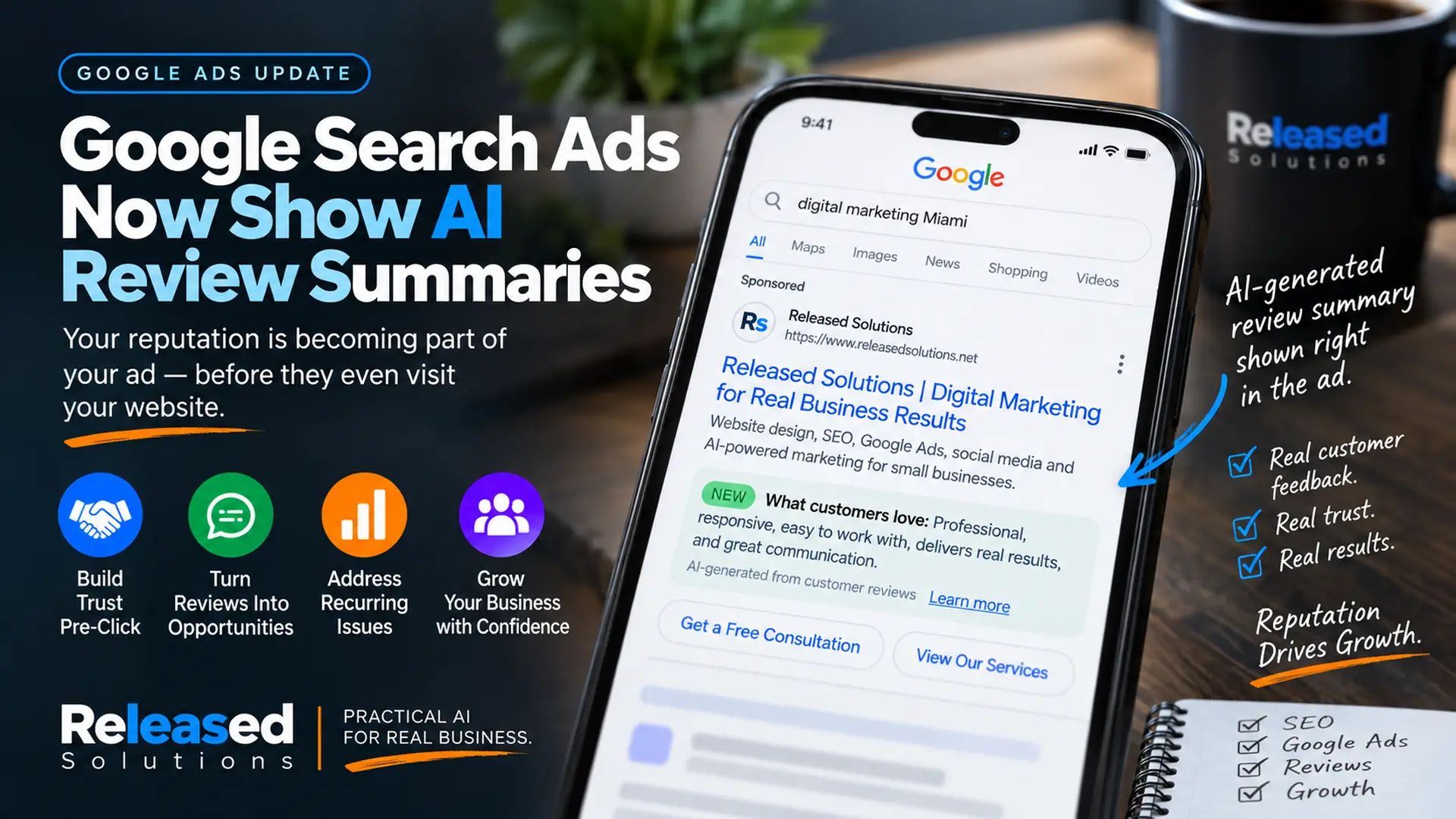

Google Search Ads Are Testing AI Review Summaries: What This Means for Your Business
A change being spotted in Google Search ads deserves the attention of small-business owners and paid-search marketers.
Google has been testing a "What customers love" section inside some sponsored search results. The examples being reported are labeled as AI-generated from store rating reviews.
That is more important than another ad-format change. It means the customer's opinion of your business may increasingly become part of the advertising experience before the prospect ever reaches your website.
My framework for how the customer journey is shifting: EXPERIENCE → REVIEWS → AI SUMMARY → AD → CLICK → WEBSITE → CONVERSION.
Google is testing AI-generated review summaries inside sponsored search results. That is more than another ad-format change.
The Customer Journey Is Shifting
For years, we have thought about paid search something like this:
This test points toward a different journey:
| Traditional paid-search journey | Emerging paid-search journey |
|---|---|
| AD → CLICK → WEBSITE | EXPERIENCE → REVIEWS → AI SUMMARY |
| → TRUST → CONVERSION | → AD → CLICK → WEBSITE → CONVERSION |
| Trust is formed after the click. | Trust may start forming before the click. |
| The advertiser controls the message. | AI may summarize what customers have been saying. |
| Landing page carries the trust burden. | The reputation carries part of the trust burden. |
As of September 2026, third-party search-industry reporting has documented Google testing a "What customers love" section in sponsored results. I have not found an official Google announcement saying this new AI summary format is generally available to every advertiser. Treat this as evidence of direction, not a rolled-out feature.
Google's official documentation says store ratings can be based on several sources, including Google Customer Reviews, supported third-party review aggregators, shopping reviews and Google-led research. Google explicitly distinguishes Google Customer Reviews from Google Business Profile reviews.
Trust Moves Pre-Click
Reputation is entering the ad experience itself. The landing page is no longer the first place trust gets built.
Source Material, Not Sentences
Businesses increasingly control the evidence AI can interpret, not every sentence AI may eventually display.
Ops = Marketing
Customer service, communication and fulfillment become paid-media issues when review sentiment can influence how the ad renders.
EXPERIENCE, REVIEWS, AI SUMMARY, AD, CLICK, WEBSITE, CONVERSION
Trust Is Moving Pre-Click
A paid-search advertiser traditionally had substantial control over the message appearing in the ad: headlines, descriptions, offers, sitelinks, callouts and landing pages. AI-assisted advertising has already changed some of that control. Review summaries add another dimension because the source material comes from customer experience rather than only from the advertiser's marketing department.
Your Reviews Are Becoming Marketing Source Material
Businesses will not always control the exact sentence an AI system produces about them. What they can influence is the quality of the information available for the system to interpret.
| Source material for AI interpretation | What it says about the business |
|---|---|
| Website content | Services, offer, positioning and expertise. |
| Business info (hours, categories, area) | Whether the basics are current and accurate. |
| Products / services listings | What is actually sold and how it is described. |
| Customer reviews | The recurring themes of how customers experience the business. |
| Third-party mentions | Coverage, listings, directories, partner sites. |
| Structured data | Machine-readable descriptions of the entity, products and content. |
| Customer experience | The actual operational reality that generates the reviews in the first place. |
Ask for authentic feedback. Make the request easy. Then pay attention to what they naturally say. Manufactured review language is a short-term optimization and a long-term reputation problem.
A Reputation Problem Can Become a Paid-Media Problem
Suppose your ads are excellent, your targeting is strong, your landing page is polished. But customers repeatedly complain about slow response times. If Google or another AI system begins summarizing recurring customer sentiment directly inside discovery or advertising experiences, the marketing team cannot simply write around the operational problem.
Customer service becomes a paid-media issue. Fulfillment becomes a paid-media issue. Communication becomes a paid-media issue. Reputation management becomes a paid-media issue. That is healthy pressure: marketing works better when the promise in the ad matches the experience after the sale. See online marketing strategy for how those pieces integrate.
Seven Things I Would Do Now
AUDIT THE REVIEW ECOSYSTEM
Understand which review sources exist for your business. Do not look only at Google Business Profile. Depending on the business, store ratings can incorporate Google Customer Reviews and supported third-party review partners. See how people find your content for the parallel view on discovery.
CHECK YOUR STORE RATING
Google provides a store-ratings lookup tool by domain. Determine whether Google currently has enough information to associate a store rating with your website. If your store rating is thin or missing, that is a separate operational task from your Business Profile reviews.
READ FOR THEMES, NOT JUST STARS
Look for repeated language around service, communication, shipping, results, support, pricing, quality and other aspects of the experience. If customers consistently praise or complain about the same thing, that is operational intelligence, not just a rating average.
ASK FOR AUTHENTIC FEEDBACK
Build review requests into the customer journey, but do not script what customers should say. Do not coach customers to write your marketing copy. Detailed reviews can certainly provide richer information than a bare star rating, but authenticity matters more than trying to engineer a keyword-rich review profile.
FIX RECURRING PROBLEMS
If the same complaint appears repeatedly, treat it as operational intelligence. If Google or another AI system begins summarizing recurring customer sentiment directly inside discovery or advertising experiences, the marketing team cannot simply write around the operational problem. Customer service, fulfillment, communication and reputation management all become paid-media issues.
CONNECT PPC AND REPUTATION
The PPC team should understand what customers are saying about the business, especially as Google experiments with bringing more review-derived information into ads. See why digital ads don't convert for the parallel post-click discipline: strong reputation cannot save a weak post-click experience, and a strong landing page cannot save a weak reputation.
MONITOR THE TEST
Do not assume every advertiser has this feature. Watch Google Ads documentation, your own search results and industry reporting for broader rollout or changes. This experiment may become general availability, may change form or may quietly disappear: treat it as evidence of direction, not a stable feature to plan around today.
This Connects Paid Search to SEO, AEO, GEO and AI Discovery
Search systems are becoming more comfortable synthesizing information. Google Search can generate AI-assisted answers. AI systems can cite and summarize web content. Advertising systems can generate and adapt creative. Now we are seeing tests that summarize customer sentiment inside sponsored results. The common thread is interpretation.
Search Search-Search results are becoming more comfortable synthesizing information. Advertising systems are generating and adapting creative. Now review summaries are appearing inside sponsored results. This is not a hidden AEO or GEO trick: it is what happens when systems get better at interpreting real evidence. See SEO, AEO, GEO, AIO and SXO for how these overlap.
Measure What Happens After the Trust Signal
If this format becomes more widely available, I would not judge it only by whether the ad looks better. Measure what happens. See AI citations and GA4 conversions for how to wire this up alongside existing AI-referral measurement.
| Signal | Question worth asking after the format widens |
|---|---|
| CTR | Are customers clicking more or less on ads showing summaries? |
| Conversion rate | Are visitors that arrived through summarized ads converting differently? |
| Lead quality | Are the leads better qualified because they saw pre-click evidence? |
| Calls / forms | Are customers arriving with more context and asking better questions? |
| Customer expectations | Are inbound messages matching the promise the AI summary implied? |
| Revenue | Does the trust signal contribute to a measurable business outcome? |
The larger measurement principle remains the same: a new trust signal is useful only if it contributes to a better customer and business outcome.
The Bigger Lesson: You Do Not Control Every Message Anymore
You still control your advertising strategy. You still control your website. You still control how you describe your services. You still control how you serve customers. But you do not control every sentence a search engine or AI system may eventually use to describe the business.
Increasingly, you control the source material. That changes the job. Reputation management is not something to think about after marketing. Customer experience is not something separate from advertising. Reviews are not simply stars sitting beside a business name. They are evidence. And AI systems are becoming increasingly capable of interpreting that evidence before the customer ever clicks.
Pre-Click Trust
Reputation is entering the ad. AI-summarized customer sentiment may render before the visitor ever reaches your site.
Store Rating vs Business Profile
Store ratings aggregate multiple review sources. They are not the same as Google Business Profile reviews.
Source Material
Website, business info, services, reviews, third-party mentions and structured data all feed the AI interpretation.
Operations Become Marketing
Service, fulfillment and communication show up in reviews. Reviews show up in the ad. Fix the operations first.
The Takeaway
Google's AI-generated review summaries in Search ads should be treated as an emerging test, not a feature every advertiser can count on today.
But the direction is significant. Trust is moving earlier in the customer journey. Customer sentiment can influence how the business is represented. Paid search, reputation, customer experience and AI are becoming more connected.
Build a business customers genuinely want to recommend. Ask for authentic feedback. Monitor the patterns. Fix recurring problems. Give search engines and AI systems accurate, useful source material. Then make sure the experience after the click lives up to the reputation that brought the customer there.
Want Your Advertising, Reputation and Customer Experience Working Together?
Released Solutions helps small businesses connect Google Ads, search visibility, reputation, websites, analytics and AI so the message customers see before the click matches the experience they receive after it.
Want Your Advertising, Reputation and Customer Experience Working Together?
Released Solutions helps small businesses connect Google Ads, search visibility, reputation, websites, analytics and AI so the message customers see before the click matches the experience they receive after it.
Reputation moves pre-click. Build a business worth summarizing.
Kenneth Durrum, Released Solutions