
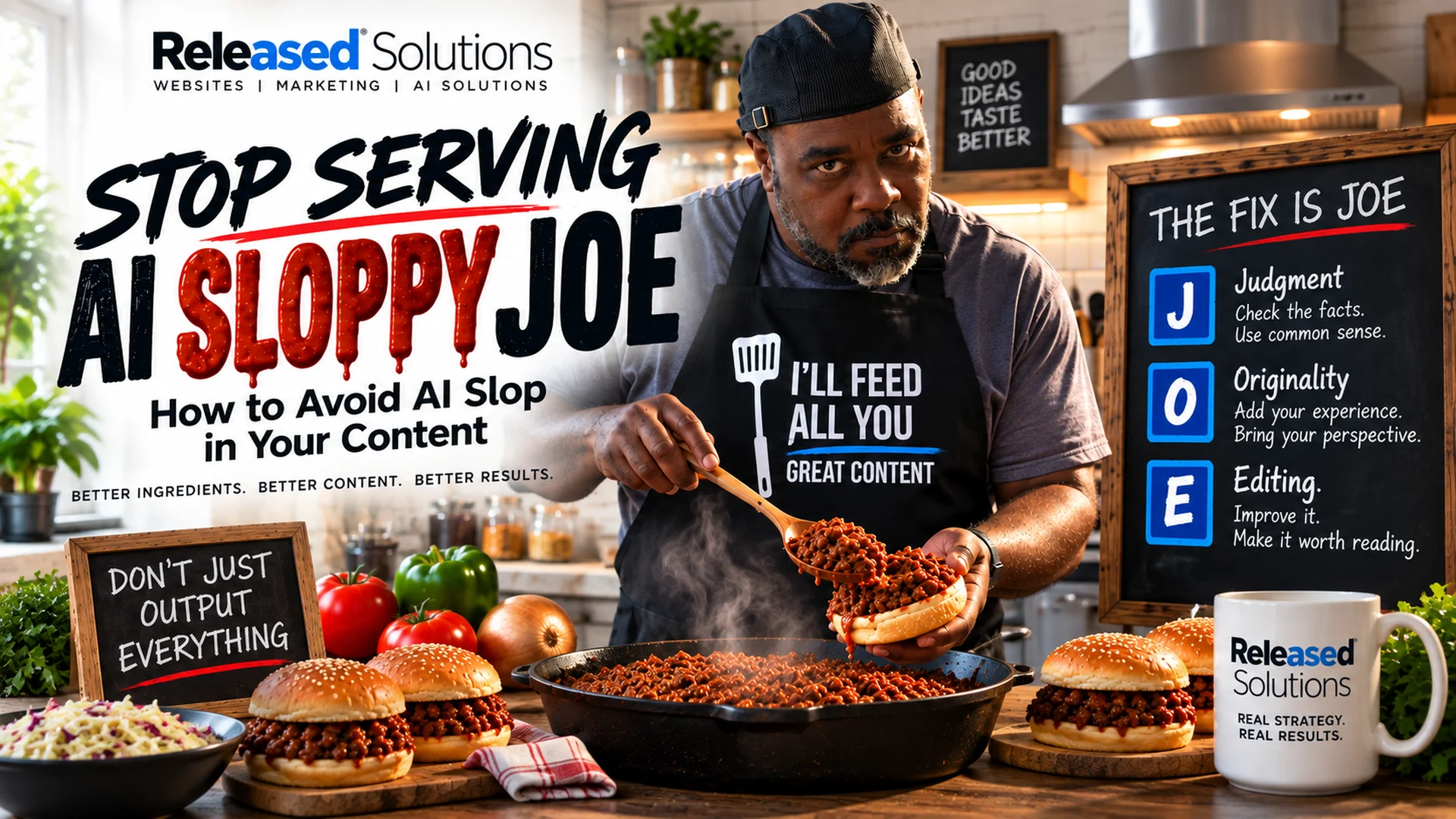

Stop Serving AI Sloppy JOE: How to Avoid AI Slop in Your Content
AI has made it incredibly easy to create content.
Maybe a little too easy.
Give an AI a topic and a few instructions, and seconds later you can have a blog post, social media update, email campaign, landing page, product description, video script, or marketing plan.
Then comes the dangerous part.
Copy. Paste. Publish.
That is how we end up with something I have started calling AI Sloppy JOE.
And no, I am not talking about lunch.
I use AI every day. I believe it can be an incredible coworker for a small business. I use it to research, organize thoughts, challenge ideas, help with development, analyze information, write drafts, improve workflows, and work through problems.
The problem is not using AI.
The problem is when the entire content process becomes: Just Output Everything.
That is my first definition of JOE.
AI Sloppy JOE: Just Output Everything
Ask AI for something. Accept the first answer. Publish it.
No fact checking. No editing. No original experience. No meaningful examples. No disagreement. No consideration of whether the author actually believes what was written.
Just Output Everything.
That may be one of the easiest ways to create what people increasingly call AI slop.
The writing might be grammatically correct. It may have attractive headings. It may sound professional. It might even rank well against an automated grammar checker.
But it can still say almost nothing.
You have probably seen this content. Everything is essential. Everything is revolutionary. Every company must succeed in today's rapidly evolving digital landscape. Every conclusion reminds us that businesses must embrace innovation.
There are 1,500 words on the page, but when you finish reading, you still do not know what the author actually thinks.
AI can make producing words nearly effortless. Producing something worth reading still requires work.
AI-Assisted Content Is Not the Same Thing as AI Slop
I think this distinction is extremely important.
I am not arguing that businesses should hide the fact that they use AI, and I certainly am not arguing that we should stop using it.
Quite the opposite.
AI can help a person communicate an idea more effectively. It can organize rough thoughts, identify gaps in an argument, research a subject, question assumptions, suggest a stronger structure, proofread, and help someone who has great ideas turn those ideas into polished written content.
That can be extremely valuable.
The problem occurs when AI is no longer assisting the person. It is replacing the person.
There is no experience being added. No perspective. No judgment. No expertise. No verification.
The person becomes little more than the button that tells the AI to generate another 1,000 words.
That is not the AI workflow I want.
LinkedIn Just Made AI Slop Harder to Ignore
This conversation became considerably more interesting in 2026 when LinkedIn began explicitly using the term AI slop.
LinkedIn now gives members a "Seems like AI slop" feedback option on posts and comments. LinkedIn says the feedback helps improve the systems it uses to identify low-value content.
LinkedIn describes AI slop as low-effort, likely AI-generated content that may appear polished but lacks a clear point of view, unique perspective, or substance. It also points to generic, repetitive, or recycled material.
In September 2026, LinkedIn reported that more than one million members had used the feature after its August rollout. LinkedIn also reported that recent efforts had reduced views of content it classified as AI slop by 40 percent.
That should get the attention of anyone using AI for content marketing.
This is no longer simply a question of whether readers might dislike generic content. Content quality can become a distribution issue.
LinkedIn is also making an important distinction. It is not saying that AI assistance itself is the problem.
The message is not: Do not use AI.
The message is closer to: Do not let AI erase you from your own content.
Other Platforms Are Moving in the Same General Direction
LinkedIn may currently be one of the clearest examples of a major platform explicitly asking users to identify AI slop, but it is not alone in reconsidering how AI-generated material should be handled.
TikTok announced in July 2026 that it was testing improved systems designed to identify accounts dedicated to posting AI-generated spam that crowds out original creators. TikTok said it had labeled more than three billion videos as AI-generated content using creator labeling, Content Credentials, and invisible watermarking. It has also tested features that let people manage how much AI-generated content they see.
Pinterest labels image Pins it detects may have been generated or modified with AI, and it gives users controls to see less generative AI imagery in supported categories.
Meta uses AI information labels across Facebook, Instagram, and Threads for certain AI-generated images and for realistic AI-generated video or audio disclosed by creators. That is primarily a transparency system for synthetic media, not a judgment about whether ordinary written content is AI slop.
YouTube requires disclosure for realistic content that is meaningfully altered or generated with AI. At the same time, YouTube specifically says production assistance such as AI-generated scripts, outlines, titles, or infographics does not itself require disclosure.
Those approaches are not identical.
But I think there is a common direction worth watching.
Platforms are beginning to make distinctions between using AI as a tool and flooding an audience with synthetic, repetitive, misleading, or low-value material.
For a business owner, that distinction matters.
Producing More Content Does Not Automatically Produce More Marketing
This is where I think businesses can get trapped.
AI changes the economics of content creation.
If writing a blog post once required several hours and AI reduces some of that work dramatically, it can be tempting to conclude that the solution is simply to publish five times as much.
But volume is not the same as value.
Producing ten generic articles instead of one useful article does not automatically make your marketing ten times better.
Publishing five forgettable social posts in one day does not necessarily create five opportunities to reach someone. It can simply create more material for people to scroll past.
And if platforms become increasingly sophisticated at recognizing repetitive, low-value, AI-produced material, generating more slop may eventually work against the person publishing it.
The real advantage of AI should not be that it lets us stop thinking.
The advantage should be that it reduces lower-value work so we have more time for the thinking that matters.
So Let's Fix JOE
If Just Output Everything creates AI Sloppy JOE, I think we need a better recipe.
Before I publish AI-assisted content, I want JOE to mean something different.
J Is for Judgment
AI can provide information. You still need to decide what deserves to be published.
Is the claim accurate? Is the source current? Would you give this recommendation to an actual customer? Does the conclusion make sense? Is the AI stating an assumption as though it were a fact? Could the information have changed? Do you understand the subject well enough to put your name behind it?
Judgment becomes especially important when AI discusses statistics, software features, pricing, regulations, health information, financial information, research findings, or anything else that can change or carry consequences.
I frequently tell AI to verify its findings. I ask it not to invent facts. I ask for primary sources. I ask which statements require additional verification.
Those instructions help.
But a verification prompt does not transfer responsibility from me to the machine.
If my name is on the article, I still need judgment.
O Is for Originality
Originality does not mean you need to discover something nobody in human history has ever considered.
It means putting something into the content that did not come from a generic prompt.
Your experience. Your observations. Your customer conversations. Your mistakes. Your successes. Your data. Your processes. Your opinions. Your disagreements. Your examples. Your screenshots. Your way of explaining the problem.
If I am discussing website development, I can tell AI about problems I have actually encountered while building websites. If I am writing about technical SEO, I can contribute what I see while actually working on technical SEO. If I am talking about advertising, I can discuss CPA, conversion tracking, reporting, and situations where the numbers changed my recommendation.
AI did not live those experiences. I did.
The AI can help me turn those experiences into useful content.
That is a very different process from asking: "Write me an article about digital marketing."
E Is for Editing
Then comes editing.
And editing means more than running a spell checker.
Delete the introduction that takes five paragraphs to reach the point. Remove the paragraph that repeats the previous paragraph. Replace generic examples with real ones. Challenge statements that sound too confident. Remove phrases you would never actually say. Check the links. Verify the statistics. Change the structure when it feels mechanically generated. Add something you learned from actually doing the work.
And sometimes delete an entire section.
AI has changed the cost of generating words.
It has not changed the value of the reader's time.
If 500 words do not make the article better, those 500 words do not belong in the article.
Sometimes the most valuable AI editing tool is still the Delete key.
J is for Judgment
O is for Originality
E is for Editing
Give AI Better Ingredients
There is another reason the Sloppy JOE analogy works for me.
Better ingredients usually produce a better result.
Consider the difference between these prompts.
"Write an article explaining why small businesses need a website."
That gives AI very little that is uniquely yours.
Now consider this:
"I own a digital marketing company that works with small businesses. I believe a business website should be judged by measurable outcomes such as leads, calls, appointments, and sales rather than design awards. I frequently encounter businesses rebuilding websites without properly configuring tools such as GA4 or Google Search Console. Help me develop an article explaining why measurement should come before another redesign. Ask me questions wherever my experience could make the article stronger."
Now AI has something to work with.
More importantly, the prompt invites collaboration instead of simply ordering content.
That is how I prefer to use AI.
Ask AI to Interview You Before It Writes
This is one of my favorite ways to reduce generic AI content.
Do not immediately ask AI to write the article.
Tell it what you want to discuss. Give it your initial position. Then ask the AI to interview you.
Have it ask about experiences, customer objections, unusual situations, mistakes, examples, disagreements, and lessons learned.
Answer those questions.
Now the source material contains information that actually came from you.
The resulting article becomes something AI helped you express rather than something AI invented on your behalf.
That difference matters.
Make AI Challenge Its Own Work
I also think people underestimate how useful AI can be as its own critic.
Before publishing AI-assisted content, I frequently want another pass that is not focused on making the writing longer or prettier. I want the AI looking for problems.
- Identify every factual claim in this article that should be verified before publication. Use current primary sources wherever possible and tell me when you cannot verify something.
- Which sections of this article sound generic, repetitive, or like they could have been produced from a basic AI prompt?
- Act as a skeptical reader. What claims, assumptions, or recommendations would you challenge?
- Where could my personal experience, examples, data, or point of view make this content more original and useful?
- Do not rewrite the article yet. First identify anything that appears invented, unsupported, outdated, overly confident, or potentially misleading.
The Most Important AI-Slop Question
There is one question I especially like:
What part of this article could only have come from me?
That can be uncomfortable.
If the answer is almost nothing, the article probably needs more work.
AI knows an enormous amount about marketing. It can explain SEO. It can explain websites. It can explain social media. It can explain analytics.
What it does not automatically know is what happened when I sat across from a business owner, opened their analytics, discovered the tracking was broken, changed the strategy, and watched the numbers move.
That is where expertise becomes content.
Your goal should not be to disguise AI-generated writing so nobody detects it.
Your goal should be to contribute enough value that detecting whether AI helped becomes largely irrelevant.
Run the JOE Test Before You Publish
Before an AI-assisted blog post, email, landing page, video script, or social post goes live, I would ask three questions.
Judgment: Can I personally stand behind what this says?
Originality: Did I contribute meaningful experience, perspective, data, examples, or ideas?
Editing: Did I improve and verify the output, or did I simply accept it?
If the answer is no to one of those questions, the content probably is not finished.
And if the process was nothing more than asking AI to create something and immediately hitting Publish, you may have fallen back into the other version of JOE.
Just Output Everything.
AI Is the Coworker, Not the Entire Company
I keep returning to the idea of AI as a coworker because I think it puts the technology in the right place.
A good coworker can help you research. A good coworker can challenge you. A good coworker can organize information. A good coworker can help you move faster. A good coworker can occasionally catch something you missed.
But you would not hire someone on Monday morning, blindly publish everything they produced by Monday afternoon, and never review their work.
Why would we manage AI that way?
The more capable AI becomes, the easier it may become to hand over larger portions of a workflow.
That makes judgment more important, not less.
Businesses need to decide where AI can work autonomously, where verification belongs, and where a person remains responsible for the final result.
Content creation is one of those places where the human still matters.
Do Not Serve Your Audience AI Sloppy JOE
I do not want businesses to become afraid of AI.
I want them to become better at using it.
Use AI to move faster. Use it to explore ideas. Use it to research. Use it to question your assumptions. Use it to organize what you know. Use it to improve your writing. Use it to find the holes in your argument.
But bring something to the table.
Your judgment. Your experience. Your perspective. Your expertise. Your voice.
Because the future of AI content is not about proving that you did not use AI.
It is about proving that a human still had something worth saying.
And before you hit Publish, remember the recipe:
J: Judgment
O: Originality
E: Editing
Anything less might just be another helping of AI Sloppy JOE.
Want AI to Work Like a Coworker Instead of a Content Vending Machine?
Released Solutions helps small businesses build practical AI workflows that preserve human judgment, measurable goals, and control. Start with the process you already have, then decide where AI can help without handing over the entire job.