

Caveman Marketing: Your Website Is Not a PowerPoint Presentation
Why a beautiful website and relentless personal promotion are not substitutes for a measurable customer acquisition system
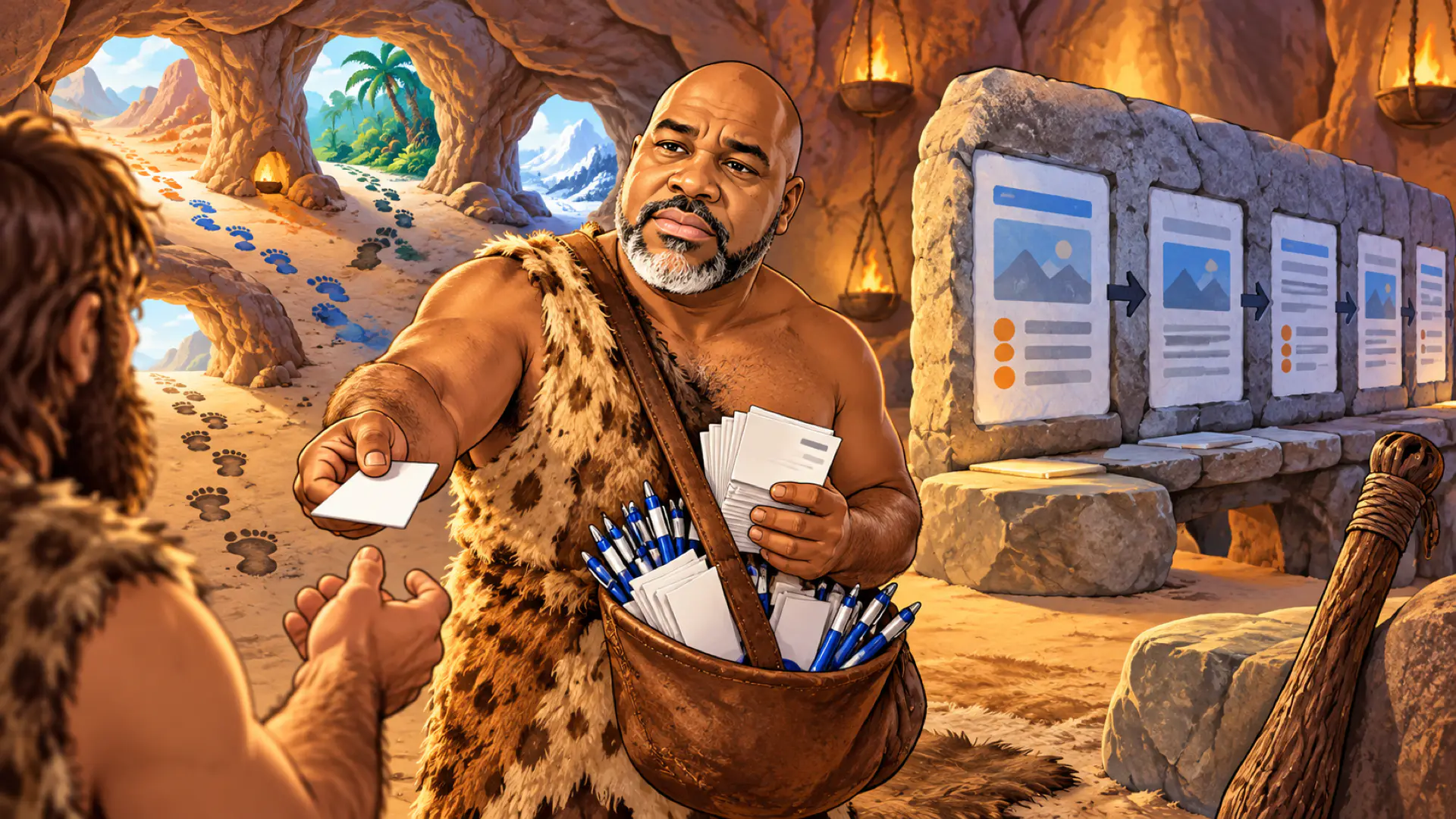
Some business owners start every morning by hunting for the next customer. They carry business cards, promotional items and a practiced introduction. They attend events, approach people one at a time and ask them to visit a website. If they stop pushing, the leads often stop too.
I call that Caveman Marketing.
I use the expression to describe a method, not the people using it. I am not criticizing anyone for working hard to promote a business. Personal relationships, networking, referrals and direct outreach can all produce real opportunities. I am questioning whether all that effort is connected to a system that keeps working after the conversation ends.
The same problem appears online when a business treats its website as a beautiful presentation instead of a working part of customer acquisition. A site can look impressive on a large monitor and still fail the person who arrives on a phone, enters through the middle of the site or wants one clear next step.
What Caveman Marketing Means
The method is slow because each new opportunity demands another round of manual effort. It is hard to scale because results depend on the owner's continued presence. It is often difficult to measure because a box of pens, a stack of business cards or a day of conversations does not automatically reveal which contacts became qualified leads or customers.
Traditional outreach is not the enemy. The problem begins when it is the whole strategy. A business card should connect someone to a useful next step. A networking conversation should be supported by a website that answers the next question. A referral should enter a process that can be followed, measured and improved.
The Caveman Marketing Quiz
How much of your marketing is still hunting by hand?
Rate 15 statements and see which of five stages your marketing is in, from The Hunter to The AI-Augmented Entrepreneur.
Your Website Is Not a PowerPoint Presentation
I recently heard someone describe a website as though every visitor would start at the beginning, move through it in the intended order and eventually reach the important information at the end. The mental model was almost identical to a PowerPoint presentation.
That is not how people use websites.
A presentation controls sequence. The audience sees slide one before slide two. A website gives the visitor choices, and many visitors never see the home page first. A Google search may lead directly to a service page. An advertisement may open a campaign landing page. A social post may lead to an article. A referral may send someone to a case study. An AI-generated answer may cite a page buried several levels inside the site.
Google Analytics defines a landing page as the first page a visitor sees when arriving at a website, and it notes that this can be any page. That simple definition changes how a business should think about the customer journey.
Every important page has to welcome a fresh arrival. It should tell the visitor where they are, what the business offers, why the information matters and what they can do next. The menu cannot carry that entire responsibility. Clear headings, relevant internal links and intentional next steps have to continue the journey from wherever it begins.
A Beautiful Website Can Still Be a Bad Website
I want businesses to have websites they are proud to show people. Good design builds confidence, supports the brand and makes information easier to understand. Cosmetics become a problem when the visual idea is allowed to overrule the visitor's needs.
A dramatic animation may look excellent in a desktop review and feel painfully slow on a phone. A full-screen image may create a strong first impression while pushing the actual message below the fold. A clever menu may delight the designer and confuse the customer. Text placed over a busy image may look refined on one screen and become unreadable on another.
The test is not whether the home page looks impressive during a presentation. The test is whether a real visitor can use the site under real conditions and improve the website conversion rate by removing friction.
Can the visitor understand the offer without hunting through several pages? Can they read the text without zooming? Can they tap the navigation and buttons easily? Can they complete the form without fighting the keyboard? Can they call, request information, make a purchase or take the next appropriate step? A website that cannot support those tasks has not finished its job.
Mobile Is Not a Smaller Desktop
Mobile deserves its own design decisions. In September 2026, StatCounter measured mobile phones at 58.99 percent of worldwide web traffic, compared with 39.26 percent for desktop computers. The United States was much closer: 49.1 percent mobile and 48.47 percent desktop. Those numbers do not prove that every business has a mobile-majority audience. They prove that treating phone visitors as a secondary audience is a serious gamble.
The right answer is to check the business's own analytics by device, page and conversion action. A local service company may see a different mix from a business-to-business firm. The percentage can also change by traffic source. Search, social, email and paid campaigns may bring visitors with different devices and different expectations.
There is also a search reason to take the mobile version seriously. Google's current mobile-first indexing guidance says Google uses the mobile version of a site's content for indexing and ranking. Google also advises site owners to keep important content, headings, metadata, structured data and image information equivalent across mobile and desktop versions.
Mobile design is therefore not the final quality check after the desktop design is finished. It is part of the content, search and conversion strategy from the beginning.
Every Page Can Be an Entry Point
Once we stop thinking in slides, the website becomes a network of useful entry points. Each page can answer a specific question and connect the visitor to the next relevant piece of information.
Service Page
A service page can explain the offer and link to proof.
Article
An article can answer a search question and connect the answer to a service.
Case Study
A case study can show what changed and lead to a conversation.
Location Page
A location page can help someone confirm availability and call.
The exact path depends on why the person arrived.
This is where website navigation and internal linking become part of marketing rather than housekeeping. The links inside the content help a visitor continue without forcing everyone through the same sequence. They also help search systems understand how the pages relate.
I do not want every page screaming for a sale. I want every important page to offer a logical next step. Sometimes that is a service page. Sometimes it is a related article, a case study, a comparison, a form or a phone call. The next step should match the visitor's level of interest.
Build a System Instead of Starting Over Every Morning
A stronger marketing system does not eliminate personal outreach. It gives that outreach support and creates additional ways for qualified demand to reach the business. The larger goal is to turn the website into a lead generation and customer support system.
I look for five connected parts.
Discoverability
People can find the business through search, maps, useful content, referrals, advertising, social channels and other sources that fit the audience.
Entry page clarity
Every important landing page quickly explains where the visitor is, what the business does and why the page is relevant.
A usable next step
The visitor can call, inquire, book, buy, subscribe or continue learning without unnecessary friction, especially on a phone.
Follow-up
Leads and customers enter a consistent process through email, SMS, CRM tasks, scheduling or another appropriate workflow.
Measurement
The business can see which sources and pages create meaningful actions, then use that information to improve the system.
These parts work best when they are managed as one online presence rather than a collection of unrelated projects.
Measure the Journey That Matters
Traffic by itself is not the goal. A beautiful site with rising visitor counts can still fail to produce qualified conversations, appointments, purchases or donations.
Measurement should connect the source of a visit to the action that matters. Which pages bring qualified search traffic? Which campaigns produce leads? Which referrals become customers? Where do mobile visitors abandon a form? Which service pages help people move forward? What happens after a lead enters the CRM?
The answers do not have to be perfect on day one. The business needs a dependable starting point: analytics configured correctly, useful conversion events, campaign tagging, a way to identify lead sources and a regular review process. That makes it possible to improve decisions instead of repeating activity on instinct.
This is the difference between a marketing asset and a digital decoration. An asset can be observed, tested and improved. Decoration can only be admired.
A Practical Website Reality Check
Open the website on a phone without using the office Wi-Fi. Start on a service page instead of the home page. Then ask the questions below as if you have never heard of the business.
✓ Can I tell what this business does within a few seconds?
✓ Can I read the content and use the navigation comfortably on a phone?
✓ If I enter on this page, do I understand where I am?
✓ Is the next useful action obvious without being aggressive?
✓ Do forms, phone links, buttons and scheduling tools work on mobile?
✓ Does the page connect to relevant services, proof or supporting information?
✓ Can the business tell how I arrived and whether I completed a meaningful action?

The Goal Is More Leverage Not Less Humanity
There is nothing wrong with handing someone a business card. There is nothing wrong with attending an event, giving away a useful promotional item, calling a prospect or personally introducing the business. Those actions can begin relationships that no automated campaign could create in the same way.
The goal is not to remove the human work. It is to make that work go farther.
When someone receives the card, the website should confirm the promise. When a referral searches the business name, the online presence should build trust. When an article answers a question, the next step should be clear. When a campaign produces a lead, the business should be able to follow what happens next.
If the only way to create demand is to keep swinging harder, the business will always be hunting for the next customer. Build the relationships, but also build the system that helps the right people find you, understand you and act when you are not standing in front of them.
That is how you move beyond Caveman Marketing without losing the personal relationships that make a small business valuable.
Build an Online Presence That Does More Than Look Good
If your website looks polished but you are not sure how people find it, what they do after they arrive, or which marketing channels produce qualified leads, Released Solutions can help you review the whole system. We can examine the website, mobile experience, traffic sources, conversion paths, follow-up and measurement, then identify the next improvements that make sense for your business.