

Why I'm Building Websites for Free or Almost Nothing
I'm rebuilding and building websites for some small businesses at little to no upfront development cost. Why? Because I've spent years telling business owners that getting online is only the beginning. Now I want to remove the financial barriers that kept so many of them from finding out what a real online presence can do.
I'm not suggesting that websites have become worthless. Quite the opposite.
And I'm willing to change how I charge for website development to help prove it.
The Website Was Never the Finish Line
For years, I've told business owners something that has become part of the philosophy behind Released Solutions:
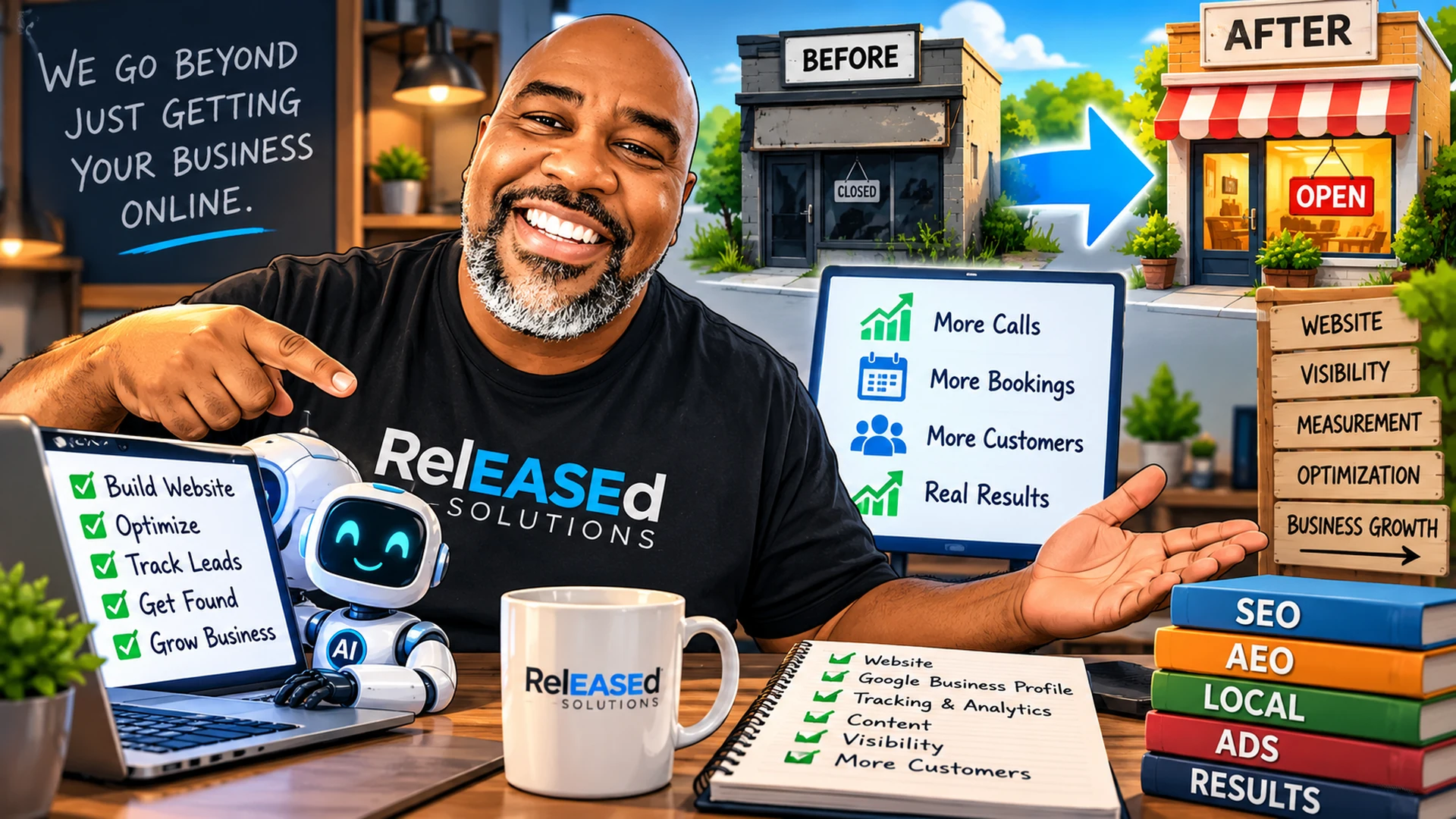
We go beyond just getting your business online.
Think about it this way.
Imagine opening a beautiful retail store. You've invested in the building, installed the shelves, arranged the merchandise and put up a fantastic sign.
Everything looks great.
Then you lock the doors, go home and wait for customers to arrive.
Sounds ridiculous, right?
Well, that's essentially what many businesses have done with their websites.
They invested in getting a website built, looked at the finished product, declared the project complete and moved on.
Six months later, they wondered why the website wasn't generating business.
I've said it before, and I'll keep saying it.
Your website is the storefront. Your online presence is how customers discover that storefront, learn to trust it and decide whether to walk through the door.
And once they get inside, the website needs to help them accomplish something.
That's where the real work begins.
Why Have So Many Small Businesses Struggled to Get Online?
I don't believe most small business owners intentionally ignored the internet.
For many, the barriers were real.
The Cost of Getting Started
A small business owner already has plenty of expenses.
Rent, payroll, insurance, equipment, inventory and utilities don't exactly leave a lot of room for experimentation.
Now someone comes along and tells that owner they need to invest thousands of dollars in a website.
That's a difficult decision when they don't know whether the investment will produce a single customer.
And when money is tight, something that feels optional often gets pushed aside.
The Fear of Paying for Something That Doesn't Work
I've encountered another problem throughout my career.
Business owners who already paid for websites and didn't see meaningful results.
Maybe the site looked beautiful but generated no leads.
Maybe they hired someone who disappeared after the launch.
Maybe they were told they needed SEO, social media, advertising and ongoing maintenance, without anyone clearly explaining how those pieces worked together.
Eventually, the owner stopped investing.
Not necessarily because they didn't believe the internet could work.
They simply didn't want to spend more money on something they couldn't measure.
Technology Became Another Job
Running a business is already a full-time responsibility.
Now we're asking owners to understand website hosting, Google Business Profiles, search engine optimization, social media, analytics, customer reviews and artificial intelligence.
Heck, some owners are still trying to remember which company registered their domain name.
I understand why they feel overwhelmed.
But here's the problem.
While the owner is trying to decide where to begin, potential customers are still searching for businesses like theirs.
The opportunities don't disappear just because the owner hasn't figured out the technology.
What Changed That Allows Me to Build Websites for So Little?
Technology changed. My development process changed. And the economics of creating websites have changed with them.
I've been developing websites and business systems for decades.
I remember when even relatively simple projects involved hours of repetitive work.
Setting up layouts, creating pages, formatting content, modifying code and troubleshooting problems could consume a substantial portion of a project's budget.
Today, artificial intelligence and modern development tools can help accomplish many of those tasks much faster.
I use AI in my development workflow because it helps me spend less time on repetitive production and more time solving business problems.
But there's an important distinction.
AI can help build a website. It doesn't automatically know how to build a successful business strategy.
Someone still needs to understand the business, its customers, its services, its competition and what the website is supposed to accomplish.
Someone needs to determine whether the tracking is accurate, whether the content answers customer questions and whether visitors can easily take action.
AI has reduced some of the labor involved in building websites.
My experience helps determine what we should build, why we're building it and how we'll know whether it's working.
That's the difference.
And instead of simply using those efficiencies to produce more websites at traditional prices, I've decided to explore something different.
What happens when I pass much of that development savings directly to the business owner?
Why Am I Willing to Build or Rebuild Websites for Free?
Because I want to demonstrate the difference between owning a website and actively managing an online presence.
I want to work with business owners who have been hesitant to invest, who have grown frustrated with previous experiences or who have essentially abandoned their digital presence.
I want to help remove the upfront development expense that has prevented them from moving forward.
Then I want to focus on the things that can actually make the website valuable.
Not just how it looks.
Not just how many pages it has.
And certainly not whether someone likes the colors.
I want to answer a much more important question.
Can we turn this online presence into something that produces measurable business opportunities?
That might mean more qualified phone calls.
It might mean more people requesting estimates, scheduling appointments or contacting the business.
It could mean improved visibility for services the business already provides.
Or it might mean discovering why customers aren't responding to an existing offer.
Those are business problems worth solving.
And those are the outcomes I want to help owners understand.
What Does an Online Presence Actually Include?
A website is an important piece of the puzzle, but it doesn't operate in isolation.
A complete online presence brings several systems together.
A Website That Helps Customers Take Action
Visitors should quickly understand what the business offers, whom it serves and what to do next.
That includes clear service pages, useful information, mobile usability and straightforward ways to contact the business.
I've written before about why a website should answer customer questions rather than simply describe the company.
A beautiful website that leaves visitors confused isn't doing its job.
Visibility Where Customers Are Looking
Customers don't all discover businesses the same way.
Some search Google.
Others use Google Maps, social media platforms or AI assistants.
Some encounter a review or recommendation before ever visiting a website.
For local businesses, Google's Business Profile guidance identifies relevance, distance and prominence as major factors in local search visibility.
The goal isn't simply to appear everywhere.
It's to make sure the business can be found, understood and evaluated in the places that matter to its customers.
A Consistent and Trustworthy Business Identity
Your business name, services, contact information and descriptions should be accurate and consistent wherever customers encounter them.
Reviews should be monitored.
Questions should be answered.
Outdated information should be corrected.
The business owner should retain control of important digital assets and accounts.
These things help create confidence long before someone fills out a contact form.
A System for Measuring Results
This is where I believe many website projects fall short.
The site launches, but nobody establishes a meaningful way to evaluate its performance.
I want business owners to understand what is happening.
How are people discovering the business?
Which services attract attention?
Are visitors contacting the company?
Are those inquiries becoming customers?
Google Analytics provides ways to measure important actions, including lead submissions.
But configuring a measurement tool isn't the same as knowing what the information means.
We need to connect online activity to actual business outcomes wherever practical.
Ongoing Improvements Instead of Another Redesign
Once a website is operating, we should be learning from it.
If customers are visiting a service page but not contacting the business, we need to investigate.
If customers are searching for a service that isn't clearly represented on the website, perhaps we need to create a better page.
If people are calling but those calls aren't becoming sales, the problem may extend beyond the website.
That's why my process has always emphasized reviewing what is happening, optimizing what works, creating what is missing and continuing to improve.
The website isn't finished simply because we pressed Publish.
Online Presence Readiness Assessment
Is your business ready to market online?
Answer 20 quick questions while we scan your website for tracking, ad pixels, structured data, search basics, speed and contact paths. Get a scored readiness report, free.
How Will I Know Whether This Approach Works?
I want to approach these projects with measurement in mind.
Let's use a hypothetical example.
Imagine a catering company that has an outdated website and an inconsistent Google Business Profile.
The owner receives occasional calls but doesn't really know where new customers come from.
We rebuild the website, improve its service information, make the Google Business Profile more accurate and establish appropriate tracking.
Now we have an opportunity to measure changes.
Are more people discovering the business?
Are visitors requesting catering estimates?
Are inquiries coming from the services we want to promote?
Which inquiries become actual booked events?
We can compare available information before and after the improvements, while accounting for seasonality, promotions and other factors.
That doesn't mean every improvement will immediately produce more customers.
And it certainly doesn't mean we can claim every new sale was caused by the website.
But it gives the owner something far more useful than an opinion about whether the site looks good.
It gives us information we can use to make better decisions.
That's the kind of demonstration I'm interested in creating.
Is the Website Really Free?
For selected businesses and projects, I'm willing to waive or substantially reduce the upfront website development cost.
That doesn't mean every service associated with operating a website is automatically free.
Domains, hosting, third-party subscriptions, ongoing maintenance, marketing campaigns and other services may involve separate costs.
Those details need to be discussed clearly before any work begins.
And not every project will qualify for the same arrangement.
I'm not suggesting that a complex ecommerce operation with dozens of integrations requires the same development effort as a straightforward service business website.
The scope matters.
But my objective is to stop making the initial website development expense the obstacle that prevents a business owner from improving their digital presence.
I would rather help an owner get started and demonstrate the value of continued improvement than have another business spend years doing nothing because the initial investment felt too risky.
What Do I Need From the Business Owner?
This isn't an invitation to receive a free website and forget about it.
That would defeat the entire purpose.
The business owner needs to participate.
I need accurate information about the company, its services, customers and goals.
I need the owner to help identify which inquiries turn into meaningful opportunities.
When changes are proposed, I need feedback.
When customers have questions, someone needs to respond.
And when the information tells us something isn't working, we need to be willing to make adjustments.
I would also like participating businesses to be open to reviewing and documenting results, with appropriate permission and respect for confidential business information.
Why?
Because I want these projects to demonstrate what works, what doesn't and what other small business owners can learn from the experience.
The website is only one part of the equation.
A business owner who participates in the process is far more likely to understand the value of what we're building together.
What's in It for Released Solutions?
Fair question.
I'm running a business too.
I want Released Solutions to grow, and I'm not pretending otherwise.
But I believe the strongest way to earn a customer's trust is to demonstrate value.
If I can help a business improve its visibility, generate better inquiries or understand its marketing performance, that creates an opportunity for a longer relationship.
Some businesses may want Released Solutions to continue managing their online presence.
Others may prefer to handle more of the work themselves after learning what is involved.
Either way, I want the owner to understand what they're investing in and why.
I'm not interested in making the website appear inexpensive only to surprise someone with unexplained fees later.
The arrangement needs to be transparent, and the results need to speak for themselves.
And here's something else I believe.
A successful client experience is worth more to my business than another website project that ends the day the site launches.
Does a Free Website Guarantee More Customers?
No.
And anybody promising otherwise should be prepared to explain how they're making that guarantee.
A website can't force people to buy something they don't need.
It can't fix poor customer service, unrealistic pricing or a business that never responds to inquiries.
It also can't guarantee that Google will rank a page or that an AI assistant will recommend a company.
What it can do is give the business a better foundation.
A foundation we can measure, maintain and improve.
But marketing doesn't happen automatically.
We still need to understand the audience, create useful content, build visibility, earn trust and encourage the right actions.
That's why I don't want to confuse the cost of building a website with the value of having an effective online presence.
They're two very different things.
Who Should Consider This Opportunity?
I'm especially interested in speaking with business owners who recognize that their online presence needs attention but haven't been able to move forward.
Maybe you never built a proper website.
Maybe you invested in one years ago and haven't touched it since.
Maybe your business depends almost entirely on word of mouth or social media.
Maybe you're frustrated because you spent money on digital marketing and never understood what happened.
Or maybe you've simply been too busy running the business to deal with any of it.
I'm not here to criticize those decisions.
I want to help you figure out what comes next.
The starting point should be a conversation about your business, not a sales pitch about how many pages your website needs.
Frequently Asked Questions
Why would Released Solutions build a website for free?
I want to reduce the upfront financial barriers that prevent small businesses from improving their online presence. The goal is to demonstrate the business value of a website supported by ongoing visibility, measurement and optimization.
Is every business eligible for a free website?
No. The arrangement depends on the business, the current condition of its online presence, the project's complexity and the work involved. Some projects may qualify for little or no upfront development cost, while others will require a different arrangement.
Will I still need to pay for hosting or marketing?
Possibly. Website development, hosting, software subscriptions, maintenance and ongoing marketing are separate services. Any applicable costs should be identified before work begins.
How long does it take for a website to generate results?
There is no universal timeline. Some improvements, such as fixing a broken contact form, can have an immediate practical benefit. Search visibility, content performance and customer acquisition may take longer to develop and evaluate.
Can I manage my own website afterward?
That should be part of the initial discussion. Business owners should understand who controls their website, domain, hosting and other digital assets, along with what they need to maintain the site over time.
Let's Find Out What Your Online Presence Can Really Do
For years, I've told business owners that a website is only the beginning.
Now I'm putting more emphasis on helping them get past that beginning.
If the cost of building or rebuilding your website has been holding you back, I'd like to understand your situation.
Let's talk about what you already have, what's missing and what your business is trying to accomplish.
We can determine whether a reduced-cost or no-cost development project makes sense and what it would take to measure meaningful progress.
I'm not promising overnight success.
I'm offering a different way to get started.
Because a beautiful storefront doesn't do much good when the doors are locked and nobody knows you're open.
Build it, go get them, and keep improving what you've built.