

Does Putting “Near Me” on Your Website Help Local SEO?
I have been reviewing small-business websites and finding “near me” in their title tags, meta descriptions, and main headings. Someone has advised these owners to put the phrase in prominent places, presumably because customers search that way.
What bothers me is that these business owners are trying to do the right thing. They are following advice they expect will help customers find them. They deserve an explanation that goes beyond “put these words on your website.”
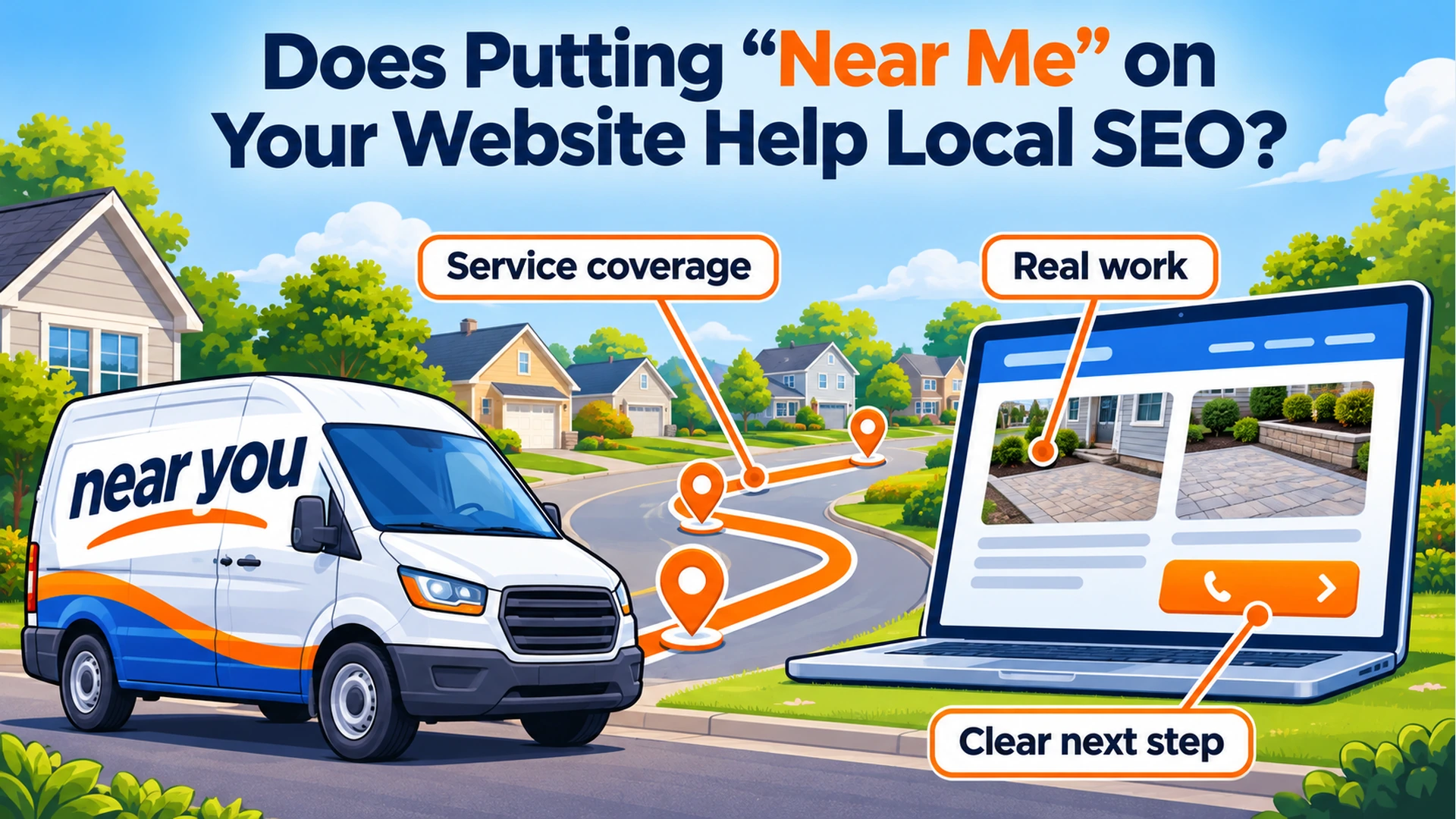
Think about putting “near you” on a delivery truck. The words might describe your availability, but they do not tell someone whether you actually deliver to their neighborhood. Your website still needs to explain what you offer, where you work, and why someone should choose you.
The useful question is bigger than whether those two words belong in a heading: How do you help customers find your business in the places you actually serve?
How do you rank in nearby cities?
Start by choosing cities you can serve profitably, checking what customers search for, and deciding whether each city needs its own page. Then publish information that helps someone in that location understand your services, your availability, and your experience.
There are two related opportunities to understand: appearing in Google’s local map results and appearing through your website in organic search results. They can support each other, but they do not behave identically.
| Search opportunity | What the customer sees | What to focus on |
|---|---|---|
| Local map results | Business listings associated with a map | An accurate Business Profile, relevance, distance, and prominence |
| Organic website results | Links to website pages | Useful service information, relevant location details, clear site structure, and evidence supporting the business |
Google explains that local rankings depend on relevance, distance, and prominence. Being able to drive to a customer does not remove the distance between your business and that searcher.
Your website gives you another way to explain your coverage. A page can answer a customer’s questions about service in a city even when your business is based somewhere else.
For the profile side of this equation, my guide to why businesses miss Google’s Map Pack goes into more detail. Here, the focus is building website coverage that deserves attention.
Does adding service areas to Google Business Profile expand your rankings?
An accurate service-area list tells customers where you operate. It should reflect your real coverage, but you should not treat each selected city as a location where Google has promised to show your business.
Google’s service-area instructions for businesses allow up to 20 areas and generally recommend coverage within about two hours of the business base. Businesses that do not receive customers at their address should remove that address from their public profile.
Sterling Sky’s testing of Business Profile service areas reports that selecting areas does not currently expand local rankings. That is practitioner testing, rather than a published guarantee about every part of Google’s ranking system.
Keep the coverage accurate because customers need accurate information. Then work on your website, your reputation, and the other factors you can improve.
Should you put “near me” on your website?
Use location and proximity language when it helps the reader. There is no reason to force “near me” into every heading, but the claim that those words can never influence rankings is too absolute.
Sterling Sky’s research on proximity wording reports improvements after adding phrases such as “near me,” “near you,” and “nearby.” It found a stronger effect on organic rankings and traffic than on local-pack results. That does not establish a guaranteed lift for every business or a rule that one mention is enough.
“Serving Homestead and nearby communities” can be perfectly natural. So can a heading that names the actual service and city.
The research for this article also turned up a useful distinction. “Near me SEO” had the largest measured search volume among the phrases we checked, but its results mainly featured agency sales pages and agency lists. The nearby-city question returned guides and discussions, which better matched what I wanted to explain.
The phrase with the biggest number is not automatically the best subject for your article or page.
Which cities deserve their own service-area pages?
Choose cities where you can genuinely deliver the service and give visitors useful information about that coverage. Existing customers, completed projects, and customer questions are strong starting points, but there is no universal minimum number of jobs or reviews required before you can publish.
Before creating a page, ask:
✓ Can we serve this city reliably and profitably?
✓ Are customers there looking for what we offer?
✓ Does our existing website already answer their questions?
✓ What can this page explain that another page does not?
✓ What evidence can we honestly show?
A city where you have completed several projects may be an obvious candidate. A city you are newly expanding into may also deserve clear coverage information, provided you explain your actual availability and avoid implying a history you do not have.
If the only information you can offer is “we also serve this city,” a regional service-area page may be enough for now. Every place you serve does not automatically need a separate URL.
What should a useful city page include?
A useful city page answers the customer’s practical questions: do you serve this location, can you handle this job, what should they expect, and how do they contact you? Local details should make those answers clearer.
I would build the page around these five elements.
The service and the coverage
Name the service and city clearly in the page title, main heading, and opening copy. Explain any meaningful limits, such as delivery boundaries, appointment days, minimum job sizes, or services unavailable in that area.
A customer should not have to submit a form just to discover that you cannot help them.
Evidence of relevant work
Show completed projects, genuine photographs, or customer feedback when you have them. Explain the problem, the work performed, and the result you can substantiate.
Protect customer privacy and get appropriate permission before publishing identifying details. A neighborhood may provide enough context without exposing someone’s home address.
Local facts that affect the service
Include local information when it changes the customer’s decision or the work itself. That might mean a verified permit requirement, a real travel charge, a delivery restriction, or a particular service schedule.
Do not invent differences because the template has an empty box. Nearby communities may share weather, building types, and customer needs.
Questions customers actually ask
Use questions from calls, estimates, emails, and completed jobs. Availability, preparation, service limits, and pricing factors often matter more than a paragraph about the city’s history.
A local FAQ earns its place by helping someone decide what to do next.
A clear next step
Make it easy to call, request an estimate, book, or check availability. Explain what happens after the customer takes that action.
A page that earns a visit still needs to help the visitor become a customer.
Can you use the same template for every city?
Yes. A shared template can make your pages easier to maintain and easier for customers to use. Keep the structure consistent while giving each page a clear purpose and information relevant to the location.
Your company history, licensing, process, and guarantees may remain the same across cities. There is no benefit in rewriting an accurate guarantee into five awkward variations just to make the sentences different.
I would not use “70% unique” as a publishing pass mark. A page could meet a similarity target by adding irrelevant filler and still fail to help anyone.
Use the swap test as an editorial check: replace the city name and read the page again. If everything still fits every other city, ask whether the page contributes enough to justify standing alone.
The answer may be better evidence, a shorter page, or combining several places into one useful regional page.
Online Presence Readiness Assessment
Is your business ready to market online?
Answer 20 quick questions while we scan your website for tracking, ad pixels, structured data, search basics, speed and contact paths. Get a scored readiness report, free.
When do city pages become doorway pages?
City pages become a concern when their main purpose is capturing similar searches and funneling visitors elsewhere without providing meaningful value. Separate city pages are not automatically doorway pages, and a shared design does not automatically make them spam.
Google’s doorway-abuse policy identifies substantially similar pages and regional pages that funnel users toward the same destination as examples of the problem. The practical question is whether the visitor has reached a useful page or merely another step toward one.
Google also explains that some duplicate content is normal. Ordinary duplication is not itself a spam-policy violation, although Google may choose one representative page from a group of very similar pages.
Changing a few adjectives does not solve a purpose problem. Start by making the page useful enough that a customer could understand the offer and take the next step from there.
How would this work for a South Florida business?
Imagine a service business based in Homestead that also serves Florida City, Cutler Bay, and Key Largo. Its city pages could share the same design, while explaining actual differences in scheduling, service coverage, travel charges, and completed work.
This is a hypothetical example, not a claim about conditions or requirements in those communities.
| Page | Information worth including, if true |
|---|---|
| Homestead | A completed local project, available services, and genuine customer questions |
| Florida City | Documented work in the area and any actual scheduling or coverage limits |
| Cutler Bay | Relevant project examples and verified requirements affecting the service |
| Key Largo | Real appointment arrangements, travel policies, and service boundaries |
Notice that the cities themselves do not supply the claims. The business records do.
A photograph from a completed job and a clear explanation of how you solved the problem can tell customers much more than another paragraph calling the city “vibrant.”
How should city pages connect to the rest of your website?
Make city pages part of a clear, browsable website. Visitors should be able to reach them from relevant service pages or a service-area hub, then find detailed service information without getting lost.
A practical structure is:
- A service-area hub explaining your overall coverage.
- Individual city pages where separate pages are useful.
- Main service pages explaining each service in depth.
- Contextual links connecting the pages when they help the visitor.
You do not need to link every city page to every other city page. A link should answer a likely next question, not satisfy a quota.
Also verify that Google can access and index the pages. If a new page fails to appear, investigate why Google might not index a page before assuming you need more keywords.
This work belongs within local SEO and Google Business Profile management, alongside accurate listings, website improvements, and ongoing measurement.
Do reviews and structured data help?
Genuine reviews can give customers useful evidence, while structured data can describe business information in a format search systems understand. Neither should be presented as a shortcut that guarantees visibility in another city.
Use relevant testimonials when you have permission to publish them. For Google review requests, ask for honest feedback without incentives, selective positive-review solicitation, or instructions to include particular keywords or locations. Google’s review policies prohibit influencing review content.
A consistent process for requesting reviews after customer service can help you collect authentic feedback over time. Customers should describe their own experiences in their own words.
For structured data, follow Google’s LocalBusiness documentation and describe the real business accurately. Do not manufacture a local branch, address, or office in the markup because you want to rank there.
How do you measure whether nearby-city pages are working?
Measure whether the pages attract relevant searches and produce qualified inquiries from places you can serve. Track Maps visibility separately from website performance so you can understand what changed.
For each city page, review:
✓ Whether Google indexed it.
✓ The queries producing impressions and clicks.
✓ Calls, forms, and bookings associated with the page.
✓ The actual service locations of those inquiries.
✓ Qualified leads, completed jobs, and business value.
A click on a city page does not prove the visitor lives there. Capture the requested service location naturally during the inquiry or booking process.
I would review early discovery and indexing, then revisit performance around 30 and 90 days. Those are useful review points, not ranking deadlines.
Keep improving the page when you have something meaningful to add: another completed project, clearer availability, a better answer, or a recurring customer question. Do not rewrite it simply because the calendar changed.
Frequently asked questions about ranking in nearby cities
Do I need an office in every city I serve?
No. You can publish useful website pages about cities you genuinely serve without maintaining an office in each one. Describe your coverage honestly and avoid implying that a service-area page represents a physical branch.
Do I need three projects and five reviews before publishing?
No universal requirement says that you do. Projects and reviews are valuable evidence, but the decision should depend on whether the page provides useful, accurate information rather than whether you have filled a prescribed number of slots.
Should I publish one page for every nearby ZIP code?
Only when separate pages serve a meaningful customer need. If several ZIP codes share the same service information, one strong city or regional page may explain the coverage more clearly.
Is publishing several city pages at once a penalty trigger?
Publication timing alone does not establish doorway abuse. Review the pages for usefulness, accuracy, and purpose; spreading weak pages across several weeks does not improve their substance.
Can AI help write service-area pages?
Yes. Give it verified service details, project records, approved customer feedback, and accurate local information, then review the result. Do not let it invent jobs, neighborhood experience, permit requirements, or response times.
Give your next city page a reason to exist
Putting “near you” on the delivery truck is easy. Explaining where you deliver, what customers can expect, and why they should trust you takes more work. Your website should make those answers easy to find.
Start with one city where a better page would help real customers. Build it from facts, connect it to the rest of your website, and measure what happens.
Give each page a job. Give each claim some evidence. Give each visitor a clear next step.
Find out where customers can find you
Before building more pages, review your current visibility across Google Maps, website search results, and your existing service coverage. Released Solutions can help you identify gaps and decide where to focus next.
Last fact-checked: November 10, 2026.