
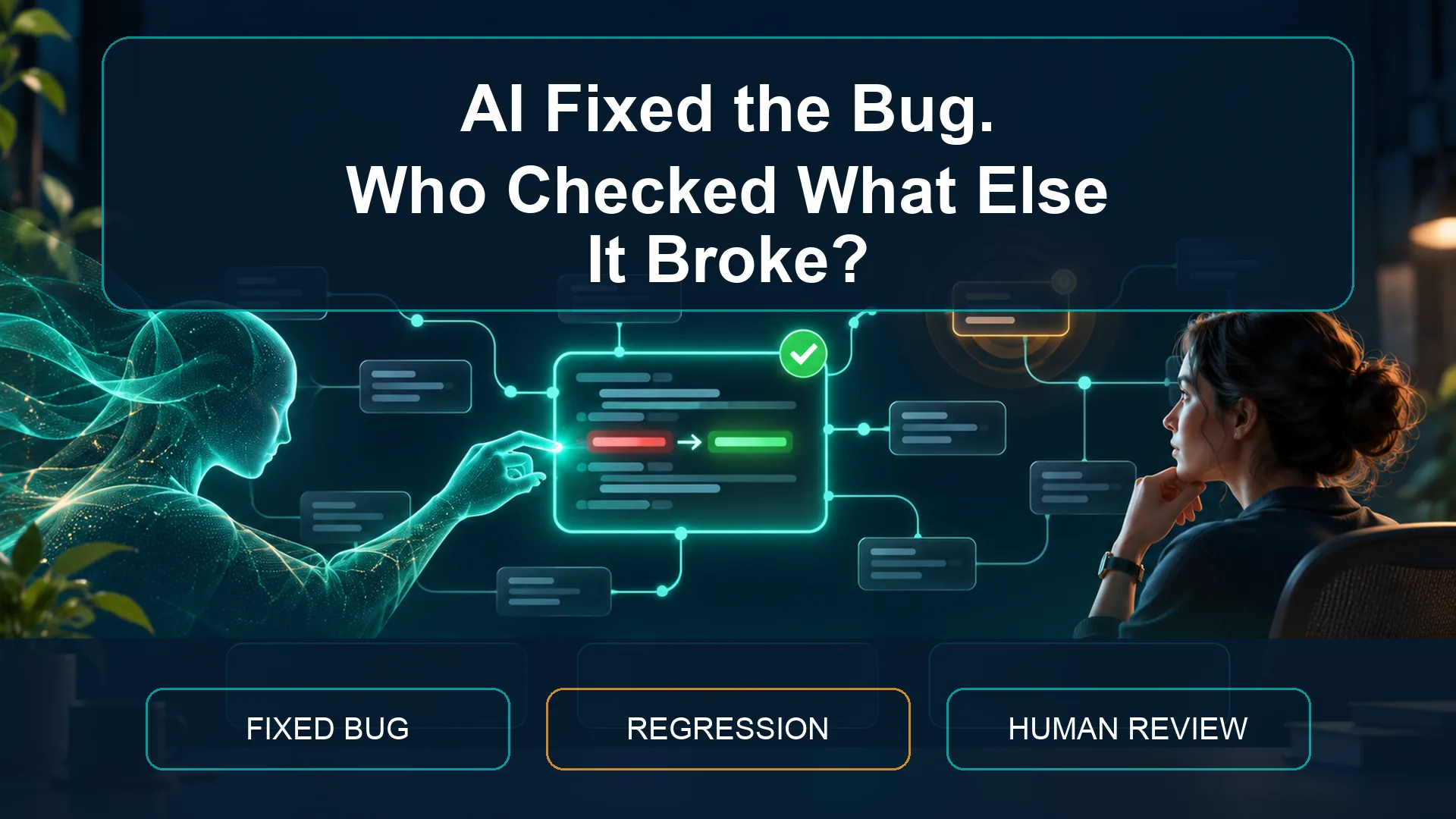

AI Fixed the Bug. Who Checked What Else It Broke?
I was watching Good Morning America when a clip featuring Microsoft CEO Satya Nadella caught my attention. He was discussing a growing challenge with artificial intelligence and software: AI can help identify bugs and accelerate fixes, but those changes can also introduce instability.
That got me thinking about something I have been watching much closer to home.
We have people everywhere discovering vibe coding, building applications, creating websites, developing plugins, and even deploying complete business systems with AI. And I think that is fantastic. I use AI extensively in my own development work.
But there is something I worry we are leaving on the floor as we celebrate how quickly AI can write code.
Writing code was never the whole job. Understanding what the code does, how it interacts with everything around it, and what happens when something goes wrong is just as important.
And now that AI can write, modify, and execute code at remarkable speed, those disciplines matter more than ever.
What Did Microsoft's CEO Actually Say About AI and Software Bugs?
On November 18, 2026, Microsoft CEO Satya Nadella discussed the growing pressure that AI places on software infrastructure.
In separate interviews at the New York Times DealBook Summit and with CNBC, he addressed how AI is accelerating vulnerability discovery, how organizations are responding with software patches, and how those changes can introduce instability.
Microsoft had also experienced a major service outage on November 12. According to the reported findings from Microsoft's investigation, the incident involved a latent software bug, unusual traffic conditions, and reduced server capacity. The available findings do not establish that an AI-generated patch caused the outage.
But the broader concern Nadella raised deserves attention.
AI can help discover problems faster than ever before. It can also help developers generate fixes. Yet implementing a fix does not automatically mean the surrounding system will continue functioning as expected.
And that brings us directly to the world of vibe coding.
When Major Systems Start Going Down, We Should Pay Attention
What made that Good Morning America segment particularly interesting to me was the timing.
Microsoft was not the only organization dealing with a major technology disruption. Within days, outages affected JPMorgan Chase, Apple, the Federal Aviation Administration, United Airlines, and even an internal network at the National Security Agency.
Think about that for a moment. We are talking about banking transactions, airline operations, government communications, and technology services that millions of people depend on.
According to reporting from Reuters, experts are examining how the accelerating pace of vulnerability discovery and software patching may be contributing to operational instability.
Now, I want to be careful here. These incidents have different reported causes, and there is no established evidence that AI directly caused every outage or that a single problem connected them.
But they raise a question I believe every business owner and developer should consider.
If some of the world's largest technology companies and government organizations can experience serious disruptions when software changes, what makes us think an AI coding agent building our WordPress plugin, reservation system, or customer portal is immune to the same kinds of mistakes?
That is not an argument against AI. I use AI to develop software, and I am excited about what it makes possible.
It is an argument for remembering the disciplines that experienced developers have spent decades learning.
Because there is a tremendous difference between making a change that works and making a change that works safely within an entire system.
Vibe Coding Is Great. But Are We Forgetting How Software Development Works?
I have spent years working with software, systems, websites, databases, and business processes. One thing I learned early is that changing a piece of code rarely means you are changing only that piece of code.
Think about taking your car to a mechanic.
You explain that something is wrong with the engine. The mechanic identifies the problem, replaces the defective part, starts the car, and announces that everything is fixed.
Wonderful.
But what if, during the repair, the mechanic disconnected something that controls another important function? What if the engine starts perfectly, but the car now stalls when you put it in gear?
Did the mechanic fix the original problem? Absolutely.
Did the mechanic finish the job? Not necessarily.
Software works much the same way.
Your application might have a database, a payment processor, a customer login, an appointment calendar, an email notification system, and several outside services communicating with each other.
An AI coding agent might successfully repair one feature while unintentionally affecting another.
The fact that the original error disappeared does not prove that the entire application is healthy.
The Difference Between Writing Code and Engineering Software
There is a reason traditional software development includes more than a programmer typing instructions into a computer.
Developers and engineering teams use requirements, version control, code reviews, test environments, security checks, documentation, and release procedures.
These practices exist because software operates inside systems, and systems have dependencies.
When I ask an AI agent to build a feature, I can get working code remarkably quickly. But if I give that same agent permission to make changes without defining the boundaries, how will it know what it must preserve?
It may know how to solve the problem I described. That does not guarantee it understands every business rule, integration, historical decision, or customer expectation associated with the application.
This is where experienced developers, systems analysts, and software engineers still bring tremendous value.
They understand that the assignment is not simply to make something work.
What Happens When AI Fixes One Problem and Creates Another?
Imagine that a restaurant owner uses AI to build a reservation system.
The system allows customers to select a date, choose a time, and reserve a table. It works beautifully.
Then the owner notices a problem. Customers can occasionally book the same table for overlapping reservations.
The AI agent is instructed to fix the double booking problem.
It updates the reservation logic, runs a quick test, and reports success.
Except the change has also introduced a new problem.
The restaurant has multiple dining areas, and different tables can accommodate different party sizes. The new logic prevents overlapping reservations so aggressively that it begins blocking perfectly valid bookings in other areas.
The original bug is fixed, but the restaurant is now losing potential reservations.
This is a hypothetical example, but the underlying problem is familiar to software developers.
We call the unintended introduction of a problem into previously working functionality a regression.
That is why regression testing exists.
It is not enough to ask whether the new feature works. We must also ask whether existing features still work.
The Dangerous Part Is When AI Tests Its Own Work
Here is where things get particularly interesting.
Many AI development workflows allow an agent to write code, create tests, run those tests, examine the results, and declare that the assignment is complete.
That sounds efficient.
And it can be.
But think about what we are asking that agent to do.
We are asking it to understand a problem, decide on the solution, implement the solution, and then determine whether its own work satisfies the requirements.
What happens when the agent misunderstands the requirements in the first place?
It might write perfectly functioning tests that validate the wrong behavior.
Every test passes, yet the customer's actual problem remains unresolved, or an entirely new problem appears.
This is one reason the OWASP Secure Coding with AI guidance emphasizes human review, independent security analysis, and careful examination of AI-generated test changes.
The lesson is straightforward.
A green test result tells you that something passed. It does not necessarily tell you that you tested the right things.
Autonomous AI Agents Introduce Another Layer of Responsibility
There is also an important difference between using AI to suggest code and giving an AI agent the ability to execute changes.
One is an assistant. The other may have the keys to the workshop.
An AI assistant might recommend how to modify a WordPress plugin. You review the recommendation and decide whether to use it.
An autonomous coding agent might open the project, modify files, install dependencies, execute commands, run database updates, and deploy the changes.
That is a very different level of responsibility.
Now we are not only evaluating the quality of the code. We are also evaluating the actions the agent took to produce it.
Did it modify only the files it was authorized to change? Did it access sensitive information? Did it preserve existing functionality? Did it request approval before doing something irreversible?
The OWASP AI Agent Security guidance addresses these concerns through restricted permissions, monitoring, security testing, and human oversight for sensitive actions.
And there is one more requirement I consider essential.
An agent must know when to stop.
If a database connection fails, instructions conflict, or a deployment behaves unexpectedly, success should not mean finding any possible way to finish the assignment.
Sometimes the correct action is to stop, report the problem, and request human intervention.
Seven Disciplines I Would Not Abandon When Vibe Coding
You do not need a large software development department to practice responsible AI development.
Whether you are building a custom website feature, an internal dashboard, a scheduling application, or a complete customer portal, I would establish these seven disciplines.
Define What Success Looks Like Before Writing Code
Tell the AI what the feature must accomplish, what must not change, and how you will know the work is complete.
For a reservation system, that might include preventing double bookings while preserving valid reservations across different tables, party sizes, and dining areas.
Use Version Control and Maintain Backups
Know what changed, when it changed, and how to reverse it.
A working backup protects data and configuration. Version control records changes to code. Both serve different purposes, and neither replaces the other.
Develop and Test Outside the Live System
Use a staging or development environment whenever practical.
An AI agent should not need unrestricted access to a live business website merely to experiment with a solution.
Test What Changed and What Depends on It
Fixing the reservation calendar should trigger tests of related processes, including customer confirmations, availability calculations, cancellations, and any connected payment or reporting workflows.
The test plan should reflect how the business actually operates, not merely how the new function was programmed.
Have an Independent Review Process
Do not depend exclusively on an agent's explanation that everything works.
Review the changes, examine the tests, and verify important behavior independently. A second AI reviewer can be useful, but for consequential changes, it does not replace accountable human oversight.
Limit What the Agent Is Allowed to Do
Give the agent access only to the files, tools, data, and environments required for the assignment.
Require approval before actions such as deleting records, changing permissions, modifying payment logic, or deploying high-risk changes.
Monitor the Deployment and Have a Recovery Plan
Testing does not stop when a change goes live.
Monitor errors, transactions, integrations, and customer-facing functionality after deployment. Know how to revert the code, restore affected data where necessary, and recover if the change creates unexpected problems.
Together, these disciplines turn vibe coding from a rapid experiment into a more controlled development process.
The Caveman Marketing Quiz
How much of your marketing is still hunting by hand?
Rate 15 statements and see which of five stages your marketing is in, from The Hunter to The AI-Augmented Entrepreneur.
A Working Demo Is Not the Same as a Production Application
This may be the most important distinction for someone discovering vibe coding for the first time.
You ask AI to build an application.
It creates an attractive interface. The buttons work. You enter information, submit a form, and see a successful result.
You have a working demonstration.
But have you tested what happens when two people submit the same form simultaneously? What happens when the payment service is unavailable? What happens when an unauthorized person tries to access someone else's account?
What happens when an AI agent makes an update six months from now without understanding why the original developer made a particular decision?
These are not reasons to abandon the project.
They are reasons to recognize that moving from a demonstration to a dependable business application requires additional work.
And that work is part of development, not an optional extra.
Experienced Coders Still Matter, Even When AI Writes the Code
I do not believe AI makes developers irrelevant.
I believe it changes where their expertise becomes most valuable.
An experienced programmer or systems analyst may spend less time typing routine code and more time defining requirements, evaluating architecture, understanding dependencies, reviewing security, and verifying outcomes.
Those activities were always important.
AI simply makes it easier to produce code without first developing those skills.
That is both the opportunity and the risk.
Someone with a great business idea can now create tools that might previously have been too expensive or difficult to build. I consider that a tremendous development, especially for small businesses.
But I would encourage anyone entering this world to learn the disciplines that make software dependable, even if they never intend to become a traditional programmer.
You do not necessarily have to write every line of code yourself.
You do need to understand what responsible development requires.
Should Small Businesses Trust AI to Build Their Software?
Yes, with appropriate safeguards and expectations.
I use AI because it allows me to build and improve business systems in ways that were previously far more time consuming. It opens opportunities for customization, automation, and experimentation that many small businesses could not reasonably afford before.
But I also approach development with the understanding that every application has a purpose, every change can have consequences, and every production system deserves protection.
That means defining the requirements, examining how systems interact, testing carefully, retaining control over credentials and data, and making sure there is a way to recover when something goes wrong.
It also means recognizing when a project needs an experienced developer or a more formal review.
Frequently Asked Questions About AI Coding and Testing
Can AI write production-ready code?
Yes. AI can generate code suitable for production, but that suitability depends on the requirements, review, testing, security, and deployment process. AI-generated code should not be considered production-ready simply because it runs successfully.
What is regression testing in vibe coding?
Regression testing checks whether existing features still function after a code change. For example, fixing an appointment scheduling problem should not break customer notifications or payment processing.
Can AI agents test their own code?
Yes. AI agents can generate and execute tests, but those tests may inherit the same misunderstandings as the code itself. Independent verification and human review remain important.
Is vibe coding safe for business websites?
It can be, provided the business uses appropriate permissions, backups, staging environments, testing, security controls, and deployment procedures. The level of oversight should increase with the potential consequences of a failure.
Do I need to know programming to use AI coding tools?
Not necessarily to create a prototype or simple tool. However, understanding requirements, security, testing, and deployment becomes increasingly important as applications grow more complex or handle sensitive business operations.
Don't Just Ask Whether AI Fixed It. Ask What Else It Changed.
Let's return to the mechanic.
Getting the engine running was never the entire assignment. The car still needs to operate safely when it leaves the shop.
Software is no different.
Whether a human developer writes the code or an AI agent generates it, the responsibility for understanding, testing, and protecting the complete system remains.
I am excited about what AI makes possible. I want more business owners experimenting with these tools, building useful applications, and discovering ways to improve their operations.
But I also want them to understand that the disciplines developed through decades of software engineering did not suddenly become unnecessary because writing code became easier.
AI may be able to write the code. It may even be able to fix the bug. But somebody still needs to make sure the rest of the system works.
Building Something With AI? Make Sure It Is Built to Last.
At Released Solutions, I approach AI-assisted development as part of a larger business system, not just a collection of features that happen to work.
If you are building a website, developing a custom application, or introducing AI agents into your business workflows, let's review how the pieces fit together, where problems could occur, and what safeguards your system needs.