
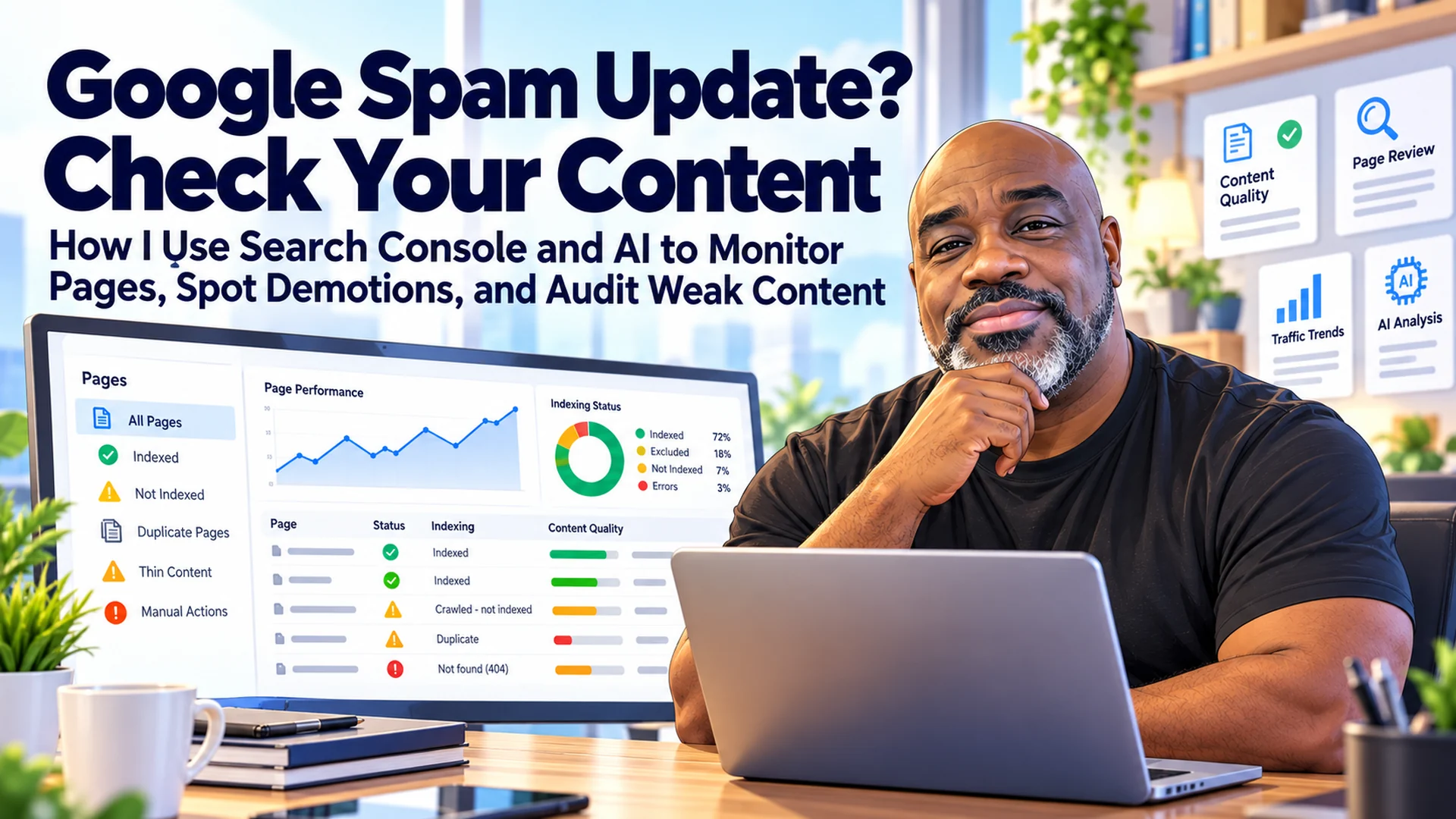

Google's September 2026 Spam Update: What I'm Watching on My Own Site
Over the past several weeks, I've become a little obsessed with Google Search Console. Not because I want to stare at rankings all day, and not because I believe every movement in Google requires an immediate SEO reaction. I started paying closer attention because I wanted a clearer answer to a more basic question: what is Google actually doing with the pages I already have?
Before I began a new round of optimization, I took a snapshot of the site. That gave me a baseline. From there, I built a custom daily report around my sitemap and Search Console data so I can see when a page that was previously indexed or visible begins to lose ground. I can compare today's state with the state I started from instead of relying on memory or a gut feeling.
At the same time, I started using AI to audit the content itself. I wanted help finding pages that overlap too heavily, repeat the same ideas, feel thin, or simply do not add enough original value. In other words, I was using AI to help me question the content I already had before asking it to create more.
Then, on September 24, 2026, Google launched another spam update.
| The central idea The update is the news. The monitoring system is the story. |
|---|
Google's September 2026 Spam Update Is Now Rolling Out
Google says the September 2026 spam update began on September 24 at 9:15 a.m. Pacific. It applies globally and to all languages, and Google says the rollout may take up to two weeks to complete.
Google has not announced that this is an AI-content update, a link-spam update, or an update aimed at one specific tactic. Its public description is broader: Google periodically improves the automated systems it uses to detect practices that violate its Search spam policies.
That matters because it is easy to turn every Google update into a headline about one supposed cause. The more useful response is to understand what Google has actually confirmed, then look at your own data before deciding what changed.
This is Google's fourth confirmed spam update of 2026
The September rollout follows three earlier spam updates this year. Those earlier updates finished quickly compared with the window Google has allowed for September.
| Update | Started | Completed | Rollout duration |
|---|---|---|---|
| March 2026 spam update | March 24 | March 25 | 19 hours, 30 minutes |
| June 2026 spam update | June 24 | June 26 | 2 days, 1 hour |
| August 2026 spam update | August 18 | August 21 | 2 days, 16 hours |
| September 2026 spam update | September 24 | Still active as of Sept. 25 | Google says up to two weeks |
I do not take the longer rollout window to mean this update is automatically bigger or harsher. Google has not said that. I do take it as a reason to be careful about drawing conclusions from one or two days of movement while the system is still changing.
Why I Was Already Watching My Own Site More Closely
My recent Search Console work started before this update. I wanted to stop treating indexing and visibility as something I checked only when I happened to remember or when traffic looked wrong.
The baseline snapshot changed that. Once I had a reference point, I could build reporting that looks for changes against a known starting state. If a page that was healthy in the snapshot is no longer indexed, loses visibility, or otherwise degrades from that earlier state, my tool flags it for review.
In my report, 'demoted' is a working flag for investigation. It is not a label Google gives the page, and it does not prove Google applied a spam penalty.
That distinction is important. A page can lose ground for many reasons. Google may have changed how it evaluates the page. The page may now overlap too much with another page. Search demand may have changed. An indexing or technical issue may have appeared. A competitor may have improved. I may have changed something myself.
The job of the report is not to declare guilt. The job is to tell me where to look.
What Google Actually Calls Spam in 2026
Google's spam policies cover a long list of deceptive or manipulative practices. They also now explicitly include attempts to manipulate generative AI responses in Google Search, not only traditional ranking results.
For most legitimate small businesses and content teams, a handful of policies deserve special attention because they can overlap with normal content-production habits when those habits are pushed too far.
| Policy | What it means in practical terms |
|---|---|
| Scaled content abuse | Producing many pages primarily to manipulate rankings instead of helping users, regardless of whether AI, automation, templates, people, or a mixture created them. |
| Doorway abuse | Creating many similar city, service, or keyword pages that mainly funnel people to the same destination. |
| Keyword stuffing | Repeating phrases, locations, or numbers unnaturally in an attempt to rank. |
| Link spam | Creating, buying, selling, exchanging, or automating links primarily to manipulate ranking signals. |
| Scraped or thin content | Republishing or lightly rewriting material without enough original value, analysis, or utility. |
| Site reputation abuse | Publishing third-party content mainly to take advantage of the host site's established reputation rather than because the host meaningfully oversees and supports it. |
| Misleading functionality | Claiming to provide a tool, service, download, or function that the page does not actually provide. |
This is why I do not think the useful question is, 'Does Google hate AI content?' Google does not say that using AI automatically violates its policies. The question is what you are using AI to do, why the page exists, and whether the result gives people something distinct and useful.
The Irony: I'm Using AI to Help Me Find Weak Content
A lot of the fear around spam updates focuses on AI as the thing creating the problem. There is some logic behind that concern because generative tools make it much easier to produce hundreds or thousands of pages quickly.
But AI can also be used in the opposite direction.
I have been using it to audit what I already published. I can ask it to compare related articles, identify duplicated sections, flag topics that overlap too heavily, point out where an explanation is thin, and question whether two pages should remain separate at all.
That does not mean I let AI decide what gets deleted. It means AI can help me surface patterns faster, then I apply judgment. It is a reviewer, not the owner of the website.
That is a very different use of AI from asking a model to generate 500 location pages so I can cover every city in a spreadsheet.
What I'm Checking During the September Rollout
Because this update may take up to two weeks, I am more interested in disciplined monitoring than rapid reaction. My workflow is straightforward.
1. Keep the baseline
I want the original snapshot intact so I can compare current conditions with where I started. Without a baseline, it is too easy to confuse normal fluctuation with a meaningful change.
2. Watch indexing
I review my sitemap and Search Console page-indexing data. A page that was previously indexed and is no longer indexed deserves attention.
3. Watch visibility
Indexing alone is not the whole story. I also care about whether pages are still earning impressions and appearing for the searches they previously reached.
4. Audit content quality and overlap
When something changes, I review the content itself. Is the page distinct? Does another article cover the same ground better? Is the page useful enough to justify staying separate?
5. Investigate before changing
A flag is a starting point, not a diagnosis. I want to understand whether the issue is technical, editorial, competitive, query-related, or connected to a broader Google change before I start rewriting.
6. Improve what has a reason to exist
The goal is not to rescue every URL. The goal is to strengthen useful pages, consolidate unnecessary overlap, and make the site easier for both people and search systems to understand.
What I Would Not Do Right Now
I would not panic-edit a good article simply because rankings move during an active rollout. I would not assume every decline is a spam penalty. I would not delete pages solely because a dashboard shows one bad day. And I would not start manufacturing more content just to compensate for lost impressions.
Google's own guidance after spam updates is to review its spam policies and make sure the site complies. If a site truly has policy problems, recovery can take time as Google's automated systems reassess it. That is another reason to favor durable improvements over frantic changes designed to reverse yesterday's chart.
A Better Question Than 'Did Google Demote Me?'
The monitoring matters. The data matters. Search Console matters. But the bigger question I am asking about each page is increasingly simple:
Would I still believe this page deserved to exist if Google never sent it a visitor?
If the answer is yes because the page explains something customers ask about, documents experience, demonstrates expertise, compares real options, solves a problem, supports a service, or provides original information, then I have a strong reason to improve and protect it.
If the only answer is, 'I wanted to rank for that phrase,' I probably need to look harder at the page.
That does not mean SEO stops mattering. I am paying more attention to Search Console than I have in a long time. It means the data should help us improve useful content, not tempt us into creating content whose only purpose is to manipulate the data.
1. Keep the baseline
2. Watch indexing
3. Watch visibility
4. Audit content quality and overlap
The Takeaway
Google's September 2026 spam update is still rolling out as I write this. It is the fourth confirmed spam update of the year, and Google has given this one a potentially longer rollout window than the three earlier 2026 updates actually needed.
I will keep watching my baseline report, indexing changes, visibility, and content quality. I will keep using AI to help me find weak or repetitive material. And I will keep treating every flag as a reason to investigate, not a reason to panic.
The lesson I am taking from the update is not "stop using AI." It is stop confusing content production with content value. The businesses that build useful, differentiated content and monitor it carefully are in a much better position than businesses chasing whichever shortcut appears to work this month.
Want a Clearer Picture of What Google Is Seeing on Your Site?
Released Solutions helps small businesses connect website quality, Search visibility, analytics, content, and ongoing optimization into one manageable system. If you are seeing indexing problems, unexplained visibility changes, or a site full of content you are no longer sure about, start with a review of the full online presence.
Explore Online Presence Management: https://releasedsolutions.net/online-presence-management-for-small-business-owners/