
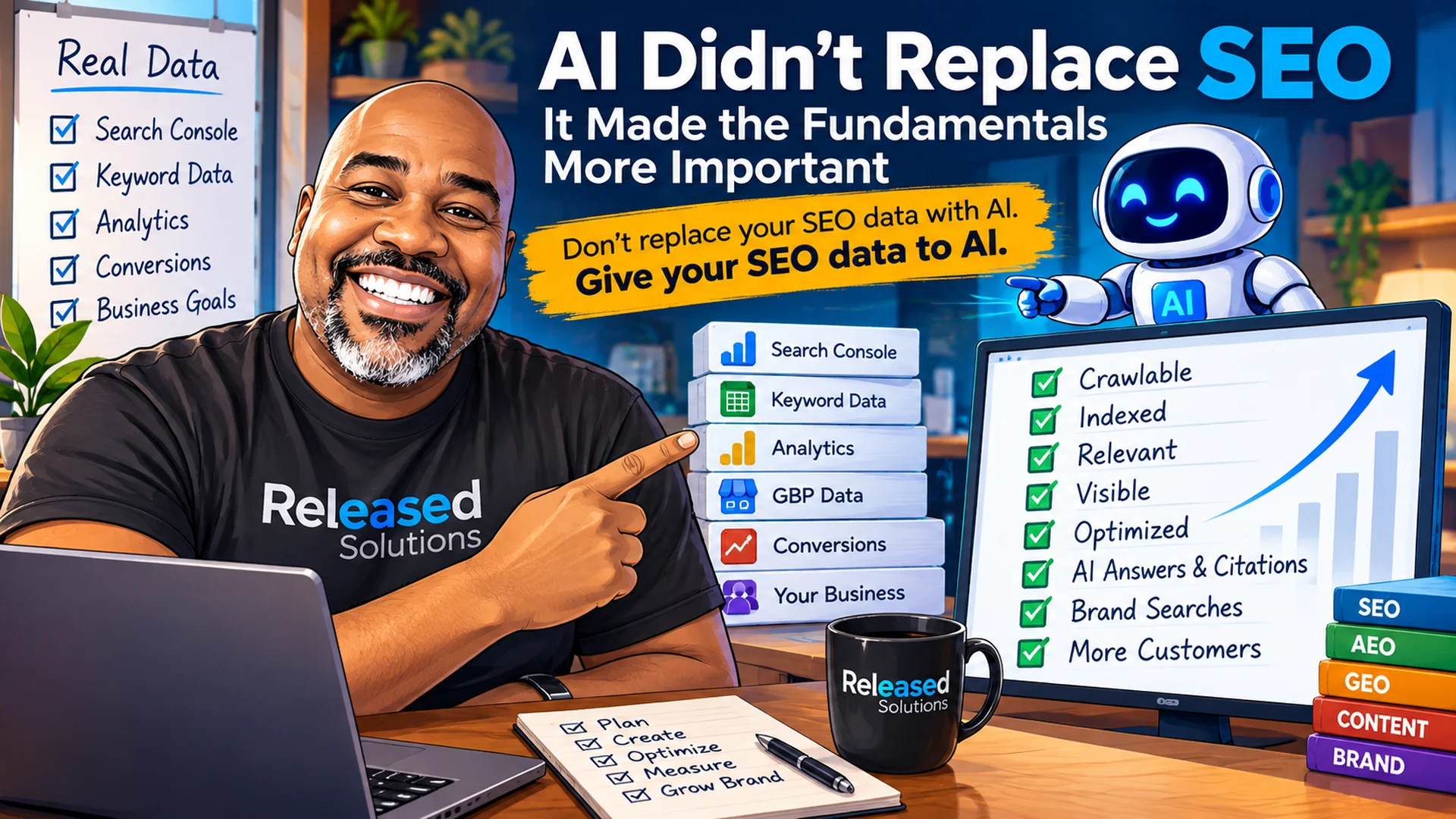

AI Didn’t Replace SEO: It Made the Fundamentals More Important
AI has made it remarkably easy to ask sophisticated-sounding SEO questions. Give ChatGPT or Claude a website and a prompt, and within seconds it can suggest keywords, identify search intent, build topic clusters, recommend internal links, propose an AEO strategy, and even create a 90-day growth plan.
The problem is not that AI cannot help with SEO. It can. The problem begins when we treat the AI’s answer as if it were the research.
I keep coming back to a simple principle: Don’t replace your SEO data with AI. Give your SEO data to AI.
That distinction matters even more now that Google search includes AI-generated answers, fewer searches necessarily end with a website click, and businesses are being told they need SEO, AEO, GEO, AI citations, topical authority, and a growing list of new tactics. Before chasing the newest acronym, I believe businesses need to make sure the foundation is working.
Start With the Most Basic Question: Is the Page Actually Indexed?
Lately, I have become almost obsessed with Google Search Console. When I publish or update an important page, I do not want to stop at knowing Google discovered the URL. I want to understand whether Google actually indexed it.
Google defines indexing as the stage where it analyzes a page’s content and meaning and stores the page in its index, where it may become eligible to appear in Search. Discovery and crawling are steps in the process, but they are not the finish line.
Search Console’s URL Inspection and Page Indexing reports let us see what Google knows about a URL, identify indexing problems, test a live page, and request indexing after problems are corrected. Google also makes an important point: requesting indexing does not guarantee that a page will be indexed.
That is the first SEO fundamental AI cannot wish away. If an important page is not indexed, asking an AI to improve its ranking is starting several steps too late.
A Practical SEO Progression
I think about the work as a progression:
Crawlable → Indexed → Relevant → Visible → Clicked or Cited → Trusted → Remembered → Searched by Brand → Converted
Each stage asks a different question. Can Google access the page? Did Google index it? Does the page match a real search need? Is it earning impressions? Are people clicking it, or is it being surfaced in an AI experience? Does the content create enough value that someone remembers the business? Does that attention eventually produce a lead, sale, booking, or other meaningful outcome?
AI can help us work through nearly every stage. But AI should not be allowed to silently invent the evidence for those stages.
AI Is a Powerful Analyst, Not a Substitute for Evidence
Consider a prompt such as: “Analyze my target keyword and identify the real search intent.” That can produce a useful hypothesis. But what evidence did the AI receive?
If the model has not examined the current search results, the relevant geography, the business’s Search Console queries, historical keyword data, landing-page performance, and conversion information, it may be reasoning from language patterns rather than from what is actually happening for that business.
This is especially important in local SEO. A phrase can sound perfectly relevant and still have little demand in a specific market. Another phrase may have modest volume but consistently produce qualified calls, appointments, or sales.
I would rather give AI a package of evidence and ask it to find the patterns. That package might include Search Console queries and pages, Keyword Planner data, current SERPs, Google Business Profile search information when available, GA4 behavior, CRM outcomes, and offline conversions.
Now the AI is not being asked to manufacture the research. It is helping analyze the research.
Keyword Research Should Not End With Search Volume
Traditional keyword research often encourages people to chase volume. But the keyword with the most searches is not automatically the keyword with the most business value.
For a local business, twenty highly relevant searches that produce four customers can matter more than a thousand broad searches that produce none.
That is why I want the SEO dataset to move toward a business dataset:
Query → Impression → Click or Citation → Landing Page → Lead → Qualified Lead → Sale → Revenue
The farther we can close that loop, the better AI becomes at helping us identify what deserves more attention. Without that outcome data, a model can estimate business value. It cannot know business value.
Search Console Turns SEO From Guessing Into Observation
Once a page is indexed, Search Console becomes one of the most useful places to see what Google is actually doing with it.
The Performance report shows impressions, clicks, average position, and the queries that caused pages to appear. That means optimization can begin with observed behavior instead of a blank sheet of paper.
A page receiving impressions but few clicks may have a title, description, positioning, or intent problem. A page appearing for unexpected queries may reveal a content opportunity. A page sitting near stronger positions may deserve a focused refresh. A page receiving no meaningful impressions may require a more fundamental relevance review.
Google also recommends combining Search Console and Google Analytics because Search Console describes what happens before a visitor reaches the site, while Analytics helps explain what happens after the visit. That is the kind of evidence I want AI to work with.
AEO Changes the Click, Not the Need for Fundamentals
AI-generated answers complicate the old search journey. A person can ask a question, receive a useful answer directly in Google, and never visit the source website.
That concern is legitimate. Businesses invest time and expertise into useful content, and an answer engine can sometimes satisfy the immediate question without producing the website traffic publishers historically expected.
But this is not a reason to abandon SEO fundamentals. It is a reason to expand what we measure.
Google Search Console now reports performance for generative AI features such as AI Overviews and AI Mode, including impressions for links shown in those experiences. Google also continues to count clicks from AI features when a user follows a link to an external site.
So the question is no longer only, “Did this page rank and get a click?” We can also ask, “Is this content being surfaced in AI experiences, is the brand gaining exposure, and does that exposure contribute to later discovery or conversion?”
The Long-Term Opportunity Is Becoming the Brand People Search For
There is another side of this discussion that I believe small businesses should pay much more attention to: brand demand.
If Google, ChatGPT, social platforms, videos, articles, referrals, and community conversations repeatedly expose people to a useful business, the best outcome may eventually be that the person stops searching for a generic category and starts searching for the business by name.
There is an enormous difference between competing for “online presence management” and someone searching specifically for “Released Solutions online presence management.” The second search begins with awareness already established.
Search Console now provides branded and non-branded query filtering for eligible properties. That gives businesses another useful signal for watching whether people are finding them only through generic topics or increasingly looking for the brand itself.
We should be careful not to claim that an AI citation automatically causes branded searches. That would be the same measurement mistake this article is warning against. But branded-query growth is something we can observe, measure, and investigate.
What I Would Give AI Before Asking for an SEO Strategy
Instead of beginning with a magic prompt, I would begin with a useful evidence package:
Then I would ask AI to cluster queries, identify gaps, compare intent, find pages with opportunity, map topics to existing content, suggest internal links, detect cannibalization, identify weak titles or content mismatches, and prioritize work based on the evidence.
That is a very different assignment from simply asking, “What keywords should I target?”
Evidence
Indexing, queries, analytics, outcomes
AI Analysis
Patterns, gaps, priorities
Business Decision
What deserves attention next
The Fundamentals Still Win
SEO is changing. AI search is changing it further. I do not think the answer is to ignore AEO, GEO, AI citations, or the new ways people discover information.
I think the answer is to make the foundation stronger.
Make the site crawlable. Make sure important pages are indexed. Create content around real customer needs. Watch what Google actually surfaces. Measure impressions, clicks, citations, leads, and conversions. Build content valuable enough that people remember who provided it. Then give that evidence to AI and let it do what it is exceptionally good at: helping us see patterns, ask better questions, and work through more information than we could reasonably analyze by hand.
AI can be an extraordinary SEO coworker.
But it works a lot better when we give the coworker something real to work with.
Key Takeaways
✓ AI can generate SEO ideas, but ideas are not the same as research.
✓ Discovery and crawling are not the same as indexing.
✓ Search Console provides observed query, impression, click, position, indexing, and now generative-AI performance data.
✓ Local SEO requires geographic and business context that a generic prompt may not contain.
✓ Search volume alone does not determine business value.
✓ AEO and AI answers make brand visibility and branded demand more important to watch, not less.
✓ The best use of AI is often to analyze evidence, not invent it.
✓ Don’t replace your SEO data with AI. Give your SEO data to AI.
Is Your SEO Foundation Giving AI Enough to Work With?
Not sure whether your website is giving AI and search engines enough reliable information to work with? Released Solutions can help review the foundation first: indexing, Search Console, analytics, content, conversions, and the data behind the strategy.
Destination: https://releasedsolutions.net/online-presence-management-for-small-business-owners/