
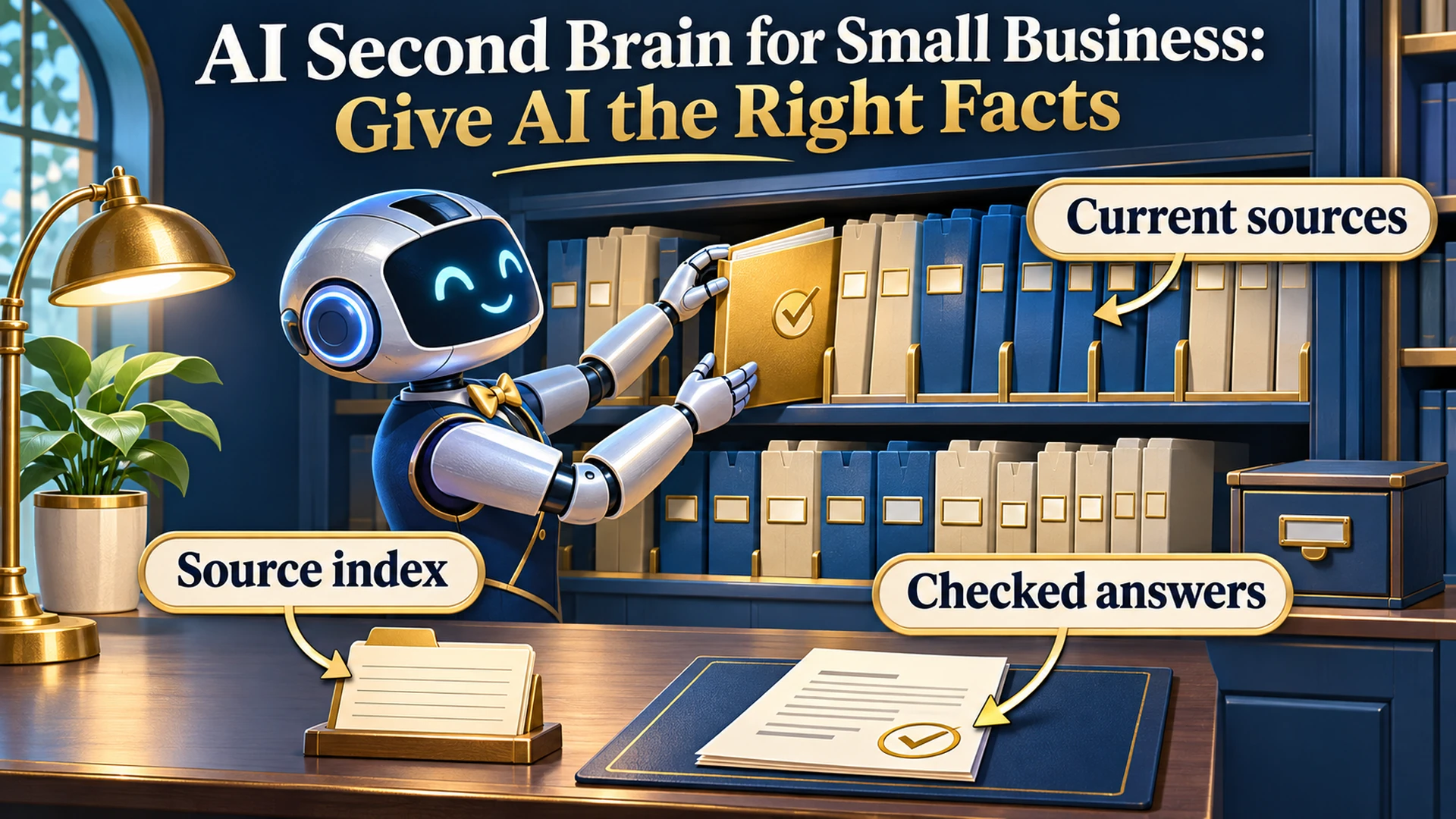

AI Second Brain for Small Business: Give AI the Right Facts
An AI second brain gives your business a way to organize information so an AI assistant can find and use it for real work. Start with current, identifiable sources for one recurring task. Then check whether the assistant retrieves the right facts, identifies its sources and admits when information is missing.
Think about a library. Putting every document you own into one room gives you a collection, but someone still needs to know which shelf holds the current information.
Now imagine that last year's price list and today's price list have the same cover. The librarian can find a book and still hand you the wrong answer.
Your business knowledge needs organization and ownership as well as storage. A bigger pile of documents does not settle which one governs the work.
This is Part 7 of Put AI to Work. We have covered giving AI an assignment and capturing a reusable procedure. Now we need to organize the business facts those procedures depend on.
What Is an AI Second Brain?
An AI second brain is a practical name for organized knowledge that an AI assistant can use to help you work. For a small business, that might include service descriptions, approved policies, reference documents and decisions worth preserving.
It does not need to contain everything your business has ever produced. Begin with the information needed to answer a useful set of questions or complete a recurring assignment.
Anthropic's explanation of project knowledge in Claude describes using uploaded documents and other reference material to provide business context. That is one possible starting point, with features and access depending on the product and setup.
The useful test is whether the system helps someone answer a question correctly. Calling a folder a second brain does not establish that its contents are current or that AI can retrieve them reliably.
What Does This Look Like in My Own Work?
My publishing process depends on several kinds of reference material. The handoff specification defines production requirements, the linking playbook explains the linking approach, and the content inventory identifies existing articles and destinations.
Those files answer different questions. The inventory can tell us whether a destination exists, while the handoff specification tells us what the production package must contain.
The current article supplies its own approved words. A reference to the subject is not enough when the next step requires exact copy.
This is why I want current sources identified before the work starts. If an assistant relies on an old inventory or reconstructs missing copy from a discussion summary, the problem can travel directly into the finished package.
The same principle applies to your proposals, customer replies and internal reports. Give the assistant a clear way to distinguish instructions, current facts and the material for this particular assignment.
Which Information Should You Organize First?
Start with the sources needed for one recurring job and the questions that job must answer. Choose material you can review and maintain, rather than importing every old email, draft and attachment at once.
For a hypothetical business preparing service proposals, the starting collection might look like this:
| Source | What it answers | What needs checking |
|---|---|---|
| Current service guide | What the business offers and what is included | Owner and effective date |
| Approved pricing reference | Which charges and conditions apply | Current version and permitted use |
| Proposal requirements | What the finished proposal must contain | Approval steps and required sections |
| Current customer brief | What this customer needs | Missing details and unconfirmed assumptions |
| Approved example | What acceptable work looks like | Example facts are not copied into a new proposal |
These sources have different roles. An old proposal might be a useful formatting example while being a poor source for today's prices.
Your AI task brief and acceptance checks should identify the sources required for the current job. The knowledge collection makes those sources easier to locate and maintain.
How Do You Decide Which Source Governs?
Assign authority deliberately: name the owner, scope, effective date and status of important sources. When two documents conflict, identify the approved governing source or have someone resolve the conflict before AI uses the disputed fact.
A recent file is not automatically an approved file. Someone may have saved an unfinished draft yesterday while the approved policy remains in force.
Keep a small source index that records:
✓ The document name and its verified location.
✓ The question or task it supports.
✓ The person responsible for it.
✓ Its effective date, version and approval status.
✓ What it replaces and when it should next be reviewed.
The index points to the source; it does not need to repeat every fact inside it. Otherwise, you create another copy that can become inconsistent.
Mark superseded material clearly and keep it outside the active collection when practical. If you retain it for history, make its historical status unmistakable.
Does Uploading Files Mean AI Has Read Everything?
Do not assume that adding a file means every answer will use every relevant passage. Confirm that the assistant can access the required material and ask it to identify the source behind important claims.
Some systems retrieve selected material rather than placing the entire collection into each response. Anthropic's guide to retrieval for project knowledge explains how Claude can search uploaded documents for relevant information when that mode applies.
This is often called retrieval augmented generation, or RAG. In plain language, the assistant looks up relevant material before using it to prepare an answer.
Finding material and using it correctly still need checking. A citation can point to a document without proving that the document supports the conclusion.
Ask for the document name and the relevant section or passage. For important figures, definitions or commitments, compare the answer with the actual source.
How Do You Test an AI Knowledge Base?
Test it with questions whose answers you already know, plus questions that the sources cannot answer. Include a conflict or outdated reference so you can see how the assistant handles uncertainty.
For the hypothetical proposal collection, try these checks:
✓ Ask what a named service includes and verify the cited section.
✓ Ask about a condition recorded only in a specific reference document.
✓ Ask for a fact that the collection does not contain and check that the assistant identifies the gap.
✓ Present an older conflicting price and check that it follows the governing-source rule or flags the conflict.
✓ Ask for a new proposal and check that it does not copy the example customer's facts.
Record the result and fix the source, index or instructions where needed. Repeat the affected check after making the change.
An assistant that says it does not know an unsupported price has given you a useful result. A polished invented price creates another problem to catch.
The Caveman Marketing Quiz
How much of your marketing is still hunting by hand?
Rate 15 statements and see which of five stages your marketing is in, from The Hunter to The AI-Augmented Entrepreneur.
What Instructions Should You Give the Assistant?
Tell the assistant which sources govern, how to identify evidence and what to do with gaps or conflicts. Keep those instructions specific enough that you can evaluate whether they were followed.
You could adapt this prompt:
Use the current approved sources listed in the supplied source index for this assignment. Check their scope, status and effective dates before relying on them.
Identify the document and relevant section supporting material facts, figures and commitments. Separate source-supported facts from suggestions or assumptions.
If required information is missing, inaccessible or contradictory, explain the gap and which part of the task it affects. Do not invent a replacement fact or treat an unapproved draft as authoritative.
Use examples for the qualities they demonstrate, such as structure or tone. Do not carry their customer details, prices or claims into new work unless the current sources support them.
A reusable procedure can hold instructions like these. The source index and current documents provide the facts it needs for this run.
When work moves into a new conversation, preserve both. My guide to recovering an AI conversation without losing progress explains why a handoff summary cannot replace exact source material.
Who Keeps the Knowledge Current?
Give each important source an owner and a review trigger. Update or remove active copies when services, policies or approved decisions change, then check that the assistant uses the revised material.
Do not assume that editing a file elsewhere automatically updates every uploaded copy or connected source. Verify how your chosen setup retrieves, refreshes or replaces information.
For a small collection, a simple review routine may be enough. Check the active index, resolve duplicates and retest the questions affected by a change.
Decide who should have access before adding client records or other nonpublic information. My AI privacy checklist for small business covers the wider questions about what you share and where it goes.
Frequently Asked Questions About an AI Second Brain
Do I Need Special Software to Start?
You need organized sources and an assistant that can access them. A focused project or supported document collection may be enough to test the idea before considering a more elaborate system.
Is a Knowledge Base the Same as AI Memory?
They can work together, but do not treat them as interchangeable. Keep important approved facts in identifiable sources and verify that the assistant uses them for the task.
Will Adding More Documents Improve the Answers?
Useful, current information can help. Duplicates, conflicting versions and irrelevant material can make the collection harder to manage, so test the answers rather than judging the system by its file count.
Give AI a Reference Collection Worth Using
Choose one recurring job and identify the sources it actually needs. Create a small index, establish which versions govern and test a few questions before expanding the collection.
That gives your AI workflow for small business a stronger information foundation. The procedure describes how to work, while the sources supply the facts to work with.
Your librarian needs more than shelves full of paper. Give the assistant a way to find the current information and a reason to flag what it cannot establish.
If you want help organizing the information behind a recurring business task, explore practical marketing and AI coaching. We can start with one assignment and identify the sources, ownership and checks it needs.
Last fact-checked: November 10, 2026.