
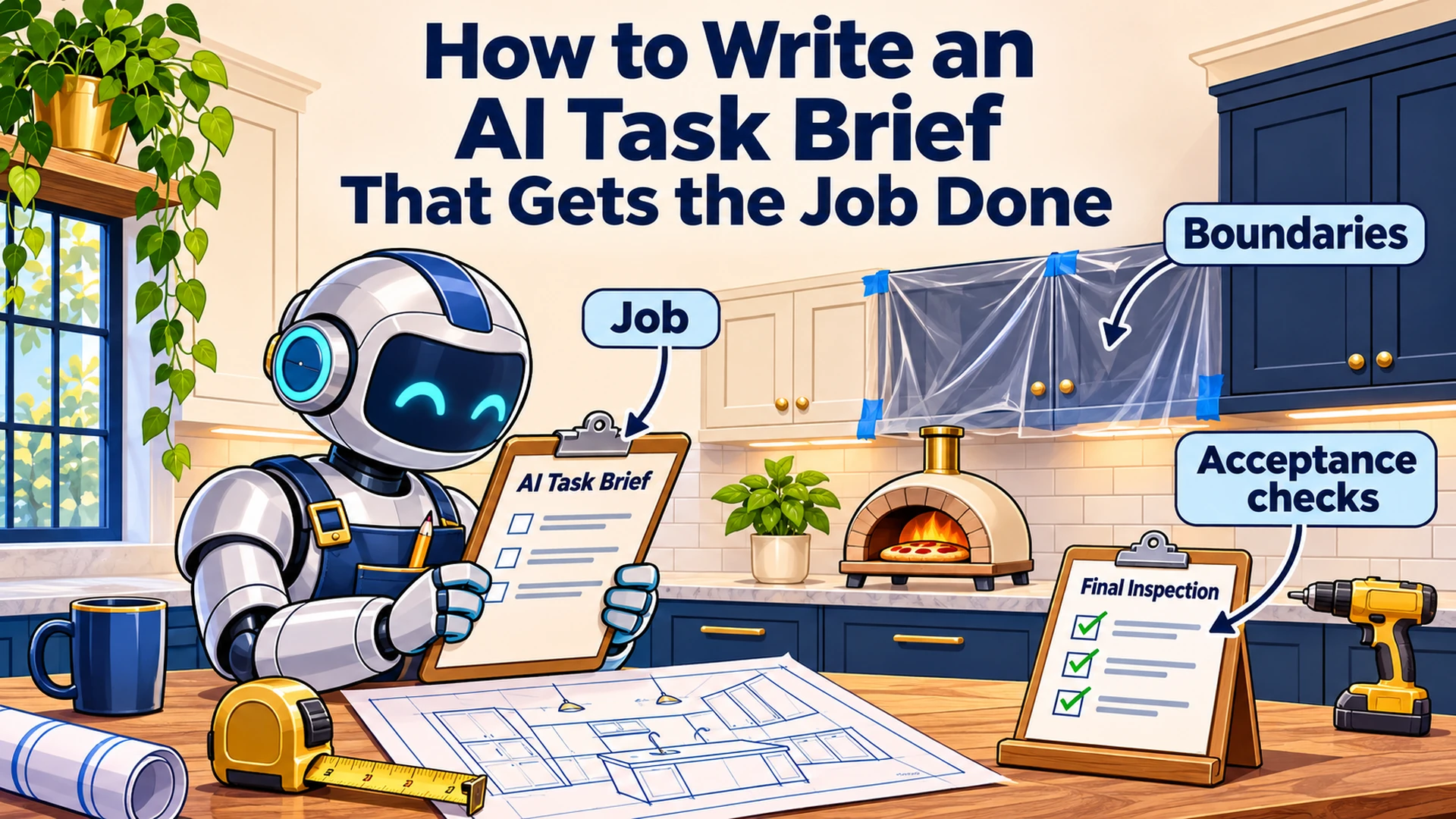

How to Write an AI Task Brief That Gets the Job Done
A useful AI task brief tells your assistant what to accomplish, why it matters, which information to use, what boundaries apply and what the finished result must contain. It gives you a way to judge the work before you accept it.
You do not need a complicated prompt for every question. But when you hand AI a business assignment, a few minutes defining the job can make the review much more straightforward.
Imagine hiring a contractor to update your kitchen. You say, “Make it look better,” and head out for the day. When you return, the cabinets are gone, the refrigerator has moved and someone is explaining why an indoor pizza oven was the obvious next step.
Perhaps it is a beautiful kitchen. You still needed to discuss the budget, the appliances you wanted to keep and what “finished” meant before someone picked up a hammer.
AI can run into the same problem. You ask for help, it fills in the blanks, and you discover that its version of the assignment is different from yours.
This is Part 2 of Put AI to Work. In the opening article, “Your AI Can Write a Post. Can It Finish the Job?”, I introduced the pieces of a repeatable workflow. Here, we are getting specific about the assignment that starts it.
What Is an AI Task Brief?
An AI task brief is a written description of a job, its purpose, the relevant inputs, the permitted scope and the expected result. It can be a message in a chat, a document attached to a task or part of a reusable workflow.
A brief is still a prompt. The difference is the amount of thought you put into defining the assignment, rather than the name you give the message.
“Summarize this paragraph” may be enough for a quick request. “Compare these proposals and help me decide what we still need to ask” deserves more explanation.
Anthropic's prompting guidance recommends clear instructions, relevant context and specific output requirements. My way of applying that to business work is to write an assignment another person could understand.
If you want the broader communication patterns, start with my guide to better AI prompts for small business. This article takes one assignment all the way from a vague request to a usable brief.
What Should You Include in an AI Task Brief?
Include the job, its purpose, the source information, boundaries, the output format and the acceptance checks. Those six pieces give AI direction and give you something concrete to review.
They do not need to become six lengthy sections every time. Use enough detail to remove the misunderstandings that would matter.
State the Job
Describe the work you want completed with an action and a specific subject. “Help me with vendors” leaves the assignment open; “Compare these three software proposals” identifies something you can inspect.
Also separate the immediate task from the larger project. Comparing proposals, choosing a vendor and signing an agreement are different activities.
Explain Why It Matters
Tell AI which decision the work should support. A comparison for an owner worried about first-year cost may emphasize different questions from one for a team worried about implementation effort.
That purpose helps explain your priorities. It does not supply missing evidence or give AI permission to assume facts that support your preferred answer.
Identify the Inputs
Name the documents, dates, definitions and examples that belong to this assignment. If one file replaces another, identify the current version rather than expecting AI to work that out.
For a proposal comparison, the inputs might include three vendor proposals and your requirements list. Tell AI whether it should use only those files or research additional information, and how to distinguish the two.
Set the Boundaries
Explain what AI may do, what it must preserve and when it should pause. Useful boundaries describe business consequences: do not contact vendors, invent missing prices or treat an optional feature as included.
Keep these instructions separate from the technical permissions of connected tools. Claude Code, for example, has its own permission controls. A sentence in a brief is not a substitute for configuring access appropriately.
Describe the Deliverable
Say what you want handed back, who will read it and how much detail they need. “Give me an analysis” could mean a paragraph, a spreadsheet or a lengthy report.
For our proposal example, an owner might need a comparison table and a short list of questions for each vendor. That is a different deliverable from a technical implementation assessment for an IT team.
Define the Acceptance Checks
Describe what must be true before you can use the result. For a proposal comparison, each stated price should be traceable to its source, missing information should be visible and optional charges should remain separate.
“Make it excellent” expresses a preference. “Label missing information and show how you calculated any first-year total” gives the reviewer a check they can perform.
What Does a Complete AI Task Brief Look Like?
A complete brief connects the assignment to its evidence, boundaries and review criteria. The example below is a hypothetical software-proposal comparison, not a recommendation about any particular vendor.
Here is the request someone might start with:
Look at these proposals and tell me which one is best.
The problem is that “best” has not been defined. Neither has the evidence AI should use, the output you expect or whether you want it to take any action.
Here is a more useful version:
Job: Compare the three attached software proposals against our attached requirements list.
Purpose: Help me prepare for vendor follow-up calls. I need to understand the differences before making a purchasing decision.
Inputs: Use the three proposals and the requirements list supplied in this chat. Do not research other sources for this comparison. If a named attachment is missing or unreadable, identify it before comparing the affected information.
Boundaries: Do not contact vendors, create accounts, change files or make a purchase. Do not assume that an unmentioned feature is included. Label anything a vendor does not specify.
Deliverable: Create one comparison table covering requirements, implementation work, support, contract term, stated charges and open questions. Follow it with a short list of questions for each vendor.
Acceptance checks: Identify the source file and page or section for each material claim. Separate optional charges from included services. Calculate a first-year total only when the supplied information supports it, show the calculation and identify exclusions. If a recommendation depends on missing information, explain what we need to confirm rather than declaring a winner.
That brief leaves room for AI to organize the comparison. It also establishes what the work is for and where the assignment ends.
You can now review the result against something more useful than whether it sounds confident.
How Do I Use This in My Own Content Workflow?
In my content process, approving the article and building the published page are separate responsibilities. The handoff needs the approved words, the available assets, the links and clear instructions for the person or AI handling production.
That makes the definition of done important. Producing an attractive page does not complete the assignment if approved paragraphs are missing or the links do not work.
I have described my Perplexity, ChatGPT and Claude content workflow separately. The relevant lesson here is that each handoff needs an assignment suited to the next stage.
The writing task needs room to question and revise. The production task needs clarity about what has already been approved and what must be preserved.
What If You Cannot Explain the Assignment Yet?
Ask AI to help clarify the job before it begins the main work. Give it your rough idea, explain what you are trying to decide and identify which choices you still need help making.
You could start with:
That is a useful planning task in its own right. You are asking AI to help expose uncertainty before it becomes part of the finished work.
You can also give it an example of an output you like. Explain which qualities to follow, such as structure, depth or tone, while making clear that the example's facts do not belong in the new assignment.
My guide to giving AI feedback and guiding the conversation covers what to do when the first attempt helps you recognize what you actually wanted.
Can a Brief Be Too Detailed?
Yes. A brief becomes harder to use when it contains conflicting instructions, irrelevant background or old decisions mixed with current requirements.
Give AI the detail needed to perform this task. Keep the history of every earlier attempt somewhere else unless it changes the current assignment.
The same applies to procedure. Specify the sequence when order matters, such as reviewing source files before calculating totals. For other work, define the result and essential constraints without prescribing every sentence.
Your kitchen contractor needs to know which wall must stay. They probably do not need you to explain how to hold the measuring tape.
The Caveman Marketing Quiz
How much of your marketing is still hunting by hand?
Rate 15 statements and see which of five stages your marketing is in, from The Hunter to The AI-Augmented Entrepreneur.
A Reusable AI Task Brief Template
Use this template for a recurring assignment, then replace the bracketed fields with the information for that job. Keep it short enough that you can review it before you send it.
Job: Complete [specific task].
Purpose: This will help [person or team] make [decision] or accomplish [business outcome].
Inputs: Use [named files, sources and relevant business facts]. The current versions are [versions or dates]. If required information is missing, [how to handle it].
Boundaries: You may [permitted actions]. Do not [prohibited actions or assumptions]. Pause when [specific unresolved decision or approval point].
Deliverable: Return [format, contents, audience and appropriate length]. Place it in [destination, if relevant and accessible].
Acceptance checks: Before returning the work, check [specific requirements]. Report what you verified, what remains uncertain and anything you could not complete.
Run the task, review the result and revise the brief where it caused confusion. Once it works reliably, you have material worth turning into a reusable process.
Frequently Asked Questions About AI Task Briefs
Do You Need a Task Brief for Every AI Request?
No. A simple request may need only a sentence, especially when the necessary information is already present. Use a fuller brief when the assignment has multiple inputs, meaningful consequences or several reasonable interpretations.
Does a Detailed Brief Guarantee an Accurate Answer?
No. A brief defines the assignment, but AI can still misunderstand information or produce unsupported claims. Keep appropriate verification of AI-generated work in the process.
Can You Reuse the Same Brief?
Yes, when the underlying task remains the same. Update its inputs, dates and requirements, and remove instructions that no longer apply before running it again.
Give AI an Assignment You Can Review
Choose one request you already give AI and ask what a new employee would still need to know. Add the missing purpose, inputs, boundaries and acceptance checks, then use those same checks to review the result.
You do not need to order the entire kitchen renovation one cabinet at a time. You do need agreement about the kitchen you are expecting when the job is done.
If you want help turning a recurring business task into a clear, repeatable assignment, Released Solutions offers one-on-one marketing and AI coaching. We can work through a real task and define a result you can evaluate.
Last fact-checked: November 9, 2026.